How long do ostriches live? These remarkable birds are among the longest-living species on Earth, with a lifespan that can stretch from 30 years in the wild to nearly 70 years in captivity. Understanding ostrich lifespan is important whether you are curious about their biology or planning a long-term farming operation.
Table of Contents
Quick Answer
Ostriches typically live 30 to 40 years in the wild. In captivity with proper care, they can live 40 to 70 years. The oldest recorded ostrich in captivity lived 62 years and 7 months. In human care at institutions like the Smithsonian’s National Zoo, some individuals have reportedly lived close to 70 years.
Lifespan of Ostriches in the Wild
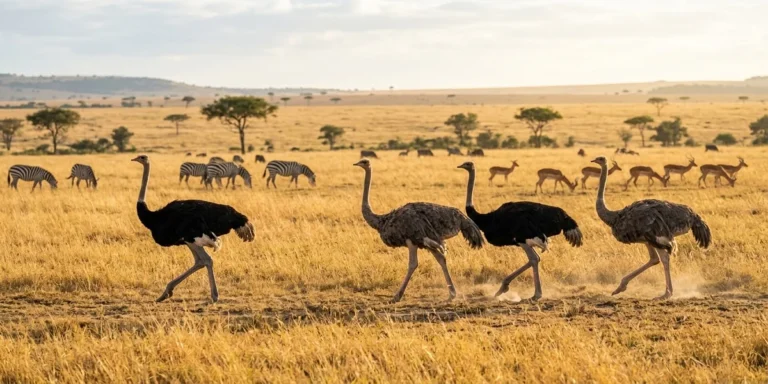
When asking how long do ostriches live in the wild, the answer is typically 30 to 40 years. Wild ostriches face many challenges that can reduce their lifespan. Although they are strong and fast, they still have natural predators such as lions, hyenas, and leopards.
Young ostriches are especially vulnerable during their early months. Many chicks do not survive to adulthood.
Adult ostriches have a better chance of survival thanks to their size and speed. They rely on open landscapes where they can detect danger early and escape. In the wild, ostriches typically live 30 to 40 years.
Lifespan of Ostriches in Captivity
How long do ostriches live in captivity? Significantly longer than in the wild. Ostriches raised on farms or in protected environments often live longer. This is mainly because they are protected from predators, given consistent food, monitored for health issues, and provided with shelter.
Under these conditions, ostriches can live 40 to 70 years. Because of their long lifespan, ostriches are considered a long-term investment in farming operations.
What Is the Longest-Lived Ostrich on Record?
The oldest documented ostrich in captivity lived 62 years and 7 months. This record highlights the significant difference between wild and captive lifespans.
In institutions like the Smithsonian’s National Zoo, ostriches under human care have reportedly lived close to 70 years. The California Academy of Sciences lists the average captive lifespan at 50 years, with a maximum of 70 years.
These numbers stand in stark contrast to wild ostriches, where predators, drought, and habitat challenges rarely allow birds to reach their full biological potential.
Why Do Ostriches Live So Long?
Several factors contribute to the relatively long lifespan of ostriches.
Omnivorous Diet: By consuming a mix of plants, seeds, and insects, ostriches maintain a steady intake of nutrients, which is why understanding what ostriches eat is important for their long-term health.
Large Body Size: In the animal kingdom, there is often a correlation between mass and longevity. Weighing over 100 kilograms, ostriches benefit from a biological pace that favors a longer lifespan, often reaching 30 to 40 years in the wild and up to 70 years in captivity.
Strong Legs and Mobility: Ostrich’s ability to run at speeds up to 70 km/h allows them to outrun most predators. Additionally, a single powerful kick is a formidable defense mechanism that keeps them safe from threats.
Adaptation to Harsh Environments: They are masters of survival in arid regions. Their ability to regulate body temperature and go for long periods without water reduces environmental stress on their organs.
The Life Stages of an Ostrich
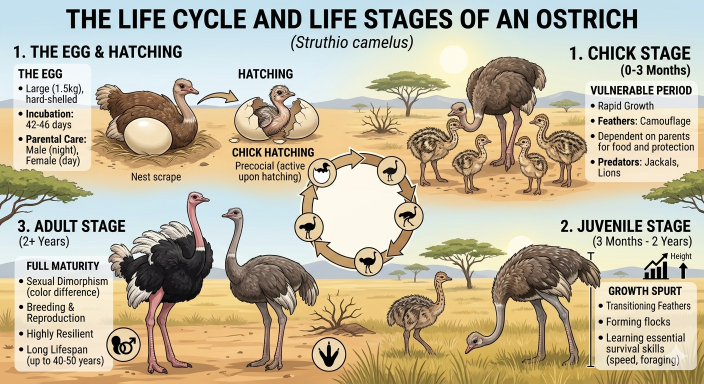
How long ostriches live depends heavily on which life stage presents the greatest risks.
Chick Stage (0–3 Months): This is the most critical and vulnerable period. When they hatch, chicks are about the size of a domestic chicken but grow at an incredible rate, roughly 25 centimeters per month. During these first few weeks, they rely entirely on their parents for protection from predators like jackals and hyenas, and for learning what is safe to eat.
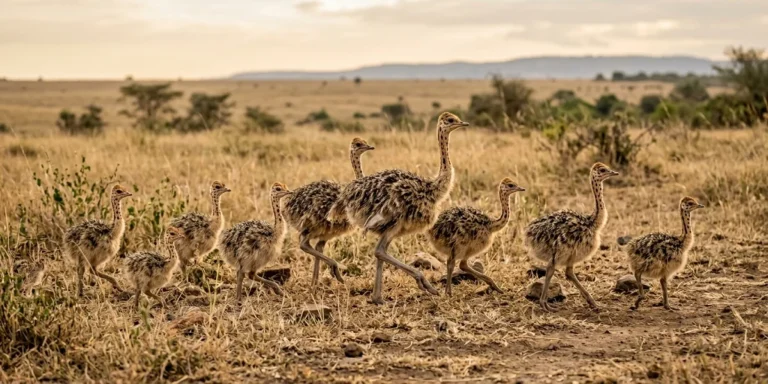
Juvenile Stage (3 Months – 2 Years): During this phase, the ostrich undergoes a massive growth spurt. By the time they are one year old, they often reach their full height. Their plumage begins to change; while chicks have spiky, camouflaged feathers, juveniles start developing the more defined feathers they will carry into adulthood. While they are faster and stronger now, they still remain in groups for safety.
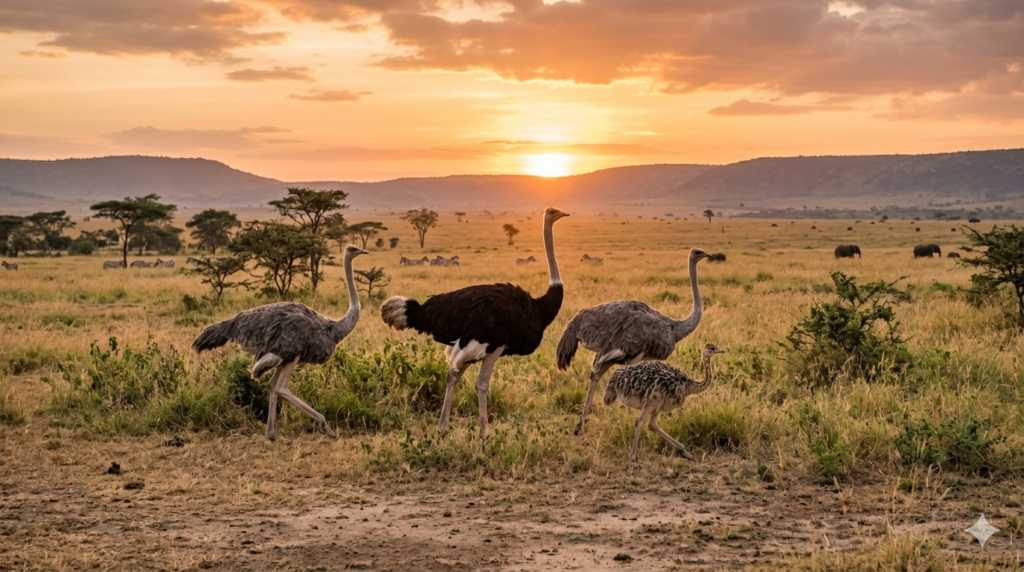
Adult Stage (2+ Years): At around two to three years of age, ostriches reach sexual maturity. This is when the distinct color dimorphism appears: males develop bold black-and-white feathers to attract mates, while females retain earthy brown tones for camouflage while nesting. As adults, they are incredibly resilient, capable of defending themselves with powerful kicks and enduring extreme temperatures.
Life Stage Summary Table
| Stage | Duration | Key Characteristics | Survival Focus |
| Chick | 0–3 Months | Rapid growth; mottled “spiky” camouflage. | Protection from predators and weather. |
| Juvenile | 3 Months – 2 Years | Reaching full height; transitioning feathers. | Learning social hierarchy and foraging. |
| Adult | 2+ Years | Sexual maturity; distinct male/female colors. | Reproduction and territorial defense. |
What Affects Ostrich Lifespan?
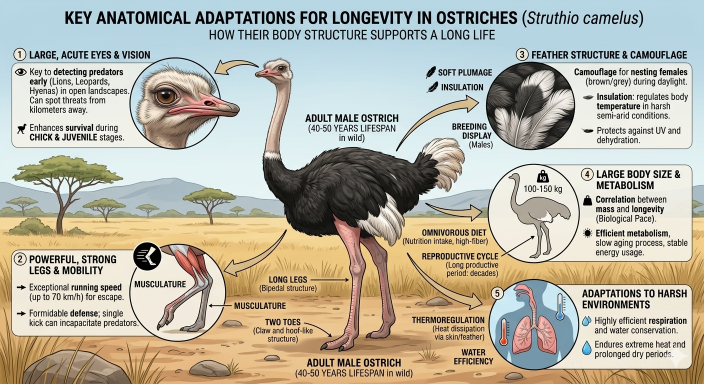
Understanding how long ostriches live requires looking at the key factors that shorten or extend their natural lifespan.
Stress Levels: Ostriches are naturally high-strung animals. Constant exposure to noise, frequent handling, or overcrowding can lead to chronic stress. This weakens their immune system and, in extreme cases, can cause “capture myopathy,” a physical condition where stress leads to muscle damage and organ failure.
Predators and Survival Instincts: In the wild, the greatest threat to an ostrich’s longevity occurs during the chick and juvenile stages. Predators like lions, leopards, and hyenas target younger birds. An adult ostrich’s primary defense, its powerful legs can deliver a lethal kick, but staying alive long enough to reach full size is the biggest hurdle.
Nutrition and Foraging Quality: As opportunistic omnivores, ostriches need a high-fiber diet consisting of grasses, seeds, and leaves, supplemented by insects for protein. A lack of specific minerals or access to clean water can lead to metabolic issues, especially during the rapid growth phases of their early life.
Environmental Stability: Ostriches are highly adapted to the semi-arid climates of savannas and grasslands. These open environments allow them to use their keen eyesight to spot threats from miles away. However, extreme prolonged droughts or sudden loss of habitat due to human encroachment can significantly shorten their natural life expectancy.
Disease and Parasites: Like all poultry, ostriches are susceptible to viral and bacterial infections, such as avian influenza or Newcastle disease. In farming environments, managing soil-borne parasites and ensuring proper ventilation is vital to preventing respiratory illnesses that can spread quickly through a flock.
Do Ostriches Age Like Other Birds?
To understand how long ostriches live compared to other species, it helps to look at how their aging process differs. Ostriches age differently compared to most smaller bird species. While many birds have relatively short lifespans, ostriches follow a slower and more extended life cycle.
They reach maturity at around 2 to 3 years of age, which is later than many common bird species such as chickens. After reaching adulthood, ostriches can remain reproductively active for many years, especially under stable conditions.
Another key difference is how their bodies develop. Ostriches grow rapidly in their early stages, but once they reach adulthood, their aging process slows down compared to smaller birds. This is partly due to their large body size and more stable metabolism.
In practical terms, this means an ostrich can remain healthy, active, and productive for decades, while smaller birds may only live a few years. This slower aging process is one of the reasons ostriches are considered unique among birds.
How Does Ostrich Lifespan Compare to Other Birds?
| Species | Wild Lifespan | Captivity Lifespan |
|---|---|---|
| Ostrich | 30–40 years | Up to 70 years |
| Emu | 10–20 years | Up to 35 years |
| Chicken | 5–10 years | Up to 15 years |
| Bald Eagle | 20–30 years | Up to 50 years |
| African Grey Parrot | 40–60 years | Up to 80 years |
Among birds, ostriches are exceptional in their longevity. Only large parrots consistently outlive them in captivity.
How Long Do Ostriches Live on a Farm?
In commercial farming, ostriches rarely live out their full natural lifespan. The answer depends on the purpose of the bird:
| Farm Purpose | Typical Lifespan |
|---|---|
| Meat production | 10–14 months |
| Feather production | 1–2 years |
| Leather production | 2–3 years |
| Breeding pair | 20–30 years |
Breeding pairs represent the longest-serving animals in ostrich farming operations. Because a healthy female can lay eggs for decades, experienced farmers treat breeding birds as long-term investments rather than short-term livestock.
This is one of the key reasons ostrich farming requires a fundamentally different approach compared to poultry or cattle farming.
Why Lifespan Matters in Ostrich Farming
Knowing how long ostriches live directly shapes every decision in a farming operation.
Because ostriches can live for decades, they are not short-term livestock. Instead, they are part of a long-term production system where each bird can contribute value over many years.
A healthy female ostrich can lay eggs for a large portion of her life, which makes breeding programs more efficient over time. Farmers do not need to replace birds as frequently as they would with shorter-lived animals.
This long productive period makes ostriches valuable for several reasons:
- breeding programs that focus on consistent chick production
- meat production, where birds can be raised and managed strategically
- long-term farming operations, where initial investment pays off over time
In practice, this means ostrich farming requires a different mindset compared to poultry farming. Instead of rapid turnover, the focus is on sustainability, animal health, and long-term planning. Farmers who understand this tend to build more stable and profitable operations over time.
Ostrich Conservation Status
According to the IUCN Red List, the common ostrich (Struthio camelus) is currently classified as Least Concern. However, the Somali ostrich (Struthio molybdophanes) is listed as Vulnerable.
Despite stable populations overall, ostriches face ongoing threats from habitat loss, hunting, and climate change across their African range. Their long lifespan means that losing breeding adults has a disproportionate impact on population recovery.
FAQ
How long do ostriches live in the wild?
Wild ostriches typically live 30 to 40 years. Their lifespan can be shorter due to predators, harsh environmental conditions, and limited food availability.
How long do ostriches live in captivity?
Ostriches can live 40 to 70 years in captivity with proper care. The oldest documented individual lived 62 years and 7 months.
Do ostriches live longer than chickens?
Yes, ostriches live much longer than chickens. While chickens usually live 5 to 10 years, ostriches can live several decades due to their larger size and slower aging process.
At what age do ostriches lay eggs?
Ostriches typically begin laying eggs at around 2 to 3 years of age. Egg production may increase as the bird reaches full maturity and optimal health.
What is the oldest ostrich ever recorded?
The oldest documented ostrich in captivity lived 62 years and 7 months. Some sources report individuals approaching 70 years under optimal care conditions.”
How long do ostriches live on a farm?
It depends on their purpose. Meat birds are typically slaughtered at 10 to 14 months. Breeding pairs can remain productive for 20 to 30 years, making them one of the longest-serving animals in any livestock operation.