
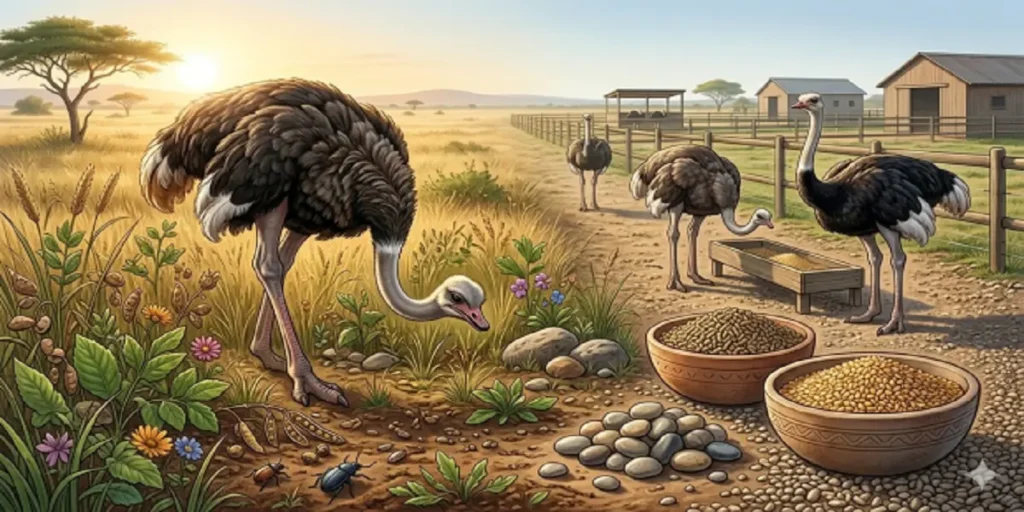
What do ostriches eat? These remarkable birds ”yes, literally the largest bird on Earth” are omnivores that thrive on a surprisingly varied diet. In the wild, they feed on grasses, seeds, leaves, and insects. On farms, their nutrition is carefully managed to support rapid growth and high egg production.
Quick Answer: Ostriches eat mostly plants such as grasses, leaves, seeds and flowers.
They also eat insects and small animals when available. In farming environments, ostriches are typically fed commercial feed, grains, alfalfa and fresh vegetation to support growth and egg production.
These birds are omnivores, which means they eat both plant material and small animals. In the wild, their diet mostly consists of grasses, leaves, seeds, and insects. On farms, ostriches are usually fed specially formulated feeds along with grains and fresh vegetation.
Understanding what ostriches eat is important whether you are curious about their biology or interested in ostrich farming and egg production.
If you want a deeper introduction to ostriches and their farming potential, read our guide to ostrich farming, eggs and meat.
Table of Contents
What Do Ostriches Eat in the Wild?
Understanding what do ostriches eat in the wild helps explain their natural behavior and digestive adaptations. Wild ostriches live primarily in African savannas and semi-arid regions, where food availability changes with the seasons.
Their natural diet is mostly plant-based but includes occasional animal protein.
Common Foods in a Wild Ostrich Diet
| Food Type | Examples |
|---|---|
| Grasses | Savanna grasses and shoots |
| Leaves | Shrubs and small trees |
| Seeds | Various wild plant seeds |
| Flowers | Seasonal flowering plants |
| Fruits | Small wild fruits |
| Insects | Locusts, beetles, caterpillars |
| Small animals | Lizards or small rodents (rare) |
Plants make up the majority of their diet, but insects provide extra protein and nutrients. This mixed diet helps ostriches survive in environments where food can sometimes be scarce.
What Do Farmed Ostriches Eat?
Ostriches raised on farms have a more controlled diet designed to support fast growth, egg production, and healthy meat development.
Farmers usually feed ostriches with a combination of commercial ostrich feed, grains, and fresh plants.
Typical Farm Ostrich Feed
| Feed Type | Purpose |
|---|---|
| Commercial ostrich pellets | Balanced nutrition |
| Corn | Energy source |
| Alfalfa | Fiber and protein |
| Soybean meal | Protein |
| Fresh greens | Vitamins |
| Mineral supplements | Bone development |
Commercial feeds are formulated to provide the correct balance of:
- Protein
- Energy
- Vitamins
- Minerals
This balance is especially important for young ostriches, which grow extremely quickly.
Myth vs. Reality: Do They Really Bury Their Heads?
The common myth that ostriches bury their heads in the sand when they are scared is actually a misunderstanding of their feeding and nesting habits.
- The Reality: Ostriches spend a lot of time with their heads close to the ground to carefully select the right stones (gastroliths) for their digestion.
- The Illusion: From a distance, an ostrich scanning the ground for stones or turning eggs in its ground-level nest looks like its head is buried, while it is actually just focusing on its “digestive tools.”
Why Do Ostriches Eat Stones?
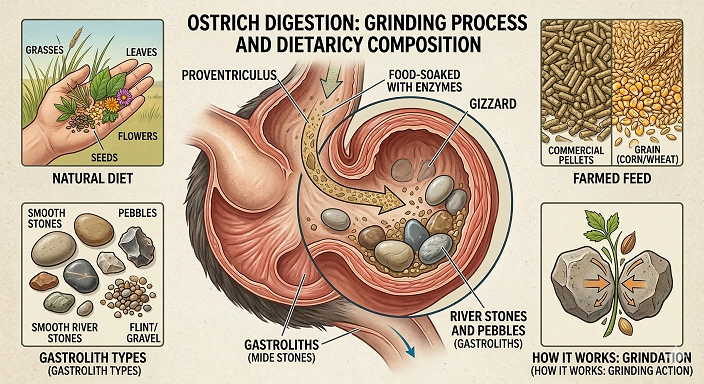
One of the most surprising facts about ostriches is that they intentionally swallow small stones and pebbles.
These stones are called gastroliths.
Ostriches do not have teeth, so they cannot chew food. Instead, the stones sit inside a muscular part of the stomach called the gizzard.
The gizzard grinds food into smaller pieces, allowing the bird to digest tough plant material.
Stones Help Digestion
| Function | Explanation |
|---|---|
| Grinding food | Stones crush plant fibers |
| Improved digestion | Breaks down tough material |
| Nutrient absorption | Helps nutrients become available |
Some ostriches may carry several hundred grams of stones in their digestive system at one time.
How Much Do Ostriches Eat Per Day?
Ostriches are large animals and need a significant amount of food each day.
The amount varies depending on age, activity level, and whether the bird lives in the wild or on a farm.
Average Daily Food Intake
| Age | Daily Food Intake |
|---|---|
| Chick | 1–2 pounds |
| Juvenile | 3–5 pounds |
| Adult | 5–7 pounds |
Adult ostriches also drink large amounts of water when it is available, although they can survive for long periods without drinking because they obtain moisture from plants.
Diet Differences Between Chicks and Adult Ostriches
Young ostriches have very different nutritional needs compared to adults.
Chicks grow quickly and need high-protein diets to support bone and muscle development.
Ostrich Diet by Age
| Age Stage | Diet Focus |
|---|---|
| Chicks | High protein starter feed |
| Juveniles | Balanced feed with greens |
| Adults | Maintenance feed and vegetation |
| Breeding adults | Higher nutrients for egg production |
Providing the correct feed at each stage is essential in ostrich farming operations. Improper nutrition can lead to growth problems or weak bones.
Coprophagy in Chicks
When looking into the broader question of what do ostriches eat, the diet of young ostrich chicks reveals a fascinating (and slightly surprising) biological process called coprophagy.
Pro Tip for Farmers: Newborn chicks often eat the droppings of adult ostriches. This behavior isn’t accidental; it’s a natural way for them to ingest the beneficial gut bacteria (microbiota) needed to digest tough plant fibers later in life. In modern farming, specialized probiotics are sometimes used to mimic this natural immune-boosting process.
What Foods Are Dangerous for Ostriches?
Ostriches are curious animals and sometimes swallow objects that are not food.
While stones help digestion, foreign objects can be dangerous.
Things Ostriches Should Not Eat
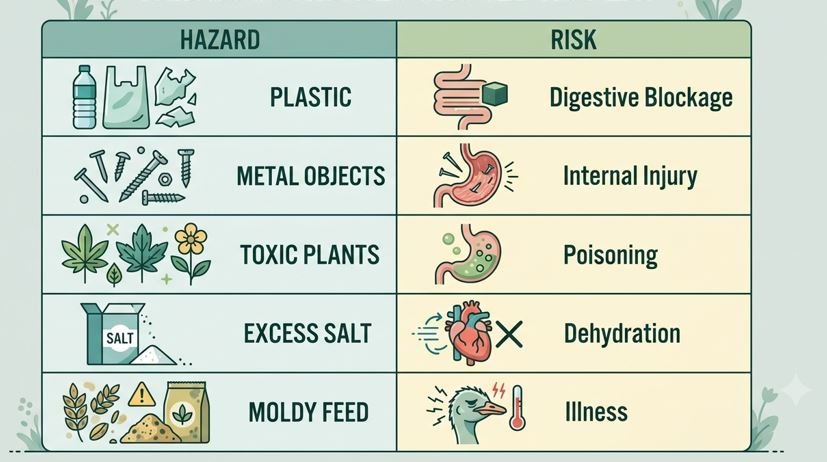
Farmers must keep enclosures clear of trash because ostriches may try to swallow shiny objects.
Why Diet Is Important for Ostrich Health
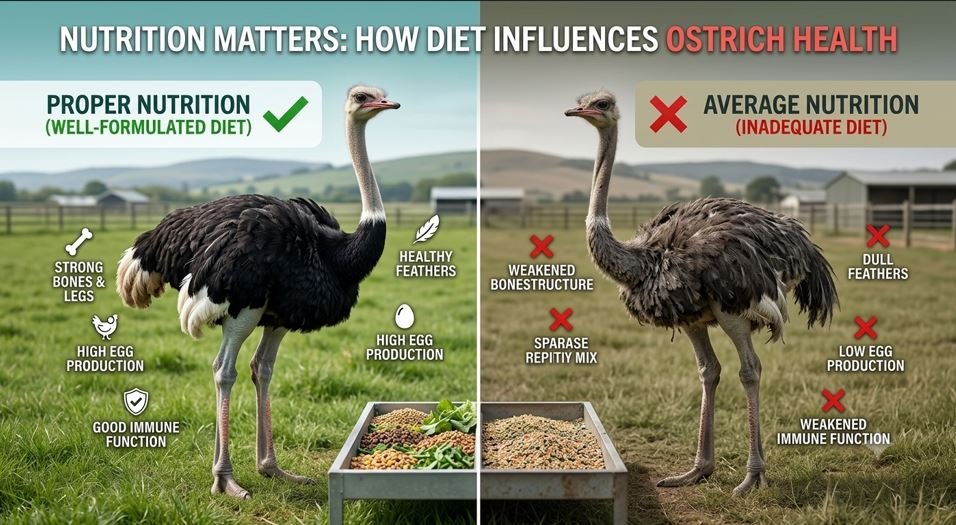
Knowing what do ostriches eat directly influences how farmers design feeding programs and manage flock health. A balanced diet affects nearly every aspect of an ostrich’s life.
Proper nutrition supports:
- Strong bones and legs
- Healthy feather growth
- High egg production
- Good immune function
- Optimal meat quality
For example, inadequate calcium can cause weak eggshells, while protein deficiency can slow growth. Diet also influences how quickly ostriches reach market weight in commercial farming systems.
Sustainability: Ostrich vs. Cattle
One of the reasons ostrich farming is considered “the livestock of the future” is their incredible Feed Conversion Ratio (FCR). They are much more efficient at turning plants into high-quality protein compared to traditional livestock.
| Efficiency Factor | Ostrich | Beef Cattle |
| Feed Conversion Ratio | Efficient ($~3:1$) | Less Efficient ($~6:1$) |
| Water Requirement | Very Low | Very High |
| Offspring per Year | 40–60 Chicks | 1 Calf |
| Time to Market | 10–14 Months | 18–24 Months |
FAQ
Are Ostriches Herbivores or Omnivores?
Ostriches are omnivores. Most of their diet consists of plants, but they also eat insects and small animals when available. In short, what do ostriches eat depends on their environment, wild birds rely on natural vegetation and insects, while farmed ostriches receive structured feed programs
Do Ostriches Really Eat Rocks?
Yes. Ostriches swallow small stones called gastroliths. These stones help grind food in the gizzard since ostriches do not have teeth.
What Is an Ostrich’s Favorite Food?
Ostriches prefer grasses, leaves, seeds, and fresh vegetation. Insects are also an important source of protein.
Do Ostriches Drink Water?
Yes, ostriches drink water when it is available. However, they can survive in dry environments because they obtain moisture from plants.
Do Ostriches Eat Meat?
Sometimes. While plants make up most of their diet, ostriches may occasionally eat insects, small reptiles, or other tiny animals.
2 thoughts on “What Do Ostriches Eat? 5 Crucial Rules for a Healthy Diet”