
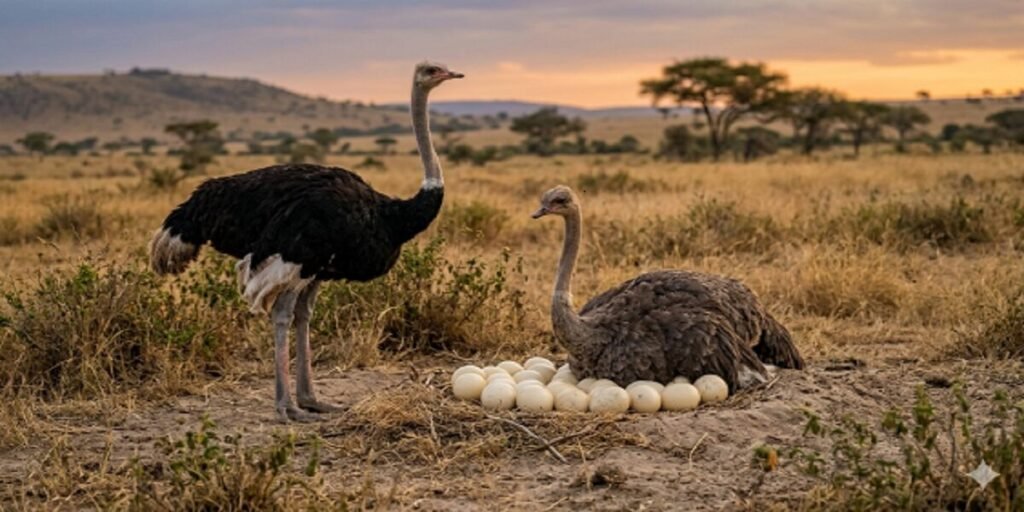
How many eggs does an ostrich lay? The answer depends entirely on whether the bird lives in the wild or on a farm, and the difference is dramatic. Wild ostriches typically lay 12 to 18 eggs per year, while farmed ostriches under optimal conditions can produce anywhere from 40 to 130 eggs annually
In the wild, egg production is usually lower because ostriches rely on natural food sources and seasonal conditions. On farms, however, controlled breeding and proper nutrition can increase the number of eggs produced each year.
Understanding ostrich egg production is important for both wildlife enthusiasts and people interested in ostrich farming and egg production.
Quick Facts: Ostrich Egg Production
- Fewer than 10% of wild nests survive to hatching
- Wild ostriches lay 12–18 eggs per year
- Farmed ostriches produce 40–130 eggs per year
- Peak production occurs between ages 7–11
- A female ostrich can lay eggs for up to 40 years
- Incubation takes 42–46 days
Table of Contents
How Many Eggs Does an Ostrich Lay Per Year?
Ostriches are seasonal layers, which means they do not lay eggs continuously throughout the year. During the breeding season, a female ostrich can lay eggs every two to three days.
Over the course of a full breeding season, this results in a large number of eggs.
| Type of Ostrich | Eggs Per Year |
|---|---|
| Wild ostrich | 12–18 eggs |
| Farmed ostrich (first year) | 10–20 eggs |
| Farmed ostrich (subsequent years) | 40–60 eggs |
| High-production farm ostrich | up to 130 eggs |
Farmed ostriches usually produce more eggs because they receive balanced nutrition and live in controlled environments.
How Often Do Ostriches Lay Eggs?
During the breeding season, a female ostrich usually lays an egg every 48 to 72 hours.
The laying cycle continues for several months. This means a single ostrich can produce dozens of eggs within one season. Egg laying often slows down or stops completely once the breeding season ends.
Ostrich Breeding Season
The breeding season for ostriches depends on climate and geographic location. In most regions, it begins in spring and continues through late summer.
During this time, males establish territories and attract females. Several females may lay eggs in the same nest, which is known as a communal nest.
A dominant female usually lays her eggs first, and these eggs often receive the best position in the nest.
Breeding seasons vary by region:
| Region | Breeding Season |
|---|---|
| East Africa | June–October |
| South Africa | June–February |
| Europe | March–September |
| United States (north) | January–September |
Ostriches raised in Africa produce 30–35% more eggs than those raised in Europe, largely due to warmer and drier climate conditions that more closely match their natural habitat.
How Many Eggs Are in an Ostrich Nest?
Ostrich nests can contain a surprisingly large number of eggs. Because several females may use the same nest, a single nest may contain 20 to 60 eggs However, only a portion of these eggs usually hatch successfully.
The dominant female and the male share incubation duties. The female usually incubates the eggs during the day, while the male takes over at night. Remarkably, despite a communal nest containing eggs from multiple females, each female ostrich can identify her own eggs among dozens of others.
The dominant female actively removes eggs she does not recognize, pushing weaker eggs to the outer edges where they are less likely to hatch successfully.
How Many Ostrich Eggs Actually Hatch?
Egg production numbers tell only part of the story. In the wild, fewer than 10% of ostrich nests survive the full incubation period. Predators including lions, leopards, jackals, and Egyptian vultures actively target nests.
Even among eggs that are successfully incubated, only about 15% of chicks survive to one year of age.
This extremely low survival rate explains why ostriches produce so many eggs, nature builds in significant redundancy.
On farms, artificial incubation dramatically improves hatch rates. By removing eggs and placing them in controlled incubators at 36.4°C (97.5°F) with 25–35% humidity, farmers can achieve far higher success rates than nature allows.”
What Affects Ostrich Egg Production?
Several factors influence how many eggs an ostrich can lay each year.
1. Age of the Female
Young ostriches may produce fewer eggs. Egg production often improves once the bird reaches full maturity, usually around two to three years of age.
2. Nutrition
Diet plays a major role in egg production. Ostriches that receive balanced feed with sufficient protein, vitamins, and minerals tend to lay more eggs.
A poor diet can reduce egg production or lead to weaker eggs.
3. Environmental Conditions
Temperature, daylight hours, and stress levels can affect laying cycles. Stable conditions usually support better egg production.
4. Breeding Management
On farms, breeders carefully manage mating groups and nesting conditions. Proper management often results in higher egg yields.
When Do Ostriches Reach Peak Egg Production?
Ostriches do not reach their maximum laying potential immediately. According to research published by ScienceDirect, female ostriches reach peak egg production between 7 and 11 years of age.
This is a critical consideration for farmers. The investment in a breeding pair pays off over the long term, a productive female can continue laying eggs for up to 40 years.
Peak production timeline:
| Age | Expected Output |
|---|---|
| 2–2.5 years | First eggs (10–20 per year) |
| 3–6 years | Growing production (40–60 per year) |
| 7–11 years | Peak production (up to 130 per year) |
| 12–40 years | Sustained production |
Why Ostrich Eggs Are So Large
Ostrich eggs are the largest eggs produced by any living bird. A single egg can weigh as much as two dozen chicken eggs combined.
The large size provides enough nutrients to support the development of a chick that is already quite large when it hatches.
If you’re curious about their size, you can read more about how big an ostrich egg is and how it compares to eggs from other birds.
Incredible Strength: Despite being an egg, the shell is surprisingly thick and strong (about 2 mm). It is so durable that an adult human can often stand on an ostrich egg without it breaking! This strength is necessary to protect the developing chick from the weight of the parent during incubation.

Ostrich Eggs in Farming
Understanding how many eggs an ostrich lays is essential for anyone planning a commercial farming operation.
Ostrich eggs have several uses:
- breeding new chicks
- food production
- decorative carving
- crafts and art
Some farms sell fertilized eggs for breeding, while others sell unfertilized eggs as food products. Because each egg is so large, a single egg can feed several people.
Artificial Incubation: On many commercial farms, eggs are removed from the nest and placed in industrial incubators. This trick often encourages the female to lay more eggs than she would in the wild, as she tries to “refill” her nest.
Natural Incubation: Preferred for organic or small-scale farming, allowing the parents to raise the chicks, which often results in hardier birds.
How Long Does It Take for an Ostrich Egg to Hatch?
After laying, each egg — regardless of how many eggs the ostrich has laid that season — requires careful incubation. Once an egg is laid and fertilized, the incubation period is relatively long compared to most birds. Ostrich eggs typically take about 42 days to hatch.
During incubation, the eggs must remain at stable temperatures. Both the male and female play an important role in protecting and warming the nest.
Nature’s Camouflage: The female ostrich, with her grayish-brown feathers, sits on the eggs during the day to blend in with the earth. The male, with his black feathers, takes over at night to remain invisible to predators in the dark. This tag-team approach significantly increases the survival rate of the eggs.
FAQ
How many eggs does an ostrich lay at once?
A female ostrich usually lays one egg at a time, typically every two to three days during the breeding season.
How many eggs does an ostrich lay per year?
Most female ostriches lay 40 to 60 eggs per year, although production may be lower in the wild.
How big is an ostrich egg compared to a chicken egg?
An ostrich egg is about 20 to 24 times larger than a typical chicken egg and can weigh up to 1.8 kilograms.
Do male ostriches lay eggs?
No. Only female ostriches lay eggs. However, male ostriches help incubate and protect the eggs.
Do ostriches lay eggs all year?
No. Ostriches are seasonal layers. Egg production usually happens during the breeding season, which often lasts several months.


1 thought on “How Many Eggs Does an Ostrich Lay? The Complete Wild vs. Farm Guide”