
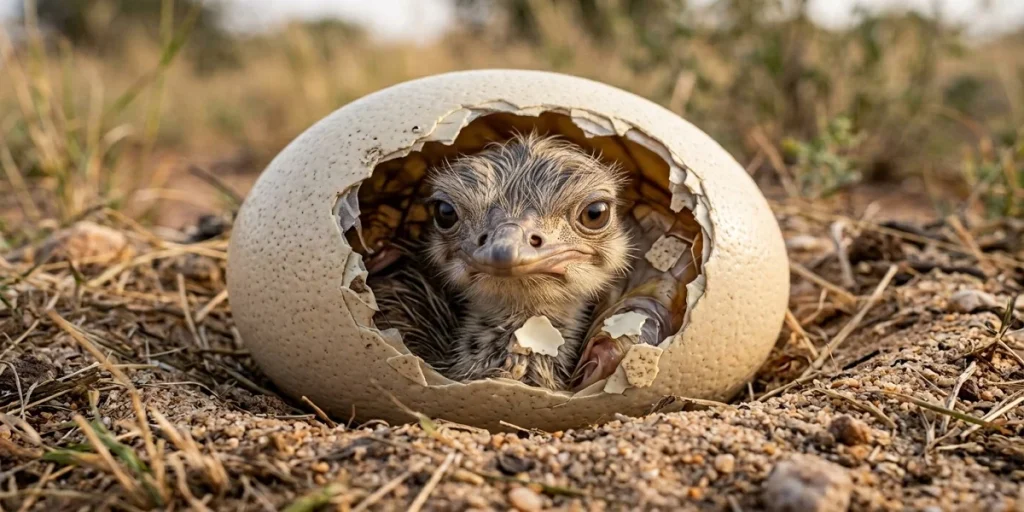
Quick Answer: Ostrich egg hatch typically takes 35 to 45 days, with 42 days serving as the standard incubation benchmark. Successful hatching requires precise environmental control, with temperatures of 36-37°C (97-98.6°F) and relative humidity commonly maintained between 20% and 35%. Hatch timing can vary depending on egg characteristics, incubation conditions, and whether incubation occurs naturally or artificially.
Table of Contents
Ostrich egg incubation takes twice as long as chicken eggs (21 days). Their thick shell, massive volume, and extended embryonic development require precise regulation of temperature, humidity, ventilation, and rotation.
This guide covers the full ostrich incubation timeline, including essential environmental parameters, target egg weight loss, and critical lockdown procedures.
How Long Does It Take an Ostrich Egg to Hatch?
While 42 days is the universally accepted target, healthy ostrich chicks regularly hatch between days 35 and 45.
Day 42 is a baseline, not a strict deadline. Several variables directly affect embryonic growth speed:
- Incubation Method: Artificial incubators maintain stable conditions, while wild nests face natural thermal swings.
- Egg Mass & Shell Thickness: Larger or thicker-shelled eggs take longer to lose moisture and reach full development.
- Environmental Stability: Fluctuations in room temperature or internal incubator humidity alter the embryonic metabolic rate.
An egg is not necessarily unviable if it does not hatch on day 42.
Natural Incubation vs. Artificial Incubation
While the core biological development of the embryo remains identical, the primary difference between natural and artificial incubation lies in environmental control and hatch rate consistency.
Natural Incubation
In the wild, male and female ostriches share incubation duties using natural camouflage:
- Female (Daytime): Lighter brown plumage blends with the dusty landscape.
- Male (Nighttime): Dark black feathers remain hidden in the dark.
Wild nests remain vulnerable to weather swings, ground humidity changes, and predators, leading to variable hatch windows and lower success rates.
Artificial Incubation
Commercial ostrich operations rely on artificial incubation to maximize hatch rates and standardize timing.
| Feature | Natural Incubation | Artificial Incubation |
| Environmental Control | Subject to weather and ground temperature | Digitally regulated temp (36–37°C) & humidity (20–35%) |
| Egg Turning | Performed manually by parent birds | Automated hourly rotation |
| Monitoring | Limited to visual inspection | Tracked via weight loss charts and candling |
| Hatch Predictability | Variable (35–45 days) | High (typically centers tightly on Day 42) |
The Ostrich Egg Incubation Timeline
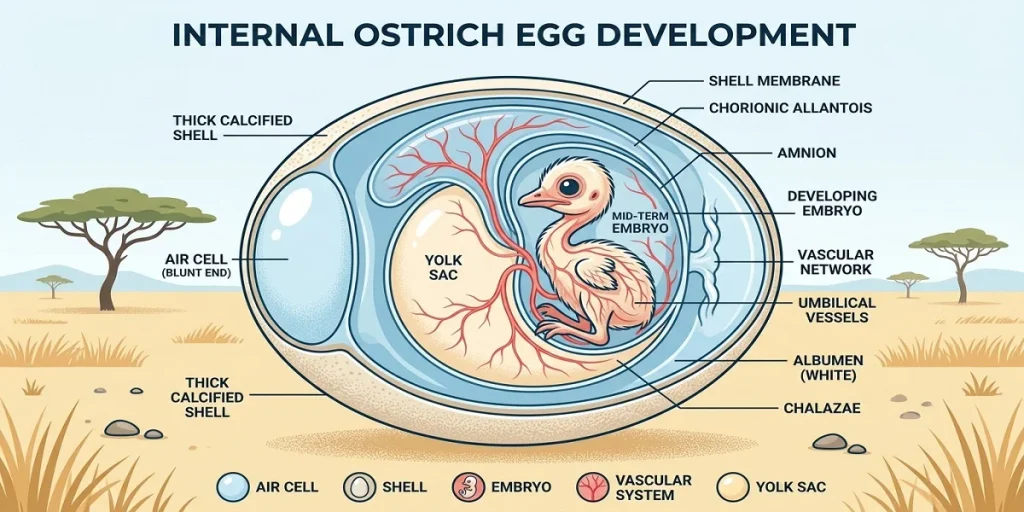
An ostrich egg progresses through distinct biological stages across its six-week journey. While 42 days is the standard benchmark, developmental milestones vary slightly based on incubator calibration, egg weight, and ambient conditions.
Artificial incubation divides into four broad phases: setting, active embryonic growth, final hatch prep (lockdown), and pipping to emergence.
Day 0: Setting the Egg
Incubation officially begins when a clean, fertile egg enters the incubator.
Before setting, hatcheries record the initial weight and inspect the shell for micro-cracks or surface defects. This baseline weight is critical for calculating water loss throughout the 42-day cycle. Eggs are positioned to optimize internal airflow and automated rotation.
Days 1–14: Early Embryonic Development
The first two weeks mark rapid cellular differentiation. Blood vessels spread across the inner shell membrane, forming the foundation for major organ systems.
- Thermal Sensitivity: Embryos are highly vulnerable to temperature spikes. Controlled studies show that eggs maintained at a steady 36.5°C yield higher hatchability than those exposed to elevated temperatures.
- Regular Rotation: Automated turning prevents the embryo from adhering to the inner shell membrane and ensures proper vascular network growth.
Days 15–28: Active Incubation & Moisture Loss
By mid-incubation, the embryo has established its core body structure and expands rapidly, driving up its metabolic rate and oxygen demand.
This phase centers on monitoring moisture loss. Ostrich eggs naturally evaporate water through microscopic shell pores. Research indicates that successful hatches require an cumulative weight loss of 13% to 15% of the egg’s initial Day 0 weight.
Days 29–38: Late Incubation
The growing chick occupies almost the entire interior volume. Development shifts toward respiratory transition as the chick increasingly relies on the expanding air cell.
Hatcheries closely monitor egg mass and air cell volume during this period, preparing the environment for the final transition to breathing.
Around Day 38: The Lockdown Phase
Approximately 3 to 4 days before expected hatching, the egg enters the “lockdown” phase:
- Rotation Stops: Automated turning ceases completely, allowing the chick to align itself into the proper hatching position.
- Transfer to Hatcher: Eggs are typically moved from the main incubator setter to a dedicated hatching unit.
- Humidity Adjustment: Relative humidity levels are altered to keep shell membranes soft and pliable for pipping.
Around Days 40–42: Internal and External Pipping
Hatching involves two distinct pipping stages:
- Internal Pipping: The chick pierces the inner membrane with its egg tooth, taking its first breath using the air inside the egg’s internal air cell. Metabolic oxygen consumption surges during this shift.
- External Pipping: Shortly after, the chick punches its first small breakthrough hole in the outer calcified shell.
Days 42–46: Final Hatching
After external pipping, the chick slowly rotates inside the egg, unzipping the shell.
This process requires immense physical effort and includes long rest periods. It is completely normal for progress to appear slow. Data from commercial ostrich farms show healthy chicks hatching naturally as late as Day 46. An unhatched egg on Day 42 should never automatically be assumed unviable.
Ostrich Egg Incubation Timeline at a Glance
| Stage | Approximate Timing | What’s Happening |
| Setting | Day 0 | Egg is inspected, weighed, and placed into the incubator. |
| Early Development | Days 1–14 | Embryo and major body structures develop rapidly; turning begins. |
| Active Incubation | Days 15–28 | Rapid growth and metabolism; target 13–15% cumulative weight loss. |
| Late Incubation | Days 29–38 | Chick fills internal space and prepares for respiratory transition. |
| Lockdown | Around Day 38 | Egg turning stops; eggs transfer to hatcher; moisture levels adjust. |
| Internal Pipping | Days 40–42 | Chick breaks inner membrane to breathe from the air cell. |
| External Pipping | Days 41–46 | Chick pierces the outer shell and begins the unzipping process. |
| Hatching | Days 42–46 | Chick emerges fully from the shell. |
Ideal Temperature and Humidity for Ostrich Egg Incubation
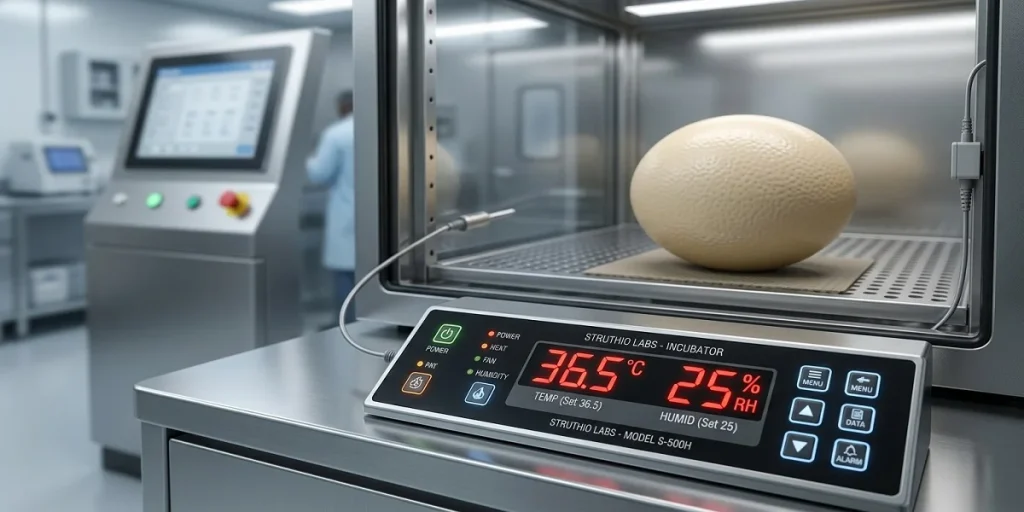
Temperature and relative humidity are the two most critical operational variables in ostrich egg incubation. Because of their massive physical volume and shell structure, ostrich eggs require lower incubation temperatures and significantly lower humidity levels compared to traditional poultry.
While target settings vary slightly based on hatchery setup and egg mass, commercial ostrich incubation generally relies on a temperature range of 36.0°C to 37.0°C (96.8°F–98.6°F) and a low relative humidity of 20% to 35%.
Ostrich Egg Incubation Temperature
Temperature directly governs the metabolic rate and developmental speed of the ostrich embryo.
Research highlights the critical role of precise thermal management:
- Thermal Benchmarks: A controlled study comparing 36.5°C, 37.0°C, and 37.5°C revealed that eggs incubated at 36.5°C yielded higher overall hatchability and significantly fewer dead-in-shell embryos than those kept at 37.5°C.
- Optimal Range: Broader physical studies place the ideal thermal window between 36.1°C and 36.9°C.
Higher temperatures do not guarantee better outcomes. In fact, overheating accelerates development at the expense of embryonic survival.
Ostrich Egg Incubation Humidity
Humidity controls the rate of water vapor movement through the porous calcified shell. The main objective of humidity management is to drive sufficient moisture loss without dehydrating the embryo.
- Low Moisture Standard: Ostrich eggs require unusually low humidity. Studies on eggshell conductance show that keeping relative humidity below 25% allows eggs to hit the target 15% total mass loss over a 45-day cycle.
- Protocol Variations: Controlled experiments often maintain 20% to 30% RH during active development, sometimes elevating humidity slightly during the final lockdown stage to soften shell membranes.
Because internal incubator hydrometers can misread, commercial operations track real-time egg weight loss as the ultimate indicator of proper humidity control.
Temperature and Humidity Standards by Source
| Source / Research | Temperature Range | Relative Humidity | Key Finding |
| Hassan et al. Study | 36.5°C – 37.5°C | 20% – 30% | 36.5°C produced the highest hatchability and lowest embryonic mortality. |
| Eggshell Conductance Study | 36.1°C – 36.9°C | < 25% | Relative humidity below 25% successfully achieved ~15% total weight loss over 45 days. |
| Commercial Field Range | 36.0°C – 37.0°C | 20% – 35% | Practical baseline; humidity is adjusted based on individual egg weight tracking. |
Why Ostrich Eggs Require Low Humidity
Ostrich eggs possess a thick, highly dense shell. As incubation progresses, internal water must gradually evaporate into the surrounding air to allow the internal air cell to expand.
If incubator humidity is too high, water cannot escape the shell fast enough. The air cell stays too small, and the chick risks drowning or being unable to complete internal pipping. Conversely, excessively low humidity causes severe embryo dehydration.
Tracking egg mass via regular weigh-ins gives hatcheries a precise, physical measure of internal moisture dynamics that ambient humidity gauges cannot match.
Does a Higher Incubation Temperature Speed Up Hatching?
Increasing incubator heat slightly may shorten embryonic development time, but it drastically reduces hatch success.
Research demonstrates that while eggs kept at 36.5°C took slightly longer to hatch than those at 37.5°C, they achieved substantially higher hatchability. Higher temperatures disrupt the delicate balance between tissue growth, oxygen consumption, and internal energy reserves, leading to late-stage embryonic mortality.
Incubation is a biological process requiring controlled thermal stability, not a race to shorten the 42-day timeline.
Why Do Ostrich Eggs Lose Weight During Incubation?
An ostrich egg steadily loses weight during incubation as internal water evaporates through microscopic pores in the calcified shell. This progressive weight loss is not a sign of abnormal drying, but a vital biological requirement for embryonic survival.
Evaporation serves a primary physiological purpose: it creates physical room inside the egg for the internal air cell to expand. By the final incubation phase, this enlarged air space provides the chick with its critical first oxygen supply during the shift to pulmonary respiration.
How Much Weight Should an Ostrich Egg Lose?
Commercial ostrich hatcheries target a cumulative weight loss of 13% to 15% of the egg’s initial Day 0 mass by the time lockdown begins.
Example Calculation:
An ostrich egg weighing 1,500 grams (1.5 kg) at setting should lose approximately 195 to 225 grams over its incubation cycle, reaching a final pre-hatch weight of roughly 1,275 to 1,305 grams.
While shell thickness, pore density, and individual incubator airflow create slight variations between eggs, moisture loss must decline steadily throughout the six-week timeline.
How Do Hatcheries Monitor Ostrich Egg Weight Loss?
o avoid relying solely on ambient hydrometer readings, hatcheries weigh eggs at regular intervals to calculate real-time moisture loss.
Instead of manual math, hatcheries track the target 13%–15% weight loss curve using this interactive calculation model:
Ostrich Egg Weight Loss Calculator
Enter the egg’s initial weight and its current weight to estimate moisture loss during incubation.
Why Is Weight Loss Important for the Chick?
Moisture loss directly dictates the physical environment inside the shell as the chick approaches its target hatch date.
- Insufficient Weight Loss (<13%): The internal air cell remains too small. The chick risks drowning in unevaporated fluid or suffocating before completing internal pipping.
- Excessive Weight Loss (>15%): The embryo undergoes severe dehydration, weakening the chick and making it too exhausted to break through the thick outer shell.
Successful hatching depends on balancing temperature, humidity, and airflow to keep moisture loss strictly within this biological target range.
Does Every Ostrich Egg Lose Weight at the Same Rate?
No. Individual eggs show naturally varying rates of water loss based on several physical variables:
- Shell Thickness & Density: Thicker shells with tightly packed pores lose moisture more slowly.
- Shell Conductance: Variations in pore structure alter how easily water vapor escapes.
- Air Velocity & Ventilation: Eggs positioned directly in strong airflow paths lose water faster than those in sheltered incubator zones.
Because of these variables, hatcheries monitor eggs as a collective batch while making minor positional adjustments for outliers that lose moisture too fast or too slowly.
Weight Loss Near the End of Incubation
By the final days before hatching, the cumulative weight loss is complete, and the air cell occupies its maximum volume.
At this stage, the developing chick consumes oxygen at its peak rate and begins internal pipping into the air cell. Once this transition occurs, moisture management shifts from driving evaporation to maintaining adequate membrane pliability so the chick can break out smoothly.
Can You Incubate an Ostrich Egg at Home?
Yes, but the biggest challenge is not simply finding an incubator that is large enough. The incubator needs to maintain stable environmental conditions for an egg that can weigh well over 1 kg and remain inside the machine for roughly six weeks. Even relatively small problems with temperature, ventilation, moisture loss, or turning can affect embryo development and hatchability. Oregon State University Extension provides additional guidance on ostrich and other ratite incubation requirements.
What Kind of Incubator Do Ostrich Eggs Need?
Ostrich eggs require a heavy-duty forced-air incubator equipped with precise digital thermal sensors and automated turning mechanisms.
- Temperature Stability: The unit must maintain a tight thermal range between 35.6°C and 37.0°C (96°F–98.6°F). Cheap household incubators with basic thermostats are unsuitable due to internal temperature spikes.
- Controlled Ventilation: As the embryo grows, oxygen demand surges. The incubator must provide continuous fresh airflow to prevent carbon dioxide buildup without dropping humidity.
Why Is Home Incubation So Difficult?
Home incubation failures typically stem from three major operational hurdles:
- Moisture Loss Management: Ostrich eggs must lose 13%–15% of their weight in moisture. Standard room humidity often prevents adequate evaporation, requiring dedicated dehumidification systems.
- Equipment Scale: Standard poultry incubators lack the internal height, tray spacing, and motor torque required to turn massive ratite eggs safely.
- Complex Rotation Requirements: Research shows that improper egg positioning (vertical vs. horizontal) or inconsistent turning angles drastically reduces hatchability.
Can You Use a Chicken Incubator for an Ostrich Egg?
No, standard desktop chicken incubators cannot be used for ostrich eggs.
While large cabinet-style poultry incubators can sometimes be modified, they require custom trays and heavy-duty turning motors. A standard chicken egg turner cannot physically hold or rotate a 1.5 kg ostrich egg.
What Equipment Is Needed for Ostrich Egg Incubation?
- Forced-Air Incubator: Digitally regulated system with high-torque automated turning.
- Precision Digital Scale: Accurate to 1 gram (up to 3 kg capacity) for routine weight loss tracking.
- Separate Hatcher Unit: A dedicated lockdown space without turning mechanisms to accommodate pipping from Day 38 onward.
- High-Intensity Candling Lamp: Specialized cool-LED light source strong enough to penetrate thick, pitted ostrich shells.
Is Incubating an Ostrich Egg at Home Worth It?
For beginners with no prior incubation experience, incubating an ostrich egg at home is not recommended. The high cost of fertile eggs, specialized equipment needs, and strict 42-day management requirements make the risk of hatch failure very high.
For experienced aviculturists and commercial farmers, however, artificial incubation is a standardized, highly successful operational practice.
The most critical rule for home incubation remains clear: thermal warmth alone is not enough. Long-term success requires complete control over temperature, airflow, humidity, and real-time egg weight loss.
Do Male Ostriches Help With Incubation?
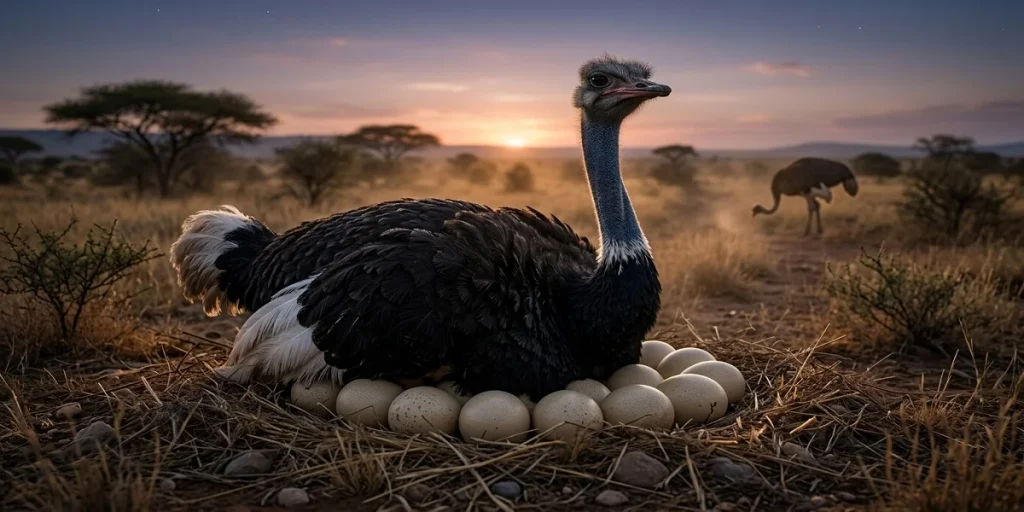
Yes, male ostriches play a vital role in incubating eggs. Unlike many bird species where incubation is handled primarily by the female, ostriches share incubation duties between the territorial male and the primary female, as part of their broader ostrich mating behavior and reproductive system.
In natural nests, the male generally takes the main incubation role at night, while the female commonly incubates during the day. This alternating system allows the eggs to remain covered for long periods while giving each parent time to leave the nest to feed, drink, and perform other activities.
How Male and Female Ostriches Share Incubation
The daily division of labor is biologically adapted to the ostrich's physical traits and natural habitat:
- Daytime Shift (Primary Female): The female’s duller, grey-brown plumage provides natural thermal camouflage, blending seamlessly with dry vegetation and dusty soil under daylight.
- Nighttime Shift (Territorial Male): The male’s black feathers render him nearly invisible to nocturnal predators in low-light conditions.
Communal Nesting Dynamics
Ostrich nests are communal. While multiple "minor" females may deposit eggs into a single communal scrape, parental care is provided almost exclusively by the resident territorial male and his "major" (primary) female.
The primary pair rolls their own eggs into the center of the nest for maximum thermal protection, placing secondary eggs around the outer edge.
Why Natural Incubation Works
Natural ostrich incubation relies on active behavioral regulation rather than simple passive sitting:
- Nest Defense: Breeding males become exceptionally territorial and aggressive, actively shielding the clutch from large apex predators.
- Continuous Thermal Cover: Role-switching happens quickly, preventing the large eggs from cooling down or overheating in harsh weather.
- Hatch Coordination: Parent birds remain on the nest even when hatching is staggered, protecting early-emerging chicks while providing heat to remaining eggs.
Natural vs. Artificial Incubation: The Key Takeaway
In nature, the breeding pair continuously adjusts body positioning, egg placement, and nest coverage in response to ambient changes.
In commercial artificial incubation, machinery must replicate this complex biological feedback loop mechanically:
- Automated incubators regulate temperature (36–37°C) and humidity (20–35%).
- High-torque turners mimic the parent birds manually rotating the eggs.
- Hatchery managers track 13–15% mass loss to mirror natural moisture evaporation.
Do male ostriches incubate eggs? Absolutely. In the wild, the male is an essential, active partner in driving the clutch through its 42-day journey to a successful hatch.
Frequently Asked Questions About Ostrich Egg Incubation
How Long Does It Take an Ostrich Egg to Hatch?
An ostrich egg typically takes 42 days to hatch. However, normal biological incubation windows range from 35 to 45+ days depending on temperature stability, egg weight, and shell density.
What Temperature Is Needed to Incubate an Ostrich Egg?
Ostrich eggs require a stable temperature of 36.0°C to 37.0°C (96.8°F–98.6°F). Research demonstrates that keeping temperatures closer to 36.5°C improves overall hatchability compared to higher settings.
What Humidity Level Is Best for Ostrich Egg Incubation?
Target incubator relative humidity should generally be kept low, between 20% and 30% (and below 25% in specific setups). Rather than relying on hydrometer displays alone, adjust humidity to achieve a total egg mass loss of 13% to 15%.
Do Male Ostriches Incubate the Eggs?
Yes. Male ostriches handle primary incubation duties at night, using their black feathers for camouflage. Females take the daytime shift, blending into the landscape with their lighter brown plumage.
Can You Incubate an Ostrich Egg at Home?
Yes, but it is challenging for beginners. Successful home incubation requires a heavy-duty forced-air incubator, automated turning, precise thermal control, and a digital scale to monitor daily weight loss over 42 days.
Why Do Ostrich Eggs Lose Weight During Incubation?
Ostrich eggs lose weight as moisture steadily evaporates through pores in the calcified shell. This evaporation creates room inside the egg for the internal air cell to expand, giving the chick its first oxygen source before hatching.
How Much Weight Should an Ostrich Egg Lose During Incubation?
An ostrich egg should lose approximately 13% to 15% of its initial Day 0 weight by the time it reaches the lockdown phase (around Day 38).
What Happens During the Lockdown Phase?
Around Day 38, automated turning stops so the chick can align itself for hatching. Eggs are often moved to a dedicated hatcher, humidity settings are adjusted to keep shell membranes soft, and the chick begins internal pipping.
How Many Eggs Do Ostriches Lay in a Lifetime?
Lifetime egg production depends on farm management, diet, health, and breeding duration. A healthy hen can lay dozens of eggs per season across a multi-decade reproductive lifespan.
How Much Does an Ostrich Egg Cost?
Prices vary based on usage, such as whether the egg is sold for culinary consumption, crafting, or breeding. Fertile hatching eggs command significantly higher prices than unfertilized or empty blown shells. (For current market rates, check our guide on how much ostrich eggs cost.)
Why Is Ostrich Egg Incubation So Difficult?
Their large volume, dense shells, low gas exchange rates, and strict moisture loss requirements make ostrich embryos exceptionally sensitive to slight shifts in temperature, humidity, airflow, and rotation angle.
Can an Ostrich Egg Hatch After 42 Days?
Yes. Day 42 is a biological benchmark, not a strict deadline. Healthy chicks regularly hatch between Days 43 and 46 under cooler conditions or due to individual egg characteristics.
Final Thoughts on Ostrich Egg Hatching Time
The typical ostrich egg hatching time is around 42 days, but successful incubation relies on far more than simply counting days on a calendar. Temperature, humidity, ventilation, egg weight loss, turning protocols, and egg storage conditions all directly influence how an embryo develops and when it eventually emerges.
For artificial incubation, maintaining environmental stability is critical. Research demonstrates that ostrich eggs react differently to incubation heat compared to standard poultry, with stable temperatures around 36.5°C yielding significantly higher hatchability than elevated settings in controlled studies.
Monitoring egg weight loss remains the most reliable benchmark throughout the six-week timeline. While individual eggs show natural variations in shell porosity, achieving a cumulative moisture loss between 13% and 15% of the original egg mass serves as the golden standard for hatchery success.
The primary takeaway is simple: 42 days is a baseline guide, not a strict deadline. An ostrich egg may hatch slightly earlier or later depending on incubation conditions and individual egg characteristics.
Understanding this process highlights the remarkable biological engineering of the ostrich egg. From precise water evaporation through thick calcified pores to the chick's final respiratory shift, almost six full weeks of development culminate in breaking through one of the strongest shells in the bird kingdom.