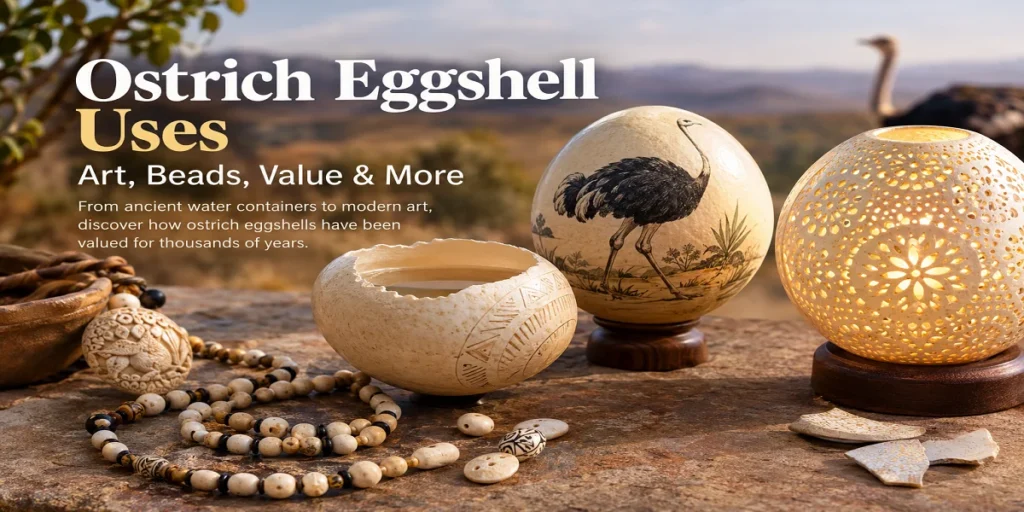
Quick Answer: Ostrich eggshell uses range from ancient water containers, beads, and carved cups to modern jewelry, lamps, and collectible art. Measuring 1.7 to 3 mm thick, or roughly 5 to 8 times thicker than a chicken eggshell, empty shells provide durable surfaces for crafting and typically list online for $17 to $41 based on condition.
Table of Contents
An ostrich egg is impressive when fresh, but its shell has a distinct story. Long before becoming painted ornaments or decorative lamps, ostrich eggshells were essential tools for carrying water, crafting beads, and creating objects with deep cultural value.
Engraved eggshell fragments found at Diepkloof Rock Shelter in South Africa date back approximately 60,000 years. Today, this same durable material appears in handmade jewelry, fine carvings, and high-end collectible art.
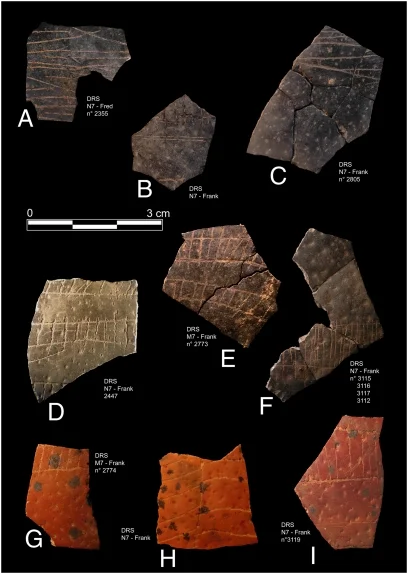
Engraved ostrich egg shell fragments from Diepkloof Rock Shelter, Western Cape, South Africa, dated to about 60,000 years ago. Image: Texier et al., PNAS (2010).What Is an Ostrich Egg Shell Made Of?
The versatility of an ostrich eggshell comes from its unique material, thickness, and structure. Composed primarily of calcium carbonate with a minor organic matrix, its rounded shape gives it high rigidity relative to its weight. Once emptied, it provides a large, sturdy canvas for carving and painting.
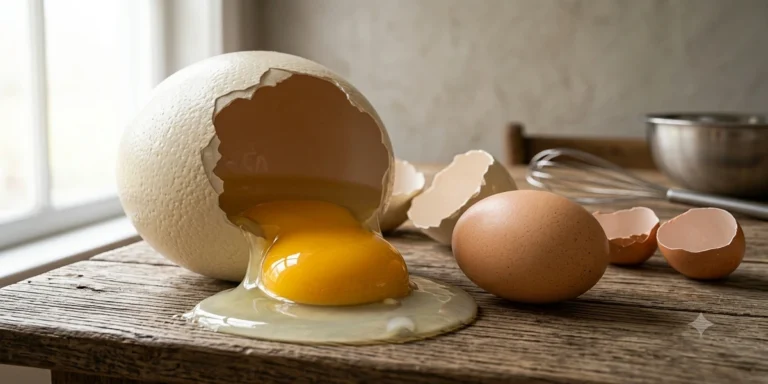
While chicken eggshells are only about 0.35 to 0.40 mm thick, ostrich eggshells range from 1.7 to 3 mm, making them roughly 5 to 8 times thicker.
| Property | Ostrich Eggshell | Why It Matters |
| Thickness | 1.7 to 3 mm | Provides a thick, durable layer for deep engraving and carving |
| Composition | ~95–96% Calcium Carbonate | Gives the shell a strong mineral structure similar to porcelain |
| Hardness | ~3 on Mohs scale | Firm yet manageable enough to pierce, cut, and polish |
| Size | ~15 cm length | Offers significantly more working surface than standard poultry eggs |
| Capacity | ~1 liter | Serves as a naturally effective small fluid vessel |
| Surface | Cream to ivory, dimpled texture | Delivers a distinct natural finish ideal for paints and dyes |
Note: Shell thickness, color, and internal volume vary naturally between individual eggs.
Ostrich Egg Shell Uses at a Glance
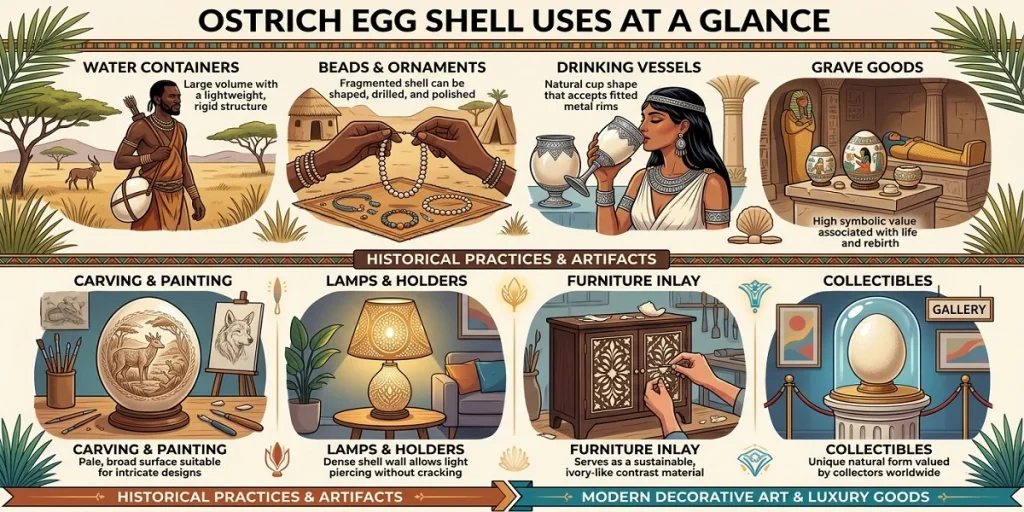
Ostrich eggshell applications fall into two main eras: practical tools and cultural artifacts of the ancient world, and modern decorative art, jewelry, and luxury collectibles.
| Primary Use | Historical or Modern Context | Key Material Advantage |
| Water Containers | Prehistoric southern Africa and traditional use | Large volume with a lightweight, rigid structure |
| Beads & Ornaments | Dating back 50,000+ years in Africa | Fragmented shell can be shaped, drilled, and polished |
| Drinking Vessels | Ancient Mesopotamia and the Mediterranean | Natural cup shape that accepts fitted metal rims |
| Grave Goods | Ancient Egypt, Nubia, and early societies | High symbolic value associated with life and rebirth |
| Carving & Painting | Contemporary fine crafts and art markets | Pale, broad surface suitable for intricate designs |
| Lamps & Holders | Modern interior lighting design | Dense shell wall allows light piercing without cracking |
| Furniture Inlay | Classical and contemporary decorative arts | Serves as a sustainable, ivory-like contrast material |
| Collectibles | Antique and contemporary galleries | Unique natural form valued by collectors worldwide |
The enduring appeal of the ostrich eggshell lies in its versatility. It can function as a practical container, a canvas for fine art, or a piece of history. To understand why humans have valued this material for millennia, we must look at its earliest historical uses.
Historical Uses of Ostrich Egg Shells
Long before ostrich eggshells appeared in craft shops and antique collections, ancient societies relied on them for daily survival, personal adornment, and spiritual expression. The archaeological record reveals a material that seamlessly served practical, social, and symbolic needs.
Water Containers and Engraved Symbols
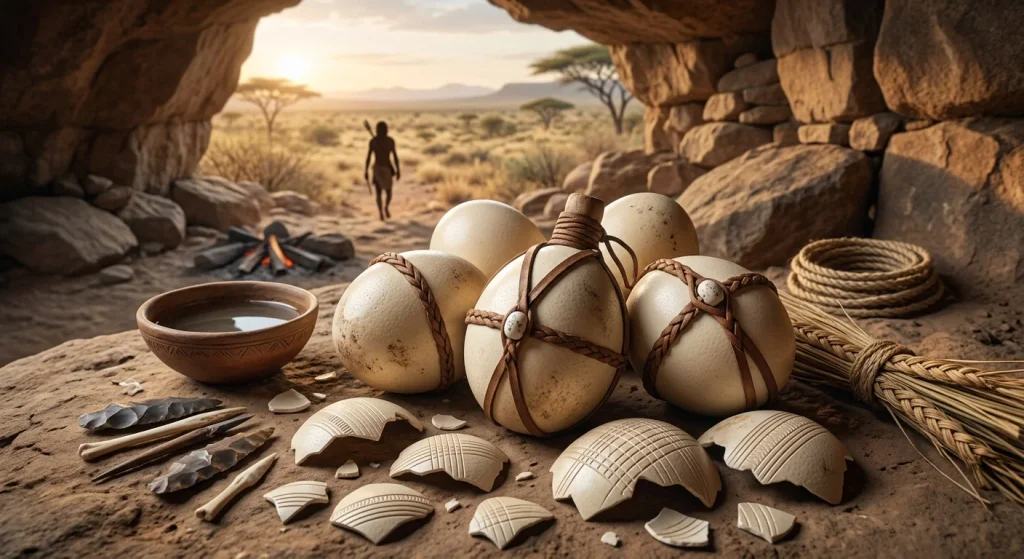
One of the earliest documented uses of ostrich eggshells comes from Diepkloof Rock Shelter in South Africa. Archaeologists recovered approximately 270 engraved fragments dating back around 60,000 years. These fragments feature recurring geometric designs, such as hatched bands and parallel lines, indicating deliberate artistic conventions long before formal writing systems emerged.
Intact ostrich eggshells hold roughly 1 liter of water. For hunter-gatherer populations operating in arid environments, these durable shells functioned as ideal lightweight canteens. Research published in the Proceedings of the National Academy of Sciences (PNAS) details these early containers, marking them among the oldest preserved human artifacts.
Similar traditional practices persist today among Kalahari hunter-gatherers, who continue to use emptied ostrich eggs as natural water vessels.
Ostrich Eggshell Beads and Ancient Social Networks
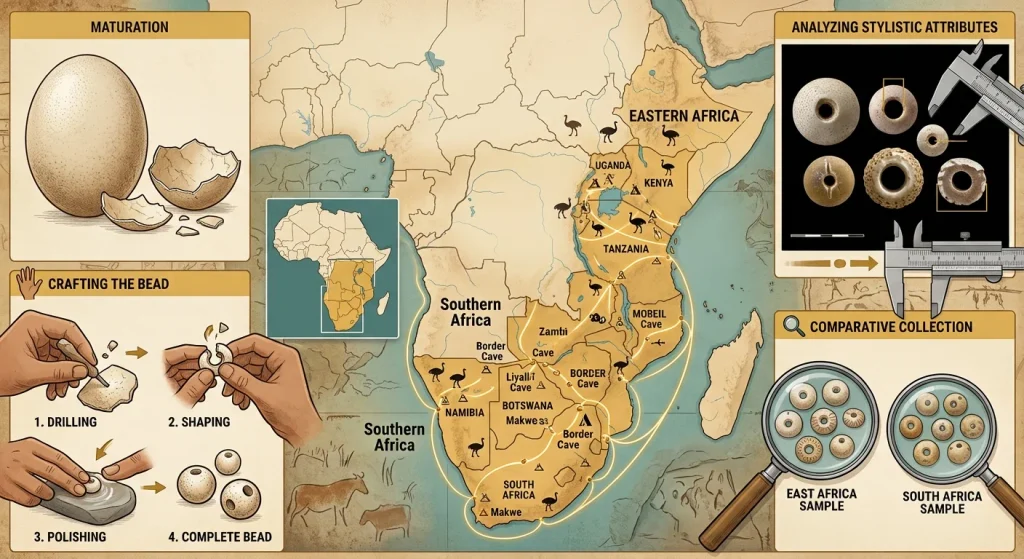
While water containers solved survival needs, eggshell beads served social and cultural functions. Crafting, wearing, and trading beads required time and skill, making them key indicators of early human interaction.
A study published in Nature analyzed 1,516 ostrich eggshell beads across 31 archaeological sites in southern and eastern Africa. The findings revealed that beads produced between 50,000 and 33,000 years ago shared identical stylistic attributes across a distance exceeding 3,000 kilometers.
| Period / Context | Geographic Range | Key Finding | Significance |
| 50,000 to 33,000 Years Ago | Southern & Eastern Africa (3,000+ km) | Uniform bead dimensions and styles | Indicates an extensive long-distance social trading network |
| Later Prehistory | Regional African Sites | Stylistic divergence and local variations | Reflects shifts in environment, social structure, and pastoralism |
This regional consistency suggests that early human communities maintained active social networks and cultural exchanges across vast geographic distances.
Cups, Ritual Objects, and Religious Buildings
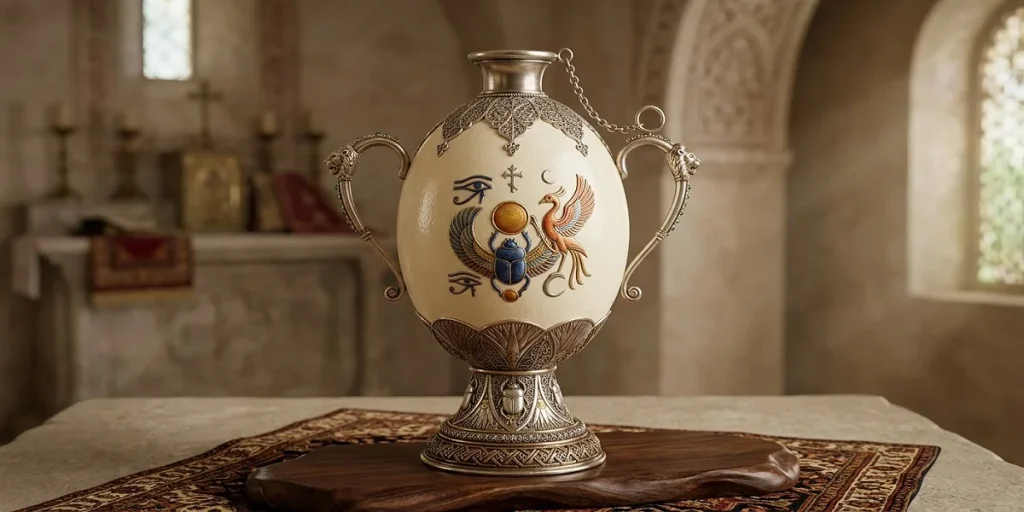
As ancient civilizations developed in the Mediterranean and Near East, ostrich eggshells evolved from simple domestic tools into status symbols and ceremonial items.
- Mesopotamian Vessels: Excavations at Kish (dating to 2500–2300 BC) uncovered eggshells cut and fitted with metal rims to form drinking cups.
- Mediterranean Rhyta: Ancient Mediterranean artisans mounted full eggshells into elaborate drinking vessels known as rhyta.
- Burial Offerings: Decorated eggshells frequently appear as grave goods in Nubian and Phoenician tombs, as well as in Ancient Egypt where they symbolized rebirth and spiritual protection.
- Sacred Architecture: In later centuries, ostrich eggs were hung near altars in Eastern Christian churches and integrated into Islamic architectural traditions as decorative, symbolic elements.
Writing Surfaces, Tools, and Historical Beliefs
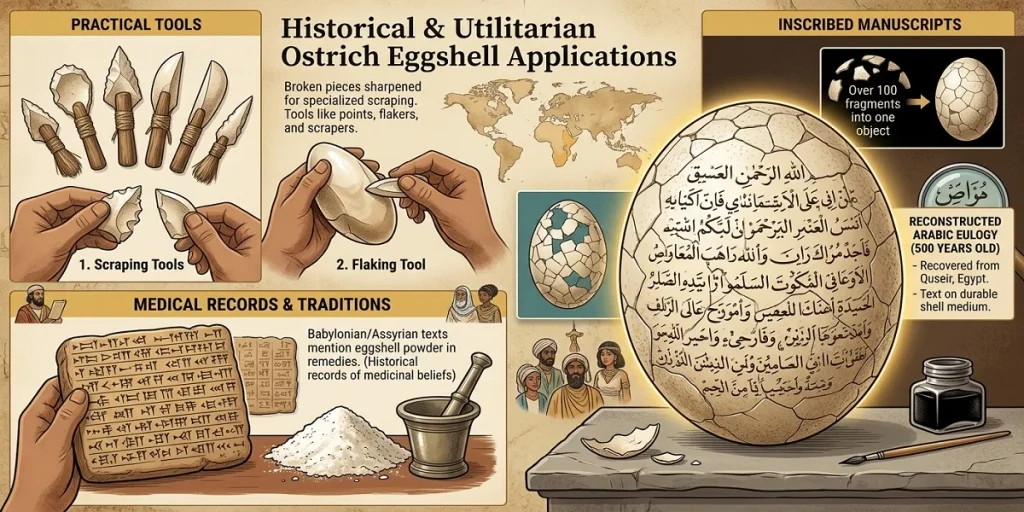
Beyond art and containers, ostrich eggshells served functional, medical, and textual purposes in later historical periods:
- Practical Tools: Broken shell pieces were sharpened or shaped into specialized scraping tools by various ancient cultures.
- Historical Medical Accounts: Ancient Babylonian and Assyrian texts mention pulverized eggshell in remedies and ritual practices. While scientifically unproven today, these records document historical beliefs.
- Inscribed Manuscripts: A notable 500-year-old artifact recovered from Quseir, Egypt, featured an Arabic eulogy written directly across the shell surface. The reconstructed object, pieced together from over 100 fragments, demonstrates the shell’s use as a durable medium for written texts.
Modern Uses of Ostrich Egg Shells
Today, ostrich eggshells are highly valued in the craft, interior design, and fine art markets. Available either as raw, emptied shells or as fully finished artwork, they offer artists a substantial, naturally curved canvas with a pale background and sufficient wall thickness for intricate design work.
Ostrich Egg Shell Art: Carving, Painting, and Scrimshaw
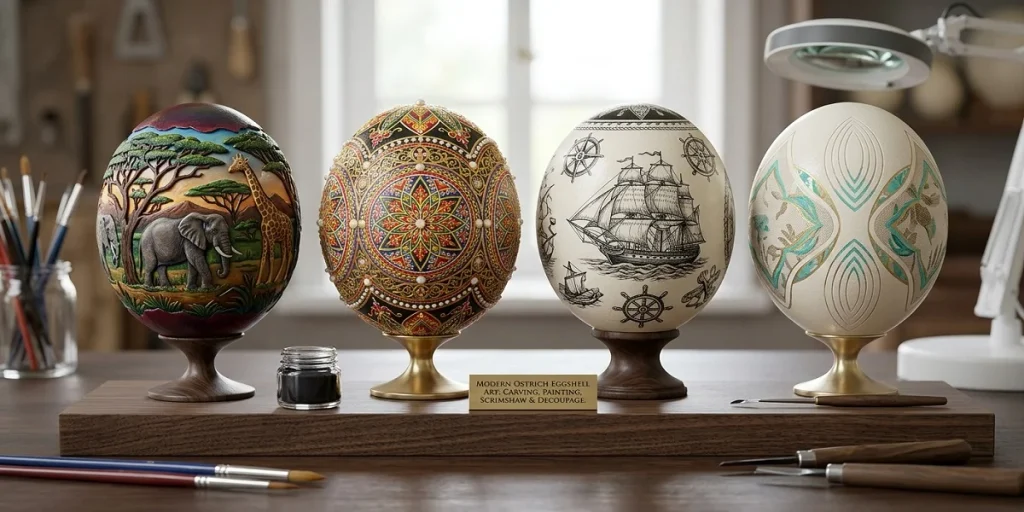
An emptied ostrich eggshell functions much like a compact natural canvas. Artists employ various techniques to transform these massive shells into collectible display pieces:
- Painting and Relief Carving: Artists paint intricate wildlife, floral, or abstract scenes directly onto the surface. Advanced carvers carefully remove layers of the shell wall to create multi-dimensional relief sculptures.
- Traditional Style Inspirations: Many artisans draw stylistic inspiration from Fabergé eggs or Eastern European pysanky traditions, applying these classic patterns to the larger ostrich egg surface.
- Scrimshaw Engraving: Artisans incise fine lines into the outer layer and rub contrasting pigments into the cuts to highlight detailed imagery. Because excessive pressure can shatter the wall, this process requires exceptional precision.
- Etching and Decoupage: Beginner-friendly techniques include acid etching, decoupage, and hand painting, which yield striking decorative results without complex structural cutting.
Lamps and Home Décor
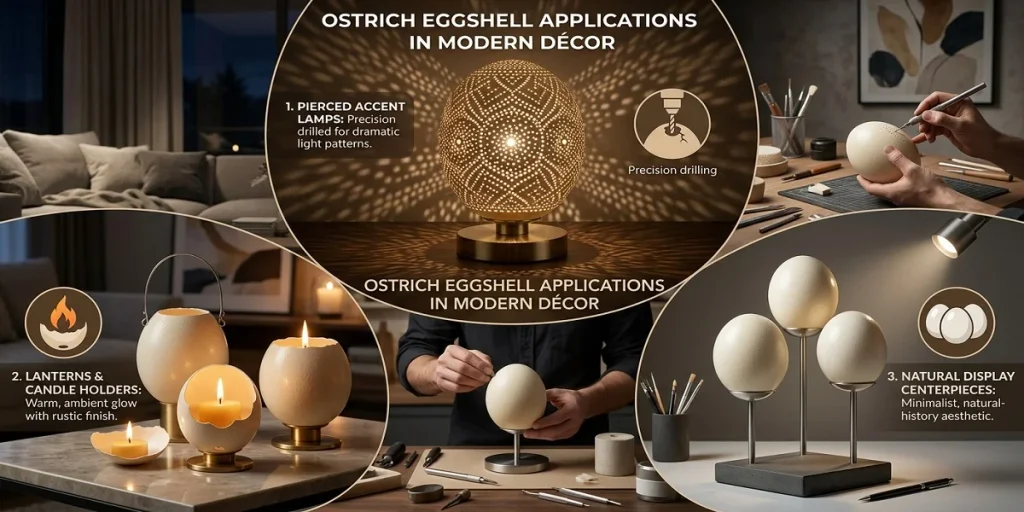
Lighting represents one of the most popular functional applications for ostrich eggshells in modern interior design.
| Decorative Application | Technique / Process | Visual Effect |
| Pierced Accent Lamps | Precision drilling of tiny pattern holes | Casts dramatic light and shadow patterns across room surfaces |
| Lanterns & Candle Holders | Strategic top/bottom cutting with heat-safe fittings | Provides a warm, ambient glow with a natural rustic finish |
| Natural Display Centerpieces | Unmodified shells mounted on minimal stands | Offers a minimalist, natural-history aesthetic for modern spaces |
Jewelry, Buttons, and Furniture Inlay
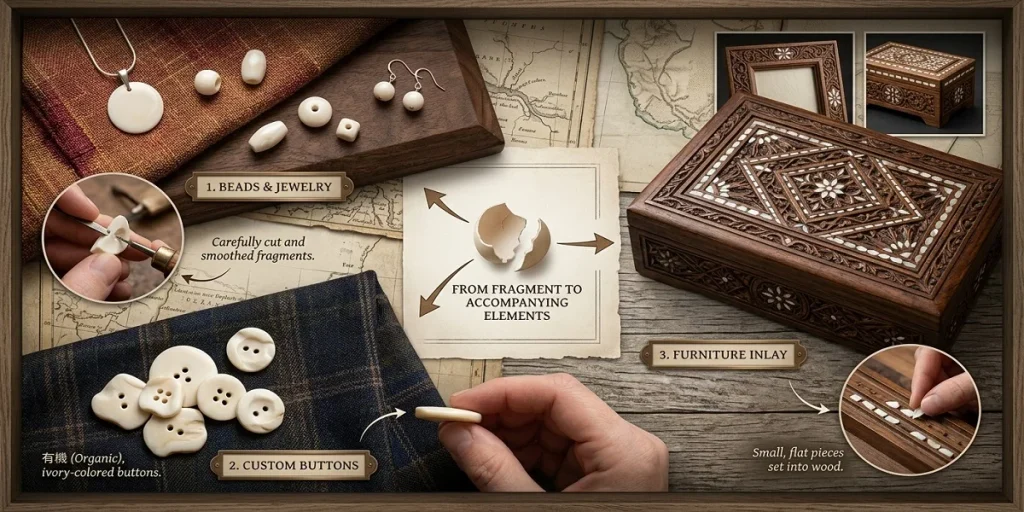
Smaller pieces from cracked or damaged shells are rarely wasted. Craftspeople repurpose shell fragments into durable, high-end accents:
- Beads and Jewelry: Carefully cut, smoothed, and drilled fragments are crafted into pendants, earrings, and statement beads.
- Custom Buttons: Thick shell pieces are shaped and polished into organic, ivory-colored buttons for specialty textiles.
- Furniture Inlay: Small, flat shell pieces are inset into carved wooden grooves on furniture, decorative boxes, and picture frames, offering a sustainable alternative to ivory.
The commercial value of these micro-crafts depends heavily on craftsmanship, polish consistency, and the labor required to prepare each fragment.
Mounted Sculptures and Collectibles
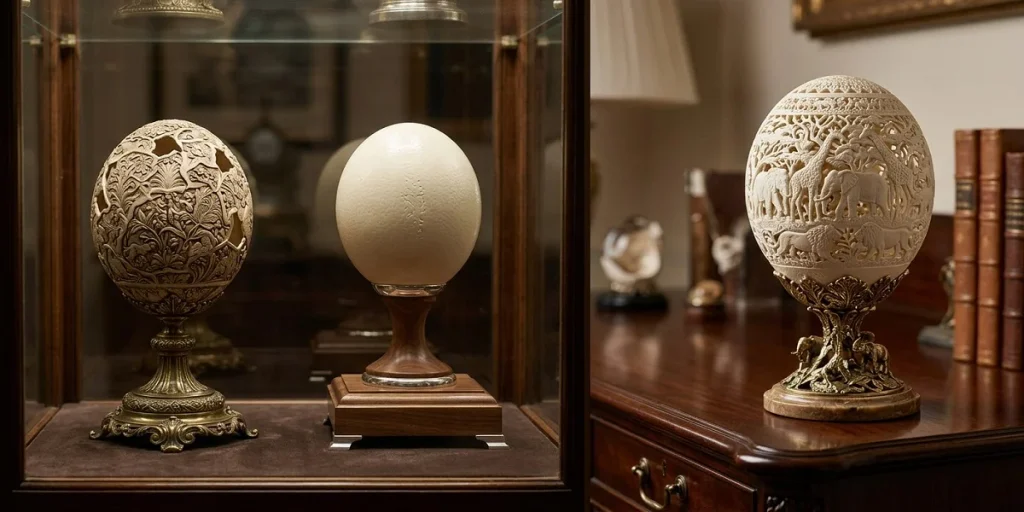
High-end ostrich eggshell art occupies a distinct segment of the luxury decor and antique markets. Shells are often elevated into fine art through brass, bronze, or polished wood bases.
- Contemporary Craft Eggs: Newly produced art pieces value technical skill, intricate carving, and artist reputation.
- Antique Collectibles: Historical items are evaluated based on documented provenance, age, condition, and the quality of their custom mountings. Buyers should always verify documentation, as stylistic aging alone does not confirm authentic antiquity.
Science, Education, and Farm Byproducts
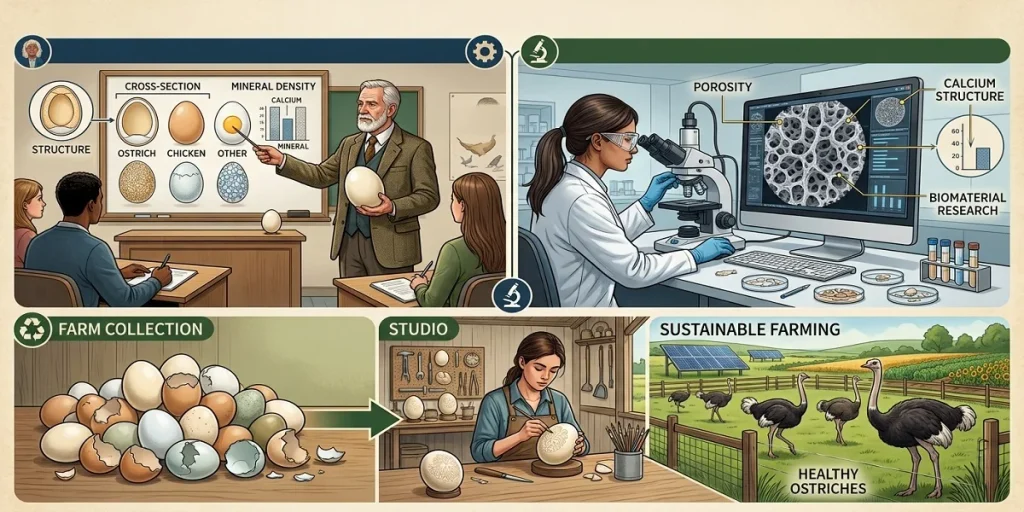
Beyond decorative arts, ostrich eggshells play valuable roles in education, materials research, and agricultural sustainability:
- Educational Tools: Classrooms and museums use full shells to demonstrate bird biology, eggshell structure, and mineral density comparisons against smaller species.
- Biomaterial Research: Scientists analyze the calcium carbonate structure of ostrich eggshells for potential applications in developing biomaterials, such as hydroxyapatite used in bone-graft research.
- Farm Byproduct Utilization: Commercial ostrich farms often sell infertile or unhatched eggs to artists. Repurposing these waste materials generates extra farm income while reducing agricultural waste.
Ostrich Egg Shell Benefits: What Is Real?
The real benefits of an ostrich eggshell lie in its physical strength, large working surface, and artistic versatility rather than unproven health claims. Raw, emptied shells typically cost $17 to $41, while hand-carved or collectible display pieces can reach $150 to $600 or more.
When evaluating ostrich eggshell benefits, it is essential to distinguish between proven material properties and unverified medical claims. The primary advantages of an ostrich eggshell center on its structural utility, durability, and economic value.
Key Material Benefits:
- Substantial Surface Area: Offers significantly more space for painting, carving, and engraving than chicken or duck eggs.
- Thick Mineral Structure: Composed primarily of dense calcium carbonate, providing high rigidity for detailed craft applications.
- Material Versatility: Whole shells serve as home decor and lamps, while broken fragments can be repurposed into beads, buttons, and furniture inlays.
- Farm Byproduct Recovery: Unfertile or damaged eggs provide secondary income for farmers when sold to artisans.
- Historical and Educational Value: Serves as a hands-on tool for teaching avian biology and examining ancient human craftsmanship.
Note: While thick, ostrich eggshells are not unbreakable. They can crack under uneven pressure or chip during drilling if proper tools are not used.
Can You Use Ostrich Eggshell as a Calcium Source or in the Garden?
Although ostrich eggshells are mostly calcium carbonate, homemade preparations lack the safety, purity, and dosage control required for health or agricultural applications.
- Dietary Supplements: Crushed ostrich eggshells should not be consumed as a home remedy or dietary calcium source. Raw shells can carry contaminants and do not provide a standardized or safe calcium dosage.
- Soil Amendment: Ground eggshell can add calcium to garden soil, but it breaks down very slowly. Because calcium carbonate raises soil pH, adding it without testing the soil first can harm acid-loving plants.
For most uses, the true value of an ostrich eggshell remains artistic, decorative, educational, and economic.
How Much Is an Ostrich Egg Shell Worth?
The market price of an ostrich eggshell depends heavily on whether it is sold as a raw crafting material or as a finished piece of fine art.
The figures below reflect average online listing prices for ostrich eggshells:
| Ostrich Eggshell Condition / Type | Approximate Asking Price | Primary Market |
| Plain, Emptied Shell (Individual) | $17 to $41 | Crafting, DIY painting, educational use |
| Plain Shells (Wholesale Case of 24) | ~$12.50 per shell | Artisans and high-volume crafters |
| Painted or Decoupage Shell | ~$65 | Modern home decor and gift markets |
| Hand-Carved Decorative Shell | $150 to $480 | Fine art collectors and luxury decor |
| Antique or Mounted Custom Piece | $600+ | High-end galleries, auctions, and specialty collections |
What Determines an Ostrich Egg Shell’s Value?
Several critical factors influence the final pricing of an ostrich eggshell:
- Physical Condition: Shells without hairline fractures, chips, or discoloration command higher prices, especially for carving.
- Surface Preparation: Properly cleaned, disinfected, and pre-drilled shells are more valuable to crafters who want immediate usability.
- Craftsmanship and Labor: Intricate hand carving, delicate scrimshaw, or hours of detailed painting dramatically increase an item’s market value.
- Rarity and Provenance: Authenticated antiques with documented history sell at a major premium compared to modern items made to look old.
- Custom Mounts and Packaging: High-quality wooden or brass display stands, along with protective shipping materials, add to the total cost.
For craft projects, buying a plain, intact shell is the most cost-effective choice. Collectors and interior designers, however, pay for artistic labor, display presentation, and historical documentation.
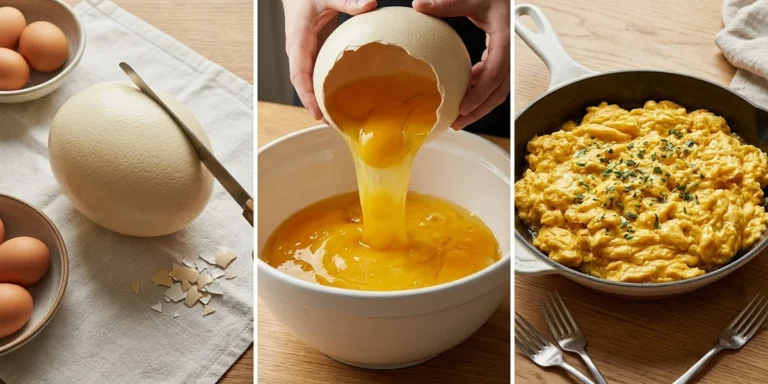
As an alternative, you may buy a fresh ostrich egg and eat it 🙂 Then you can use the ostrich eggshell for your craft project.
How to Empty and Clean an Ostrich Egg Shell for Crafts
Preparing a fresh ostrich eggshell at home is an affordable way to secure raw craft material. Because the shell is thick and dense, creating an initial opening without causing hairline fractures requires patience and appropriate tools.
Step-by-Step Shell Preparation
- Prepare Your Workspace: Place the egg on a soft ring or stable holder inside a sink or basin. Wear protective eyewear when drilling, and keep raw egg material away from food surfaces.
- Drill a Small Hole: Using a fine masonry or rotary drill bit, apply light, controlled pressure at one end of the egg. Do not force the tool, as sudden pressure can shatter the surrounding shell.
- Drain the Contents: Allow the egg whites and yolk to drain into a bowl. A long, clean wire or thin utensil can be inserted into the hole to break the yolk membrane and speed up the flow.
- Rinse the Interior: Inject clean, lukewarm water into the hole using a syringe or squeeze bottle, swirl thoroughly, and drain. Repeat until the water runs completely clear.
- Sanitize the Inside: Flush the internal cavity with a mild bleach-and-water solution or dish soap mixture to break down remaining organic lining. Rinse thoroughly afterward.
- Air Dry Completely: Leave the shell upside down in a well-ventilated area for several days. Trapped internal moisture or organic residue will cause unpleasant odors over time.
Safety Note: Shells prepared with craft tools or cleaning solutions are not food-safe. If you intend to eat the egg contents, use strict food-handling procedures from the start.
Buying Tips: What to Check Before You Pay
When purchasing empty ostrich eggshells online, listings vary significantly in shell quality, cleanliness, and hole size. Inspect the following details before purchasing:
- Shell Grade and Flaws: Inquire about hairline cracks, surface scratches, or chips. Request detailed close-up photographs rather than relying solely on arbitrary seller grades.
- Hole Size and Placement: Intact display pieces and fine carvings require a tiny, clean drill hole. Larger or uneven openings may work for lamps or candle holders but reduce overall shell value.
- Cleaning Standard: Confirm with the seller that the inner membrane has been sanitized and dried to prevent lingering odors.
- Packaging and Transit Guarantees: Thick shells can still crack under rough handling. Verify that the seller uses double-boxing or thick foam packaging, and check their policy regarding damage during shipping.
- Provenance for Antiques: If a shell is advertised as a historical or antique artifact, request authentic documentation and provenance before paying a premium.
Final Thoughts
An ostrich eggshell is far more than a simple byproduct of the world’s largest bird. Across millennia, human ingenuity has transformed this natural canvas into water vessels, delicate beads, ceremonial cups, and high-end collectible art.
Whether serving as an accessible medium for contemporary carvers or testifying to early human symbolic expression 60,000 years ago at Diepkloof, the ostrich eggshell remains a unique bridge between practical utility, deep history, and decorative craftsmanship.
Frequently Asked Questions
What can you do with an ostrich egg shell?
You can paint, carve, or engrave an ostrich eggshell, turn it into a decorative lamp, display it on a stand, or shape broken fragments into jewelry, beads, and buttons. Historically, eggshells served as water containers, drinking cups, and grave goods.
How much is an ostrich egg shell worth?
Plain, emptied ostrich eggshells typically range from $17 to $41 each. Hand-painted shells sell for around $65, while intricately hand-carved or antique display pieces can command between $150 and $480 or more.
How thick is an ostrich egg shell compared to a chicken egg shell?
An ostrich eggshell measures between 1.7 and 3 mm thick, compared to a chicken eggshell, which measures roughly 0.35 to 0.40 mm. This makes an ostrich eggshell approximately 5 to 8 times thicker. Keep reading to compare ostrich egg vs chicken egg
What did ancient people use ostrich egg shells for?
Ancient populations used ostrich eggshells as lightweight water vessels, engraved ornaments, drinking cups, and symbolic burial offerings. Archaeological sites show decorated eggshells dating back tens of thousands of years.
How old are the oldest ostrich egg shell beads?
Ostrich eggshell beads found in Africa date back at least 50,000 years. Engraved eggshell water container fragments from South Africa’s Diepkloof Rock Shelter date back even further, to approximately 60,000 years ago.
Can you carve or paint an ostrich egg shell?
Yes. Ostrich eggshells provide a large, dense surface ideal for oil painting, acrylics, acid etching, and rotary tool carving. Crafters must work carefully, as uneven drill pressure can still cause cracks.
How do you empty and clean an ostrich egg shell safely?
Drill a small hole at one end, break the internal membrane, drain the contents, rinse the interior repeatedly with water, sanitize with a mild solution, and allow it to dry completely in a ventilated area.
Why are ostrich egg shells so strong?
Ostrich eggshells are strong because they consist of 95% to 96% calcium carbonate in a thick, naturally dome-shaped structure. Despite their strength, they remain susceptible to sharp impacts and uneven pressure.
Can you use ostrich egg shell as a calcium source or in the garden?
While rich in calcium carbonate, crude homemade eggshell powder is not a proven or safe human dietary supplement. Finely ground shells can add calcium to garden soil, but they break down slowly and can raise soil pH levels.
Do ostrich eggs taste like chicken eggs?
Yes. Ostrich eggs are edible and offer a flavor similar to chicken eggs, though they are slightly richer with a lighter, fluffier texture when cooked in large batches. To see how they compare in size and nutritional value, check out our guide on Ostrich Egg vs Chicken Egg: Size, Nutrition & 5 Remarkable Facts.