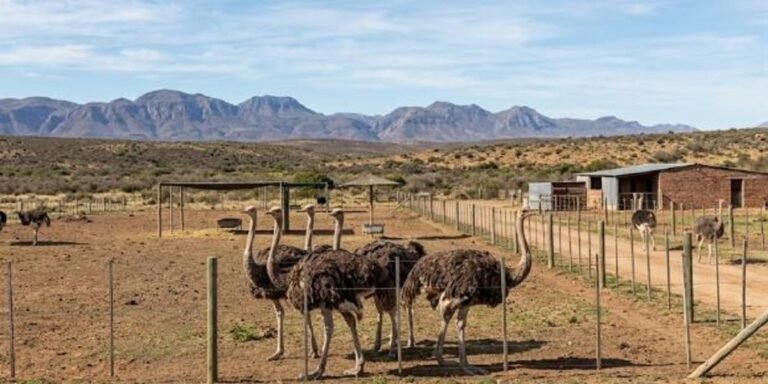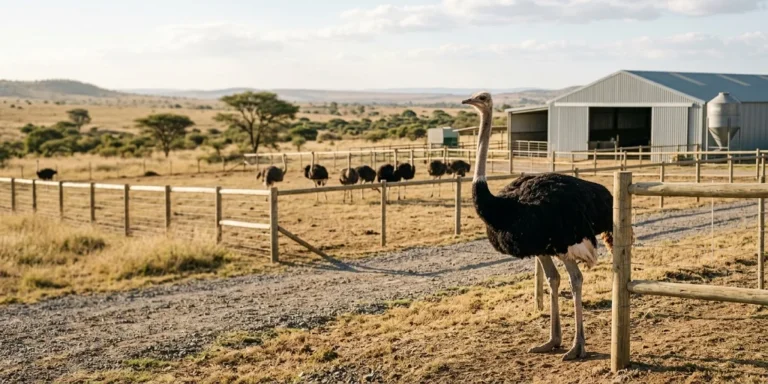
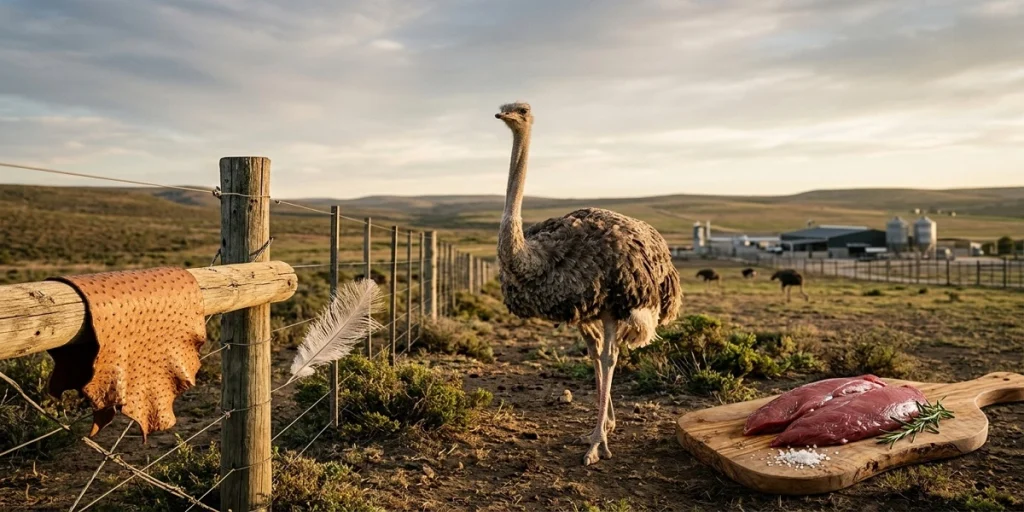
Quick Answer: The modern ostrich industry is a diversified agricultural business built primarily around three products: meat, leather, and feathers. South Africa remains the world’s dominant producer, accounting for roughly 75% of global ostrich product production according to industry and agricultural sources. What makes the industry unusual is that a single bird can generate value across several markets rather than being raised solely for its meat.
Table of Contents
For most people, the ostrich industry brings one of two images to mind. Either it is the old-fashioned feather trade that made parts of South Africa wealthy more than a century ago, or it is today’s niche market for lean red meat.
Both images are correct, but neither tells the whole story.
The modern ostrich industry is the result of a remarkable transformation. It began as a highly profitable feather business, suffered a devastating collapse when fashion and global trade changed, and eventually rebuilt itself around a much broader combination of meat, leather, feathers, and other usable products.
That history is important because it explains how the industry works today.
An ostrich is not simply a bird raised for meat. The economics of commercial ostrich farming depend on how efficiently producers can turn the entire bird into multiple saleable products. Meat enters food markets, hides enter the luxury leather industry, feathers continue to serve fashion and specialized markets, and smaller by-products can provide additional value.
This is what makes the ostrich industry different from many conventional livestock businesses.
What Is the Ostrich Industry?
The ostrich industry is the commercial farming, processing, and marketing of ostriches and the products obtained from them.
At its core, the industry revolves around three major product categories:
- Ostrich meat, sold as a premium red meat
- Ostrich leather, used in luxury fashion and other high-end leather goods
- Ostrich feathers, used in fashion, costumes, decorations, dusters, and specialized applications
Other parts of the bird can also be utilized, including fat for ostrich oil and certain bones and other materials for secondary products. The relative importance of these smaller categories varies by producer and market.
This multi-product structure is one of the defining characteristics of ostrich farming.
A commercial ostrich operation therefore cannot be understood simply by looking at the price of ostrich meat. The value of the hide, feathers, and other usable parts can also influence whether processing a bird is economically attractive.
South Africa’s ostrich industry explicitly describes the bird as a highly utilized agricultural animal, with meat, leather, feathers, and other by-products forming part of the commercial value chain.
This also explains why ostrich farming developed into a specialized industry rather than simply becoming another source of alternative meat.
The bird itself created several different markets.
How the Ostrich Industry Began
The commercial ostrich industry began in southern Africa, and its earliest major expansion was driven by a product that is now only one small part of the business: feathers.
Ostrich feathers had been valued for centuries for ceremonial, decorative, and fashion purposes. But during the nineteenth century, demand increased dramatically as ostrich plumes became fashionable in Europe and other international markets.
South Africa was ideally positioned to take advantage of that demand. Ostriches were already native to the region, while the dry conditions of areas such as the Karoo and Klein Karoo were well suited to raising them.
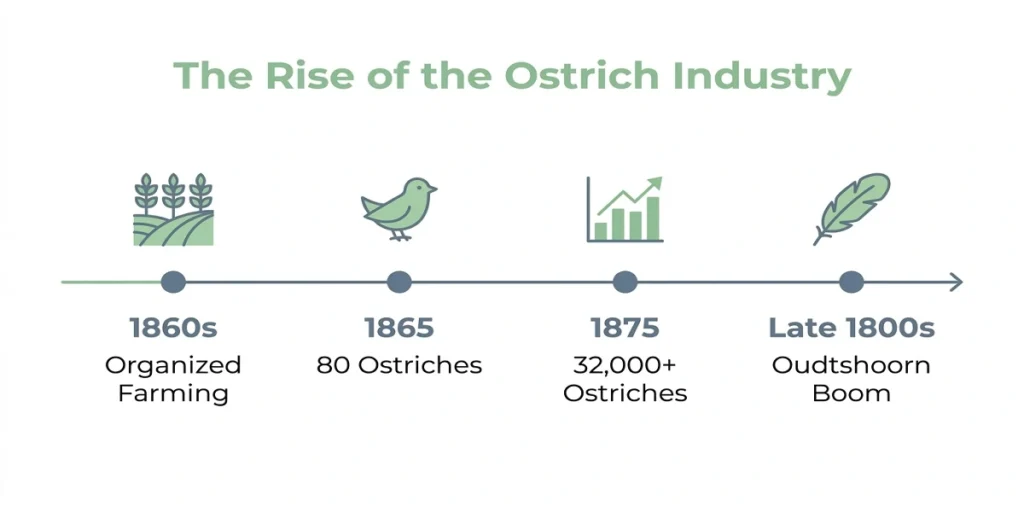
Commercial ostrich farming developed rapidly during the nineteenth century. South African sources place the organized development of the industry in the 1860s, when improvements such as wire fencing and lucerne cultivation made it much easier to manage larger flocks. The introduction of artificial incubation also helped producers expand their breeding operations.
The numbers grew remarkably quickly.
According to South African industry records, there were only around 80 tame ostriches in South Africa in 1865, but more than 32,000 by 1875. By the late nineteenth and early twentieth centuries, ostrich farming had become an important source of wealth in the Cape region.
The center of this development became the Klein Karoo, particularly the area surrounding Oudtshoorn in the Western Cape.
The region became so closely associated with ostrich farming that Oudtshoorn eventually earned the nickname the ostrich capital of the world.
And the reason for the boom was not meat.
It was fashion.
The Feather Boom That Built the Industry
During the late nineteenth and early twentieth centuries, ostrich feathers were a luxury fashion commodity.
Feathers were used extensively in hats, clothing, accessories, costumes, and decorative items. Demand became so strong that ostrich farming developed into a highly specialized commercial enterprise focused on producing feathers of consistent quality.
The financial rewards could be enormous.
The South African Ostrich Business Chamber records the period from approximately 1875 to 1880 as the First Ostrich Boom, when ostrich farming became one of the most valuable agricultural activities in the Cape. A second major boom began in the late 1890s, and by 1913 ostrich feathers ranked among South Africa’s largest export products.
The prosperity generated by the industry left a visible mark on Oudtshoorn and the surrounding region. Wealthy producers built elaborate homes that became known as feather palaces, reflecting just how profitable the trade had become.
But the industry had a fundamental weakness. It depended heavily on fashion. When consumer preferences changed, there was no equally large alternative market waiting to absorb the production.
That vulnerability became painfully obvious in the years surrounding the First World War.
Why the Ostrich Feather Industry Collapsed
The collapse of the original ostrich industry was not caused by one event. Several forces came together at almost exactly the wrong time.
Fashion moved away from the elaborate feathered hats and accessories that had created enormous demand for ostrich plumes. At the same time, the First World War severely disrupted international trade and shipping, making it much harder for South African producers to reach overseas buyers.
The rise of the automobile also changed fashion and everyday life. Large, elaborate hats became less practical in an increasingly automobile-oriented society, further weakening demand for oversized feather decorations.
The result was catastrophic for ostrich farmers.
The South African Ostrich Business Chamber describes World War I as the decisive turning point in the collapse of the feather trade and notes that an estimated 80% of ostrich farmers lost their livelihoods during the period. The number of ostriches subsequently fell dramatically.
The lesson was clear.
A farming industry built almost entirely around a single luxury product was extremely vulnerable to changes in fashion and international trade.
The ostrich industry would eventually survive, but it could no longer depend on feathers alone.
The Rebirth of the Ostrich Industry
The recovery did not happen overnight.
During the decades following the collapse of the feather boom, producers and industry organizations experimented with ways to stabilize ostrich farming and create new sources of value.
One of the most important developments came in 1945, when the organization that became associated with Klein Karoo International was established in Oudtshoorn. Its development was closely connected to the restructuring of South Africa’s ostrich industry and the gradual shift toward meat and leather alongside feathers.
The industry became increasingly organized in the postwar period.
South Africa introduced a single-channel cooperative marketing system in 1958, designed to bring greater stability to the marketing of ostrich products. The country’s first dedicated ostrich abattoir was built in 1964, while the first ostrich tannery became operational in 1970.
These developments were much more important than simply adding new processing facilities.
They marked a fundamental change in what an ostrich was worth. The industry was no longer trying to rebuild the old feather business.
It was building a multi-product agricultural industry. Meat could provide a food-market revenue stream. Leather could serve the luxury-goods market. Feathers could continue to generate additional income. The same bird could therefore serve several completely different industries.
The Three Main Products of the Modern Ostrich Industry
The modern ostrich industry is primarily built around meat, leather, and feathers.
Each product has a different market, different customers, and different economic characteristics.
Ostrich Meat
Ostrich meat is the product most likely to reach ordinary consumers today.
It is marketed as a premium red meat and is particularly known for being very lean and high in protein. It can be sold as steaks, fillets, ground meat, sausages, and other processed products.
South African producers have developed dedicated processing and export systems for ostrich meat, with Europe representing an important destination for the country’s production.
Ostrich meat is also the product with perhaps the greatest potential to introduce new consumers to the industry.
Someone may never buy ostrich leather or a feather product, but they may encounter ostrich meat at a restaurant, specialty butcher, or retailer and become interested in the bird for the first time.
And because the meat is only one part of the commercial picture, its value should never be considered in isolation.
Ostrich Leather
Ostrich leather occupies a completely different part of the market.
Its distinctive follicle pattern gives it a recognizable appearance, while properly processed ostrich hide is valued for its durability, flexibility, and luxury appeal.
It is used in products such as handbags, wallets, belts, footwear, watch straps, and other high-end leather goods.
Commercial ostrich leather production became increasingly important during the industry’s postwar diversification. South African industry records state that the first ostrich tannery became operational in 1970, after which ostrich leather developed into an important luxury export product.
This makes ostrich particularly unusual as a livestock species.
The same animal that produces food for the consumer market can also provide a premium raw material for luxury fashion.
Ostrich Feathers
Feathers may no longer dominate the industry, but they remain commercially important.
Modern ostrich feathers are used in fashion, costumes, decorations, wedding products, entertainment, and feather dusters. High-quality plumes continue to have a place in luxury and performance-related applications, while lower-grade feathers can serve more practical purposes.
The modern feather market is therefore very different from the market that existed before World War I.
It is smaller, more specialized, and much less capable of supporting an entire agricultural industry on its own.
But that does not make feathers unimportant.
For an ostrich producer, a product that generates additional revenue from the same bird can still contribute meaningfully to overall farm economics.
Ostrich Oil and Other By-Products
Meat, leather, and feathers are the three main commercial categories, but they are not the only things that can be obtained from an ostrich.
Fat can be processed into ostrich oil for specialty applications, while other parts of the bird can be used in products such as pet food, fertilizer, crafts, and other secondary markets.
These by-products are not large enough to redefine the global ostrich industry, but they reinforce one of its central advantages:
the objective is to extract value from as much of the bird as possible.
That principle becomes especially important when production and processing costs are considered.
Why the Modern Ostrich Industry Is a Multi-Product Business
The history of the ostrich industry explains something that is easy to miss when looking at the sector from the outside.
The industry did not simply recover from the collapse of the feather trade.
It changed its business model.
The old industry essentially asked:
How much are ostrich feathers worth?
The modern industry asks a very different question:
How much total value can one ostrich generate across meat, leather, feathers, and other usable products?
That distinction is critical.
Meat has one market.
Leather has another.
Feathers have another.
A producer therefore has the potential to spread commercial risk across several product categories rather than depending entirely on one customer base.
South Africa’s modern industry reflects this structure clearly. Its major commercial organizations continue to operate across meat, leather, feathers, farming, processing, and related value-added activities.
This multi-product approach is one of the main reasons the ostrich industry still exists today despite the spectacular collapse of its original market.
And it leads to the next major question:
What does one ostrich actually produce, and which of those products contributes the most economic value?
That is where the real economics of the ostrich industry begin.
How Much Does One Ostrich Produce?
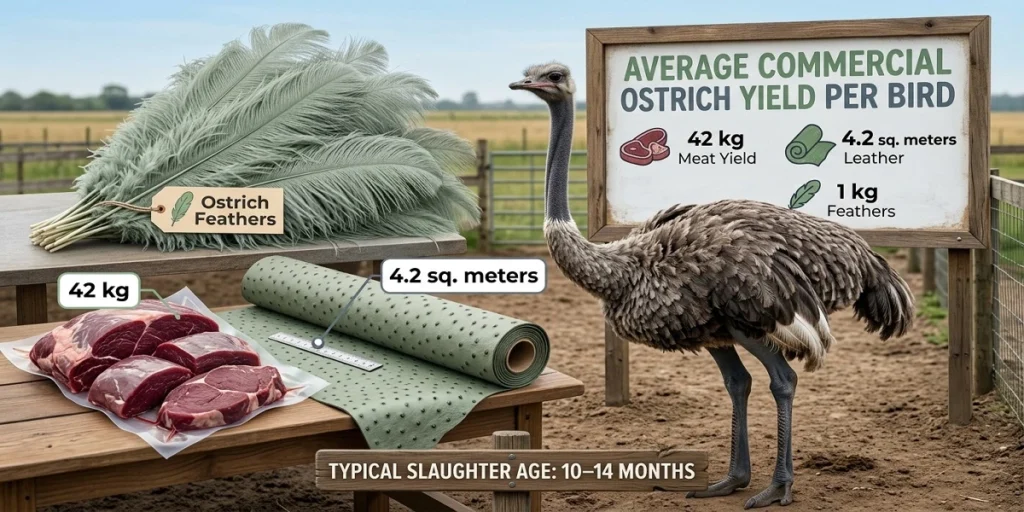
One of the easiest ways to misunderstand the ostrich industry is to look only at the amount of meat produced by a bird. A commercially processed ostrich can generate several different products, and the economic value of those products depends not only on their physical quantity but also on quality, market demand, processing, and where the bird is sold.
South African industry data commonly places the slaughter age at around 10 to 14 months. At that stage, a well-developed bird can provide a substantial carcass along with a usable hide and commercially valuable feathers. The exact yield varies with the bird, production system, slaughter weight, and processing method, so published figures should be treated as industry averages rather than guaranteed output from every ostrich.
A South African government value-chain profile published in 2023 gives approximately 42 kg of meat, 4.2 square metres of leather, and 1 kg of feathers from an ostrich processed at the typical slaughter age. Older South African value-chain data reported approximately 27 kg of meat from a carcass, which illustrates why meat-yield figures should always be tied to the specific definition and processing stage used by the source.
| Product | Approximate output per slaughter bird | Main commercial use |
|---|---|---|
| Meat | Up to about 42 kg in recent South African value-chain data | Food and food service |
| Hide | About 4.2 m² | Luxury leather goods |
| Feathers | About 1 kg | Fashion, decorative and specialty products |
The important point is not that every ostrich produces exactly these quantities. It is that one bird generates multiple commercial outputs, and those outputs enter completely different markets.
That is the foundation of the ostrich industry’s economics.
How Much Meat Does an Ostrich Produce?
Ostrich meat is usually the largest physical product obtained from the bird, but the amount that ultimately reaches the consumer depends on how the carcass is processed.
South African processing information describes an ideal slaughter bird at around 90 kg live weight producing a carcass of approximately 42 kg. From that carcass, steak, fillet, and trimming portions can provide around 27 kg of meat. This helps explain why different sources can report either a carcass weight or a usable meat yield without necessarily contradicting each other.
The distinction matters because “meat yield” can mean different things. A source may be referring to the entire carcass, while another may be counting only saleable ostrich meat cuts after bones, fat, and other material have been removed.
For consumers, the most valuable portions include cuts such as fillet and steak, while trimmings can be directed into ground meat and processed products. This gives processors several ways to market the same carcass rather than relying on one premium cut.
The amount of meat is also only one part of the economic calculation. An ostrich that produces a large amount of meat can still have substantial additional value because the hide and feathers are sold separately.
How Much Leather Comes From an Ostrich?
The ostrich hide is one of the reasons the industry cannot be evaluated like an ordinary meat business.
South African government value-chain data puts the typical hide area at approximately 4.2 square metres per slaughter bird. That is a considerable amount of usable skin, but physical area alone does not determine its commercial value. Hide quality, follicle pattern, size, defects, tanning, finishing, and final product all influence what the leather is worth.
This is particularly important because ostrich leather occupies a luxury niche rather than competing directly with commodity leather. The characteristic follicle pattern created by the feather quills gives the material a distinctive appearance that is used in handbags, wallets, footwear, belts, watch straps, and other premium products.
The hide therefore has a different economic role from the meat. Meat is sold by weight and ultimately competes for consumer spending in the food market, while leather can be transformed into a high-value finished material where craftsmanship, brand, rarity, and design have a major influence on the final selling price.
That difference is one reason the economic contribution of ostrich leather can be disproportionately large compared with its physical weight.
How Many Feathers Does an Ostrich Produce?
Feathers are the smallest of the three major product categories when measured by their contribution to the modern industry’s overall value, but they remain commercially useful.
South African value-chain data gives approximately 1 kg of feathers per slaughter bird. More detailed industry information shows that feather production is not simply one uniform product. Different feather types have different characteristics, uses, and values, with large plumes, wing feathers, body feathers, and softer feathers entering different markets.
The majority of feathers used by the industry can be recovered from slaughter birds, while some feathers are also harvested from live breeding birds as part of routine feather management. Quality matters considerably, particularly for feathers destined for fashion and decorative applications.
The modern feather market is therefore much more specialized than the enormous fashion market that supported the industry before World War I. Feathers remain commercially relevant, but they are generally an additional revenue stream rather than the primary reason a modern ostrich is raised for slaughter.
Which Is More Valuable: Ostrich Meat, Leather, or Feathers?
This question sounds simple, but there is no single answer that applies to every ostrich-producing country.
Historical South African industry data has commonly estimated the value of a slaughtered ostrich at approximately 45% skin, 45% meat, and 10% feathers. In contrast, the same industry sources have reported a very different pattern for Europe, where meat can account for around 75% of the value and skin around 25%.
The difference does not mean that European ostrich leather suddenly becomes less valuable, nor does it mean that South African meat is worth less. It reflects the structure of the market in which the bird is processed and sold.
South Africa has developed specialized infrastructure around both meat and leather, including slaughter facilities and tanneries. Europe, meanwhile, has historically placed greater commercial emphasis on ostrich meat as a premium food product. The relative contribution of each product can therefore change depending on processing costs, market access, demand, and the prices available for finished products.
This is why product yield and product value must not be confused.
A hide may weigh far less than the meat produced by a bird, but its value after tanning and conversion into luxury goods can be substantial. Likewise, feathers may represent only a small share of total value while still contributing useful additional income to a farm or processor.
The ostrich industry’s economics are therefore based on the combined value of the bird rather than simply the number of kilograms of meat it produces.
Why Does the Value Split Change by Region?
The biggest reason is that ostrich products do not move through identical supply chains everywhere.
In South Africa, the industry developed around a complete value chain that includes farming, slaughter, meat processing, leather tanning, feather processing, and exports. This allows producers and processors to capture value from several products at different stages of the supply chain.
Europe has historically developed a stronger consumer market for ostrich meat, which changes the relative importance of the products. When more of the commercial value comes from selling meat directly into food markets, meat naturally represents a larger proportion of the value generated by the bird.
The same principle applies to other producing countries. A farm located near a strong meat market but without access to specialized tanning facilities may place more emphasis on meat. A producer with reliable access to a leather processor may see greater value in the hide.
This also explains why quoting a single global percentage for the value of ostrich meat, leather, and feathers can be misleading. There is no universal value split that applies to every farm, country, or processing system.
Instead, the economics depend on what happens to the bird after it leaves the farm.
Why the Whole Bird Matters
The most important economic advantage of ostrich farming is not simply that an ostrich produces a lot of meat.
It is that the same animal can generate revenue from several markets.
A processor can sell meat to restaurants and retailers, send the hide to a tannery, and market feathers to specialized buyers. Additional parts of the bird can also enter secondary markets, reducing waste and creating smaller revenue streams.
South African industry sources emphasize this whole-bird approach, noting that meat, skin, and feathers are all important in determining slaughter income. Research on ostrich production likewise identifies meat, leather, and feathers as the industry’s three economically important products and stresses that their yield and quality need to be considered together when evaluating production efficiency.
That is the key difference between looking at an ostrich as a food animal and looking at it as a commercial agricultural product.
The question is not simply “How much meat does an ostrich produce?”
The better question is:
“How much total value can be recovered from one ostrich?”
And that question takes us directly to the global industry, because the answer depends heavily on where the bird is raised, processed, and sold.
South Africa’s Dominance in the Global Ostrich Industry
South Africa is the undisputed center of the modern ostrich industry. Depending on the source and whether the figure refers to production, products, or market share, estimates generally place South Africa’s share at roughly 70% to 85% of the global ostrich industry, with around three-quarters being a reasonable figure to use when describing its overall position. The country’s dominance is built on more than the number of birds it raises. It also has the farming expertise, processing infrastructure, leather tanneries, export networks, and specialized knowledge that have developed over more than a century.
Most of South Africa’s commercial ostrich production is concentrated in the Western Cape, particularly the semi-arid Klein Karoo region surrounding Oudtshoorn. The environment is well suited to ostrich production, while decades of accumulated farming experience have created a specialized regional supply chain connecting farms with slaughter facilities, meat processors, leather operations, and feather businesses. The Oudtshoorn municipal government describes ostrich farming and processing as an important part of the local economy, supplying meat, feathers, and leather products while supporting local processing activity.
Oudtshoorn’s importance is therefore not simply historical. It remains one of the world’s most important geographic centers for ostrich production, and the concentration of expertise in the region gives South African producers an advantage that would be difficult for a new producing country to reproduce quickly.
This concentration also helps explain why South Africa has remained dominant even as ostrich farming has spread to other parts of the world.
Why Is the Ostrich Industry So Concentrated in South Africa?
There is no single reason for South Africa’s dominance. It is the result of several distinct advantages reinforcing one another over generations:
- Favorable Climate & Land: Ideal semi-arid conditions suited to large-scale ratite production.
- Specialized Research: Decades of technical and veterinary expertise developed specifically for ostriches, rather than adapted from conventional livestock.
- Integrated Supply Chain: Co-located slaughter facilities, tanneries, processing plants, and experienced exporters within a single region.
Geography matters significantly. When all nodes of the value chain are concentrated geographically, operational efficiency soars, creating a formidable barrier to entry for competing international markets.
A new market can import breeding stock and build farms relatively quickly. Building an entire commercial ecosystem around those birds is vastly more complex.
South Africa has already built that ecosystem.
Where Does South Africa Export Ostrich Products?
South Africa’s position in the global industry is strengthened by its export-oriented production model. Ostrich meat, leather, and feathers do not necessarily go to the same countries because each product serves a different market.
Industry and agricultural sources identify the European Union as an important market for South African ostrich meat, while countries such as the United Kingdom, Hong Kong, and China have also appeared as export destinations. Ostrich leather has traditionally had strong connections with luxury markets in countries including France, the United States, and Mexico.
The distinction between these markets is important.
A consumer buying ostrich meat in Europe is participating in a very different supply chain from a luxury brand purchasing ostrich leather for handbags or watch straps. The bird may originate from the same South African production system, but the commercial journey after processing can be completely different.
This is another reason the ostrich industry should be viewed as several connected markets rather than one single commodity business.
The Ostrich Industry in the United States
The United States has a very different ostrich industry from South Africa.
Modern commercial ostrich farming in the United States expanded rapidly during the 1980s, when much of the investment was based on selling breeding birds and breeding stock to new farmers. The business model attracted substantial interest because investors expected the emerging ostrich industry to develop into a major alternative livestock sector.
That expansion eventually produced a classic boom-and-bust cycle.
As the supply of breeding birds increased, the market could not sustain the expectations that had driven the original investment. The result was a major contraction in the breeder market, after which surviving producers increasingly looked toward actual products such as meat, leather, and feathers rather than simply selling birds to new entrants.
The modern US industry is therefore much smaller and more fragmented than the South African sector.
One important difference is infrastructure. South Africa developed a specialized commercial chain over many decades, while US ostrich producers have generally operated within a much smaller niche market. This makes processing, distribution, consumer awareness, and access to reliable buyers more important challenges for American producers.
There is still evidence that ostrich meat raised in the United States can enter international markets. For example, the USDA’s Food Safety and Inspection Service maintains export certification requirements specifically covering ostrich meat for certain destinations, demonstrating that US-raised ostriches are part of an established but highly specialized export system.
For American consumers, however, the domestic industry remains a niche livestock sector rather than a mainstream meat industry.
The Ostrich Industry in Europe
Europe occupies an unusual position in the global ostrich industry because it is both a consumer market and, in some countries, a producer of ostriches.
European demand has historically been particularly important for ostrich meat. Earlier European livestock studies found significant consumer demand for ostrich meat but noted that much of that demand was being supplied from outside the European Union.
This helps explain why the economic structure of the European ostrich market can look different from South Africa’s.
South Africa has a deeply integrated production and processing industry in which leather remains commercially important. European markets, by contrast, have historically placed greater emphasis on the food side of the business, particularly premium ostrich meat.
That does not mean Europe has no ostrich leather market or that South Africa produces ostriches mainly for leather. It simply shows how the same animal can have different economic priorities depending on where it enters the supply chain.
Ostrich Production Beyond South Africa: A Fragmented Global Map
While South Africa remains the overwhelming dominant force, commercial ostrich farming is not limited to one country. Established operations exist in Australia, China, Namibia, Zimbabwe, Israel, and the United States, among others.
The primary difference between South Africa and the rest of the world, however, is not just flock numbers. It is supply chain integration. No other nation has yet developed the same combination of long-term production volume, specialized processing infrastructure, and dedicated export logistics that South Africa commands. Other producers generally serve domestic niche markets rather than large-scale international exports.
China: The Rising Domestic Giant
Among global producers outside South Africa, China is the most significant. The country has successfully cultivated a substantial domestic farming sector alongside an expanding consumer market. Rather than competing for export share, China’s industry structure is primarily focused on serving its internal demand for meat, leather, and health products.
The Structure of Global Dependency
The current structure of the global ostrich industry is best described as highly concentrated, with one dominant production center and a collection of much smaller regional industries.
The World Ostrich Association has previously echoed this assessment, stating that South Africa accounts for the clear majority of ostrich meat, while the remaining supply is distributed among numerous smaller, disconnected producing regions.
This fragmentation creates a unique market dynamic:
For Global Buyers: It creates an extreme dependency on the production, political stability, and export capabilities of a single source country.
For South Africa: It locks in its position as the unavoidable main supplier.
How Big Is the Global Ostrich Market?
Putting a single dollar figure on the global ostrich industry is surprisingly difficult.
There is no universally accepted statistical system that measures the entire industry in the same way that major livestock sectors such as beef, pork, or poultry are measured. Private market-research companies often calculate separate markets for ostrich meat, ostrich leather, feathers, or finished products, and their definitions can vary substantially.
For example, one recent market-research estimate places the global ostrich meat market at approximately $400 million in 2025, while another estimates the ostrich leather market at more than $1 billion. These figures should not be added together and presented as the total value of the ostrich industry because the underlying reports may use different definitions, geographic coverage, and stages of the supply chain.
The same problem appears when comparing market forecasts.
One report may measure the value of raw ostrich leather, while another may include finished luxury goods. A meat report may measure wholesale or processed meat sales rather than the value generated at the farm level.
For that reason, the most useful conclusion is not a single headline market-size number.
The more important fact is that ostrich remains a small global livestock industry with multiple high-value niche markets, rather than a commodity sector capable of competing directly with beef, pork, or poultry on production volume.
Why Ostrich Has Not Become a Mainstream Global Meat Industry
The limited scale of the ostrich industry is not necessarily a sign that the animal is poorly suited to commercial farming.
Instead, the industry faces a combination of market and infrastructure limitations.
Ostrich meat is still unfamiliar to many consumers, and demand remains concentrated in specialty restaurants, premium retail, and selected regional markets. Processing infrastructure is also much less widespread than it is for conventional livestock, which makes it difficult for a new producer to enter the market without already having access to suitable slaughter and processing facilities.
There is another problem that is easy to overlook: scale creates its own advantages.
Beef, poultry, and pork have enormous global industries with established feed systems, processors, distributors, retailers, consumer habits, and supply chains. Ostrich producers cannot simply replicate those systems at a smaller scale and expect the same economics.
The ostrich industry therefore occupies a different position.
It is a specialized agricultural sector built around premium and alternative products rather than a mass-market protein system.
That can be a limitation, but it can also be an advantage.
A niche product does not necessarily need to compete with chicken on price. It can compete on characteristics such as leanness, novelty, premium positioning, or exclusivity.
The Strength and Weakness of South Africa’s Dominance
South Africa’s heavy concentration of production provides the global market with an undeniable operational advantage: deep infrastructure, specialized labor, and high-volume processing efficiency. However, that same concentration creates a single point of failure for the entire global supply chain.
| Strategic Advantages (The Strengths) | Structural Risks (The Weaknesses) |
|---|---|
| Economies of Scale: Lower per-unit processing and tanning costs due to high throughput. | Single Point of Failure: Regional disease outbreaks (e.g., Avian Influenza) can trigger global supply shortages. |
| Technical Expertise: Decades of specialized veterinary research, genetic selection, and flock management records. | Export Bans & Trade Restrictions: Animal health disruptions in South Africa frequently result in immediate border closures. |
| Established Logistics: Direct access to matured, specialized international export channels for meat, leather, and feathers. | Global Supply Vulnerability: International buyers and processors are left entirely reliant on one country’s domestic stability. |
When an animal-health crisis occurs in South Africa, export borders close. Yet consumer and commercial demand worldwide remains completely intact. The World Ostrich Association has repeatedly highlighted how regional disease events disrupt South African production, instantly paralyzing global inventory flows.
The central challenge facing the modern ostrich trade is no longer just production volume, it is resilience.
💡 The Core Industry Paradox: The ostrich sector successfully survived the collapse of the 19th-century feather fashion boom by diversifying into high-value meat and premium leather. Today, its survival depends on a new challenge: reducing geographic dependency on a single production region without sacrificing the premium quality that makes ostrich products profitable.
The Biggest Challenges Facing the Ostrich Industry
The modern ostrich industry is far more diversified than the feather industry of a century ago, but diversification has not eliminated its vulnerabilities. Disease outbreaks, export restrictions, production costs, limited processing infrastructure, and consumer unfamiliarity continue to shape how quickly the industry can grow.
These challenges are particularly important because the global market is highly concentrated. When one country supplies a large share of the world’s ostrich products, problems affecting that country’s farms or export channels can have consequences far beyond its borders.
Avian Influenza Is One of the Industry’s Biggest Risks
Few issues demonstrate the vulnerability of the ostrich industry better than avian influenza.
South African ostrich production has experienced repeated disruptions from avian influenza outbreaks, with export restrictions affecting the industry’s ability to sell fresh meat to major international markets. Historical data shows just how severe the impact can be: South African ostrich meat exports fell sharply after the 2017 outbreak, while earlier outbreaks had also resulted in prolonged restrictions on exports to Europe.
The problem is not simply the loss of birds.
For an export-oriented industry, a disease outbreak can trigger movement restrictions, additional testing, quarantine requirements, slaughter restrictions, and temporary closure of foreign markets. Even farms that are not directly affected by an outbreak can suffer if the country or production region loses its disease-free export status.
South Africa’s own agricultural authorities identify avian influenza as one of the major risks to the industry’s sustainability. The sector has responded by investing in stronger biosecurity, surveillance, testing, and alternative processing methods that can keep some exports moving even when fresh-meat exports are restricted.
This has created an important distinction within the industry.
Fresh ostrich meat is particularly vulnerable to animal-health restrictions, while properly heat-treated products can provide an alternative route to international markets.
That does not eliminate the risk, but it gives processors another tool for keeping part of the value chain operating during periods of disruption.
Export Dependence Makes the Industry Vulnerable
The ostrich industry is unusually dependent on international trade.
South African industry data indicates that around 90% of ostrich meat and products are exported, making exchange rates, border regulations, market access, and international demand major factors in producer profitability.
This creates both an opportunity and a weakness.
International markets allow a relatively small industry to sell premium products to consumers and businesses far beyond its domestic market. But the same dependence means that a change in one country’s import regulations can have an immediate effect on producers thousands of miles away.
The European Union is a good example. South African ostrich meat exports have historically depended heavily on compliance with strict European animal-health and food-safety requirements. Export abattoirs and processing facilities must meet specific standards, while meat requires official inspection and certification before entering the market.
For producers, this means that raising a healthy ostrich is only the first part of the job.
The bird also has to move through a supply chain capable of meeting the requirements of the destination market.
Trade Policy Can Change the Economics Quickly
Ostrich diseases are not the only external risk.
Tariffs and trade-policy changes can also affect the competitiveness of ostrich products, particularly leather and other premium goods that cross international borders.
This became especially visible in 2025 when the United States imposed a new tariff regime on South African imports. South African agricultural and business groups specifically warned that ostrich leather producers could be affected by the additional trade costs. The situation has continued to evolve, with tariff arrangements changing again during 2026.
The important lesson for the ostrich industry is broader than any single tariff rate.
A highly concentrated export industry is exposed to trade-policy decisions made in markets over which producers have little control.
For this reason, developing additional export destinations is strategically important. South African industry bodies and government agencies have already identified market diversification, particularly for leather and heat-treated meat, as an important part of the industry’s future.
Production Costs Are Another Major Constraint
Ostrich farming is sometimes presented as a low-input alternative to conventional livestock, but commercial production is not inexpensive.
Feed is one of the largest costs. South African agricultural data indicates that feed can account for more than 70% of input costs in ostrich production, making feed prices and the availability of suitable grazing conditions important factors in farm profitability.
Climate can compound the problem.
The main ostrich-producing regions of South Africa are relatively dry, and prolonged drought can reduce the availability of grazing and increase the cost of supplementary feed. Producers therefore have to manage not only the biological needs of the birds but also the economic consequences of changing weather conditions.
The industry’s own value-chain analysis also highlights another challenge: ostrich farming can require a long period before capital begins generating returns, while chick mortality can be high and young birds are particularly vulnerable to disease.
This makes ostrich farming a very different proposition from simply buying a few birds and waiting for them to become valuable.
Processing Infrastructure Is a Barrier to Industry Growth
A farm can produce excellent ostriches and still struggle commercially if there is no reliable route to market.
Commercial slaughter, meat processing, hide handling, tanning, feather processing, veterinary inspection, export certification, and distribution all require specialized infrastructure. South Africa has spent generations building this ecosystem, while many newer producing countries have not developed the same level of integration.
This is one reason ostrich farming can expand geographically without necessarily creating a fully functioning ostrich industry.
A country may have thousands of birds but still lack enough processors, certified abattoirs, tanneries, experienced exporters, or reliable buyers to turn those birds into consistently marketable products.
The South African government has explicitly identified the need for access to suitable abattoirs and tanneries, export expertise, guaranteed markets, and consistent product quality as challenges for producers.
That infrastructure gap is one of the strongest reasons South Africa continues to dominate the global sector.
Consumer Awareness Still Limits Ostrich Meat
There is also a much simpler problem: many consumers have never eaten ostrich meat.
Ostrich meat has several characteristics that make it attractive as a premium food, but consumers do not automatically buy products they do not recognize. Beef, chicken, pork, and other conventional meats have enormous advantages because consumers already know how they taste, how to cook them, where to buy them, and what they should cost.
Ostrich has to overcome that familiarity gap.
This is particularly important in markets where ostrich meat is positioned as a premium product. A higher price can work when consumers perceive a product as desirable and distinctive, but it can become a barrier when they simply do not understand what they are buying.
That means future industry growth will depend partly on education and market development, not just on producing more birds.
Animal Welfare and Environmental Expectations Are Becoming More Important
Modern agricultural industries are increasingly judged on more than productivity.
Consumers, retailers, regulators, and international buyers are paying greater attention to animal welfare, traceability, environmental impact, and production standards. The ostrich industry is not exempt from those expectations.
South African industry documents specifically identify animal welfare and food-safety guarantees as requirements for export markets, while environmental awareness around land and veld utilization is also becoming more important.
This creates an additional cost for producers, but it can also become a competitive advantage.
An industry that can demonstrate strong biosecurity, responsible land management, humane handling, traceability, and consistent quality is better positioned to supply premium international markets.
For ostrich producers, sustainability therefore needs to be treated as part of market access rather than simply as a public-relations issue.
What Could the Future of the Ostrich Industry Look Like?
The future of the ostrich industry is unlikely to involve becoming another beef or poultry industry.
Its more realistic opportunity is to become a larger and better-organized premium agricultural sector built around multiple products.
Several developments could support that growth:
- Greater market diversification: Reducing dependence on a small number of export destinations would make the industry less vulnerable to individual trade restrictions.
- More value-added products: Finished leather goods, processed meat, and specialized feather products can capture more value than exporting raw materials alone.
- Improved disease management: Stronger biosecurity, surveillance, testing, and regional disease-control systems can reduce the economic damage caused by outbreaks.
- Better processing infrastructure: Expanding suitable slaughter, tanning, and processing capacity outside South Africa could allow other producing countries to develop more sustainable industries.
- Consumer education: Introducing more consumers to ostrich meat and explaining how to prepare it could help turn curiosity into repeat demand.
The South African industry is already pursuing several of these strategies. Government and industry sources have highlighted new markets for leather and heat-treated meat, genetic and quality improvements, and continued investment in research as part of the sector’s future development.
The industry’s history suggests that diversification is not simply a useful strategy.
It is what allowed ostrich farming to survive in the first place.
Can the Ostrich Industry Become a Mainstream Agricultural Sector?
That remains uncertain.
Ostrich farming has several characteristics that make it commercially attractive: one animal can produce multiple valuable products, the meat occupies a premium niche, the hide has an established luxury market, and the industry already has an international customer base.
At the same time, ostrich production faces structural limitations that conventional livestock industries do not. Consumer demand is smaller, processing infrastructure is less widespread, production is geographically concentrated, and international trade can be disrupted by disease or regulatory changes.
The most realistic future is therefore probably not one in which ostrich replaces conventional livestock.
Instead, the industry is more likely to grow by strengthening the markets it already serves and developing new premium applications for meat, leather, feathers, and other by-products.
That may sound less dramatic than becoming the world’s next major meat industry, but it could ultimately be a more sustainable path.
The ostrich industry has already demonstrated that it can reinvent itself when its main market disappears.
The feather boom collapsed.
The industry survived.
Leather became important.
Then meat became increasingly important.
Today, the sector is built around all three.
And that history may be the industry’s greatest reason for optimism: it has already survived the kind of disruption that would have destroyed a single-product agricultural business.
Why Is the Ostrich Industry Bigger Than the Emu and Rhea Industries?
Ostriches are not the only commercially farmed ratites. Emus and rheas are also raised for meat, hides, feathers, and other products, but neither has developed an industry on the same global scale as the ostrich.
Ostrich vs. Emu
The emu industry has developed several valuable niche products, particularly emu oil, meat, leather, and feathers. Australia has a long history of emu farming, and commercial operations also exist in other countries.
The difference is scale and market integration. Ostriches produce substantially larger hides and more meat per bird, while ostrich leather has become an established luxury material with a global supply chain. The ostrich industry also benefits from more than a century of specialized production and processing experience centered in South Africa.
Ostrich vs. Rhea
Rheas are commercially farmed in parts of South America and elsewhere, primarily for meat, leather, feathers, and occasionally oil. However, the global rhea industry remains considerably smaller and more regionally focused.
Rhea farming never developed the same combination of large-scale production, specialized processing infrastructure, international trade, and established luxury markets that helped the ostrich industry expand.
Why Ostrich Became the Dominant Ratite Industry
The ostrich industry’s lead ultimately comes down to three factors:
- Scale: A larger bird produces substantial quantities of meat, hide, and feathers.
- Multiple valuable products: Meat, leather, and feathers can all contribute meaningful commercial value from the same bird.
- Established supply chain: More than a century of commercial development has created specialized farms, processors, tanneries, exporters, and international buyers.
Biological potential alone does not create a global agricultural industry. Infrastructure, market demand, processing capacity, and decades of commercial development matter just as much.
Frequently Asked Questions About the Ostrich Industry
What country has the most ostriches and dominates the industry?
South Africa dominates the global commercial ostrich industry, accounting for roughly three-quarters of global production and exports according to commonly cited industry estimates. Most commercial production is concentrated in the Western Cape, particularly the Klein Karoo region around Oudtshoorn.
Are there ostrich farms in the United States?
Yes. Ostrich farms operate across the United States, although the US industry is much smaller than South Africa’s. American production developed rapidly during the 1980s breeder boom and later shifted toward meat, leather, feathers, and other commercial products.
Can you make money with ostriches?
Yes, ostrich farming can be profitable, but profitability depends on factors such as feed costs, bird survival, access to processing facilities, and reliable buyers for meat and leather. The economics are considerably more complicated than simply buying birds and selling them when they mature.
Which is more valuable: ostrich meat, leather, or feathers?
There is no universal answer because the value distribution varies by market. In South Africa, meat and leather generally account for the largest portions of commercial value, while feathers contribute a much smaller share. In some European markets, meat represents a larger proportion of the value because of stronger demand for fresh and chilled products.
Why did the ostrich feather industry collapse after World War I?
The feather industry was already being weakened by changing fashion and declining demand for large decorative feathers. World War I then severely disrupted international trade, accelerating the collapse of a market that had previously been enormously profitable for South African ostrich farmers.
Is ostrich leather more expensive than crocodile leather?
Not necessarily. Both are premium exotic leathers, and prices vary considerably according to hide quality, size, grading, finishing, and the final product. Ostrich leather is highly valued for its distinctive quill pattern and durability, but there is no universal rule that makes it more expensive than crocodile leather.
The ostrich industry has come a remarkably long way from its origins as a feather-driven agricultural business in nineteenth-century South Africa.
Today, it is a diversified global industry built around three principal products: meat, leather, and feathers. South Africa remains at its center, while producers and consumers across the United States, Europe, China, Australia, and other markets contribute to a much broader international supply chain.
Its biggest strength is also one of its greatest vulnerabilities. Ostriches provide several commercial products from a single animal, but global production remains heavily concentrated in South Africa, leaving the industry exposed to disease outbreaks, trade restrictions, and disruptions within a relatively small number of production regions.
The sector is unlikely to replace conventional livestock industries in terms of volume. Its more realistic opportunity is to continue developing as a specialized, high-value agricultural industry, expanding premium meat consumption, luxury leather applications, and other commercial uses while improving disease control, processing efficiency, and market access.
The history of the industry offers some reason for optimism.
The world’s appetite for ostrich feathers once collapsed almost completely. The industry adapted, rebuilt itself around leather and meat, and survived.
That ability to adapt may ultimately be more important than the size of the industry itself.