
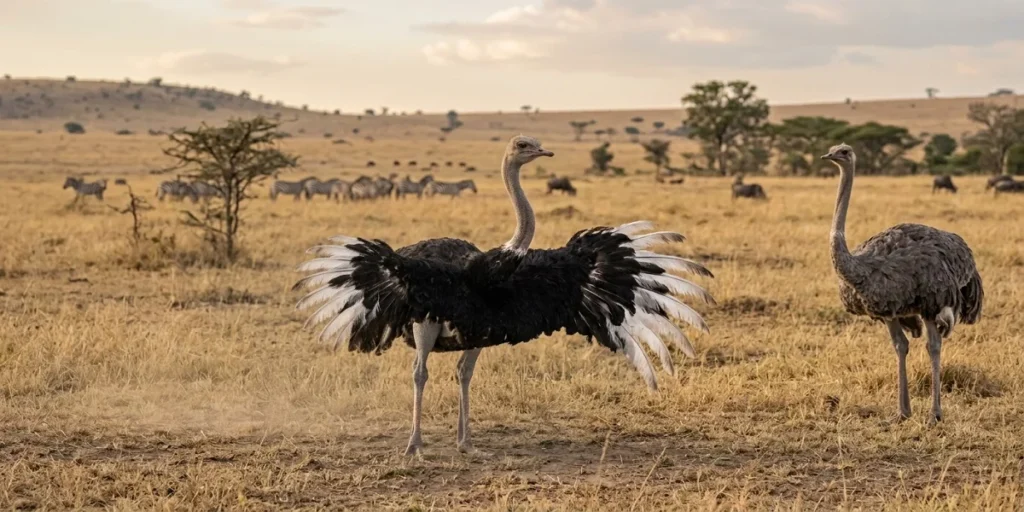
Quick Answer: Ostriches mate through an elaborate courtship display where the male drops to his knees, alternates his wings, and sways his neck while producing a deep booming call. Commonly referred to as kantling, this display forms the core of ostrich breeding behavior. Ostrich mating is seasonal and genetically complex; while traditionally described as a single territorial male with a harem, genetic research confirms that both males and females frequently mate with multiple partners.
Table of Contents
What Does Ostrich Mating Look Like?
Ostrich mating begins with an elaborate courtship ritual rather than immediate physical contact. The male approaches a receptive female, raises his feathers, and initiates a performance designed to signal his presence and physical readiness.
The central feature of this ritual is the ostrich mating dance:
- Kneeling and Wing Display: The male drops to his knees and sways his body from side to side while rhythmically alternating his large wing feathers.
- Neck Twisting: His long neck moves from side to side in sync with his body posture.
- Vocalization: The male emits a low, resonant booming call that travels across open savanna distances.
The female signals her receptivity by lowering her head, flapping her wings close to the ground, and settling onto the earth. Once she assumes this posture, the male mounts her from behind to complete copulation.
The Ostrich Mating Dance: What Is Kantling?
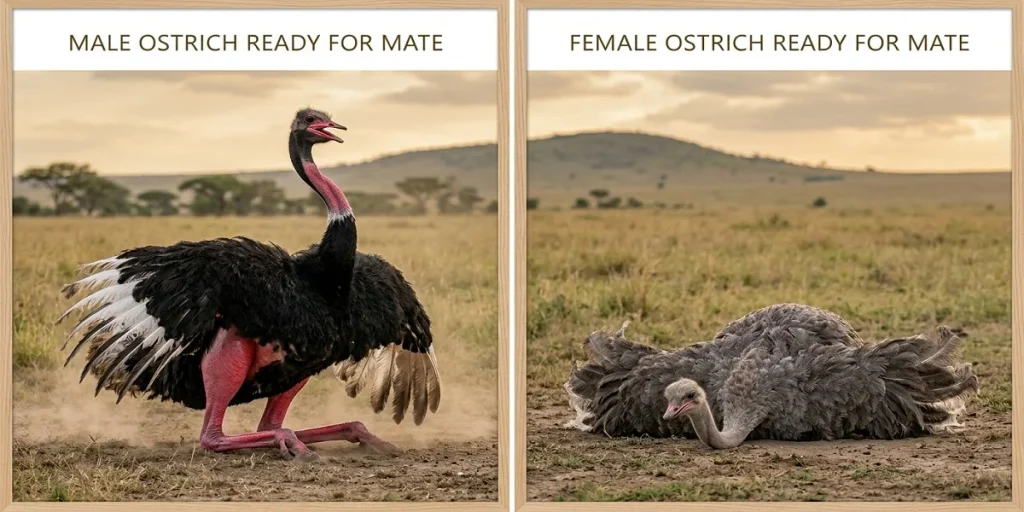
In southern Africa, wildlife guides and ostrich farmers use the specific term kantling to describe this dramatic kneeling courtship display.
Kantling combines visual and acoustic signals into a single, high-energy demonstration. During the breeding season, high testosterone levels cause the male’s beak, neck, and shins to turn a distinct red or bright pink color, making his physical appearance significantly different from the non-breeding period.
Visual Display (Wing swaying & vibrant pink/red skin) + Acoustic Signal (Deep booming call) = Kantling (Female assessment & territorial declaration)
This sequence allows the female to evaluate the male’s health and vigor before accepting him. What is commonly referred to as “ostrich mating” is actually a multi-stage behavioral process where the male’s pre-copulatory display plays the central role.
Ostrich Mating Season
Ostriches are seasonal breeders, but their breeding period varies globally depending on hemisphere, local climate, rainfall, and food availability. Reproductive activity can last for six to eight months, providing a extended window for establishing territories, courting, and egg laying.
| Region | Typical Breeding Period | Primary Environmental Drivers |
| Northern Hemisphere | March to August / September | Daylight hours & seasonal temperature |
| Southern Hemisphere | July / August to March | Seasonal transitions & resource access |
| East Africa | Aligned with seasonal rains | Rainfall timing & vegetation availability |
In regions like East Africa, ostriches adjust their reproductive timing based on when seasonal rains arrive rather than following a rigid calendar.
During the breeding season, males become highly territorial:
- Territory Defense: Males establish and guard physical areas against competing rivals.
- Courtship Display: Males perform conspicuous courtship behaviors to attract roaming females.
- Resource Preparation: Farmers adjust spatial allocation and specialized nutrition to support increased reproductive demand.
Are Ostriches Polygamous or Promiscuous?
While ostriches are traditionally described as polygynous (one dominant male with a harem), genetic research shows that their mating system is promiscuous, featuring multiple overlapping partners for both sexes.
A landmark 2003 genetic study by Kimwele and Graves analyzed DNA from communal nests, revealing that social pairings do not strictly determine genetic parentage. Multiple males and females frequently contribute to a single clutch of eggs.
Social vs. Genetic Mating Dynamics
- Multiple Partners: A dominant male mates with several females, while females routinely mate with multiple males.
- Communal Nesting: Several females deposit their eggs into a single communal nest.
- Shared Incubation: The major female (primary female) incubates the nest during the day, while the territorial male incubates at night.
- Genetic Complexity: External observation suggests a exclusive harem, but DNA evidence confirms non-exclusive parentage within the group.
This distinction makes the ostrich reproductive strategy exceptionally flexible among large birds, combining territorial courtship, communal nesting, and complex multi-partner genetics.
Why Do Ostriches Try to Mate With Humans?
In captive environments, adult male ostriches occasionally direct courtship displays toward human handlers rather than female ostriches. Instead of a normal wild interaction, a male raised in close proximity to people may perform his full kneeling courtship ritual when a familiar person approaches.
This unusual behavior stems from imprinting, social habituation, and altered early development rather than species attraction:
- Human Imprinting: Chicks raised with intensive human contact and minimal interaction with other ostriches can misidentify humans as conspecifics (members of their own species).
- Display Execution: The male lowers himself, spreads and alternates his wings, sways his neck, and exhibits the exact same courtship sequence used during natural mating.
- Captive vs. Wild Contrast: This behavior is virtually non-existent in wild populations, where young ostriches grow up exclusively within flock structures.
For breeders, understanding these behaviors is an important part of responsible ostrich farming practices. Providing young birds with proper species socialization reduces abnormal behavioral traits and ensures successful breeding performance later in life.
Frequently Asked Questions
How do ostriches mate?
A male ostrich initiates mating with an elaborate courtship display: he drops to his knees, sways his alternating wings, and twists his neck. If the female is receptive, she lowers her head and settles onto the ground, allowing the male to mount her from behind.
What is the ostrich mating dance called?
The dramatic kneeling courtship display is called kantling in southern African farming and wildlife contexts. It involves structural wing swaying, neck movement, and a deep booming vocal call.
How long do ostriches mate for?
An individual copulation event lasts only a few minutes. However, the overall reproductive mating period for an ostrich group spans six to eight months depending on region and climate.
How long does ostrich mating season last?
The ostrich breeding season typically lasts six to eight months. Exact timing varies across regions based on hemisphere, seasonal rainfall, and local vegetation availability.
Do ostriches mate for life?
No, ostriches do not mate for life. Relationships are seasonal rather than lifelong. Genetic research confirms that both males and females regularly mate with multiple partners throughout a single breeding season.
Can ostriches lay eggs without a male?
Yes, a female ostrich can lay eggs without a male. However, these eggs are unfertilized and cannot hatch into chicks.
What are female ostriches called?
Female ostriches are called hens, while adult male ostriches are called cocks or roosters.
Why do ostriches try to mate with humans?
Captive ostriches raised with close human contact may display courtship behavior toward people due to early-life imprinting and abnormal social habituation.
How many females does a male ostrich mate with?
A dominant male mates with multiple females in a season. However, because females also mate with multiple males, the system is scientifically classified as promiscuous rather than a strict exclusive harem.
Where do ostriches lay their eggs after mating?
Ostriches deposit their eggs into a shallow communal scrape on the ground. Multiple females lay eggs in the same nest, while the major female and territorial male handle incubation duties.
The Complexity of Ostrich Mating Systems
Ostrich mating is far more complex than the spectacular dance seen on the surface. The famous kneeling display, known as kantling, serves as the entry point to a reproductive strategy defined by seasonality, territorial defense, communal nesting, and multi-partner genetics.
While ostriches were historically viewed as simple harem-builders, modern DNA research confirms a dynamic promiscuous system. Both sexes engage with multiple partners, while the primary territorial pair secures the center of the nest to raise the next generation.
This blend of dramatic visual courtship and intricate reproductive mechanics ensures the ostrich remains one of the most evolutionarily resilient species on Earth.

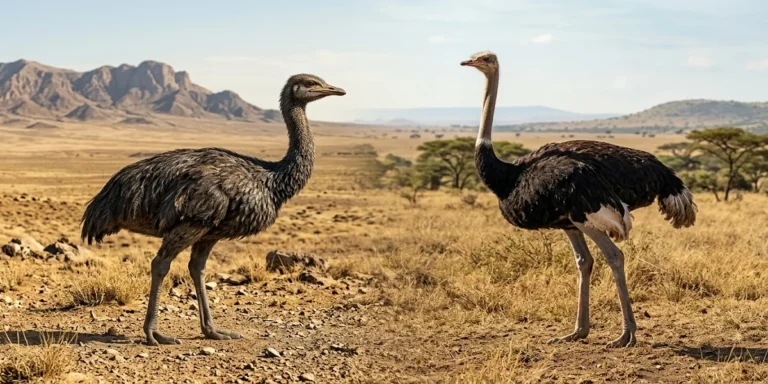
I saw a situation where one male was walking and raising and lowering his wings alternately. There were two males, both of whom seemed to be more interested in each other than the two females who were shaking their feathers and lowering their necks. I wanted to know if this was some sort of dominance display. My guide had not seen this particular behavior so was not able to clarify just what we were seeing. I’d be interested if you have any details as to what that might have been.
What you observed is very interesting, and your guide was right to be cautious about identifying it from a single observation.
The alternating wing-raising and lowering between the two males may have been a social or dominance-related display rather than part of the actual courtship sequence. Male ostriches use their wings, posture, neck movements, and overall body position in several social contexts, including courtship, competition, and interactions with other males.
The fact that the two males appeared more focused on each other while the females were shaking their feathers and lowering their necks is particularly interesting. The females’ behavior sounds consistent with courtship activity, while the males’ interaction may have involved assessing or challenging each other.
However, I would not confidently label the behavior as a dominance display based on this observation alone. Context matters a lot, including how close the males were, whether they faced each other, whether one approached or displaced the other, and whether there were any aggressive movements afterward.
It is also possible that what you saw was part of the social interaction surrounding courtship rather than a completely separate behavior. Ostrich social behavior can be surprisingly complex, and some displays are still not as well documented as the more familiar mating behaviors.
If you are interested in this side of ostrich behavior, you may also enjoy our article on **ostrich behavior during the breeding season**, where we discuss some of the behavioral changes and social interactions that occur during this period:
https://ostrichpro.com/ostrich-breeding-season/
Thank you for sharing the observation. These kinds of field observations are especially valuable because they can highlight behaviors that are easy to miss in general descriptions of ostrich mating.