Quick Answer: Ostriches evolved from an ancient lineage of birds whose early relatives lived in Asia. Fossil evidence links ostriches to extinct two-toed birds of the Ergilornithidae group, which lived in Central Asia roughly 35 to 10 million years ago. Although modern ostriches are found only in Africa, extinct ostriches once lived across parts of Asia. Genetic research has also changed our understanding of ostrich evolution, showing that flightlessness evolved independently in several ratite lineages rather than being inherited from one ancient flightless ancestor.
Table of Contents
Introduction
The ostrich is one of the most unusual birds alive today. It is the world’s largest living bird, has a highly specialized two-toed foot, and has lost the ability to fly while becoming exceptionally well adapted for running.
But the modern ostrich is only the latest stage of a much longer evolutionary history.
For many years, the evolution of ostriches was explained through a relatively simple story. Large flightless birds were thought to have descended from a common flightless ancestor that lived on the ancient supercontinent Gondwana, with different lineages later becoming separated as the continents drifted apart.
Fossils and genetic evidence have since made that story much more complicated.
Today, scientists have evidence that early ostrich relatives lived in Asia, that their distinctive two-toed feet evolved much earlier than previously understood, and that flightlessness developed independently in several groups of large ground-dwelling birds.
This article follows the evolutionary history of the ostrich from its ancient relatives to the two species living in Africa today.
Ostrich Evolution at a Glance
| Question | Short answer |
|---|---|
| Where did ostriches originate? | Fossil evidence points to Asia |
| What are their closest known extinct relatives? | Ergilornithidae, an extinct group of two-toed birds |
| When did these early ostrich relatives live? | Roughly 35 to 10 million years ago |
| Did ostriches inherit flightlessness from one ancient ancestor? | No. Flightlessness evolved independently multiple times among ratites |
| Are ostriches descended from elephant birds? | No. Elephant birds are more closely related to kiwis |
| Why do ostriches have two toes? | Their specialized two-toed foot evolved as part of their adaptation to life as fast-running ground birds |
| How many ostrich species live today? | Two: the common ostrich and the Somali ostrich |
| Where do living ostriches occur naturally? | Africa |
The fossil record does not provide a perfectly continuous family tree, and some evolutionary relationships remain under discussion. However, the combination of fossil discoveries and genomic studies has transformed our understanding of where ostriches came from and how their unusual body evolved.
What Did the Ostrich Evolve From?
For much of the history of ostrich research, scientists had only a limited fossil record to work with. Living ostriches are so distinctive that identifying their distant relatives from fragmentary fossils was difficult, especially when researchers had to rely on individual bones or isolated parts of the skeleton.
A major piece of the puzzle emerged from fossils discovered in Central Asia.
In a 2021 study, paleontologists Gerald Mayr and Nikita Zelenkov re-examined fossil birds that had traditionally been associated with cranes and other crane-like birds. Their analysis found that these fossils had important similarities to the ostrich lineage instead. The findings provided strong evidence that some of these ancient Asian birds were early ostrich relatives.
Early Ostrich Relatives in Asia
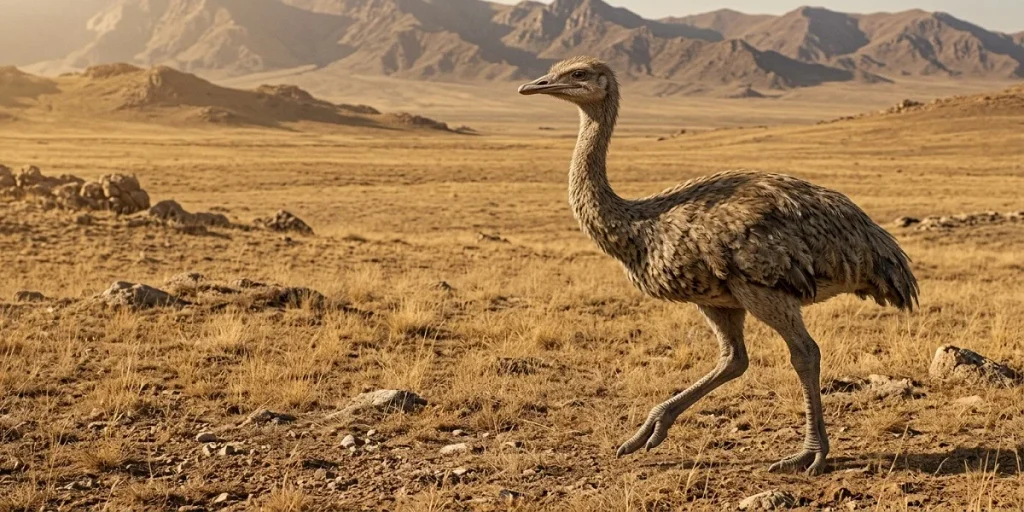
Two fossil groups are particularly important in this story: Eogruidae and Ergilornithidae.
The Ergilornithidae were an extinct group of large, flightless-looking birds that lived across parts of Asia during the Cenozoic Era. Fossils indicate that members of this group survived from roughly 35 to 10 million years ago.
The Cenozoic Era is Earth’s current geological time period, spanning the last 66 million years from the extinction of non-avian dinosaurs to the present day
Their importance to ostrich evolution comes partly from their feet.
Unlike most birds, ergilornithids had a two-toed foot, closely resembling the unusual foot structure found in living ostriches. This was not simply a superficial resemblance. The structure of the fossil bones provided an important anatomical clue that these birds belonged somewhere within the ostrich lineage.
The researchers’ analysis also revealed a mixture of anatomical characteristics that had previously made these fossils difficult to classify. Rather than fitting neatly into the crane group where they had traditionally been placed, their anatomy was consistent with an early stage of ostrich evolution.
Why the Reclassification Matters
The significance of the discovery goes beyond giving an old fossil a new name.
It changes the geographic picture of ostrich evolution.
If these two-toed Asian birds belong to the early ostrich lineage, then the ancestors of modern ostriches were not confined to Africa. Instead, important stages of ostrich evolution occurred in Asia, where these birds diversified over millions of years.
The discovery also helps explain why the ostrich has such a distinctive foot.
The two-toed foot is one of the most recognizable features of a modern ostrich, but it is not an entirely recent adaptation. Similar foot anatomy was already present in extinct Asian members of the ostrich lineage millions of years ago.
That makes the ostrich’s feet more than just an adaptation for running. They are also an important piece of evidence for reconstructing the bird’s evolutionary history.
From Ancient Asian Birds to Modern Ostriches
It is important not to imagine a single fossil species suddenly turning into the ostrich we know today.
Evolution happens through populations and branching lineages over long periods of time. The fossil record represents snapshots of that history, and scientists use anatomical similarities, geological age and evolutionary relationships to reconstruct the branches between those snapshots.
The evidence from Central Asian fossils therefore gives us something more useful than a simple “ancestor = modern ostrich” story. It places early ostrich relatives in Asia and shows that the characteristic two-toed foot appeared deep within this evolutionary history.
The result is a very different picture from the older idea that ostriches simply emerged as large flightless birds in Africa.
Source, Credit and Greeting to: Mayr and Zelenkov, Ornithology (2021), “The fossil record of the early evolution of the ostrich.”
Ostrich Evolution Timeline
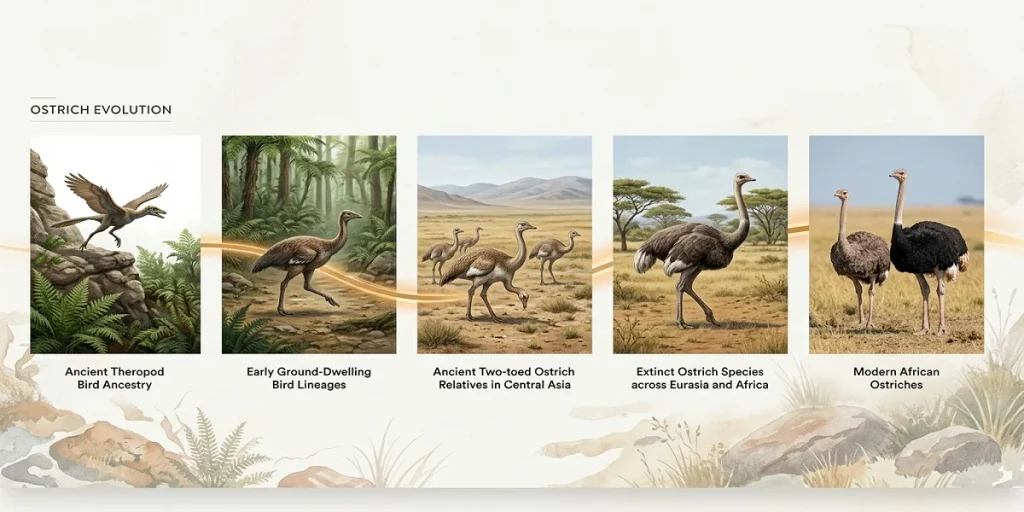
The evolutionary history of the ostrich stretches across tens of millions of years. However, it is not a simple straight line from an ancient bird to the modern ostrich. Instead, the ostrich lineage changed through a series of branching populations, with some groups becoming extinct while others continued to evolve.
The fossil record is incomplete, so scientists cannot identify every stage of this history. Still, several important discoveries provide a useful timeline of how ostriches and their relatives changed over time.
| Time period | Evolutionary milestone |
|---|---|
| Late Cretaceous | The ancestors of modern birds were already diversifying from other theropod dinosaurs |
| Cenozoic Era | Early branches of the ratite group diversified into several different lineages |
| About 35–10 million years ago | Two-toed Ergilornithidae lived across parts of Asia and are now recognized as early ostrich relatives |
| Miocene to Pliocene | Ostrich-like birds and early members of the genus Struthio became established across parts of Eurasia and Africa |
| Pleistocene | Extinct ostrich species lived across parts of Asia, including China and Mongolia |
| About 3.8 million years ago | Ostrich eggshell from Laetoli, Tanzania, preserved ancient proteins that can still be studied today |
| About 1.3 million years ago | Ostrich eggshell from Olduvai Gorge, Tanzania, also preserved molecular evidence |
| Today | Two living ostrich species remain: the common ostrich and the Somali ostrich |
The Deepest Roots of the Ostrich Lineage
The deepest part of the story reaches back much farther than the first recognizable ostrich fossils.
Ostriches are birds, and birds themselves are descendants of theropod dinosaurs. The lineage that eventually produced modern ostriches therefore began within the broader evolutionary radiation of early birds rather than appearing suddenly as a completely separate type of animal.
Over the Cenozoic Era, different bird lineages occupied ground-dwelling niches in different parts of the world. Some became large and flightless, while others retained the ability to fly.
This is important because the familiar ostrich body plan is the result of millions of years of specialization, not a primitive form that has simply remained unchanged since the age of dinosaurs.
The Asian Ostrich Relatives
One of the clearest points in the fossil record comes much later, during the Cenozoic.
Between roughly 35 and 10 million years ago, members of the Ergilornithidae lived in Asia. Their two-toed feet provide an important anatomical connection to ostriches and help place them within the early history of the ostrich lineage.
This period represents one of the most important pieces of evidence for an Asian origin of ostriches.
The fossil record then becomes more complicated. Different ostrich-like birds appeared and disappeared, and the genus Struthio eventually became distributed across a much wider geographic area than its modern range.
Ostriches Once Lived Far Beyond Modern Africa
The ostrich’s modern distribution can make its evolutionary history seem exclusively African, but the fossil record tells a different story.
Extinct ostrich species have been identified from parts of Asia, including fossils associated with China and Mongolia. This means that the evolutionary history of Struthio extended well beyond the range occupied by living ostriches.
The modern African distribution is therefore only the latest chapter in a much longer geographic history.
By the Pleistocene, ostriches and their relatives had experienced major changes in distribution as climates and habitats changed. Some populations disappeared, leaving Africa as the stronghold of the surviving lineage.
From Ancient Relatives to the Ostriches Alive Today
The two ostrich species alive today represent the surviving branches of this much older history.
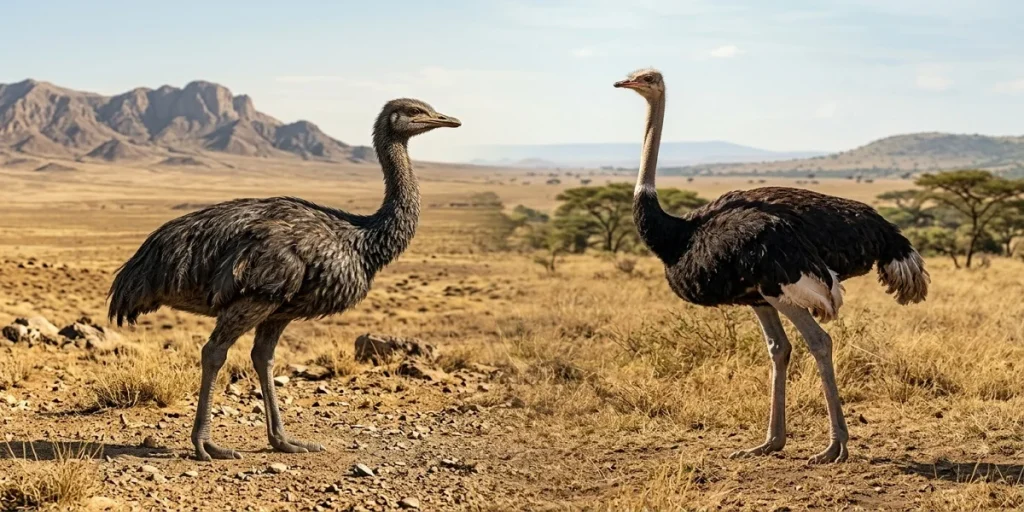
The common ostrich (Struthio camelus) occupies large parts of sub-Saharan Africa, while the Somali ostrich (Struthio molybdophanes) is restricted primarily to the Horn of Africa.
Their existence today should not be interpreted as evidence that ostriches have remained unchanged. Modern ostriches have their own evolutionary history, shaped by changes in climate, habitat, body size, locomotion and geographic distribution.
The fossil record simply gives us snapshots of that process.
What makes the ostrich especially interesting is that several of its most distinctive characteristics, particularly its enormous body, powerful running legs and two-toed feet, are products of a long evolutionary history that began long before the modern species appeared.
Where Did Ostriches Originate and How Did They Reach Africa?
The fossil record points to Asia as an important center of early ostrich evolution, even though all living ostriches are now found in Africa. This may seem surprising at first, but the fossil history of Struthio shows that ostriches once occupied a much larger geographic range than they do today.
Fossils from Central Asia provide some of the strongest evidence for this early history. Extinct ostrich relatives lived across parts of Asia for millions of years, and later ostrich species also occurred well beyond the modern African range.
Extinct Ostriches Lived Across Asia
The discovery of early ostrich relatives in Asia is important because it changes the way scientists reconstruct the origin of the group.
Ergilornithids, for example, were two-toed birds that lived in Asia roughly 35 to 10 million years ago. Their anatomy, particularly the structure of their feet, provides evidence linking them to the early evolution of ostriches.
Other extinct members of the genus Struthio have also been identified from Asia. Fossil ostriches have been reported from regions including China and Mongolia, showing that the genus was not historically restricted to Africa.
This wider distribution suggests that the ostrich lineage expanded across Eurasia before surviving populations became concentrated in Africa.
How Did Ostriches Reach Africa?
The exact route by which early ostriches expanded from Asia into Africa is not fully known.
Fossils provide evidence for where different ostrich relatives lived, but they do not preserve a complete map of every migration between populations. Ostrich evolution therefore should not be presented as a simple journey from one specific location in Asia directly into modern Africa.
Instead, the fossil record points to a much longer process of geographic expansion, diversification and extinction. As climates and habitats changed over millions of years, different ostrich populations occupied different parts of Africa and Eurasia.
The important point is that Africa became the last major stronghold of a lineage that once had a much broader distribution.
The Ostrich Once Had a Larger African and Eurasian Range
The modern distribution of ostriches is also much smaller than their historical range.
The common ostrich, Struthio camelus, once occurred in areas that are no longer part of its natural range, including the Arabian Peninsula. Human activity, habitat changes and hunting contributed to the disappearance of ostriches from parts of their former distribution.
Today, the common ostrich remains widespread across much of sub-Saharan Africa, while the Somali ostrich, Struthio molybdophanes, is primarily associated with the Horn of Africa.
This means that when we look at an ostrich living on an African savanna today, we are seeing the surviving part of a lineage whose evolutionary history extends far beyond Africa.
Does an Asian Origin Mean Ostriches Are Not African Birds?
No. Evolutionary origin and modern geographic distribution are two different things.
Ostriches are unquestionably African birds in the ecological and geographic sense today. They are deeply associated with African savannas, deserts and open landscapes, and Africa is home to the only living ostrich species.
When scientists say that ostriches have an Asian evolutionary origin, they are referring to the geographic evidence from their early fossil history. It does not mean that modern ostriches are somehow “non-African.”
The fossil record simply reveals that the story of the ostrich began much farther back and across a much wider part of the world than its present-day distribution suggests.
Why Did Ostriches Lose the Ability to Fly?
The ostrich is a flightless bird, but its inability to fly is not simply a primitive trait left over from the dinosaur era. It is the result of evolutionary changes that gradually favored life on the ground.
For a long time, scientists thought that the major flightless birds, often called ratites, inherited their flightlessness from a single ancient ancestor. Under this older model, one large flightless bird would have lived on the ancient southern supercontinent Gondwana, and its descendants would have become ostriches, emus, rheas, cassowaries, kiwis and other flightless birds as the continents separated.
Genetic research has changed this picture.
Flightlessness Evolved More Than Once
Modern genomic studies indicate that flightlessness evolved independently in several different ratite lineages.
This means that ostriches did not necessarily inherit their inability to fly from the same flightless ancestor as every other ratite. Instead, different populations appear to have lost flight independently as they adapted to life on the ground.
Research by Mitchell and colleagues estimated that flightlessness evolved independently at least six times within the broader ratite group.
One of the most important clues came from an unexpected member of the group: the tinamou.
The Tinamou Changed the Ratite Family Tree
Tinamou are small South American birds that can fly, although they are closely connected to the group traditionally known as ratites.
When genetic evidence placed tinamous within the ratite family tree rather than outside it, it created a major problem for the old Gondwana model.
If all ratites had descended from one ancient flightless ancestor, a flying tinamou would require flight to have evolved again later. A more likely explanation is that the common ancestors of these lineages retained the ability to fly, while flightlessness evolved independently in several descendant groups.
This discovery changed how scientists interpret the evolution of ostriches and other large flightless birds.
The ostrich therefore should not be viewed as a bird that simply “stopped flying” once and passed that trait unchanged to all other ratites. Its flightlessness is part of a much more complex evolutionary history.
Why Would Flightlessness Be Advantageous?
Losing the ability to fly can be beneficial when a bird becomes highly specialized for life on the ground.
Flight is energetically expensive and requires a body built around powerful flight muscles, lightweight bones and wings capable of generating lift. A large ground-dwelling bird can instead invest heavily in legs, muscles and other structures that improve terrestrial movement.
The ostrich represents an extreme example of this trade-off.
Its wings are no longer capable of powering sustained flight, but they still have important functions. Ostriches use their wings during courtship displays, balance and changes in direction while running. Their large bodies are supported by exceptionally powerful legs, allowing them to move rapidly across open landscapes.
Flightlessness therefore does not mean that the wings became useless. It means that natural selection favored a different combination of traits as the ostrich lineage became increasingly specialized for terrestrial life.
The Ostrich Took a Different Evolutionary Path
The modern ostrich is not a failed flying bird. It is a highly specialized running bird.
Its large body, long legs, reduced flight capability and unusual two-toed feet work together as part of the same terrestrial lifestyle. The evolutionary history of its feet is especially revealing because similar two-toed anatomy appeared in ancient Asian ostrich relatives long before the modern species existed.
This helps explain why the ostrich looks so different from most other living birds.
Rather than preserving a generalized ancestral bird body plan, the ostrich lineage underwent millions of years of specialization for life on the ground. Its inability to fly is one part of that broader evolutionary transformation.
Evolution of the Ostrich Foot: From Four Toes to Two
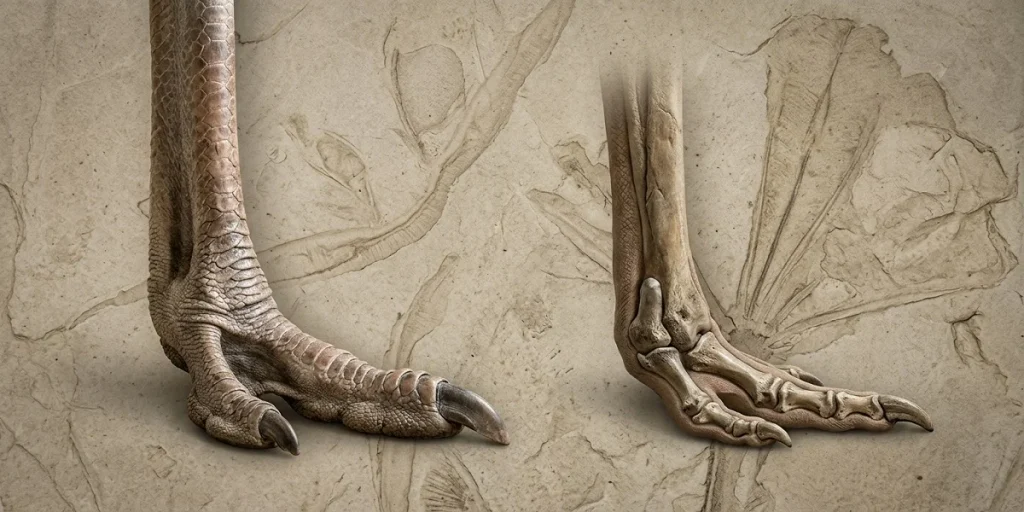
One of the most remarkable features in ostrich evolution is the bird’s two-toed foot.
Most birds have three or four forward-facing toes, but the ostrich has only two. The larger inner toe carries most of the weight and ends in a large claw, while the smaller outer toe is much shorter and lacks the same prominent claw.
This unusual structure is not simply a characteristic of modern ostriches. Fossil evidence shows that two-toed feet appeared much earlier in the evolutionary history of ostrich relatives.
Why Do Ostriches Have Only Two Toes?
The two-toed foot is closely associated with the ostrich’s adaptation to fast terrestrial movement.
Reducing the number of toes can make the foot lighter and more streamlined, while concentrating force through the remaining structures. In an animal that relies on long, powerful legs and rapid running rather than climbing, perching or grasping branches, this type of specialization can provide an advantage.
The ostrich’s foot works as part of a larger running system. Its long lower legs, powerful muscles and specialized toes allow it to generate and control large forces while moving across open ground.
The large inner toe is particularly important because it carries most of the bird’s weight and contributes to propulsion. The smaller outer toe provides additional support but is much less substantial.
The Two-Toed Foot Is Older Than the Modern Ostrich
The evolutionary importance of the ostrich’s foot becomes even clearer when fossils are considered.
Members of the extinct Ergilornithidae from Asia already possessed two-toed feet roughly 35 to 10 million years ago. Their foot anatomy is one of the important features that helped researchers recognize their connection to the early ostrich lineage.
This means that the characteristic two-toed foot did not suddenly appear in the modern ostrich.
It was already present in ancient ostrich relatives millions of years ago, showing that specialization for terrestrial locomotion began deep within the evolutionary history of the group.
From Four-Toed Birds to a Specialized Running Foot
The broader evolutionary story can therefore be summarized as a progression:
- Early bird ancestors had more generalized feet suited to a wider range of movements.
- Ground-dwelling ostrich relatives became increasingly specialized for terrestrial locomotion.
- Two-toed anatomy appeared in ancient Asian ostrich relatives.
- The modern ostrich retained and further specialized this basic foot design.
- Today, the ostrich is the only living bird with a fully two-toed foot.
The important point is that the ostrich did not simply lose two toes because they were no longer needed. The entire lower limb evolved as a coordinated system for supporting a very large body and moving efficiently across open ground.
Its feet are therefore both a running adaptation and an evolutionary clue.
The same unusual anatomy that makes an ostrich instantly recognizable also helps scientists connect living ostriches with their extinct relatives.
Ostrich vs Other Ratites: Are They Close Relatives?
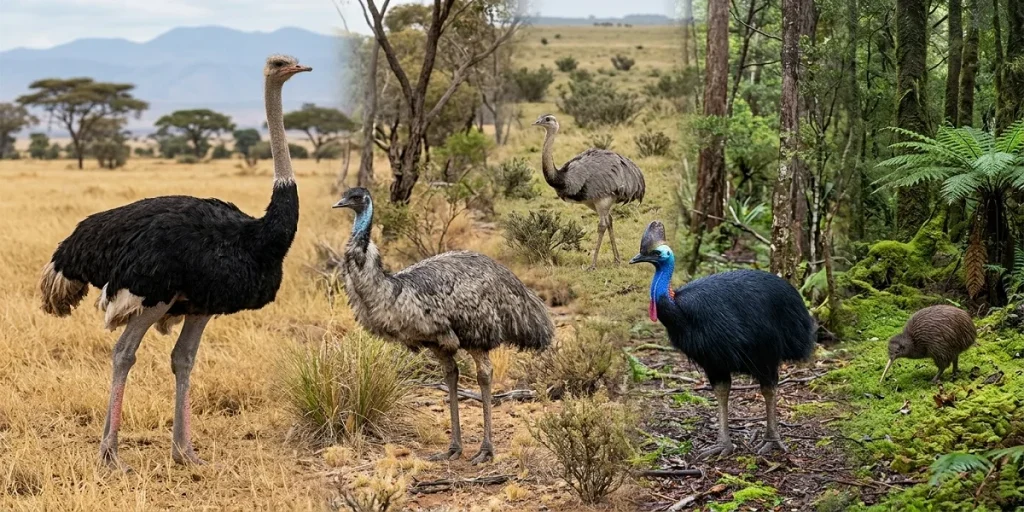
Ostriches are often grouped together with emus, rheas, cassowaries, kiwis, moas and elephant birds because they share several obvious characteristics. Most are large, ground-dwelling birds that cannot fly, and many have reduced wings.
For a long time, these similarities were interpreted as evidence that all of these birds descended from one ancient flightless ancestor.
Modern genetic research has shown that the relationship is much more complicated.
Are Ostriches Closely Related to Emus, Rheas and Kiwis?
Ostriches are part of the broader ratite group, but that does not mean that every ratite is a close relative of the ostrich.
The similarities between these birds are partly the result of their shared history and, importantly, repeated adaptations to life on the ground. Flightlessness evolved independently in several lineages, which means that similar body shapes and lifestyles can evolve in birds that are not each other’s closest relatives.
This is why the old idea of a single flightless ancestor for all ratites no longer provides a satisfactory explanation for the genetic evidence.
The modern evolutionary tree is better understood as a collection of related lineages with different evolutionary histories rather than one simple family of large flightless birds.
See our detailed guide to solve connection between ostriches, emus, rheas and cassowaries
Did Ostriches Evolve From Elephant Birds?
No. Ostriches did not evolve from elephant birds.
Elephant birds were an extinct group of enormous flightless birds that lived on Madagascar. They disappeared relatively recently in geological terms, but genetic evidence has shown that they were more closely related to kiwis than to ostriches.
This is one of the most interesting examples of why appearance alone can be misleading in evolutionary biology.
An elephant bird and an ostrich both had large bodies, long legs and an inability to fly. Yet these similarities do not mean that one evolved directly from the other.
Their shared characteristics are better understood in the context of their broader ratite evolutionary history and repeated adaptation to terrestrial life.
Ratites Have Very Different Evolutionary Histories
| Bird | Status | Flight | Notable evolutionary feature |
|---|---|---|---|
| Ostrich | Living | Flightless | Specialized two-toed foot |
| Emu | Living | Flightless | Large Australian running bird |
| Rhea | Living | Flightless | South American ground bird |
| Cassowary | Living | Flightless | Forest-dwelling Australian/New Guinean bird |
| Kiwi | Living | Flightless | Small, nocturnal New Zealand bird |
| Moa | Extinct | Flightless | Diverse group formerly found in New Zealand |
| Elephant birds | Extinct | Flightless | Giant Madagascar birds, closer to kiwis |
This comparison shows why the term “ratite” should not be interpreted as meaning that all of these birds are simply variations of the same evolutionary lineage.
Some share more recent ancestry with one another than they do with the ostrich, while other similarities evolved because different birds faced similar challenges as large ground-dwelling species.
Why Does the Ostrich Look So Different?
The ostrich’s distinctive appearance is the result of its own evolutionary path.
Its enormous body, long legs, powerful muscles and two-toed feet evolved together as adaptations to an open-ground lifestyle. Other ratites followed different paths in different environments.
A kiwi became small and nocturnal in New Zealand. A cassowary became specialized for life in dense tropical forests. An emu evolved as a large Australian running bird, while elephant birds became enormous island birds in Madagascar.
The result is a useful lesson in evolution: similar lifestyles can produce similar features without requiring the animals to be close relatives.
The ostrich’s closest evolutionary relationships therefore cannot be determined simply by asking which flightless bird looks most similar to it. Fossils and genomic evidence provide a much more reliable picture of where the ostrich belongs.
Tanzania’s Fossil Record: Ostrich Eggshells From Laetoli and Olduvai
Tanzania provides another fascinating piece of the ostrich’s evolutionary history.
Two important fossil sites, Laetoli and Olduvai Gorge, have preserved ostrich eggshell fragments that are millions of years old. These fragments show that ostriches lived in ancient East Africa, but they also carry something more. Proteins trapped inside the shell survived for millions of years in a hot climate where DNA did not. That gives scientists a molecular record to study when ancient DNA is unavailable.

East Africa holds some of the best evidence of how long ostriches have been around. Ostrich eggshell is abundant at African archaeological and paleontological sites.
A 2016 study in eLife analyzed eggshell samples from sites in South Africa and Tanzania. They included Laetoli (2.6 to 4.3 million years old) and Olduvai Gorge (about 1.3 million years old).
The results were remarkable:
- Protein sequences survived in eggshell from Laetoli (about 3.8 million years old) and Olduvai
- The dominant eggshell proteins are called struthiocalcin-1 and struthiocalcin-2
- The proteins stayed preserved because they bind tightly to the calcite mineral in the shell
- Thermal age calculations showed these peptides are 50 times older than any previously authenticated sequence
- Researchers could not recover avian DNA from the Laetoli eggshell they tested, which is why the proteins matter so much
Not every ancient eggshell is from a modern ostrich
The oldest Laetoli fragments do not come from the ostrich species alive today. The study attributes the eggshell dated to roughly 3.8 to 4.3 million years ago to Struthio kakesiensis, an extinct ostrich species. Only the younger Laetoli sample, about 2.66 million years old, is attributed to Struthio camelus, the common ostrich.
This fits the wider picture in this guide. The ostrich lineage is old, and the genus Struthio once included several species that no longer exist.
| Site | Approximate age | Species attribution in the study |
|---|---|---|
| Olduvai Gorge | About 1.3 million years | Not specified in the study |
| Laetoli (younger layer) | About 2.66 million years | Struthio camelus |
| Laetoli (older layers) | About 3.8 to 4.3 million years | Struthio kakesiensis |
These findings matter for evolution research. Ancient proteins can help scientists study species that left no usable DNA. Anyone curious about the shell itself can compare it with our guide to ostrich egg size and weight.
Humans have also used ostrich eggs for a very long time. See ostriches in ancient Egypt for the cultural side of that story.
Why Ostrich Eggshell Is So Valuable to Evolutionary Research
Ostrich eggshell is unusually useful in the fossil record because it is strong, durable and widespread in archaeological and paleontological sites.
Ostriches have also been producing distinctive eggshell for millions of years, leaving behind abundant fragments even where complete skeletons are rare.
This makes eggshell an important complement to skeletal fossils.
In Tanzania, the combination of ancient ostrich eggshell, well-studied fossil landscapes and modern molecular techniques has opened an unusual window into the past. It allows researchers to study not only where ostriches lived, but also biological information preserved within material that has survived for millions of years.
For the evolutionary history of ostriches, these discoveries help connect the ancient fossil record with the animals living across Africa today.
A Personal Connection to Tanzania’s Ostrich History
There is also a personal reason I wanted to include these sites in OstrichPro.
I currently live and work in Tanzania, which means that some of the most important places connected to the ancient history of ostriches are much closer to me than they would be for most writers covering this subject. I have not yet had the opportunity to visit Laetoli or Olduvai specifically to explore their ostrich fossil evidence, but it is something I hope to do when I get the chance.
If the relevant fossil material or associated exhibits are still accessible to visitors, I would like to see them firsthand and share that experience with OstrichPro readers. Seeing the landscapes where these ancient ostrich populations lived would add an entirely different perspective to the scientific evidence discussed in this article.
Until then, the published research provides an extraordinary connection between Tanzania’s fossil record and the evolutionary history of the ostrich.
Are Ostriches Living Dinosaurs?
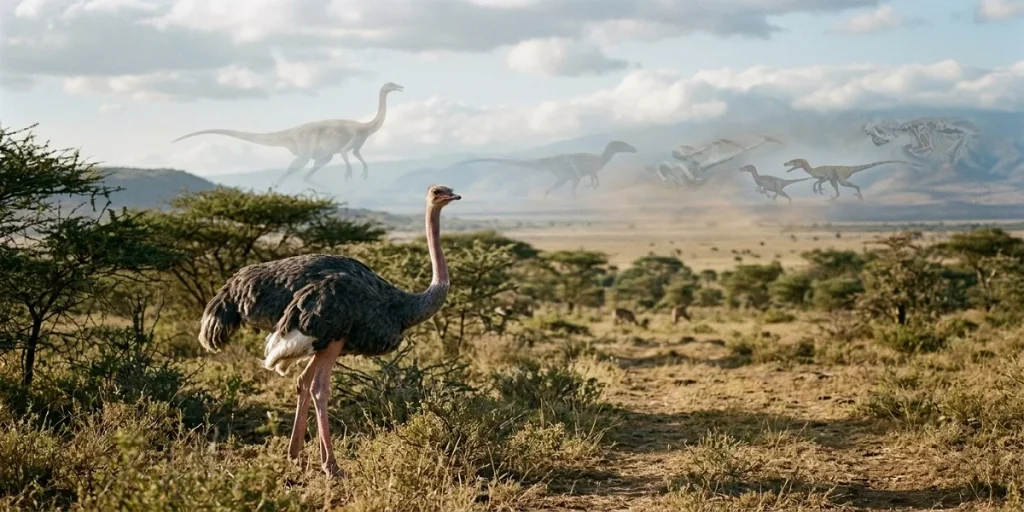
Yes, but there is an important distinction.
Ostriches are birds, and modern birds are the surviving members of the dinosaur lineage. In evolutionary terms, birds are living theropod dinosaurs, the same broad dinosaur group that included animals such as Tyrannosaurus and Velociraptor.
This does not mean that ostriches evolved directly from a Tyrannosaurus or another famous dinosaur. Instead, birds and other theropod dinosaurs share much older common ancestors.
Did Ostriches Evolve From Dinosaurs?
Yes. The lineage that eventually produced modern birds originated within theropod dinosaurs during the Mesozoic Era.
Over millions of years, bird ancestors developed features that distinguished them from other theropods. Feathers, changes to the skeleton, modifications of the forelimbs and many other anatomical adaptations accumulated through evolutionary time.
Eventually, one branch of this dinosaur lineage became the birds we know today.
Ostriches belong to that surviving bird lineage. Their ancestors therefore ultimately trace back to theropod dinosaurs, just as the ancestors of every other modern bird do.
Why Don’t Ostriches Look Like Dinosaurs?
Evolution does not preserve an animal’s appearance unchanged.
The modern ostrich is the result of tens of millions of years of evolutionary change after its distant dinosaur ancestors lived. Its enormous body, long legs, two-toed feet and specialized running ability evolved much later as its lineage adapted to a terrestrial lifestyle.
In other words, the ostrich is not a “primitive dinosaur bird.”
It is a highly specialized modern bird whose distant ancestry happens to lie within the dinosaur lineage.
Is the Ostrich the Most Primitive Living Bird?
Not exactly.
The idea that one living bird is the “most primitive” is misleading because every living species has been evolving for the same amount of time since its lineage diverged from its relatives.
Ostriches have some unusual characteristics that can make them appear ancient, particularly their large body and flightlessness. But these features are specialized adaptations, not evidence that the ostrich has remained unchanged since prehistoric times.
The ostrich is therefore best understood as a modern evolutionary specialist with a very ancient ancestry.
That combination is what makes its evolutionary history so fascinating.
Ostrich Evolution FAQs
What did the ostrich evolve from?
Ostriches evolved from an ancient lineage of birds whose deeper ancestry ultimately traces back to theropod dinosaurs. Fossil evidence places important early ostrich relatives in Asia, including extinct two-toed birds associated with the Ergilornithidae.
Where did ostriches originate?
Fossil evidence points to Asia as an important center of early ostrich evolution. Ancient ostrich relatives lived across parts of Central Asia, while later extinct ostrich species also occurred in other parts of Eurasia and Africa.
When did ostriches evolve?
The deeper evolutionary history of ostriches extends back tens of millions of years. Fossil evidence identifies important two-toed ostrich relatives from roughly 35 to 10 million years ago, while the genus Struthio has a much longer and more complex fossil history.
Why can’t ostriches fly?
Ostriches cannot fly because their lineage became highly specialized for terrestrial life. Over evolutionary time, natural selection favored a large body, powerful legs and efficient running rather than the anatomical features required for powered flight.
Did ostriches evolve from dinosaurs?
Yes. Ostriches are birds, and birds are the surviving branch of theropod dinosaurs. However, ostriches did not evolve directly from famous dinosaurs such as Tyrannosaurus or Velociraptor. Their lineage shares much older common ancestors with those animals.
Are ostriches related to elephant birds?
Yes, but not as direct ancestors and descendants. Ostriches and elephant birds are both part of the broader ratite group, but genetic evidence indicates that elephant birds were more closely related to kiwis than to ostriches.
Why do ostriches have only two toes?
Ostriches have two toes because their feet became highly specialized for terrestrial locomotion. The large inner toe carries most of the bird’s weight and helps generate powerful forces during running, while the smaller outer toe provides additional support.
Which bird is the most prehistoric?
There is no scientifically meaningful single “most prehistoric” living bird. All modern birds have been evolving for millions of years, and an unusual or ancient-looking appearance does not mean that a species has remained unchanged since prehistoric times.
Are ostriches related to emus, rheas and kiwis?
Yes. Ostriches, emus, rheas and kiwis are all part of the broader group traditionally called ratites. However, genetic evidence shows that their evolutionary relationships are more complicated than the old idea of one ancient flightless ancestor giving rise to all ratites.
How many species of ostrich exist today?
There are two living ostrich species: the common ostrich (Struthio camelus) and the Somali ostrich (Struthio molybdophanes). Both are native to Africa, although their ranges differ.
Do ostriches lay eggs or give birth?
Ostriches lay eggs. Like all birds, they reproduce by laying eggs rather than giving birth to live young. The exceptionally large ostrich egg is another distinctive feature of the species.