
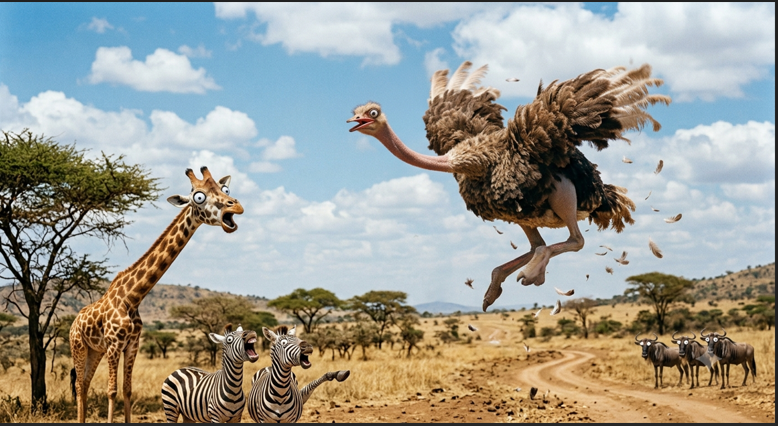
Quick Answer: Can ostriches fly? No, ostriches cannot fly, even for short distances. Their heavy bodies, relatively small wings, and lack of the powerful flight muscles needed for takeoff prevent them from becoming airborne. Instead, ostriches have evolved powerful legs that make them the fastest running birds on Earth.
Can ostriches fly? Despite having large wings, ostriches are flightless birds. Their bodies have evolved for running rather than flying, but their wings still play important roles in balance, courtship, and protecting their chicks.
Table of Contents
The Simple Answer: Can Ostriches Fly or Not?
Ostriches cannot fly, not even slightly. This is not a matter of effort or technique. No ostrich, under any circumstances, is capable of becoming airborne.
This places them in a group of birds known as ratites, as flightless birds that share specific anatomical features preventing flight. Other members of this group include emus, rheas, kiwis, and cassowaries. What unites them is the absence of a keel, the ridge on the breastbone that anchors the powerful flight muscles birds need to take off and sustain aerial movement.
Without a keel, there is simply nothing for flight muscles to attach to. And without flight muscles, wings are decorative at best.
5 Biological Reasons Ostriches Cannot Fly
Ostriches are not just slightly unsuited to flight, their entire body is built in a way that makes it impossible. There are five distinct biological reasons for this.
1. Ostriches Are Too Heavy
The average adult ostrich weighs between 100 and 150 kg (220 to 330 lbs), making it the heaviest bird alive. For context, the heaviest flying birds, like the great bustard or the kori bustard, max out at around 20 kg (44 lbs). Even they struggle to get airborne.
The relationship between body weight and the wing surface area needed to generate lift means that beyond a certain size, flight simply becomes physically impossible. Ostriches crossed that threshold long ago.
2. Their Wings Are Too Small
An ostrich’s wingspan reaches roughly 2 meters (6.5 feet), which sounds impressive until you consider the body mass those wings would need to lift. For a bird of this weight, the wings would need to be many times larger to generate the required lift. In practical terms, the wing-to-body ratio is nowhere near sufficient for flight.
3. They Lack a Keel on Their Breastbone
Flying birds have a prominent ridge on their sternum called the keel. This structure is the anchor point for the large pectoral muscles that power wing beats during flight. Ostriches, like all ratites, have a flat sternum with no keel. Without this anchor, powerful flight muscles cannot develop, and without those muscles, sustained wing movement strong enough for lift is impossible.
4. Their Feathers Are Not Aerodynamic
The feathers of flying birds are tightly structured, with interlocking barbs that create a smooth, unified surface capable of manipulating airflow. Ostrich feathers are loose, soft, and fluffy, beautiful, but aerodynamically useless. They cannot generate or control lift in any meaningful way.
This loose feather structure actually serves a different purpose: temperature regulation. The open structure allows air to circulate close to the skin, helping ostriches manage heat in the hot African environments they inhabit.
5. Their Legs Dominate Their Musculature
In flying birds, the largest and most powerful muscles are in the chest, driving the wings. In ostriches, the situation is reversed. The vast majority of their muscle mass is concentrated in their legs, which are among the most powerful limbs of any land animal.
An ostrich’s legs can deliver kicks powerful enough to kill a lion, and those same legs can sustain running speeds of up to 72 km/h (45 mph). This muscular investment in the legs came at the direct expense of any meaningful wing development.
What Ostrich Wings Are Actually Used For
Despite being useless for flight, ostrich wings are far from vestigial. They serve several important functions that help explain why evolution retained them rather than eliminating them entirely.
Balance during running: At high speeds, ostriches use their wings like a rudder. By extending one wing or the other, they can shift their center of gravity mid-stride, allowing them to change direction rapidly without losing speed. This makes them exceptionally difficult to catch in open terrain.
Courtship displays: Male ostriches use elaborate wing displays during mating rituals. They spread and flutter their wings in a distinctive pattern to attract females and establish dominance over rival males. Wing size and condition signal genetic fitness.
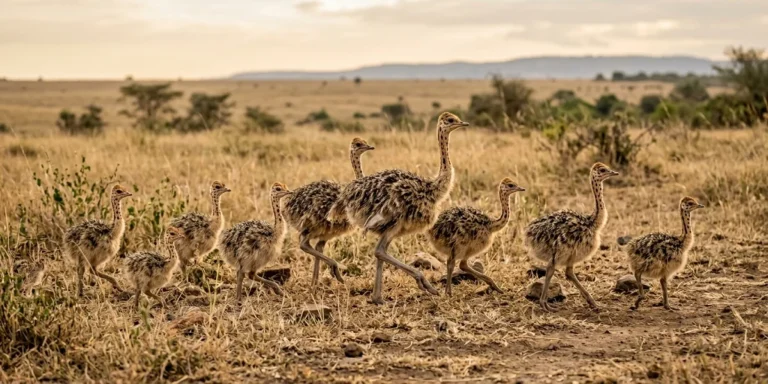
Shade for chicks: Ostrich parents spread their wings over their young to provide shade from the intense African sun and shelter from rain. The broad wing surface is well suited to this purpose.
Threat displays: When threatened, ostriches spread their wings wide to appear larger and more intimidating. Combined with their natural size, this display is often enough to deter predators.
The Evolutionary Story: Did Ostriches Ever Fly?
This is where the science gets genuinely fascinating. The ancestors of modern ostriches almost certainly could fly, but that was a very long time ago.
The leading scientific consensus is that ratites descended from flying ancestors that spread across the ancient supercontinent of Gondwana before it broke apart approximately 180 million years ago. As the landmasses separated and drifted, populations became isolated on different continents. Over millions of years, without the need to escape predators by flying, or perhaps because running became more energetically efficient in open grassland environments, flight was gradually lost.
Recent genetic research has added nuance to this picture. Some studies suggest that flightlessness evolved independently multiple times in different ratite lineages, rather than all descending from a single flightless ancestor. Either way, the result is the same: modern ostriches are the product of an evolutionary path that traded the skies for the savanna, and by every measure, it worked.
How Ostriches Survived Without Flight
Losing the ability to fly might seem like a catastrophic evolutionary disadvantage. For ostriches, it turned out to be the opposite. In the open grasslands of Africa, where they evolved, flight was not the most effective survival strategy. Speed and endurance on the ground were.
| Adaptation | How It Helps Ostriches Survive |
|---|---|
| Speed | Ostriches can reach speeds of around 72 km/h (45 mph), making them the fastest running birds on Earth. Their speed helps them escape many predators. |
| Stride length | At full speed, an ostrich can cover several meters in a single stride, helping it travel quickly across open terrain. |
| Eyesight | Their large eyes provide excellent distance vision, helping them spot potential threats across the savanna. |
| Powerful kicks | Their strong legs and sharp claws provide a formidable last line of defense when escaping is not an option. An ostrich kick can seriously injure or even kill a large predator. |
These adaptations help explain why flight is not essential to an ostrich’s survival. Rather than escaping danger through the air, ostriches rely on speed, awareness, and strength to navigate life on the ground.
Ostriches vs Other Flightless Birds: A Comparison
Ostriches are the most famous flightless bird, but they are part of a broader group of birds that independently lost the ability to fly. Here is how they compare:
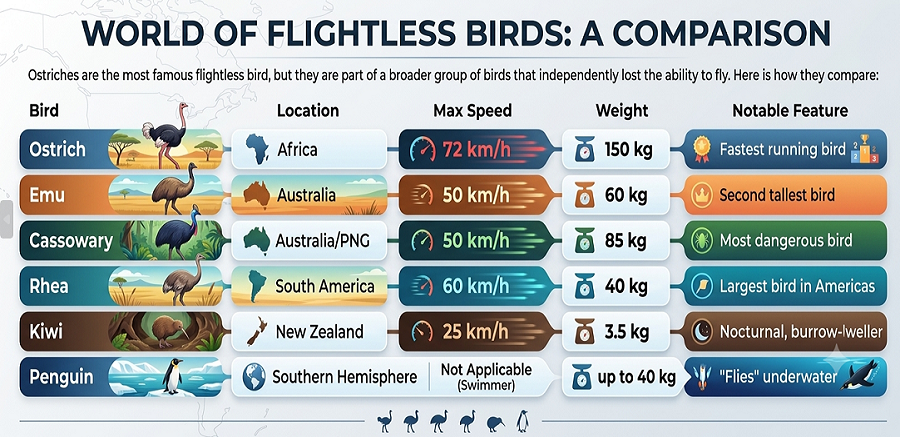
What this comparison reveals is that flightlessness is not a single evolutionary dead end, it is a recurring adaptation that emerges when ground-based survival proves more effective than aerial survival in a given environment. Each of these birds found a different solution to the same problem.
Frequently Asked Questions
Can ostriches fly at all, even short distances?
No. Ostriches are completely incapable of flight, not even for short hops or assisted takeoffs. Their body mass, flat sternum, weak wing muscles, and loose feathers make flight physically impossible under any conditions.
Why do ostriches have wings if they cannot fly?
Ostrich wings serve several non-flight functions: balance during high-speed running, courtship displays, shading chicks, and threat displays toward predators. Evolution retained the wings because they remain useful, even without flight.
Did ostriches ever fly in prehistoric times?
Almost certainly yes. The ancestors of modern ostriches were likely capable of flight. Over millions of years, as they adapted to life in open grassland environments, the ability to fly was gradually lost in favor of running speed and endurance.
How fast can an ostrich run?
Ostriches can reach top speeds of 72 km/h (45 mph), making them the fastest running birds on Earth and the fastest two-legged animals alive. For a full breakdown of ostrich speed, see our dedicated guide: How Fast Can an Ostrich Run?
Are ostriches the only flightless birds?
No. Other flightless birds include emus, cassowaries, rheas, kiwis, and penguins. Ostriches, emus, rheas, cassowaries, and kiwis are traditionally grouped as ratites, while penguins belong to a separate group of flightless birds adapted for swimming.
Can an ostrich run faster than a horse?
Yes, over short distances an ostrich can outpace most horses. A horse’s top speed is around 70 km/h (43 mph), while an ostrich can reach 72 km/h (45 mph). More importantly, ostriches can sustain high speeds for much longer than horses at a full gallop.
Key Takeaways
Ostriches cannot fly, and they are all the better for it. What looks like a biological limitation is actually the result of millions of years of successful adaptation to life on the ground. The trade-off of wings for legs gave ostriches speed, endurance, and power that has allowed them to thrive in some of Africa’s most demanding environments for millions of years.
Their wings, though flightless, are not wasted. From mating rituals to high-speed cornering, they remain a vital part of what makes ostriches such a remarkable animal.
If you want to learn more about ostrich biology and behavior, our guides on How Fast Can an Ostrich Run? and How Big Do Ostriches Get? go deeper into what makes these birds such extraordinary animals.
OstrichPro covers everything about ostriches, biology, behavior, farming, eggs, and meat. Explore the full site for in-depth guides on every aspect of the ostrich world.

1 thought on “Can Ostriches Fly? 5 Surprising Reasons They Can’t”