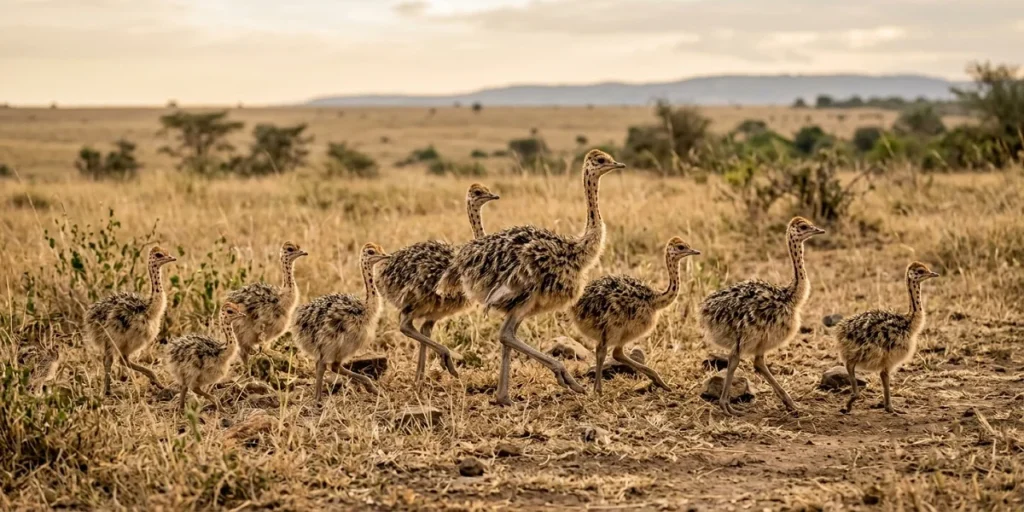
Quick Answer: Ostrich chick care depends on four basics: warmth, safe footing, appropriate nutrition, and controlled growth. Young ostriches need a warm, dry and well-ventilated environment, a non-slip surface that allows them to walk and exercise, and a complete diet formulated for fast-growing ratites. The first weeks are particularly important because poor nutrition, overcrowding, inadequate exercise and excessive growth can contribute to serious leg and digestive problems.
Table of Contents
Feeding recommendations vary between sources, particularly during the first few days after hatching. Some traditional ostrich-management guides delay feeding while the chick absorbs its yolk sac, while other protocols introduce starter feed much earlier. Rather than treating one number as universal, chick owners should follow the protocol of their hatchery and veterinarian and monitor the chick closely.
Why Ostrich Chick Care Is Different From Raising Chickens
Ostrich chicks may look surprisingly tough when they hatch, but their rapid growth makes the first weeks a demanding stage of production. Their bodies become larger and heavier quickly, while their legs and joints are still developing. That means a mistake in flooring, nutrition, exercise or general management can have much greater consequences than it would in a typical poultry chick.
The MSD Veterinary Manual identifies poor ventilation, overcrowding, excessive temperatures, improper nutrition, inadequate incubation and other management problems as important causes of disease and poor performance in ratite chicks. Musculoskeletal problems, digestive impactions and feather picking are among the management-related problems seen in young ostriches.
This is why successful ostrich chick care is not simply about keeping a chick warm and putting feed in front of it. The goal is to create an environment in which the chick can eat, digest, walk, exercise and grow without being pushed into excessively rapid development.
That last point is particularly important. Ostriches are naturally fast-growing birds, but faster is not always better. Current veterinary guidance notes that excessively rapid growth can contribute to angular leg deformities, while appropriate exercise and suitable substrate help support normal leg development.
Quick facts about ostrich chicks
- Newly hatched chicks are small compared with the adults they will eventually become.
- Growth is extremely rapid during the first months.
- Leg development depends heavily on movement and suitable footing.
- Young chicks are prone to swallowing foreign objects.
- Nutrition needs change as the chick grows.
- Overcrowding can increase management-related health problems.
- Clean water should always be available.
- A chick that stops eating, becomes weak or develops an abnormal gait needs prompt veterinary attention.
For anyone raising chicks commercially, these fundamentals are more important than trying to maximize weight as quickly as possible.
Ostrich Chick Care Timeline
The exact management schedule varies with climate, housing system, feed and veterinary protocol, so the following timeline should be treated as a practical framework rather than a rigid prescription.
| Age | Feeding | Environment | Main priorities |
|---|---|---|---|
| Day 0-5 | Follow hatchery/veterinary protocol regarding first feed | Warm, dry and well ventilated | Yolk-sac recovery, hydration, navel hygiene |
| Day 5-10 | Complete starter feed as appropriate | Warm brooding area | Establish eating and drinking, prevent chilling |
| Week 2-3 | Starter ration | Gradually less supplemental heat | Exercise, traction and clean environment |
| Week 3-8 | Starter/growth ration according to feed program | Increasing access to exercise space | Controlled growth, leg development |
| Week 6-8+ | Growing access to outdoor areas when conditions permit | Shelter from rain, cold and predators | Exercise and environmental enrichment |
| Around month 2-4 | Transition according to the feed manufacturer’s program | Increasingly natural conditions | Growth monitoring and appropriate nutrition |
Temperature should always be measured where the chick actually lives, rather than relying only on the temperature elsewhere in the building. Chicks that crowd tightly beneath a heat source may be cold, while chicks that consistently avoid the heat or pant may be too warm.
The important principle is to adjust the brooding environment according to the chick’s behavior, condition and environmental measurements, rather than treating a single temperature as correct for every farm and climate.
What Should Baby Ostriches Eat?
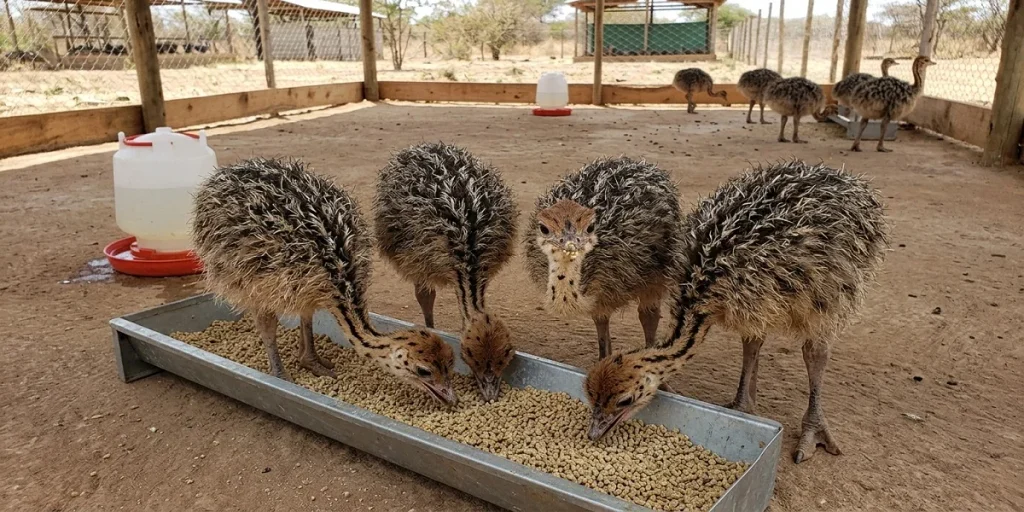
Baby ostriches need a nutritionally complete ration designed for their unusually rapid growth. The ideal feed is not simply whatever poultry feed happens to be available. Ratites have nutritional requirements that differ from ordinary poultry, and veterinary guidance recommends feed specifically formulated for ostriches, emus or rheas when available.
A good feeding program should provide appropriate levels of protein, energy, calcium, vitamins and minerals without encouraging unnecessarily rapid weight gain.
Day 0 to 5: The First Feed Question
One of the most confusing parts of ostrich chick care is when a newly hatched chick should receive its first feed.
Traditional ostrich-production guidance has recommended delaying feeding for several days while the chick uses nutrients from its yolk sac. Other management programs introduce starter feed within the first one or two days.
This difference does not necessarily mean that one source is correct and every other source is wrong. Hatchery procedures, chick condition, yolk-sac absorption, housing systems and veterinary protocols can all affect the appropriate approach.
The safest practical rule is to follow the protocol established by the hatchery and an avian or ratite veterinarian, particularly when managing newly hatched chicks for the first time.
Fresh water should be managed carefully, and the chick should be monitored for normal activity, hydration, yolk-sac absorption and willingness to eat once feeding begins.
A chick that remains weak, refuses both food and water, has an abnormal abdomen or shows signs of infection should not simply be left without intervention because it is “too young to eat.” It should be evaluated by a veterinarian.
Ostrich Chick Starter Feed: What to Look For
The best starting point is a complete ratite starter or pre-starter ration from a reputable manufacturer.
When a dedicated ostrich feed is unavailable, some producers use turkey or gamebird starter products. However, substitution should be based on the nutritional composition of the actual feed rather than simply its name.
Look for:
- A feed specifically formulated for ratites, when available
- Clearly stated protein, calcium and fiber levels
- Appropriate energy density for the growth stage
- Fresh, dry and mold-free feed
- Crumble or pellet size that chicks can consume easily
- A feeding program appropriate for the chick’s age
Current MSD veterinary guidance gives a useful example of how nutrition changes with age. Its ratite nutrition table lists a 25% crude-protein pre-starter for 0-2 months, followed by a 21.5% starter ration for 2-4 months and lower protein levels as the birds mature. These figures are part of a specific nutritional framework, not a universal formula that should automatically replace the label instructions for every commercial feed.
This is an important distinction because ostrich nutrition is an area where older recommendations and modern commercial practices do not always match.
Ostrich Chick Starter Feed: Why Protein Recommendations Differ
If you search for ostrich chick feeding advice, you will find surprisingly different protein recommendations.
Older production literature, farm guides and experimental studies have used different protein levels, and modern veterinary nutrition references provide their own age-specific recommendations.
| Source or approach | Protein level | How to interpret it |
|---|---|---|
| Current MSD ratite nutrition guidance | 25% pre-starter, 0-2 months | Age-specific veterinary nutrition framework |
| Current MSD starter guidance | 21.5% starter, 2-4 months | Part of a staged feeding program |
| Experimental ostrich diets | Approximately 18-24% in some studies | Research results depend on age, diet and conditions |
| Older production recommendations | Up to 26%+ | Useful historical context, but not necessarily current best practice |
| Commercial feeds | Varies by manufacturer | Follow the complete nutritional label and feeding program |
The important lesson is not to choose a feed simply because it has the highest protein percentage.
Ostrich chicks need enough protein and minerals to support healthy development, but excessive growth can also create problems. Current veterinary guidance specifically warns that excessively rapid growth can contribute to angular limb deformities.
So instead of asking, “What is the magic protein percentage for an ostrich chick?” a better question is:
Does this complete feed provide appropriate nutrition for this age and produce steady, healthy growth?
That is a much more useful standard.
Fiber, Alfalfa and Grit
Ostriches are unusual among large birds because they can utilize substantial amounts of fibrous plant material. Their digestive system is adapted to fermentation, and young ratites develop the ability to digest fiber early in life.
That does not mean a newly hatched chick should simply be given unlimited grass or rough forage.
Young chicks still require a nutritionally complete ration. Forage or other supplements should be introduced in a way that fits the feeding program and does not replace the balanced starter ration.
Grit is another area where caution matters. Young ostriches are notorious for investigating their environment with their mouths, and inappropriate stones, litter or foreign objects can contribute to digestive obstruction.
MSD reports that young ostriches are at risk of proventricular impaction and foreign-body ingestion, particularly during the first weeks after moving to a new environment or changing substrate or diet. Foreign materials such as hardware and rocks can require surgical removal.
For that reason, clean housing is part of nutrition management.
How Much Food Does an Ostrich Chick Eat Per Day?
There is no single daily amount that applies to every ostrich chick.
Feed consumption changes rapidly with age, body weight, feed energy density, environmental temperature and the bird’s health. A young chick that is growing normally should not be managed using the same daily quantity throughout its first several months.
Instead of chasing a fixed kilogram-per-day number, monitor:
- Body weight
- Weekly weight gain
- Body condition
- Appetite
- Droppings
- Leg posture and gait
- Activity level
This is especially important because the goal is healthy growth, not maximum growth.
A commercial feeding chart can provide a useful starting point, but the manufacturer’s recommended intake should be interpreted alongside the chick’s age and weight. If growth is unusually fast or slow, the feeding program should be reviewed with a veterinarian or experienced ratite nutritionist.
Feeding Mistakes and Hazards
Many problems attributed to “weak chicks” are actually management problems.
| Mistake or hazard | Why it matters |
|---|---|
| Moldy or spoiled feed | Can expose chicks to harmful toxins and microorganisms |
| Sudden diet changes | Can disrupt digestion and increase digestive problems |
| Excessive feeding for rapid weight gain | Can increase the risk of skeletal and leg abnormalities |
| Dirty water | Creates an avoidable source of contamination |
| Wire, hardware or stones | Young ostriches may swallow foreign objects |
| Unsafe litter | Can contribute to impaction |
| Overcrowded feeding areas | Can prevent weaker chicks from accessing feed |
| Poorly positioned feeders | Increase contamination and spillage |
Young ostriches explore their environment aggressively, so anything small enough to swallow deserves attention.
A brooder should therefore be inspected at chick level every day. Remove wire, plastic, stones, loose fasteners, excessive litter and anything else a curious chick could pick up.
How to Set Up a Brooder for Ostrich Chicks
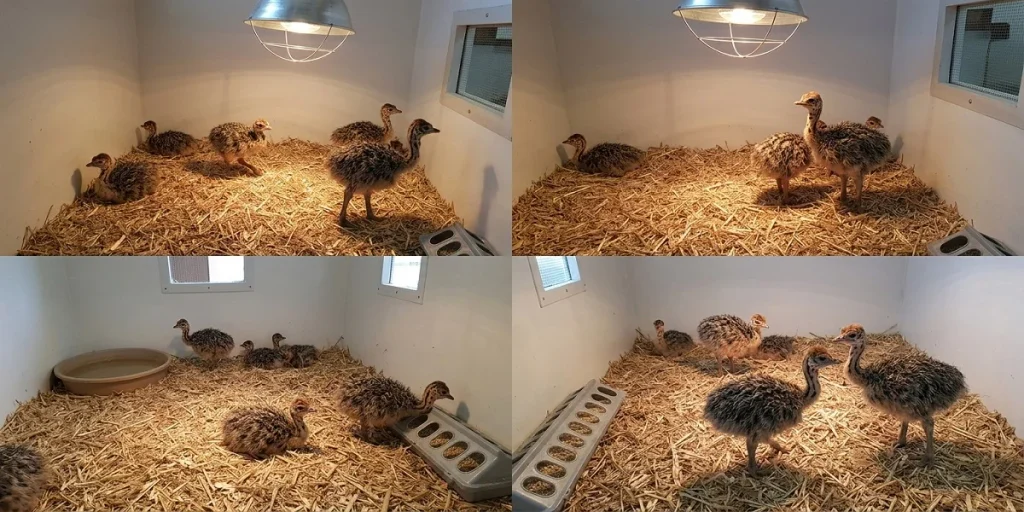
A good brooder does more than provide heat. It should give ostrich chicks a warm, dry, clean and secure environment where they can walk normally, find food and water easily, and move away from the heat when they become too warm.
The brooding area should also be easy to inspect and clean. This matters because young ostriches spend much of their time exploring their surroundings, and anything left on the floor can potentially become a feeding hazard.
Heat, Ventilation and Weather Protection
Temperature management is particularly important during the first weeks because young chicks cannot regulate their body temperature as effectively as older birds.
Traditional ostrich-management recommendations commonly start with supplemental heat around 88 to 92°F (31 to 33°C) at chick level during the first days, gradually reducing the temperature as the chicks become better feathered and more capable of regulating their body temperature.
These numbers should be treated as a starting point rather than a universal prescription. Climate, housing design, humidity, chick age and whether the chicks can move freely between warm and cooler areas all affect the appropriate brooding environment.
A thermometer should therefore be positioned at the level where the chicks actually spend their time.
Chick behavior is also useful:
- Huddling tightly under the heat source: the chicks may be too cold.
- Moving as far away from the heat as possible: they may be too warm.
- Panting or holding the wings away from the body: excessive heat may be a concern.
- Moving normally between warm and cooler areas: the brooder is more likely to be comfortable.
Ventilation is equally important. A brooder can be warm without being stuffy. Fresh air should circulate without creating strong drafts directly across the chicks.
The area should remain dry, particularly around waterers. Wet flooring combined with poor traction creates an unnecessarily difficult environment for rapidly growing legs.
Floor, Space and Exercise
If there is one part of ostrich chick care that deserves more attention than it usually gets online, it is the floor beneath the chick’s feet.
Ostrich chicks grow extremely quickly, but their legs still need to support that increasing body weight. A slippery floor can make normal walking difficult and may contribute to abnormal leg positioning.
The MSD Veterinary Manual recommends providing young ratites with sufficient room for movement and avoiding unsuitable flooring. Chicks confined to inappropriate surfaces, particularly slippery or hard flooring, are more vulnerable to musculoskeletal problems.
Avoid Slick Floors
A newly hatched ostrich chick may look stable when standing, but it does not take much slipping to create a problem.
Avoid surfaces such as:
- Smooth concrete
- Smooth plastic
- Slippery newspaper
- Polished or wet surfaces
- Any flooring where the chick repeatedly loses traction
The goal is not simply to make the floor soft. It needs to provide reliable traction while remaining clean and dry.
A chick that can walk, turn, stop and run without repeatedly slipping has a much better environment for normal musculoskeletal development.
Give Chicks Room to Walk
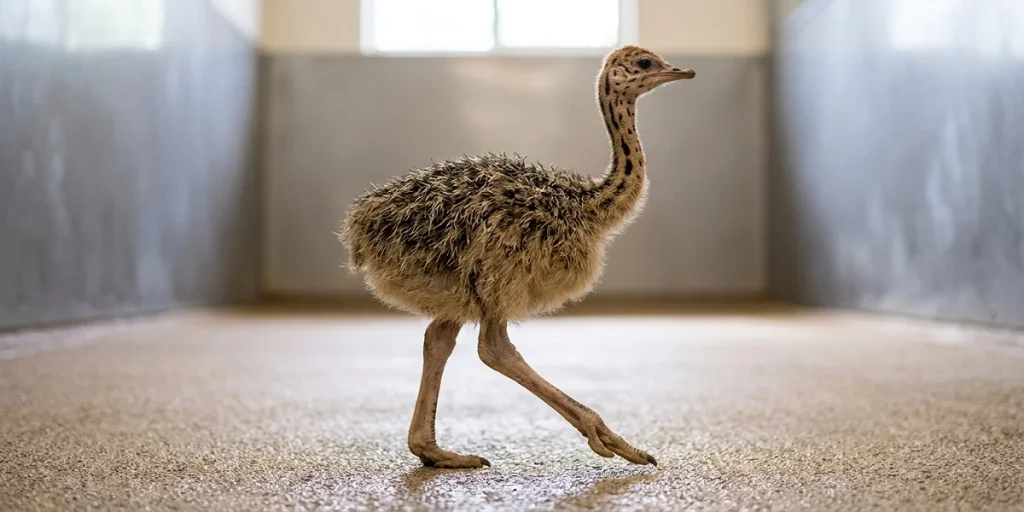
Exercise is not an optional extra for a rapidly growing ostrich chick.
The MSD Veterinary Manual notes that young ratite chicks require substantial space and recommends approximately 100 to 133 square feet per bird for chicks up to three months of age under its management recommendations.
That figure may seem surprisingly large if you are accustomed to raising chickens.
But ostriches are not chickens.
They are large, highly active running birds, and restricting movement during a period of extremely rapid growth can create unnecessary problems.
The objective is to give chicks enough room to:
- Walk normally.
- Exercise their legs.
- Move between feeding and resting areas.
- Escape the heat when necessary.
- Explore their environment.
- Develop coordination as their bodies grow.
Space is therefore part of chick health, not simply a housing preference.
🦤 Ostrich Chick Space Calculator
How much space do ostrich chicks need? Enter the number of chicks below to estimate the recommended enclosure area using the 100–133 ft² per chick guideline for ratite chicks up to three months old.
What Should Ostrich Chick Flooring Look Like?
There is no single substrate that works perfectly for every climate and production system.
Depending on the setup, young ostriches may be raised on suitable sand, grass, pasture or other surfaces that provide traction and remain clean and well drained. The MSD Veterinary Manual emphasizes appropriate substrate, adequate ventilation and sufficient room for exercise rather than keeping chicks permanently on hard, unsuitable floors.
The most important questions are:
Can the chick walk without slipping?
Can the surface stay dry and clean?
Can the chick accidentally swallow large amounts of it?
Does the environment allow normal exercise?
If the answer to any of these is no, the housing system deserves another look.
Companions and Human Contact
Ostrich chicks are social animals, and raising a single chick in isolation can create serious management problems.
Farm-management guidance reports that mortality can be higher in isolated chicks and that a lone chick may sometimes be raised alongside suitable young poultry such as turkey poults, ducklings or goslings when another ostrich chick is unavailable.
That does not mean any bird can simply be placed into the same enclosure. Size, disease risk, temperament, feeding requirements and biosecurity all need to be considered.
Whenever possible, raising ostrich chicks with other healthy ostrich chicks of a suitable age and size is the more natural arrangement.
Can Ostriches Bond With Humans?
This question is more complicated than a simple yes or no.
Ostrich chicks can become accustomed to people through regular, calm interaction, and birds that are handled appropriately from a young age can be easier for keepers to manage later.
But tameness is not the same thing as domestication, and familiarity is not the same thing as safety.
A large adult ostrich remains a powerful animal regardless of how accustomed it is to its keeper.
There is also an important distinction between ordinary habituation and imprinting. Young birds can develop strong behavioral associations with the individuals or animals around them during early development. That is one reason why early social management matters.
For a keeper, the practical goal should not be to make a chick dependent on humans. It should be to create a bird that can be calmly and safely managed when routine handling, veterinary examination or transport becomes necessary.
And there is something particularly interesting here from field observation.
While living and working in Tanzania, I have had opportunities to observe ostriches in natural environments when circumstances allowed. One thing that becomes obvious when watching them outside a farm setting is how strongly they rely on awareness of their surroundings and movement within a larger landscape. Their behavior makes much more sense when you remember that these are running birds adapted to open habitats, rather than oversized poultry kept in small pens.
That perspective is useful when designing chick housing: space and movement are biological needs, not luxuries added after the basic setup is complete.
How Fast Do Baby Ostriches Grow?
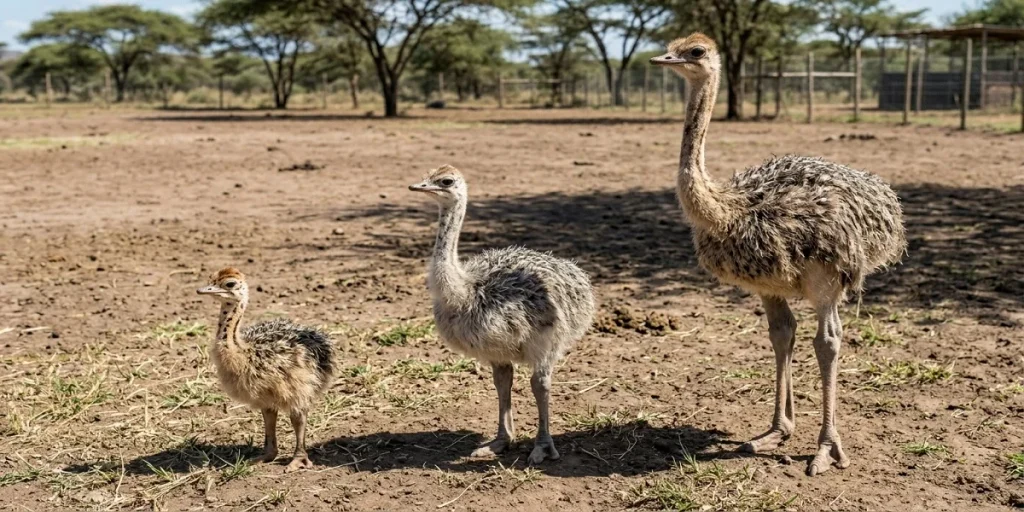
Few things surprise people more than the growth rate of an ostrich chick.
A newly hatched chick is tiny compared with the adult bird it will eventually become, yet the transformation happens remarkably quickly.
Zoo New England reported a chick weighing approximately 2 pounds (0.9 kg) and measuring about 8 inches (20 cm) at hatching. The same zoo reported that the chick was expected to reach approximately 150 pounds (68 kg) and 6 feet (1.8 m) by six months of age.
That does not mean every ostrich should reach exactly those numbers.
Growth varies with genetics, sex, nutrition, environment, health and management. Zoo animals also live under controlled conditions that may differ substantially from commercial farms or natural environments.
Still, the example demonstrates why early management matters so much.
Ostrich Chick Growth at a Glance
| Age | Approximate reported size | What it means for care |
|---|---|---|
| Hatch | ~2 lb / 0.9 kg; ~8 in / 20 cm | Warmth, hydration and early management are critical |
| First weeks | Rapid increase in body size | Nutrition and flooring become increasingly important |
| Several months | Dramatic growth continues | Exercise and controlled nutrition become essential |
| 6 months | ~150 lb / 68 kg and ~6 ft / 1.8 m in the reported zoo example | The chick is already a very large juvenile |
The most important lesson is that weight gain should not be pursued blindly.
If a chick gains weight rapidly but its legs cannot keep up with the mechanical demands of that growth, problems can develop.
That is why experienced keepers monitor more than the scale.
They watch the chick’s posture, gait, appetite, activity and overall condition.
A healthy growth program should produce a strong, active bird rather than simply the heaviest bird possible at a particular age.
Common Ostrich Chick Health Problems
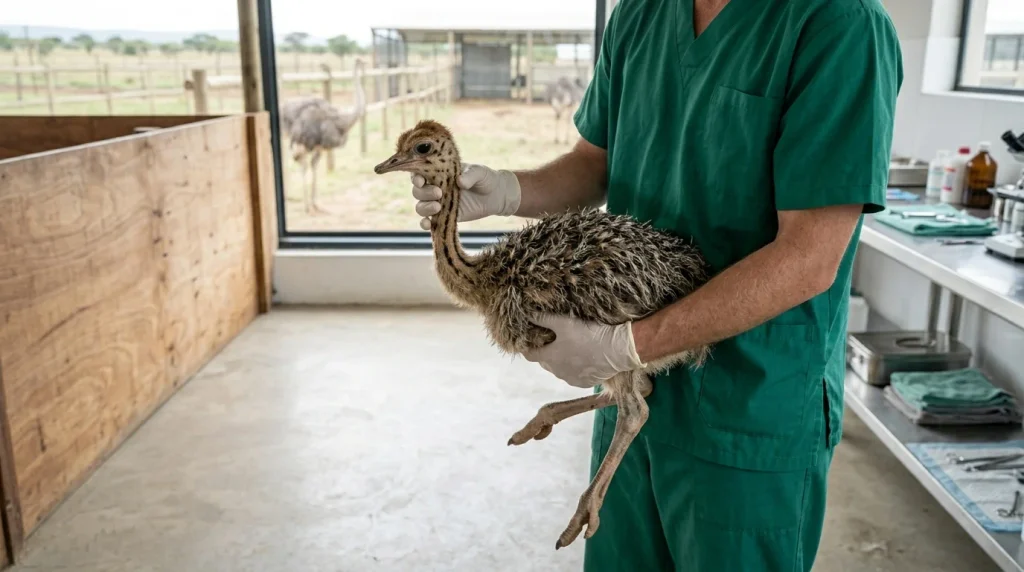
The first months are when management mistakes can have their greatest consequences.
Young ostriches can develop digestive, skeletal and infectious problems, and some conditions become difficult to correct once they are advanced. The MSD Veterinary Manual emphasizes prevention through appropriate nutrition, housing, sanitation, ventilation and exercise.
Leg Abnormalities
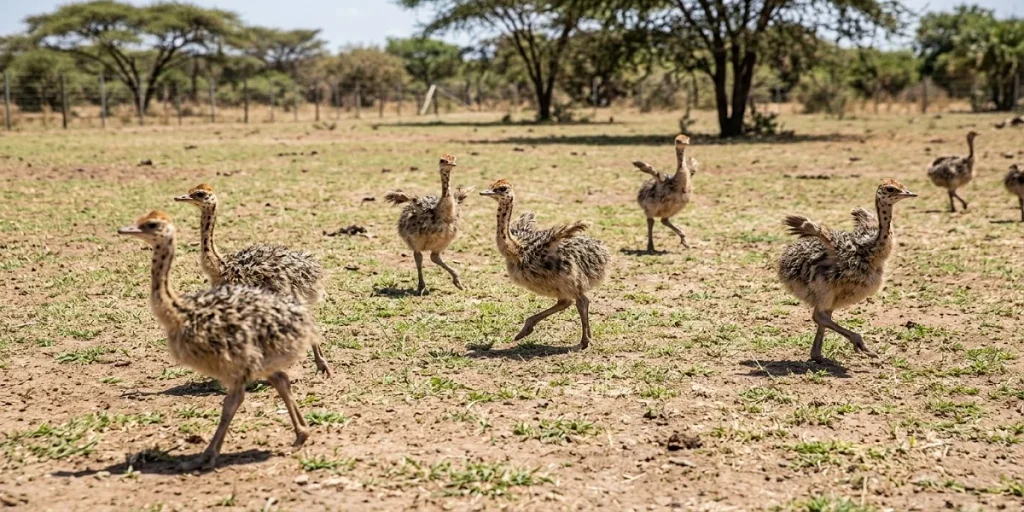
Leg problems are among the most serious concerns in rapidly growing ostrich chicks.
Abnormal limb positioning can be associated with inadequate exercise, poor footing, nutritional imbalance and excessively rapid growth. Once severe deformities develop, treatment can become difficult and the prognosis may be poor.
Prevention is therefore far more important than trying to correct an advanced deformity.
Provide:
- A surface with good traction
- Plenty of room for movement
- Appropriate nutrition
- Controlled growth
- Regular observation of gait and posture
Check the chicks every day, particularly during periods of rapid growth.
A chick that suddenly begins sitting excessively, walking abnormally, crossing its legs or struggling to stand deserves immediate attention.
Impaction and Foreign-Body Ingestion
Ostrich chicks investigate their surroundings with their mouths.
Unfortunately, this can turn ordinary farm debris into a medical emergency.
Stones, pieces of plastic, wire, hardware and other foreign objects can be swallowed and become lodged in the digestive tract. The MSD Veterinary Manual describes digestive impaction and foreign-body ingestion as important problems in young ratites.
This is why cleaning the pen is part of veterinary prevention.
Do not simply remove obvious manure and leave the rest of the environment unchecked. Get down to chick level and look for anything the bird could pick up.
Chilling and Overheating
A chick can become stressed when brooder conditions are too cold or too hot.
The solution is not to guess.
Measure temperature at chick level, provide an area where chicks can move toward or away from supplemental heat, and observe their behavior.
Chicks should not be forced to remain directly beneath a heat source.
Failure to Eat or Drink
A chick that is not eating can deteriorate quickly.
Possible causes include stress, weakness, poor access to feed or water, inappropriate brooder conditions, digestive problems and underlying disease.
If a newly hatched chick does not begin behaving normally after the expected transition to feeding, do not assume it will eventually “figure it out.”
Check:
- Is the water accessible?
- Can the chick recognize the feed?
- Is another chick demonstrating normal feeding behavior?
- Is the brooder temperature appropriate?
- Is the chick active?
- Is the abdomen and navel area normal?
- Are droppings being produced?
Persistent refusal to eat or drink warrants professional assessment.
Feather Picking and Other Management Problems
Feather picking can occur in ratites and may be associated with environmental or management factors.
Overcrowding, poor environmental conditions, insufficient resources and stress can all make behavioral problems more likely.
The answer is not necessarily a single supplement or medication.
Look at the whole management system:
space + ventilation + nutrition + social environment + cleanliness + access to feed and water.
When several of these are inadequate at the same time, problems become much harder to solve.
Ostrich Chick Care Prevention Checklist
Before you consider a chick-management system successful, check the basics every day:
- ☐ Chicks are warm but can move away from the heat.
- ☐ The brooder is dry and adequately ventilated.
- ☐ Flooring provides reliable traction.
- ☐ Chicks have enough room to walk and exercise.
- ☐ Feed is fresh and appropriate for their age.
- ☐ Clean water is continuously accessible.
- ☐ Feeders and drinkers are clean.
- ☐ No wire, plastic, hardware or dangerous debris is accessible.
- ☐ Chicks are eating and drinking normally.
- ☐ Leg posture and gait are checked daily.
- ☐ Body weight and growth are monitored regularly.
- ☐ Sick or abnormal chicks are separated and assessed promptly when appropriate.
- ☐ A veterinarian familiar with ratites is available when problems arise.
The principle is simple: prevent problems before the rapidly growing chick turns a small management mistake into a major veterinary problem.
Is It Difficult to Raise Ostrich Chicks?
Raising ostrich chicks is manageable with the right preparation, but it is not a low-maintenance job. The first weeks require close attention to temperature, feeding, hydration, flooring, exercise, cleanliness and growth.
The biggest challenge is that ostrich chicks grow extremely quickly. A management mistake that might have little consequence in a slower-growing bird can become much more serious when the chick is gaining weight rapidly.
For a first-time keeper, the most important preparation is not buying the chick itself. It is having the brooder, feed, water system, secure flooring, outdoor space and veterinary support ready before the chick arrives.
If you are considering ostrich farming as a business, chick care is only one part of the equation. Our guides on whether ostrich farming is profitable cover the financial side in more detail.
How Much Does an Ostrich Chick Cost?
There is no universal price for an ostrich chick.
Cost varies considerably according to location, age, genetics, breeder, sex, health status and whether the bird comes from a commercial breeding operation or a specialist breeder.
If you are comparing prices, do not look only at the purchase price. A cheap chick can become an expensive bird if you do not already have appropriate housing, feed and veterinary support.
Before purchasing, check:
- The chick’s age and health
- Feeding history
- Vaccination or health records where applicable
- Parent or breeding stock information
- Current feed requirements
- Local transport requirements
- Whether the seller provides care instructions
For a broader cost breakdown, see our guide on how much an ostrich costs.
Is It Legal to Own an Ostrich?
That depends entirely on where you live.
Ostrich ownership can be subject to national, state, provincial, county or municipal regulations. Some jurisdictions may regulate the keeping, transport, sale or breeding of large exotic birds, while others may have relatively few restrictions.
Before buying a chick, contact the relevant animal, agriculture, wildlife or local government authority in your area.
Do not assume that because a breeder is selling ostriches, you automatically have permission to keep one at your property.
Frequently Asked Questions About Ostrich Chick Care
What should baby ostriches eat?
Baby ostriches should receive a nutritionally complete starter or pre-starter ration formulated for ratites or an appropriate substitute recommended by a veterinarian. Clean water should be available, while forage and supplements should not replace the balanced starter diet during the critical early growth period.
What is the best food for ostrich chicks?
The best food for an ostrich chick is a complete, age-appropriate ratite starter or pre-starter feed from a reputable manufacturer. The correct protein, energy, mineral and vitamin balance matters more than choosing the feed with the highest protein percentage.
What is ostrich chick starter feed?
Ostrich chick starter feed is a complete ration designed to support the rapid growth of young ostriches. Current veterinary guidance uses different formulations as chicks mature, so the feed should be changed according to age and the manufacturer’s feeding program rather than using one formula indefinitely.
How much food does an ostrich chick eat per day?
There is no single daily amount for every ostrich chick. Intake changes with age, body weight, feed energy density and environmental conditions, so monitoring growth and following the manufacturer’s feeding recommendations is more reliable than using one fixed kilogram-per-day figure.
When do ostrich chicks start eating?
There is no universally accepted first-feeding schedule across all ostrich-management systems. Some traditional sources recommend delaying feed for several days while the yolk sac is absorbed, while other protocols introduce starter feed within 24 to 48 hours. Follow the protocol provided by your hatchery and veterinarian.
How fast do baby ostriches grow?
Very quickly. Zoo New England reported a chick at approximately 2 pounds at hatching and expected it to reach about 150 pounds by six months, although individual growth varies with genetics, nutrition and management.
How long is an ostrich pregnant?
Ostriches are not pregnant because they lay eggs. After mating, the female lays eggs, which are then incubated for roughly six weeks before hatching. See our guide on how long an ostrich egg takes to hatch for the complete incubation timeline.
Can ostrich chicks be raised alone?
They can be raised alone in some circumstances, but isolation is not ideal. Young ostriches are social birds, and farm-management sources report higher risks for isolated chicks. When another ostrich chick is unavailable, some producers use suitable young poultry companions, provided health, size and biosecurity are carefully managed.
Can ostriches bond with humans?
Ostriches can become accustomed to humans through calm, consistent interaction, particularly when handled appropriately while young. However, a tame ostrich is still a powerful wild-derived bird, so familiarity should never be treated as a guarantee of safety.
What is poisonous or dangerous to ostrich chicks?
Common dangers include moldy feed, contaminated water, foreign objects, unsafe litter and inappropriate food. Wire, plastic, hardware and stones are particularly concerning because young ostriches may swallow objects they find on the ground.
Not everything dangerous is technically poisonous. For example, a piece of wire is a foreign-body hazard, not a toxin.
Is it difficult to raise ostrich chicks?
Yes, compared with ordinary poultry, ostrich chicks require more specialized management. The most demanding areas are temperature control, nutrition, flooring, exercise, sanitation and monitoring rapid growth.
With appropriate preparation, however, the process is manageable.
What is an ostrich chick’s biggest health risk?
There is no single risk in every flock, but leg abnormalities, digestive problems, infections and poor early management are major concerns. Prevention is largely based on appropriate nutrition, good traction, sufficient space, cleanliness and close observation.
Do ostrich chicks need heat?
Yes, newly hatched chicks generally need a warm brooding environment until they are capable of maintaining body temperature without supplemental heat. The exact temperature should be adjusted according to age, environmental conditions and chick behavior rather than following one fixed number throughout the brooding period.
How much space do ostrich chicks need?
Young ostriches need considerably more room than conventional poultry because exercise is important for normal development. The MSD Veterinary Manual recommends approximately 100 to 133 square feet per chick up to three months of age under its ratite chick-management guidance.
When can ostrich chicks go outside?
They can gradually spend more time outdoors when weather conditions, temperature, ground conditions and predator protection are appropriate. Outdoor access should provide safe footing, shelter from severe weather and enough space for normal movement.
Final Thoughts on Ostrich Chick Care
The secret to raising healthy ostrich chicks is not a single feed, temperature or supplement.
It is consistent management.
Give chicks appropriate warmth without overheating them. Give them clean water and a nutritionally complete diet. Give them enough room to exercise on a surface that provides traction. Keep foreign objects and contaminated material out of their environment. Most importantly, monitor how they are actually growing rather than trying to make them grow as quickly as possible.
Ostrich chicks have an extraordinary growth rate, and that is exactly why their early environment matters so much.
A strong start can support healthy development for years to come. A preventable problem during the first weeks can become much harder to correct later.
For anyone planning to raise ostriches, the best approach is therefore simple:
Prepare first. Observe every day. Control growth. Protect the legs. And get professional help early when something looks wrong.