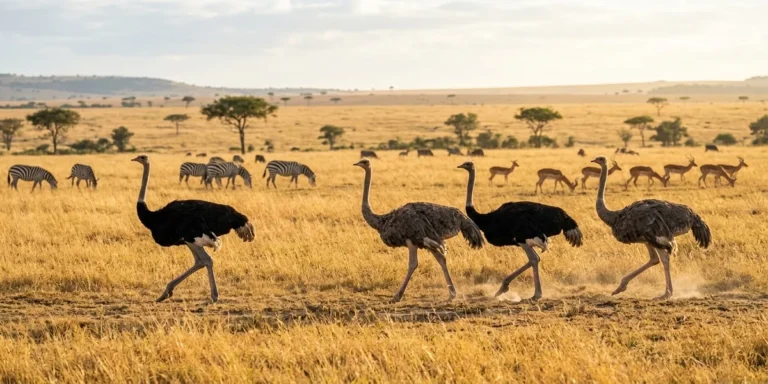
Quick Answer: The ostrich (Struthio camelus) is the world’s largest and heaviest living bird, reaching up to 9 ft (2.75 m) tall and weighing around 345 lb (156 kg). It cannot fly, but it can run at speeds of about 43 mph (70 km/h). Ostriches lay the largest eggs of any living bird, have just two toes on each foot, and have enormous eyes that are even larger than their brains. Despite a common claim repeated online, ostriches do not have three stomachs.
Ostriches are famous for their size, speed, and unusual appearance, but some of the most interesting facts about them are the ones that rarely make it into standard animal fact lists.
Many websites repeat the same claims about ostriches, sometimes without explaining where the numbers come from. In this guide, the OstrichPro team has brought together 30 interesting ostrich facts and separated well-established information from commonly repeated myths and uncertain figures.
Where reliable sources give different numbers, we do not simply choose the largest or most impressive figure. Instead, we explain the range and why the estimates can differ. That is particularly important for facts such as ostrich lifespan, egg weight, and digestive anatomy.
Ostrich Quick Facts at a Glance
| Feature | Fact |
|---|---|
| Scientific name | Struthio camelus for the Common ostrich |
| Height | Up to about 9 ft (2.75 m) |
| Weight | Up to about 345 lb (156 kg) |
| Top speed | About 43 mph (70 km/h) |
| Egg weight | Roughly 1.3–1.4 kg (2.9–3.1 lb) |
| Incubation period | About 42 days |
| Lifespan | Typically around 30–40 years, with higher estimates reported for some captive birds |
| Living species | 2 recognized species: Common ostrich and Somali ostrich |
| Native range | Africa |
| Toes | 2 per foot |
| Flight | Flightless |
The numbers above provide a quick snapshot, but the details become much more interesting once you look at how ostriches are built, how they run, how they raise their chicks, and how their biology differs from many other birds.
Size and Body Facts
Few birds can compete with the ostrich when it comes to sheer size. From its towering height and enormous eyes to its unusually powerful two-toed feet, almost every part of the ostrich’s body reflects its adaptation to life as a fast-moving, flightless bird.
1. The Ostrich Is the Tallest and Heaviest Living Bird
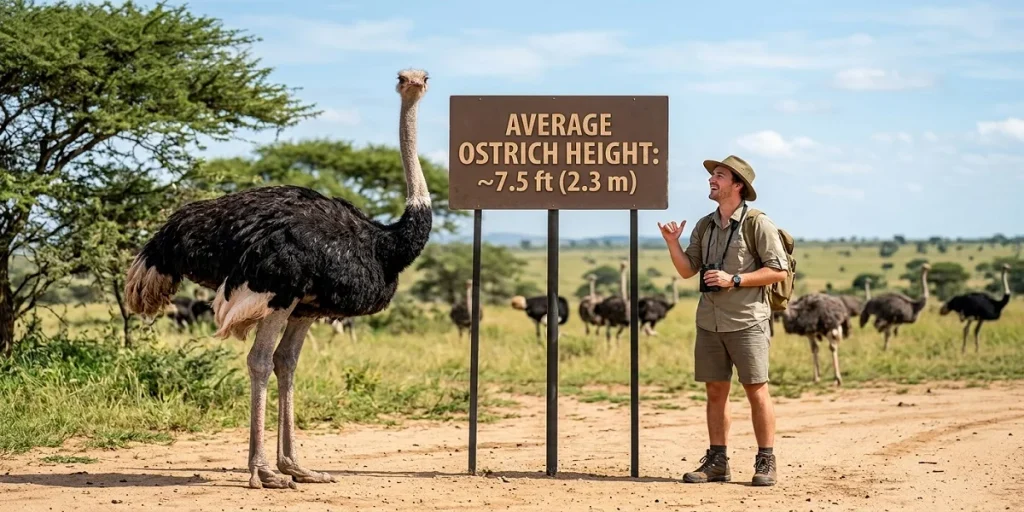
The ostrich is the tallest and heaviest living bird on Earth. Large males can reach about 9 ft (2.75 m) in height and weigh up to roughly 345 lb (156 kg), although individual size varies with sex, age, and population.
Males are generally larger than females, with a taller neck and more massive body. Their long legs and neck account for much of their impressive height, while their relatively small head can make the bird look even more unusual.
2. An Ostrich Has Enormous Eyes
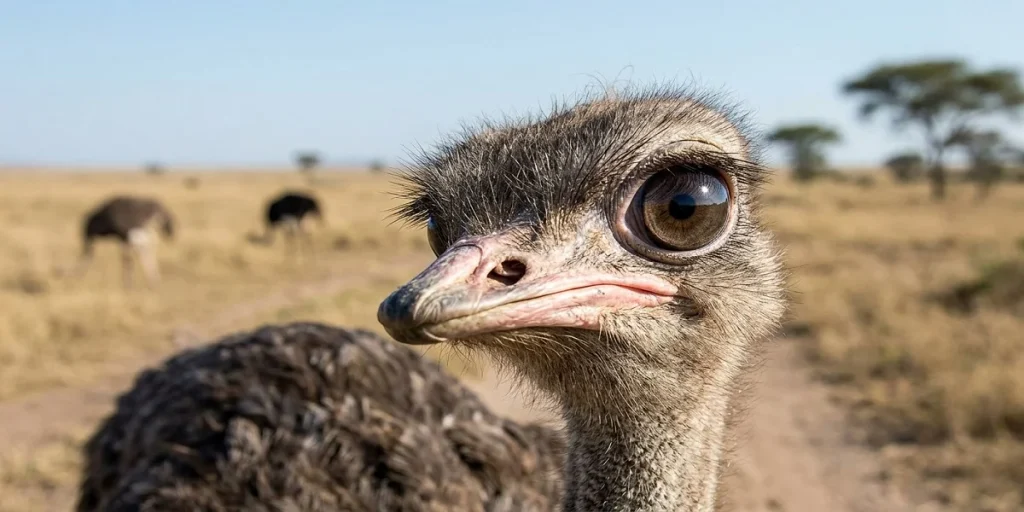
An ostrich’s eyes are remarkably large, measuring roughly 2 inches (5 cm) across. Their size gives the bird an excellent view across the open landscapes where it lives, helping it detect potential predators from a considerable distance.
The eyes are so large that an ostrich’s eye is actually bigger than its brain. This unusual proportion is one reason the ostrich has become famous for its exceptional eyesight.
3. An Ostrich Has Only Two Toes on Each Foot

Unlike most birds, which have three or four toes, an ostrich has just two toes on each foot. The larger inner toe carries a strong nail, while the smaller outer toe helps with balance as the bird runs.
This unusual foot structure is closely tied to the ostrich’s running ability. Instead of carrying extra toes that could add weight, its feet are specialized for efficient movement over long distances.
4. Ostrich’s Wings Are Large but Cannot Fly
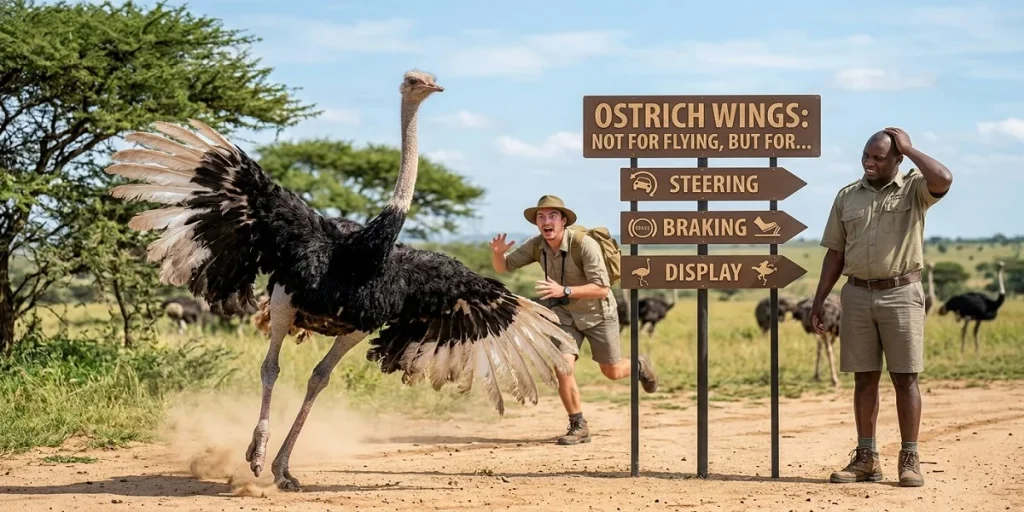
Ostrich wings can span roughly 6.6 ft (2 m), yet the birds are completely flightless. Their wings are not useless, however. Ostriches use them for balance, steering, braking, courtship displays, and threat displays.
During a fast run, an ostrich can spread or move its wings while changing direction. The wings therefore play an important role in the bird’s movement even though they cannot generate enough lift to make the bird airborne.
5. Ostrich’s Feathers Have a Distinctively Loose Structure
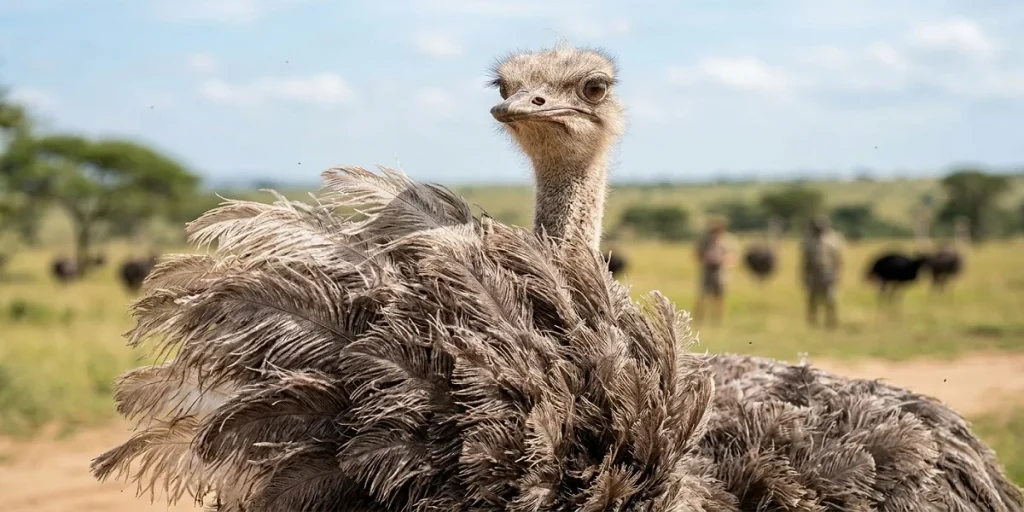
Ostrich feathers look different from the tightly organized flight feathers of birds that can fly. Their branches do not lock together in the same way, giving the plumage its characteristically soft and shaggy appearance.
The feathers also help with temperature regulation in Africa’s often hot environments. Long feathers around the wings and body provide shade and airflow, while the bird’s long eyelashes help protect its large eyes from dust, sand, and intense sunlight.
Speed and Defense Facts
An ostrich’s body is built for one thing it does exceptionally well: moving quickly across open ground. Its long legs, powerful muscles, lightweight foot structure, and large wings work together to help it accelerate, change direction, and escape danger when predators get too close.
6. The Ostrich Is the Fastest Two-Legged Animal

An ostrich can reach speeds of about 43 mph (70 km/h), making it the fastest living animal that runs on two legs. It can also maintain a high running speed for considerably longer than a human sprinter can.
This combination of speed and endurance is one of the ostrich’s most important defenses. Rather than confronting a predator, an ostrich will usually try to create distance as quickly as possible.
7. An Ostrich Can Cover Several Meters in a Single Stride
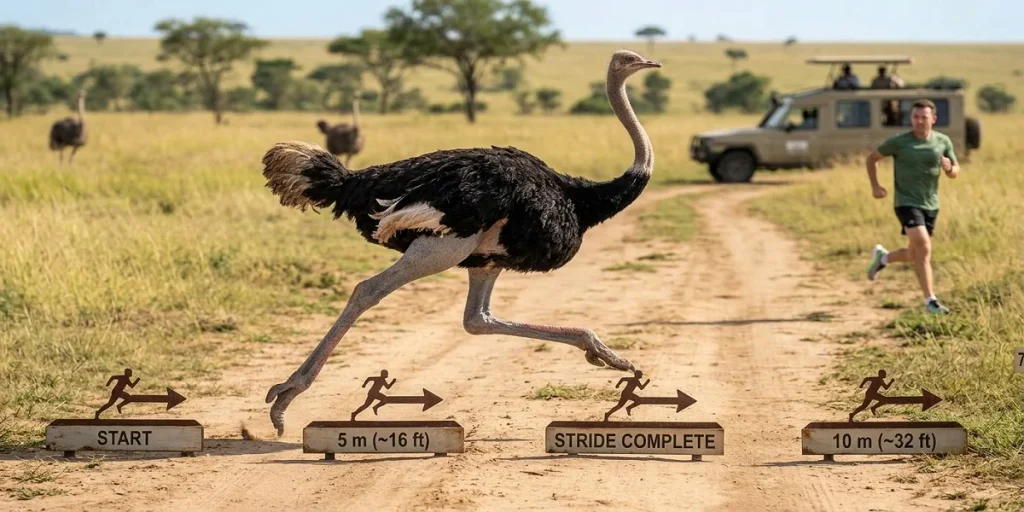
At full speed, an ostrich can cover roughly 10 to 16 ft (3 to 5 m) in a single stride. Its long legs allow it to cover enormous distances with relatively few steps.
The two-toed feet also help reduce unnecessary weight at the end of the legs. Together with powerful leg muscles, this unusual anatomy allows the ostrich to move efficiently across open terrain.
8. Ostrich Chicks Can Run Surprisingly Fast
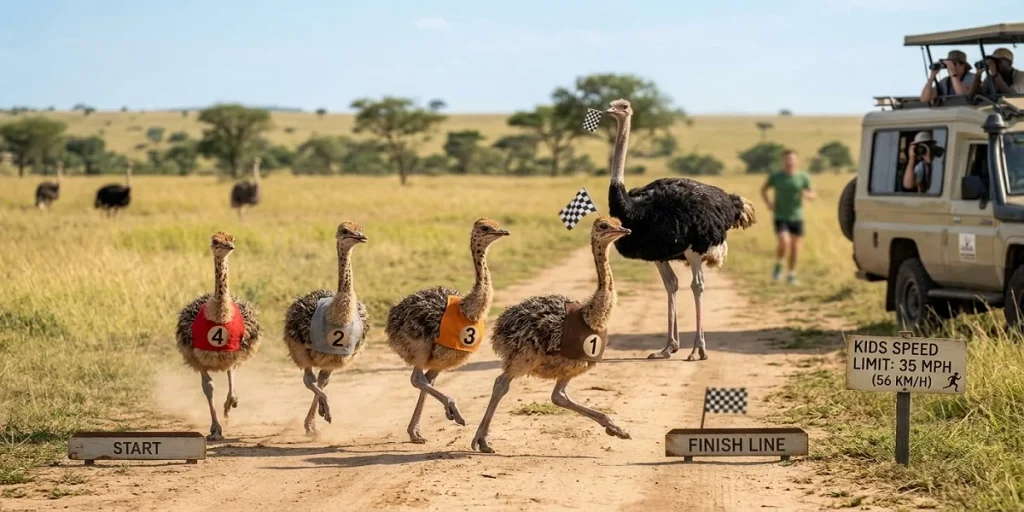
Ostrich chicks become remarkably mobile soon after hatching. According to the San Diego Zoo, young ostriches can reach speeds approaching 35 mph (56 km/h) by about one month of age.
Being able to run quickly at such a young age is a major survival advantage. Ostrich chicks are vulnerable to predators, so staying close to the group and keeping up with adults can make the difference between escape and capture.
9. An Ostrich Can Deliver a Powerful Defensive Kick
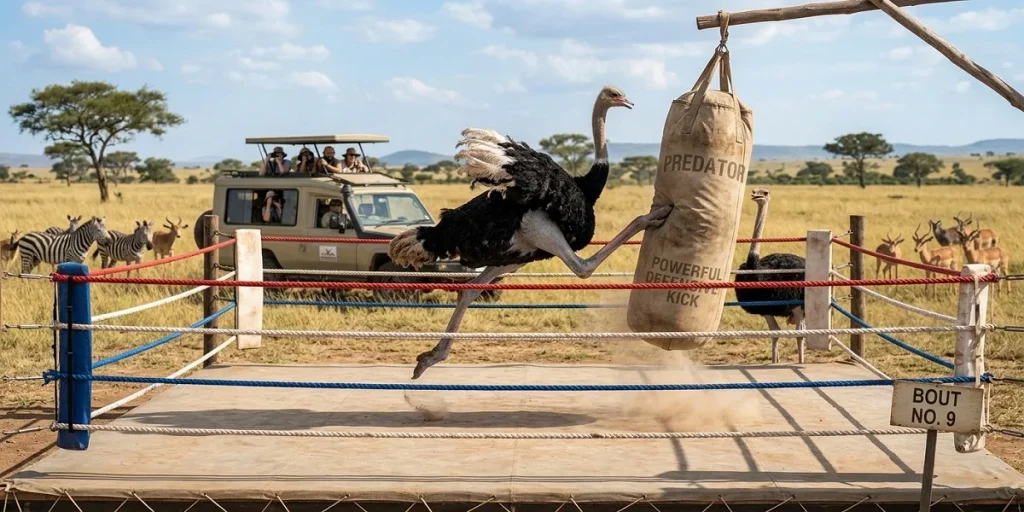
An ostrich has exceptionally strong legs, and its large inner toe carries a powerful claw. When threatened at close range, the bird can use its legs to deliver a potentially dangerous kick to a predator.
Despite the dramatic stories surrounding ostrich attacks, kicking is generally a defensive response rather than a hunting behavior. The bird’s first line of defense is usually its ability to detect danger early and run away at high speed.
10. Ostriches Use Threat Displays Before Physical Defense
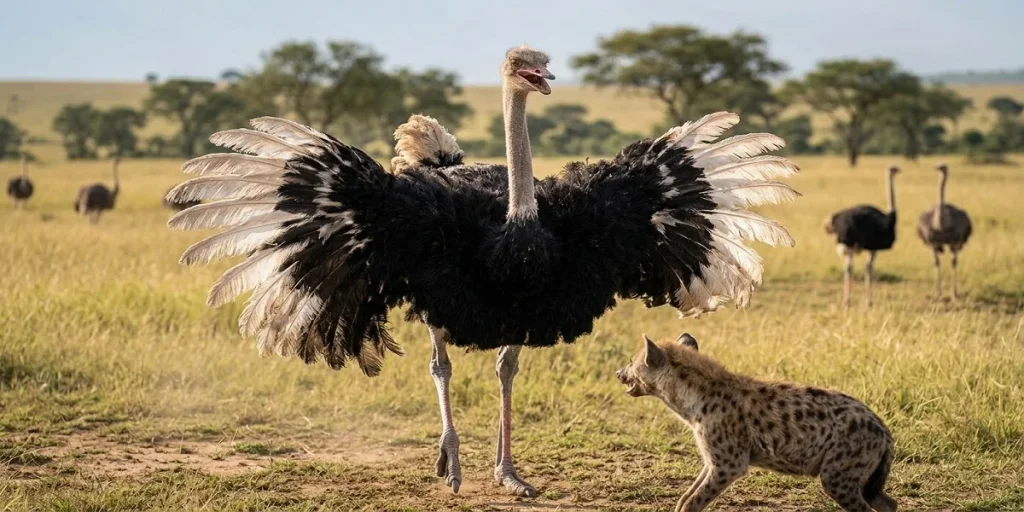
An alarmed ostrich may spread its wings, raise its feathers, hiss, and make itself appear larger when confronting a threat. These displays can help discourage a predator before the situation becomes a physical confrontation.
If the threat persists, the ostrich can switch from intimidation to escape or, at close range, defensive kicking. Its combination of sharp eyesight, speed, size, and powerful legs gives it several layers of protection.
Egg and Chick Facts
Ostrich eggs are famous for being the largest eggs laid by any living bird, but their size is only part of the story. From communal nests to surprisingly well-adapted chicks, ostrich reproduction is full of unusual behaviors that help these birds survive in challenging environments.
11. An Ostrich Lays the Largest Egg of Any Living Bird
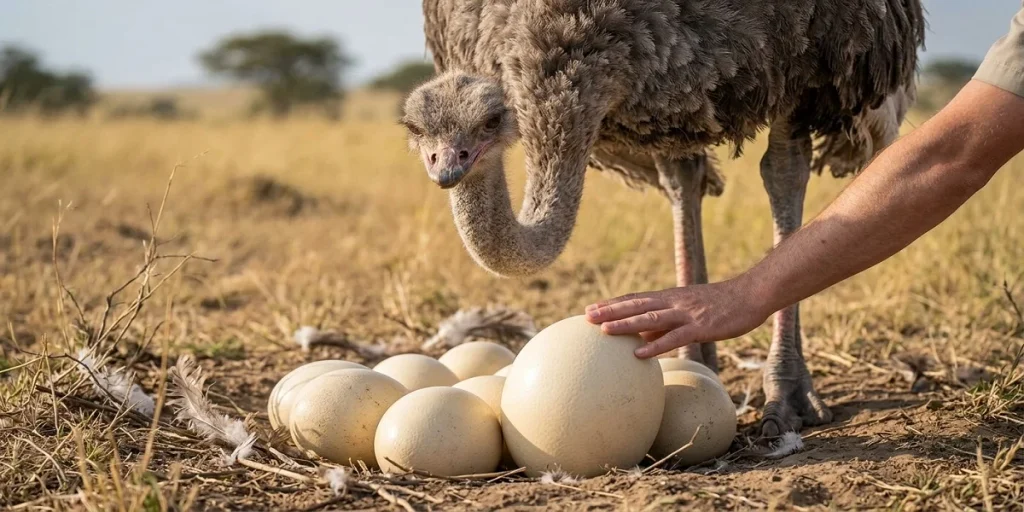
The ostrich lays the largest egg of any living bird. A typical egg weighs roughly 1.3 to 1.4 kg (2.9 to 3.1 lb), although measurements vary between individual eggs and populations.
An ostrich egg can measure around 6 inches (15 cm) long, with a thick shell that protects the developing embryo. Despite its impressive size, it is still surprisingly small relative to the enormous body of the female that lays it.
12. An Ostrich Egg Is Surprisingly Small for the Bird’s Size
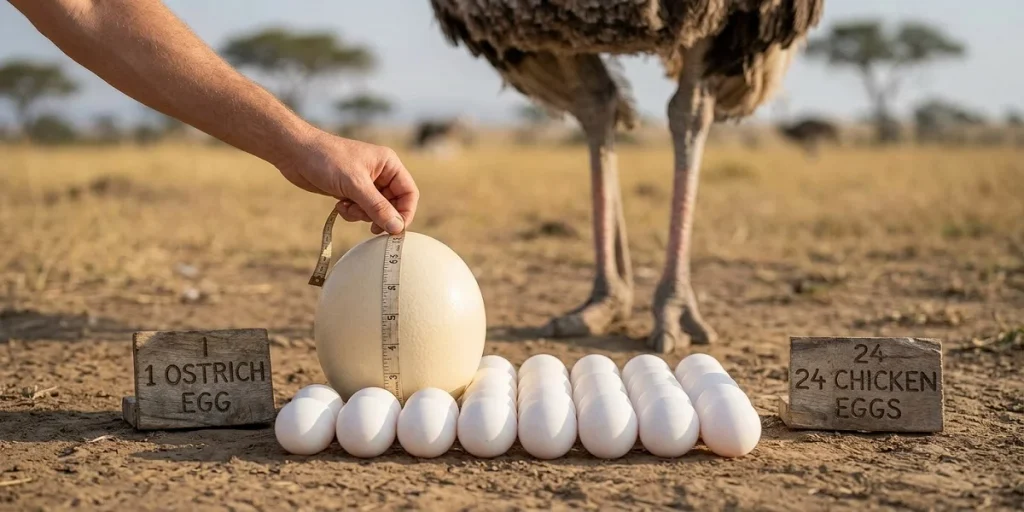
The ostrich produces the largest bird egg in absolute terms, but relative to the mother’s body size, it is actually one of the smallest eggs among living birds.
By volume, one ostrich egg is roughly equivalent to 24 chicken eggs. That makes it enormous compared with an ordinary bird egg, yet proportionally modest considering that an adult female ostrich can weigh well over 200 lb (90 kg).
13. Several Female Ostriches Can Lay Eggs in the Same Nest
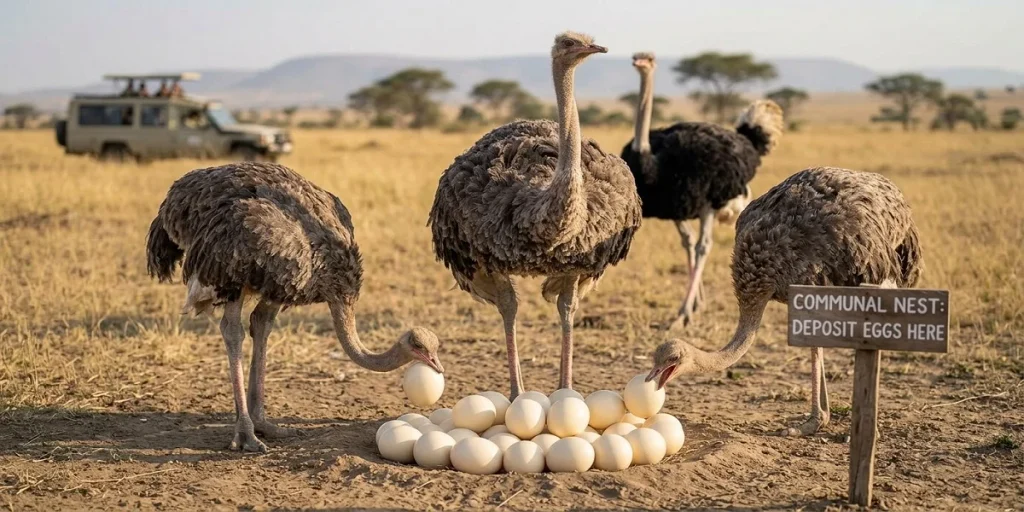
Ostriches do not always raise their young in isolated nests. A dominant male establishes a simple scrape in the ground, and several females may lay their eggs in the same communal nest.
A female ostrich may lay roughly 7 to 10 eggs, while a communal nest can eventually contain many more. The arrangement allows several females to contribute to the same nest while the dominant pair takes the leading role in incubation and defense.
14. Male Ostriches Usually Incubate the Eggs at Night
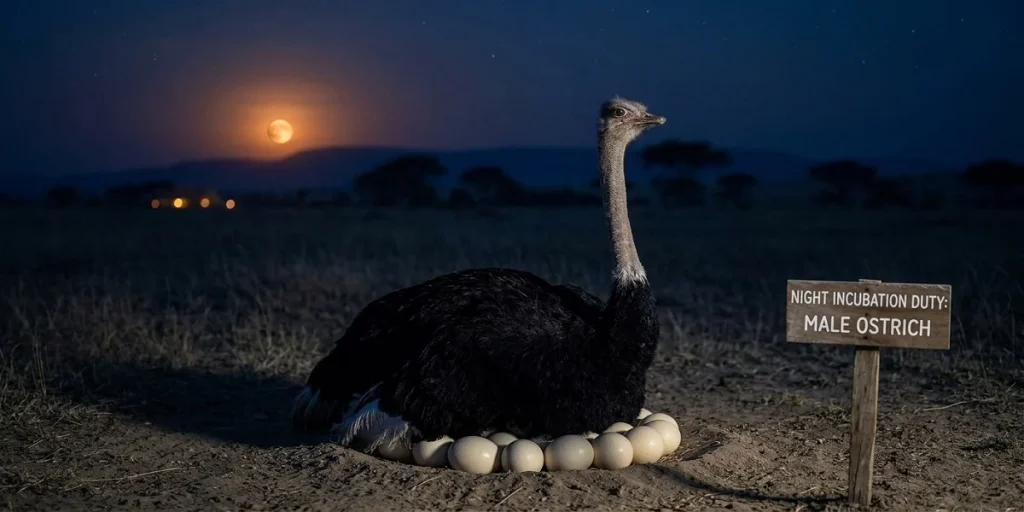
One of the most unusual parts of ostrich parenting is the division of incubation between the sexes. Males usually incubate the eggs at night, while females generally take over during the day.
The timing also provides useful camouflage. The male’s darker plumage blends into the darkness at night, while the female’s lighter brown and gray coloring makes her less conspicuous against the sunlit ground during the day.
15. Egyptian Vultures Use Stones to Break Ostrich Eggs
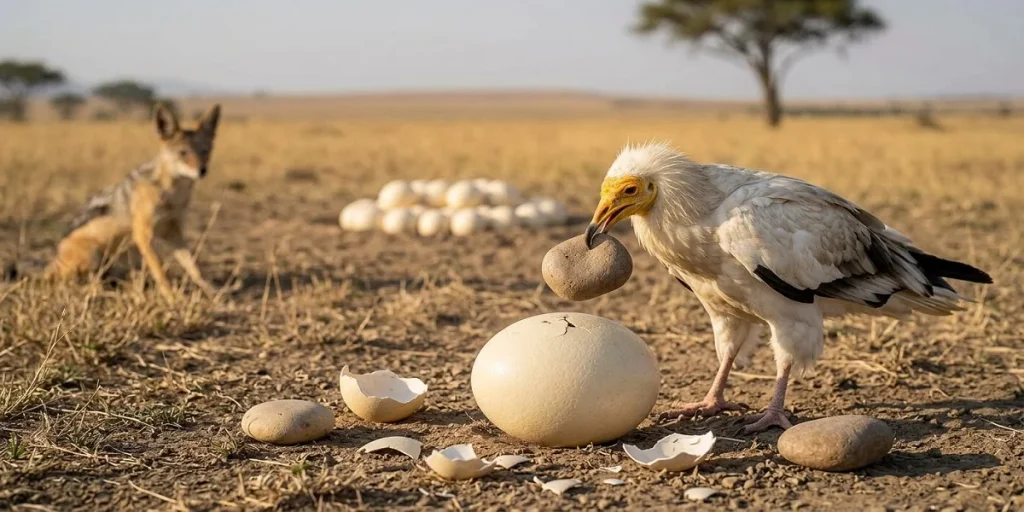
Ostrich eggs are protected by an exceptionally strong shell, but at least one bird has developed a remarkable way to get through it. Egyptian vultures have been observed using stones as tools, dropping them onto ostrich eggs to crack the shell.
Other predators, including jackals and hyenas, may also raid ostrich nests. For an ostrich, producing a large egg does not guarantee that the chick will survive, which is why incubation, nest defense, and the mobility of newly hatched chicks are all critical parts of reproduction.
Digestion and Survival Facts
Ostriches have a digestive system that is remarkably well adapted to a diet dominated by tough plant material. Their anatomy also explains several common misconceptions, including the widespread claim that ostriches have three stomachs.
16. Ostriches Swallow Stones to Help Digest Their Food
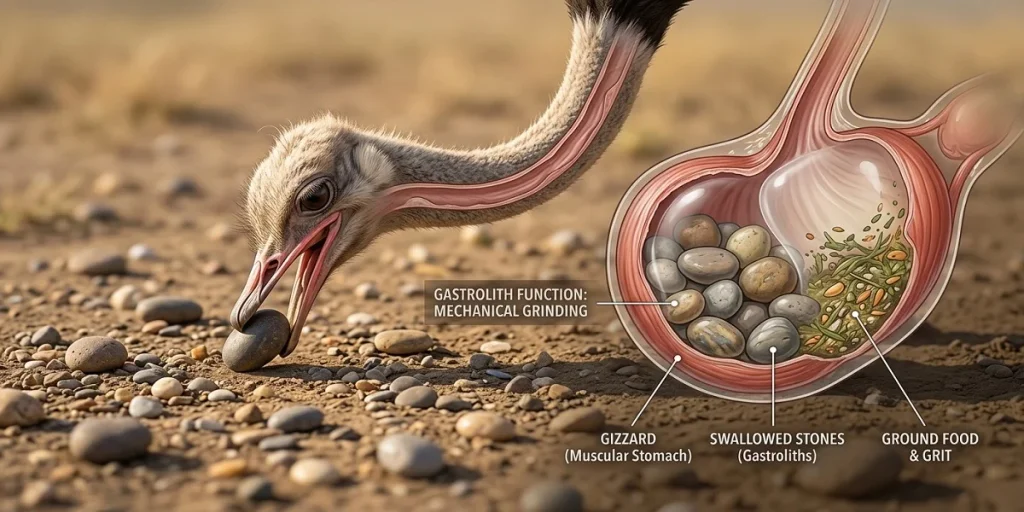
Ostriches have no teeth, so they cannot chew food before swallowing it. Instead, they deliberately swallow small stones and other hard particles that collect in the gizzard, where powerful muscular contractions help grind food.
This behavior, known as gastrolith use, is common among many birds. In ostriches, the amount of grit and stones found in the digestive system can be substantial, reflecting the important role they play in breaking down food mechanically.
17. Ostriches Do Not Have Three Stomachs
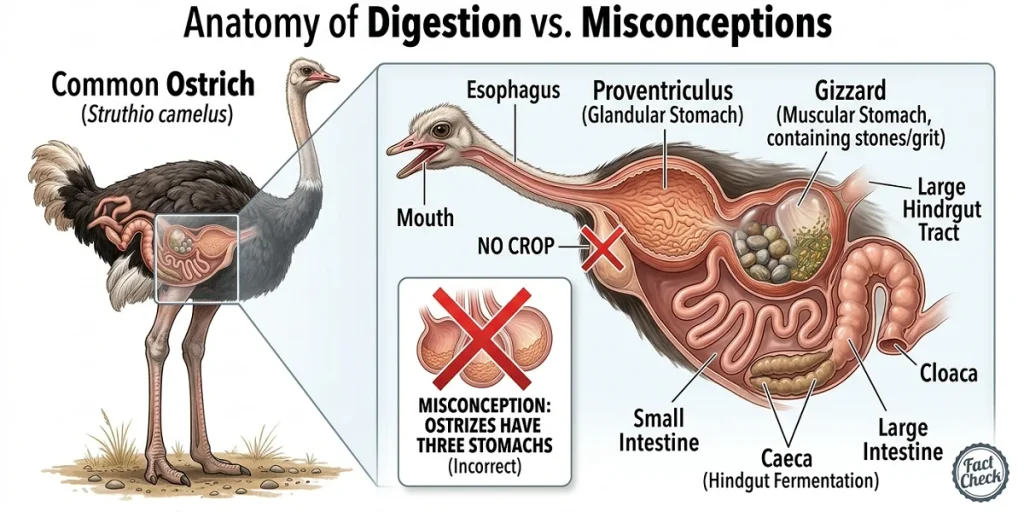
Despite a claim repeated across many animal fact websites, ostriches do not have three stomachs. Their digestive system includes a glandular stomach called the proventriculus and a muscular gizzard, which perform different parts of the digestive process.
Ostriches also do not have a crop, another structure sometimes incorrectly described as an additional stomach. They do have two large caeca farther along the digestive tract, but these are part of the hindgut rather than separate stomachs.
| Common claim | What the anatomy shows |
|---|---|
| “Ostriches have three stomachs.” | They have a proventriculus and a muscular gizzard. |
| “The crop is the first stomach.” | Ostriches do not have a crop. |
| “The caeca are extra stomachs.” | The two large caeca are part of the hindgut. |
The confusion probably comes from the way different sources divide the digestive tract into functional sections. Some descriptions use terms such as chambers rather than referring strictly to stomach structures. That is very different from saying that an ostrich has three separate stomachs.
18. Much of an Ostrich’s Digestive System Is Adapted for Plant Fiber
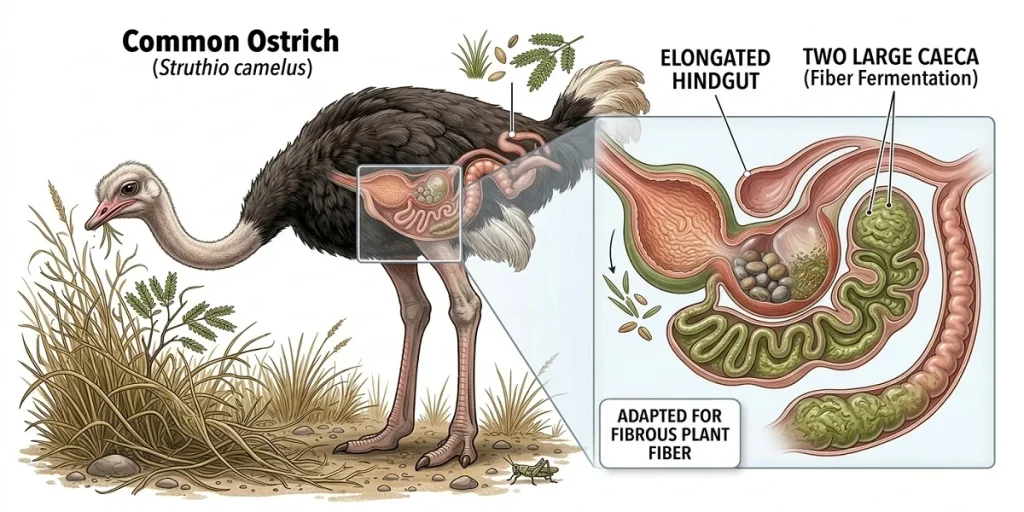
An ostrich’s digestive tract contains two large caeca and an elongated hindgut, allowing it to process fibrous plant material through microbial fermentation.
This adaptation helps ostriches make use of grasses, leaves, seeds, and other vegetation that would be difficult for many animals to digest efficiently. Their diet can also include insects and other small animals when available.
19. Ostriches Are Well Adapted to Hot, Dry Environments

Ostriches are naturally suited to Africa’s hot and often dry landscapes. Their bodies can tolerate high temperatures, and they can obtain some of the water they need from the foods they consume.
They will still drink when water is available, but their ability to function in dry environments is an important part of their ecological success. Their behavior, physiology, and diet all contribute to their ability to live across open savannas and other arid habitats.
20. Ostriches Do Not Bury Their Heads in the Sand
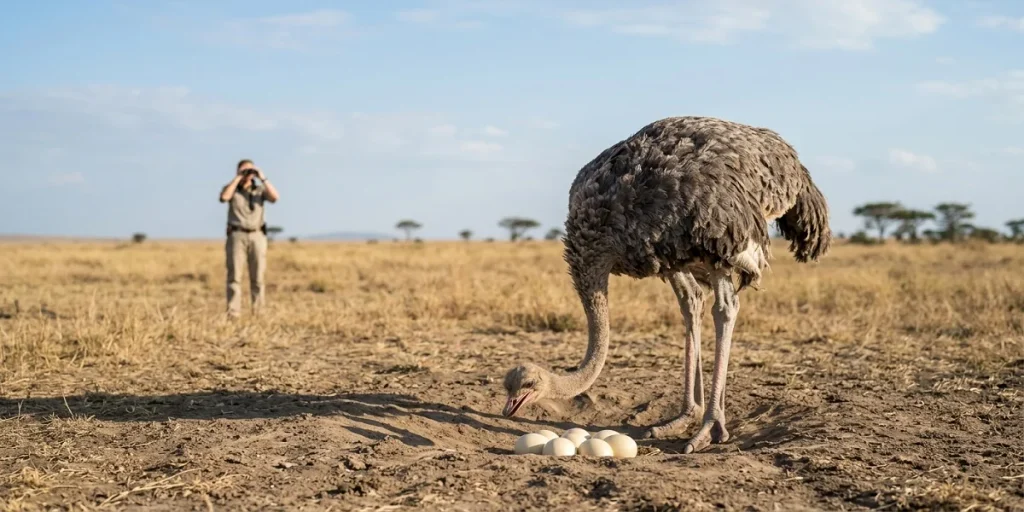
One of the most famous ostrich myths is also one of the easiest to disprove. Ostriches do not bury their heads in the sand to hide from predators.
The misconception may come partly from nesting behavior. Ostriches dig shallow nests in the ground and regularly lower their heads toward the nest, while a distant observer may see only the body and legs. From far away, this can create the illusion that the bird has disappeared into the ground.
In reality, an ostrich’s best defense against a predator is its excellent eyesight, speed, and ability to run across open terrain, not hiding its head in the sand.
Species, Range and Conservation Facts
Ostriches may look like a single familiar species, but their taxonomy and distribution are more interesting than many basic fact lists suggest. Modern classifications recognize two living ostrich species, while several populations and historical forms have their own conservation stories.
21. There Are Two Living Ostrich Species

There are two living ostrich species: the Common ostrich (Struthio camelus) and the Somali ostrich (Struthio molybdophanes).
The Common ostrich is the more widespread of the two and is found across much of sub-Saharan Africa. The Somali ostrich is native to the Horn of Africa and was historically treated as a subspecies of the Common ostrich before being recognized as a separate species.
This distinction matters because many older websites still describe all living ostriches as a single species. Modern taxonomy no longer supports that simplified view.
22. The Somali Ostrich Has Blue-Gray Skin
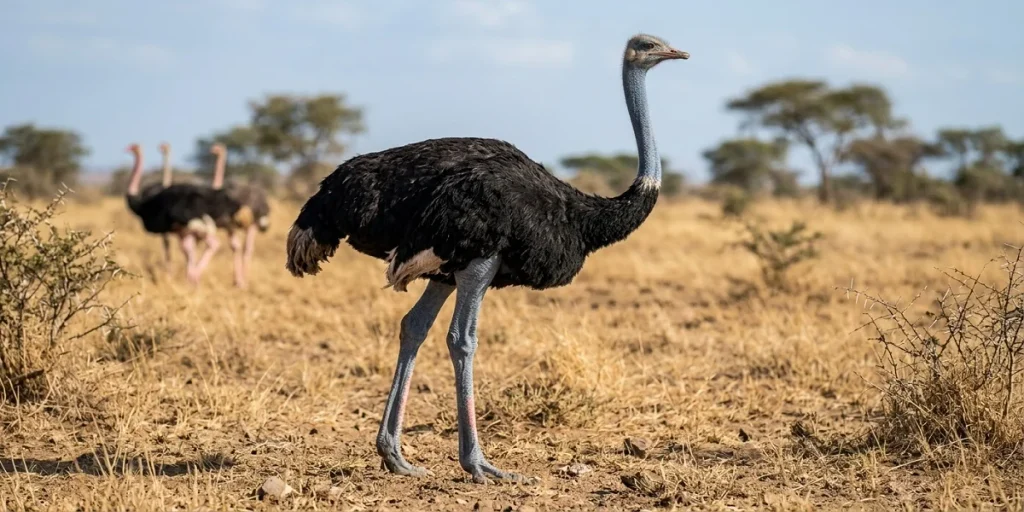
The Somali ostrich has a distinctive blue-gray coloration on its neck and legs, making it visually different from many Common ostriches.
This blue-gray skin becomes particularly noticeable in males during the breeding season. The coloration is one of the easiest external features to use when distinguishing the Somali ostrich from other ostrich populations.
23. Some Ostrich Populations Have a Serious Conservation History
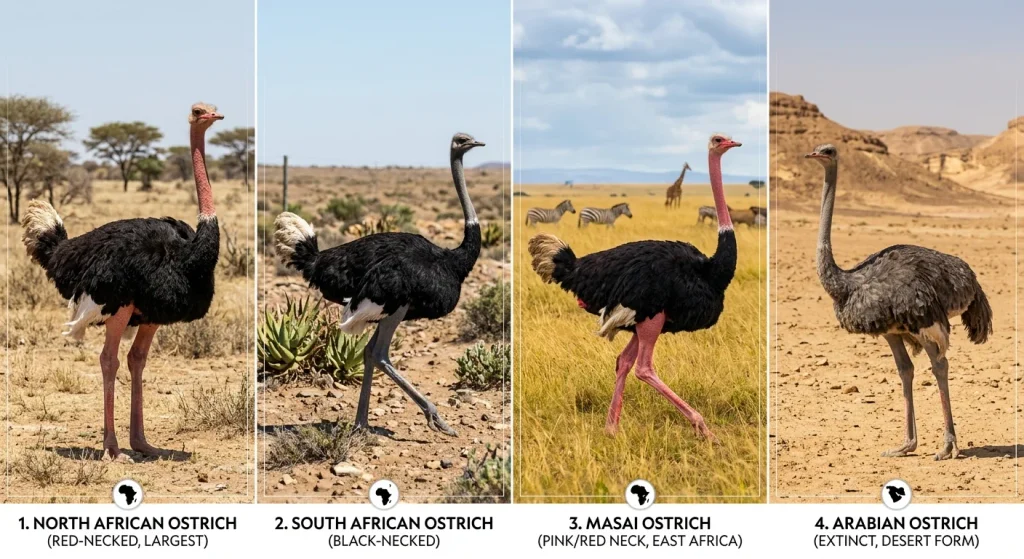
Not every ostrich population has the same conservation story. The Arabian ostrich, a historical form that once lived across parts of the Arabian Peninsula, became extinct during the 20th century, with the last known individuals disappearing by the 1960s.
The North African ostrich, sometimes called the red-necked ostrich, has also faced severe population declines and is considered critically endangered at the population or subspecies level. This is an important reminder that the widespread presence of ostriches in Africa does not mean every population is secure.
| Ostrich population or form | General range or history | Conservation note |
|---|---|---|
| Common ostrich | Much of sub-Saharan Africa | Widespread overall |
| North African ostrich | North Africa and parts of the Sahel | Critically endangered population |
| Masai ostrich | Eastern Africa | Native East African population |
| Southern ostrich | Southern Africa | Important wild and farmed population |
| Somali ostrich | Horn of Africa | Recognized as a separate species |
| Arabian ostrich | Arabian Peninsula | Extinct |
Conservation status can vary depending on whether a source is discussing the entire species, a subspecies, or a particular regional population, so these categories should not be treated as interchangeable.
24. Wild Ostriches Live Only in Africa
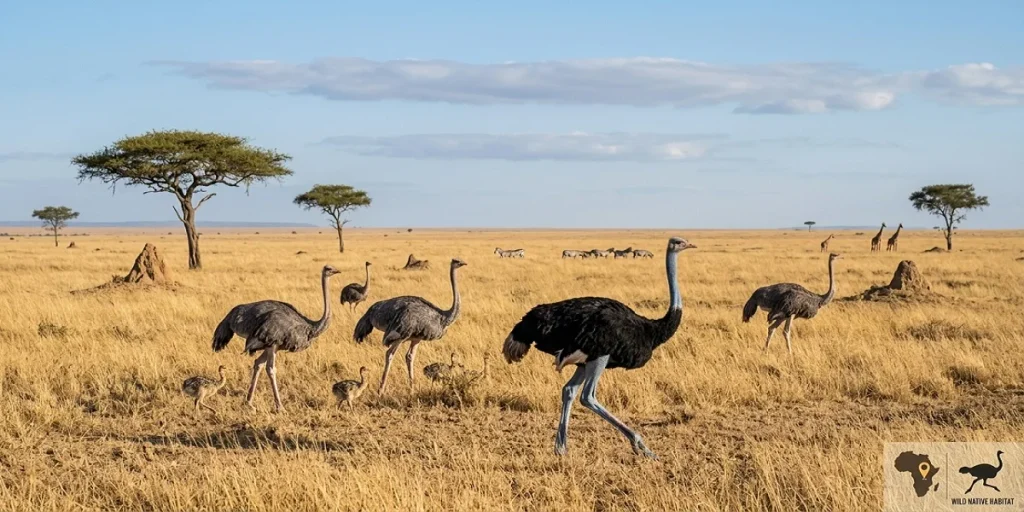
Wild ostriches are native to Africa, where they inhabit open environments such as savannas, grasslands, semi-arid regions, and open woodland.
Their preference for open landscapes is closely connected to their biology. Long legs, excellent eyesight, and exceptional running ability are particularly useful where there is little vegetation to obstruct their view or movement.
Ostriches are also farmed far beyond their native range, so seeing a domesticated ostrich in another part of the world does not mean the species naturally occurs there in the wild.
25. Ostriches Belong to the Ratite Group of Flightless Birds
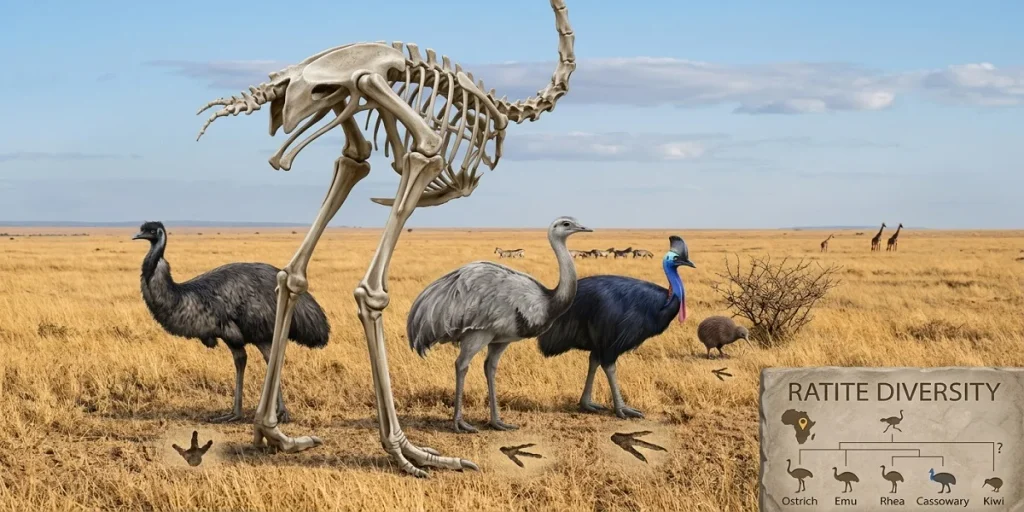
Ostriches are traditionally grouped among the ratites, a group of large flightless birds that also includes emus, rheas, cassowaries, and kiwis.
These birds share the broad characteristic of being flightless, although modern evolutionary research has shown that the relationships among ratites are more complicated than the traditional classification suggests.
The ostrich is therefore not simply a giant version of an ordinary bird that lost the ability to fly. Its anatomy has evolved around a completely different lifestyle, with powerful legs, reduced flight adaptations, and a body built primarily for efficient movement across open ground.
Ostriches and Humans
Humans have interacted with ostriches for thousands of years, long before modern ostrich farming and commercial production developed. Their feathers, eggs, meat, and leather have all found uses in different cultures and industries, giving the ostrich an unusual place at the intersection of wildlife, agriculture, and human history.
26. Ostrich Feathers Have Been Prized for Thousands of Years

Ostrich feathers have been valued by humans for thousands of years and have appeared in clothing, decoration, ceremonial objects, and other cultural traditions.
Their unusual softness and large size made them especially attractive for decorative purposes. Ostrich feathers are still used today in fashion, costumes, interior decoration, and specialized products, although modern production and trade are subject to different regulations depending on the country and whether the feathers come from farmed or wild birds.
27. Ostrich Leather Is a Valuable Commercial Product

Ostrich leather is one of the most distinctive animal leathers used in the luxury goods industry. Its characteristic pattern comes from the large feather follicles distributed across the skin, producing a texture that is immediately recognizable.
The leather is valued for its durability, flexibility, and appearance and can be used for products such as footwear, handbags, wallets, belts, and other accessories. Unlike conventional poultry production, ostrich farming can therefore generate several commercial products from the same bird.
28. Ostrich Eggshells Have Been Used as Containers and Ornaments

Long before ostrich eggs became associated with farms, restaurants, or wildlife attractions, their exceptionally strong shells were useful to people living in regions where ostriches occurred naturally.
Ostrich eggshell fragments have been used to make beads and ornaments, while intact shells have been used as containers and vessels for water and other materials. Archaeological discoveries of ostrich eggshell artifacts provide evidence of a long history of human use.
29. Modern Ostrich Farming Began in South Africa
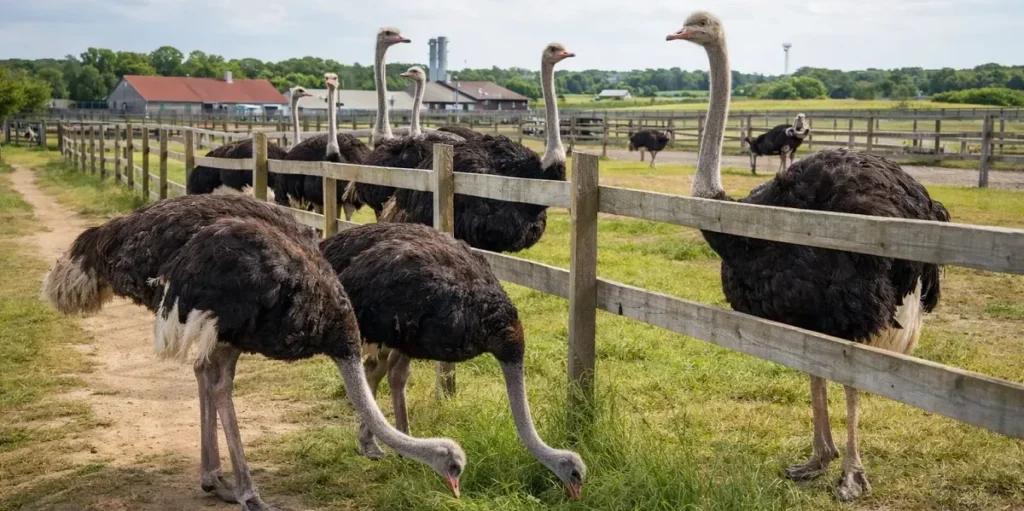
Modern commercial ostrich farming developed in South Africa during the 19th century, initially driven largely by demand for ostrich feathers.
The industry later expanded beyond feathers to include meat, leather, eggs, and other products. Today, ostrich farming exists in several countries and is often presented as a form of diversified livestock production because a single bird can provide multiple commercially valuable products.
30. Ostrich Meat Is Classified as Red Meat

Ostrich meat comes from a bird, but nutritionally and commercially it is generally classified as red meat rather than white poultry meat.
The dark red color is related largely to the high concentration of myoglobin in ostrich muscle. Ostriches are active, powerful runners, and their muscles are adapted for sustained movement, which contributes to the characteristics of the meat.
Ostrich meat is also relatively lean compared with many conventional red meats, which is one reason it has attracted interest among consumers and producers looking for alternative meat products.
How Long Does an Ostrich Live?
There is no single universally accepted number for how long an ostrich can live. Different sources report lifespans ranging from around 30 years to more than 70 years, with the biggest differences often coming from whether they are discussing wild birds, captive birds, typical lifespan, or exceptional individuals.
Ostriches Commonly Live for Around 30 to 40 Years
A lifespan of 30 to 40 years is a reasonable range commonly reported for ostriches, particularly when discussing typical adult longevity rather than exceptional captive records.
Wild ostriches face many challenges that can shorten lifespan, including predators, drought, disease, food availability, and injuries. Because following individual wild ostriches throughout their entire lives is difficult, reliable data on maximum lifespan in the wild are limited.
Captive Ostriches May Live Longer
Ostriches kept under human care can sometimes live considerably longer than the commonly quoted 30 to 40 years. Some sources report captive birds reaching 50 years or more, while higher estimates of 70 years or beyond have also been published.
These exceptionally high figures should not be interpreted as the normal lifespan of every ostrich. A maximum reported age and a typical lifespan are two different measurements, and animal fact lists often blur that distinction.
Why Do Ostrich Lifespan Estimates Vary So Much?
The main reason is that researchers do not have equally reliable long-term records for every ostrich population. A source reporting a maximum age in captivity is answering a different question from a source estimating the typical lifespan of wild birds.
| Lifespan figure | What it generally represents |
|---|---|
| Around 30 years | A lower-end lifespan estimate |
| 30–40 years | A commonly reported typical range |
| Around 50 years | Longer-lived captive birds |
| 70+ years | Exceptional or high-end reported estimates |
For that reason, it is more accurate to say that ostriches can live for several decades, with around 30 to 40 years being a useful general range and substantially longer lifespans reported for some birds in captivity.
The important point is not which source gives the biggest number. It is understanding what each number actually represents.
Ostrich Myths vs Facts
Ostriches have inspired some of the most persistent animal myths on the internet. A few of these stories come from misunderstandings of normal ostrich behavior, while others have simply been repeated so often that they are treated as facts.
Here are five of the most common ostrich myths, along with what the evidence actually shows.
Myth 1: Ostriches Have Three Stomachs
Fact: Ostriches do not have three stomachs.
Their digestive system includes a proventriculus, which is the glandular stomach, and a muscular gizzard that mechanically grinds food. They also have two large caeca farther along the digestive tract, but these are parts of the hindgut rather than additional stomachs.
The “three stomachs” claim likely comes from oversimplified descriptions of different digestive chambers. Anatomically, calling all of these structures separate stomachs is incorrect.
Myth 2: Ostriches Bury Their Heads in the Sand
Fact: Ostriches do not deliberately bury their heads in sand to hide from predators.
The myth may partly come from nesting behavior. Ostriches regularly lower their heads toward their shallow ground nests, and from a distance this can make the head difficult to see against the ground.
When threatened, an ostrich is far more likely to rely on its excellent eyesight, speed, and ability to run across open terrain than attempt to hide its head.
Myth3 : Ostriches Can Fly a Little
Fact: Ostriches are completely flightless.
Their wings are large and useful for balance, steering, braking, courtship, and threat displays, but they cannot generate enough lift to carry the bird into sustained flight.
Instead, ostriches have evolved powerful legs and a highly efficient running anatomy. Their ability to reach speeds of around 43 mph (70 km/h) is far more important to their survival than flight would be.
Myth4 : An Ostrich Egg Is Huge Compared With the Mother
Fact: An ostrich egg is the largest bird egg in absolute size, but it is surprisingly small relative to the size of the female.
A typical ostrich egg weighs roughly 1.3 to 1.4 kg (2.9 to 3.1 lb), which sounds enormous until it is compared with an adult female that can weigh well over 200 lb (90 kg).
This makes the ostrich egg a good example of why “largest” does not always mean “largest relative to body size.”
Myth5 : There Is Only One Living Ostrich Species
Fact: Modern classifications recognize two living ostrich species: the Common ostrich (Struthio camelus) and the Somali ostrich (Struthio molybdophanes).
Older sources often describe the Somali ostrich as a subspecies of the Common ostrich. Modern taxonomic treatments recognize it as a distinct species, which means older ostrich fact lists can contain outdated information even when the rest of their descriptions are accurate.
Frequently Asked Questions About Ostriches
What are 5 interesting facts about ostriches?
Five interesting ostrich facts are that they are the largest and heaviest living birds, can run at around 43 mph (70 km/h), have only two toes on each foot, lay the largest eggs of any living bird, and have eyes that are larger than their brains.
What is an ostrich famous for?
An ostrich is famous for its enormous size, exceptional running speed, large eyes, two-toed feet, and large eggs. It is also widely known for the myth that it buries its head in the sand, even though ostriches do not actually behave this way.
Do ostriches have three stomachs?
No, ostriches do not have three stomachs. Their digestive system includes a glandular stomach called the proventriculus and a muscular gizzard, followed by other parts of the digestive tract including two large caeca.
The widespread “three stomachs” claim usually comes from confusing different digestive structures with separate stomachs.
How long does an ostrich live?
Ostriches commonly live for around 30 to 40 years, although longer lifespans have been reported, particularly for birds kept in captivity. Some sources report captive ostriches reaching 50 years or more, while exceptionally high estimates of 70 years or beyond have also been published.
Because reliable lifetime records for wild ostriches are limited, it is better to give a range than to present one maximum figure as a typical lifespan.
Why don’t we eat ostrich eggs?
People can eat ostrich eggs, but they are not commonly eaten because they are large, expensive, and relatively impractical compared with chicken eggs. One ostrich egg can weigh roughly 1.3 to 1.4 kg (2.9 to 3.1 lb) and is equivalent to roughly two dozen chicken eggs by volume.
Their thick shells also make them more difficult to crack, while the limited supply of ostrich eggs makes them much less convenient for everyday cooking.
Is it legal to eat ostrich eggs in the US?
Generally, eating ostrich eggs is not inherently illegal in the United States, but the rules surrounding their sale, handling, processing, and commercial distribution can vary. Food-safety requirements and state regulations may apply, particularly when eggs are being sold commercially.
For that reason, legality should not be reduced to a simple nationwide yes-or-no answer. Anyone buying or selling ostrich eggs for food should check the applicable federal, state, and local requirements.
How much is one ostrich egg worth?
The price of an ostrich egg varies considerably depending on the country, whether it is intended for eating or decoration, and whether it is fresh, fertilized, or preserved. Edible eggs can cost substantially more than ordinary chicken eggs because ostriches produce relatively few eggs and the eggs are much larger.
Decorative or collectible ostrich eggshells can also command different prices, so there is no single universal value for one ostrich egg.
How much does a baby ostrich cost?
A baby ostrich can cost anywhere from a few hundred dollars to significantly more depending on age, breeder, location, genetics, and local market conditions. Newly hatched chicks are generally less expensive than older juveniles, while breeding-quality birds can be worth considerably more.
Can an ostrich really kill a lion?
An ostrich can potentially inflict serious or even fatal injuries on a predator with a powerful defensive kick, but killing a lion is not normal ostrich behavior. Ostriches generally rely on their eyesight and remarkable speed to avoid predators rather than deliberately fighting them.
A large predator such as a lion presents a serious threat, particularly to chicks and vulnerable adults. An ostrich’s powerful legs and claw are primarily defensive adaptations used when escape is difficult or impossible.