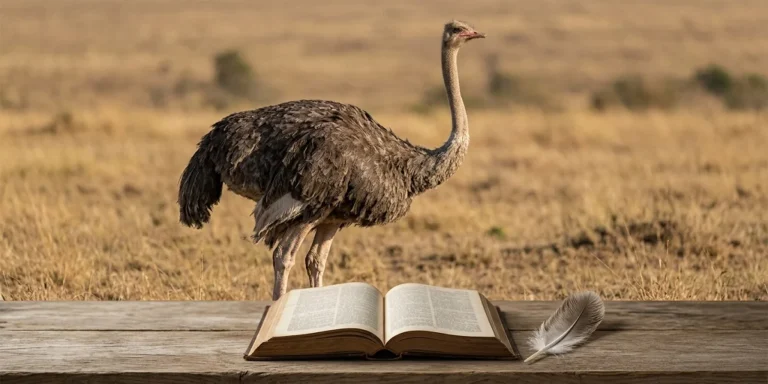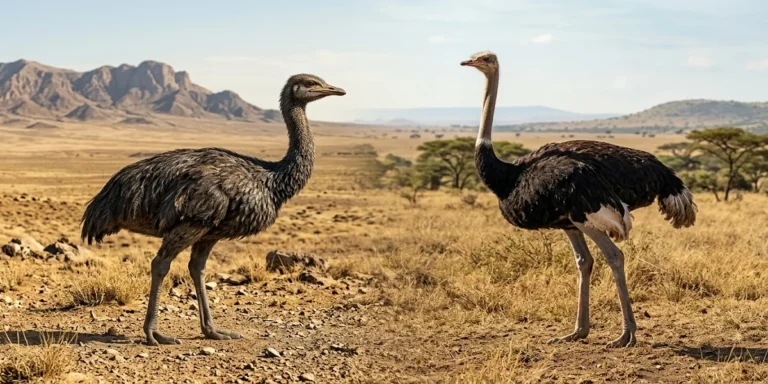
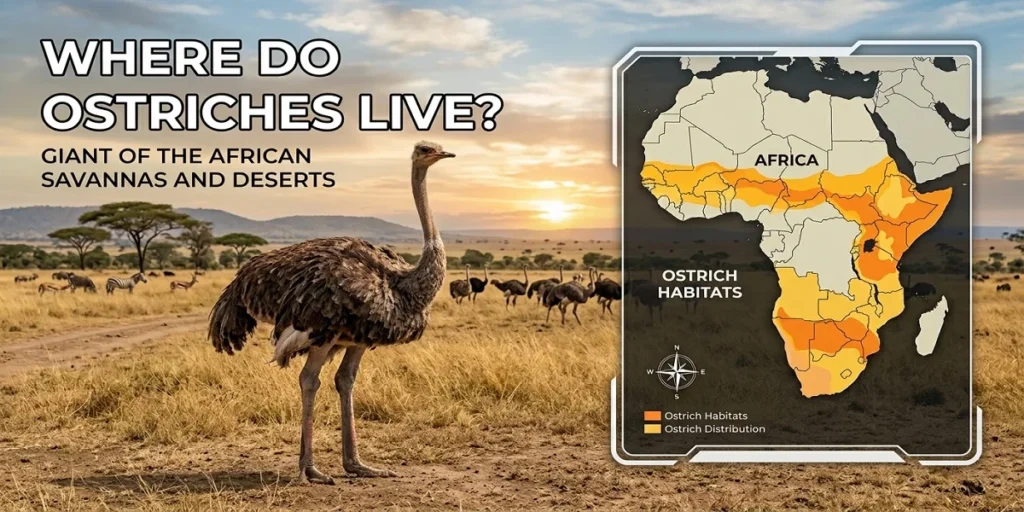
Quick Answer: The ostrich habitat is found primarily across Africa, where they naturally live in open habitats such as savannas, dry grasslands, semi-deserts, and open woodlands. Their native range extends across parts of eastern, southern, and northeastern Africa, with different ostrich species and populations occupying distinct geographic regions. Small introduced or feral populations have also occurred outside Africa, including in Australia, Israel, and the United States, though these are not part of the bird’s original natural range.
Table of Contents
The ostrich is the world’s largest living bird, and its enormous size is closely connected to the environments it occupies. Rather than living in dense forests or rugged mountain landscapes, ostriches strongly favor broad, open country. These vast terrains allow them to forage efficiently, move quickly, and spot potential predators from a considerable distance.
Understanding ostrich habitat therefore means looking beyond a simple map of Africa. The species’ distribution is shaped by complex factors, including vegetation density, rainfall patterns, temperature variations, water availability, and above all, the need for unobstructed space.
Where Do Ostriches Live in the Wild?
Wild ostriches are exclusively native to Africa. Their modern distribution is heavily concentrated in the continent’s open and relatively dry regions, including parts of the Sahel, East Africa, and southern Africa.
Historically, ostriches occupied a much broader area than their present-day range. They once roamed across large parts of northern Africa and extended deep into the Middle East. Over time, heavy hunting, sweeping habitat changes, and human expansion caused several historic populations to vanish entirely.
Today, the largest and most recognizable wild populations are firmly tied to the open landscapes of sub-Saharan Africa. These environments encompass vast savannas, dry grasslands, semi-arid plains, and areas of sparse, open woodland.
The exact natural range depends on which ostrich species or subspecies is being considered:
- Common Ostrich (Struthio camelus): Occupies the majority of the species’ traditional range across western, eastern, and southern Africa.
- Somali Ostrich (Struthio molybdophanes): Distinctly concentrated in the Horn of Africa, particularly across Somalia, Ethiopia, and northern Kenya.
These geographic differences matter because the specific environments used by each species are not identical. Overall, ostriches are exceptionally well suited to landscapes where vegetation is available for food but does not obstruct visibility. This unique balance allows them to combine daily feeding with their primary survival strategy: detecting danger early and leveraging their exceptional running speed to escape.
Ostrich Habitat Map: The Natural Range Across Africa
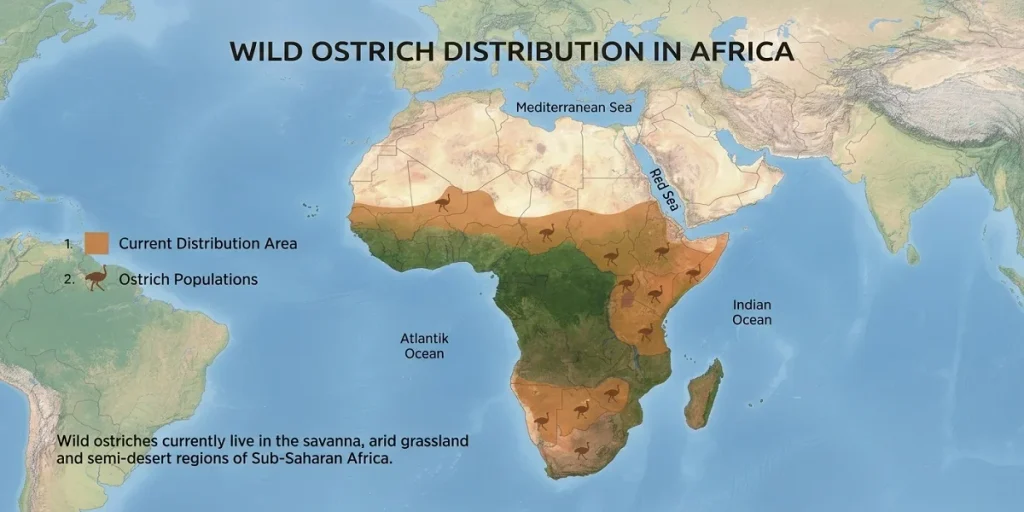
An ostrich habitat map can look deceptively simple if it merely shades the African continent as a whole. In reality, ostrich distribution is clustered within specific ecological zones rather than being uniformly spread across the region.
To truly understand their natural range, it helps to break the continent down into several major geographic zones.
The Sahel and Southern Sahara Fringe
The Sahel forms a critical portion of the ostrich’s northern sub-Saharan range. This semi-arid belt stretches directly across Africa, south of the Sahara Desert, featuring a rich mix of dry grassland, scattered shrubs, open plains, and seasonal vegetation.
These exact conditions suit ostriches perfectly. They provide continuous foraging opportunities without creating dense thickets that would restrict movement or block sightlines.
While ostriches were historically widespread across the Sahel and North Africa, surviving northern populations are now fragmented. This makes the northern edge of their natural range far less continuous than it was in centuries past.
East Africa
East Africa stands out as one of the most vital strongholds for wild ostriches. Countries like Kenya, Tanzania, and Ethiopia feature vast expanses of savanna, open grassland, and semi-arid terrain ideal for giant flightless birds.
This region is particularly fascinating because it serves as an overlap zone for multiple species. The common ostrich and the Somali ostrich occupy slightly different ecological niches here, allowing them to utilize distinct environments even where their geographic ranges meet.
Furthermore, East African savannas clearly show why ostriches do not require barren deserts to thrive. Seasonal grasses, hardy shrubs, scattered trees, and sweeping plains supply plenty of food while preserving the wide-open sightlines ostriches need to stay safe.
Southern Africa
Ostriches also occupy extensive territories across southern Africa, thriving in open grasslands, savannas, and arid brushlands.
Southwestern Africa provides some of the most extreme examples of functional ostrich habitat. In regions like the Kalahari and Namib deserts, ostriches live in hyper-dry environments where surface water is exceptionally scarce and temperatures swing dramatically between day and night.
Their remarkable ability to extract moisture directly from food, tolerate intense heat, and cover immense distances in search of resources explains how they master such unforgiving landscapes.
Why the Range Is Not Continuous
An essential detail often overlooked on basic animal distribution maps is that being located within Africa does not automatically make a region suitable for ostriches.
Ostriches actively avoid several major environmental zones:
- Dense tropical rainforests (such as the Congo Basin)
- Heavily urbanized or developed zones
- Steep, rugged mountain ranges
- Regions with thick, impenetrable brush
Human activity has further fragmented their historic range. The expansion of commercial agriculture, intensive livestock grazing, fences, infrastructure, and habitat conversion have drastically reduced the unbroken open land available to wild birds.
As a result, a truly accurate ostrich habitat map should be viewed as a network of suitable, interconnected ecological zones rather than a blanket coverage of the African continent.
Where Different Ostrich Species Live
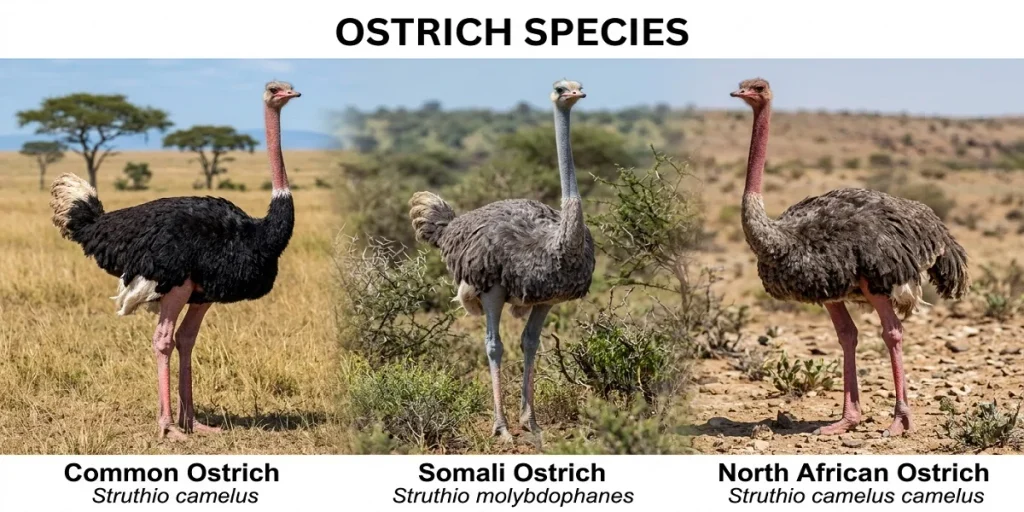
Although people often speak of “the ostrich” as if every population occupies the exact same environment, modern taxonomy recognizes more than one living ostrich species, and their geographic ranges are distinctly separate.
The common ostrich (Struthio camelus) occupies broad stretches of eastern, southern, and northeastern Africa. In contrast, the Somali ostrich (Struthio molybdophanes) is concentrated predominantly in the Horn of Africa.
Furthermore, key regional populations exist within the common ostrich’s broader range, including the North African ostrich, which has experienced a severe collapse in its historical range.
These ecological distinctions are critical when analyzing an ostrich habitat map. The shaded regions on a map do not represent one uniform biome; instead, different populations have adapted to specific combinations of rainfall, vegetation density, ambient temperature, and seasonal food availability.
Common Ostrich: The Widest African Range
The common ostrich (Struthio camelus) boasts the most expansive modern distribution among living ratites. Its range spans vast parts of the Sahel, East Africa, and southern Africa, covering a remarkably diverse array of open landscapes.
Common ostriches are heavily tied to open savannas, dry grasslands, semi-arid plains, and other sparsely vegetated biomes. They can easily adapt to areas with scattered shrubs and isolated trees, provided the woody growth never becomes dense enough to obstruct movement or clear sightlines.
This broad ecological tolerance explains why common ostriches thrive in environments ranging from productive, rain-fed grasslands to hyper-arid desert fringes. Their diet is highly flexible, allowing them to travel vast distances when surface water and preferred forage grow scarce.
Somali Ostrich: The Horn of Africa Specialist
The Somali ostrich (Struthio molybdophanes) is recognized as a distinct species rather than a mere regional variant. Its natural range is centered on the Horn of Africa, encompassing Somalia, eastern Ethiopia, and northern Kenya.
Compared to its common relative, the Somali ostrich is far more specialized for arid and semi-arid brushlands containing higher densities of shrubs and thorny trees. It is particularly noted for its browsing habits, frequently feeding on leaves, buds, and elevated vegetation rather than relying solely on ground forage.
This specialized adaptation does not mean Somali ostriches inhabit dense forests. They remain deeply dependent on open, navigable landscapes where they can move freely and spot potential threats. However, their preferred habitats routinely feature thicker scrubland than the classic open grasslands favored by common ostriches.
In northern and eastern Kenya, the geographic ranges of the common ostrich and Somali ostrich overlap. Their differing habitat preferences and feeding strategies help reduce direct competition for resources across these shared territories.
North African Ostrich: A Fragmented Former Range
The North African ostrich serves as a poignant example of how human expansion can rewrite a species’ historical map.
Historically, ostriches roamed across vast reaches of North Africa and the Sahel, occupying a significantly larger territory than they do today. Intense hunting, habitat degradation, and encroaching human activity triggered severe population collapses, leaving surviving North African populations isolated and highly fragmented.
These birds are finely adapted to harsh, dry environments, including Sahelian drylands and semi-arid plains. Their historic decline is not merely a story of declining numbers; it represents the total loss of ostriches from extensive biomes where they naturally evolved.
This historical context is vital when reading modern distribution maps. A map depicting where ostriches live today presents only a remnant of the expansive geographic footprint they once held.
Ostrich Species and Habitat Differences at a Glance
| Species / Population | Primary Geographic Region | Typical Habitat Biome | Key Ecological Trait |
|---|---|---|---|
| Common Ostrich | East, Southern, and Northeastern Africa | Open savanna, dry grassland, semi-arid plains | Broad habitat tolerance; versatile mixed feeder |
| Somali Ostrich | Horn of Africa and Northern Kenya | Arid savanna, dense scrubland, open woodland | Heavy reliance on browsing leaves and shrubs |
| North African Ostrich | Sahel and North Africa (Historically) | Open dry grasslands and semi-arid plains | Adapted to extreme aridity; highly fragmented range |
As the comparison highlights, simply stating that “ostriches live in Africa” overlooks essential ecological nuances. Their total range spans multiple complex ecosystems, with distinct species demonstrating specialized habitat preferences.
A First-Hand View of Ostrich Habitat in Tanzania
One of the clearest ways to grasp the relationship between ostriches and open terrain is to observe them directly in their native habitat.
Living in Tanzania, I have had the opportunity to watch ostriches move across these landscapes firsthand. What strikes you immediately is how completely exposed the birds are in open country. Rather than seeking cover in dense thickets, an ostrich stands tall against the sweeping horizon, using its immense height to scan miles of surrounding grassland.
Experiencing this landscape makes the ecological logic behind their habitat preference instantly clear. An ostrich’s incredible stature, elongated neck, keen eyesight, and powerful legs are perfectly engineered for landscapes that offer unrestricted views and room to run.
It serves as an unforgettable reminder that an ostrich habitat map is far more than shaded political boundaries. The true story lies in the relationship between the bird and the wide-open landscape beneath its feet.
What Is an Ostrich’s Natural Habitat?
Ostriches are frequently depicted standing alone in a vast, barren desert. However, that popular image is incomplete. In reality, their natural habitat is far broader and generally much more biologically productive than a true desert.
Wild ostriches are most strongly tied to open savannas, dry grasslands, semi-deserts, and open woodlands. While these biomes can look visually distinct, they all share crucial physical characteristics suited to an ostrich’s unique biology: expansive room to move, adequate vegetation for foraging, and clear, unobstructed sightlines.
An ostrich does not require a completely treeless landscape. Scattered trees, hardy shrubs, and patches of taller vegetation are routinely part of ideal habitat. The key distinction is that the landscape must remain open enough for a massive, fast-running bird to navigate without constant physical barriers.
Savanna and Dry Grassland
Savanna and dry grassland represent the quintessential ostrich habitats. These biomes combine native grasses with scattered shrubs or trees, striking a perfect balance between abundant food supply and clear spatial visibility.
Seasonal rainfall creates dynamic conditions in these environments, bringing periods of lush growth followed by long dry spells. Ostriches are exceptionally well adapted to this variability thanks to their versatile diet and their ability to travel extensive distances in search of fresh forage.
Open grasslands also deliver a vital defensive advantage. With minimal tall cover to block the view, an ostrich can forage while continuously monitoring its surroundings. Its impressive physical height provides an elevated perspective over tall grasses, allowing it to spot incoming threats from impressive distances.
This powerful combination of food, visibility, and space to run explains why open savannas remain the ultimate stronghold for wild ostriches.
Semi-Desert and Desert Environments
Ostriches are equally capable of thriving in severe, hyper-arid environments, including semi-deserts and the margins of true deserts.
These arid biomes are particularly prominent across parts of southern and southwestern Africa, where annual rainfall is exceptionally low. In regions like the Kalahari, ostriches often trek vast distances between scattered feeding grounds and sparse water sources.
Crucially, their daily survival does not depend on visiting a permanent waterhole. Ostriches possess remarkable physiological adaptations that allow them to extract substantial moisture directly from succulent plants, roots, and seeds. This moisture retention capability enables them to exploit harsh regions where standing surface water is virtually non-existent.
This physiological edge highlights why calling ostriches “desert birds” is slightly misleading. They are not limited to deserts; rather, they are open-habitat specialists capable of mastering everything from productive savannas to hyper-arid plains.
Open Woodland and Shrubland
Not every high-quality ostrich habitat is dominated exclusively by open grass.
Certain populations, particularly the Somali ostrich, regularly utilize open woodlands and shrub-dense environments where woody vegetation is more prevalent. These landscapes maintain sufficient gaps for rapid locomotion and clear sightlines while offering a wider dietary selection of leaves, tender shoots, buds, and fruit.
The defining factor remains spatial density. A landscape can feature numerous trees and still serve as prime ostrich habitat provided those trees are adequately spaced. The true obstacle is dense, continuous canopy or thick brush that restricts movement and blindfolds the bird to approaching predators.
Why Ostriches Avoid Dense Forests
Dense forests are fundamentally incompatible with the evolutionary design of the ostrich.
An ostrich’s primary survival mechanism relies entirely on early threat detection and explosive speed. Its long, powerful legs are built to cover vast open ground, but that physical advantage becomes useless in tightly packed timber or jungle thickets.
Furthermore, dense tropical or temperate forests present constant physical obstacles for such a large bird. Instead of enjoying a wide, 360-degree field of view, an ostrich in a forest would be hemmed in by tree trunks, low-hanging branches, and dense undergrowth.
This distinction clarifies an important nuance: while dense, closed-canopy rainforests are completely uninhabitable for ostriches, open woodlands with wide natural corridors suit them very well.
Why Mountainous Terrain Is Also Unfavorable
Ostriches evolved to sprint across relatively flat or rolling ground, not to traverse steep, rocky mountain slopes.
Their heavy bodies and specialized two-toed feet are engineered for high-speed efficiency across open plains. Steep inclines, loose scree, and narrow mountain passes negate their speed, increase the risk of injury, and severely hamper mobility.
Moreover, mountainous terrain naturally fragments the wide, continuous fields of view that ostriches rely on to stay safe. For a flightless bird whose main defense is spotting danger early and running away at 40 mph, a sweeping, uninterrupted plain is infinitely safer than a craggy canyon or steep ridge.
What All Ostrich Habitats Have in Common
Despite the visual differences between a grassy savanna, a thorny shrubland, and a dusty semi-desert, every successful ostrich habitat features the exact same core ecological ingredients:
- Unobstructed Space: Expansive terrain for walking, high-speed running, and long-distance foraging.
- Reliable Forage: Sufficient vegetation (grasses, succulents, shrubs, seeds) to sustain them through changing seasons.
- 360-Degree Sightlines: Open views that allow their elevated eyes to detect predators early.
- Navigable Topography: Flat, gently rolling, or accessible terrain rather than steep, rocky mountains.
- Seasonal Resilience: Conditions that support nomadic or wide-ranging movements when resources shift.
This shared set of requirements forms the common thread running across their entire geographic footprint. An ostrich does not specifically seek out the hottest or most barren landscape on Earth; it simply requires a habitat that gives it space to see, room to run, and enough food to fuel its massive frame.
How Ostriches Adapt to Different Climates
The ostrich is deeply associated with sun-scorched African landscapes, but its survival capabilities are not defined by high temperatures alone. Across their native continent, wild ostriches navigate drastic shifts in intense heat, seasonal rainfall, and shifting climate patterns.
Their unique physical physiology gives them distinct advantages in biomes where climate conditions reach natural extremes. At the same time, the fact that ostriches demonstrate notable cold tolerance in captive farming environment does not mean that snowy, sub-zero conditions form part of their wild African range.
How Ostriches Handle Extreme Heat
Ostriches comfortably inhabit some of Africa’s most punishing environments, thriving even where natural shade and surface water are minimal.
While a massive body might seem like a disadvantage in extreme heat, an ostrich possesses specialized biological defenses against thermal stress. Their thick plumage acts as highly effective insulation against intense solar radiation, while their long, bare legs elevate the main body high above the superheated ground surface.
Behaviorally, ostriches adjust their routine based on ambient temperatures. During peak daytime heat, they minimize physical exertion, face into the light wind, or seek sparse shade, saving their active foraging for cooler morning and evening hours.
Furthermore, their ability to extract essential fluids directly from their diet is vital in arid zones. While ostriches will readily drink when water is accessible, their metabolic efficiency allows them to survive extended periods without standing surface water.
Can Ostriches Survive in Cold Climates?
Yes, ostriches can tolerate surprisingly cold conditions. Their dense plumage provides substantial insulation, and healthy adult birds can handle temperatures far lower than the scorching heat most people expect.
This high cold-tolerance explains why commercial ostrich farming has succeeded across cold-winter regions in Europe, North America, and Asia.
However, a clear distinction must be made between physiological tolerance and natural habitat.
The ability to endure a freezing night inside an enclosure does not mean wild ostriches naturally occupy alpine environments or snowy evergreen forests. Wild ostriches remain strictly bound to open African landscapes; cold-climate populations outside Africa exist exclusively under human management or agricultural farming.
In short, the ostrich is far more climate-flexible than its popular reputation suggests, yet its ecological preference remains firmly anchored to open terrain.
How Water Availability Shapes Ostrich Habitat
While water is vital for survival, an ostrich’s relationship with it differs significantly from that of obligate-drinking wildlife that must stay tied to permanent rivers.
In dry regions, ostriches derive a large portion of their fluid intake from succulent vegetation, roots, seeds, and insects. This physiological trick allows them to exploit wide territories far beyond the reach of permanent lakes or watering holes.
When localized rains fall, ostriches utilize their long legs to move across vast distances toward freshly sprouted green vegetation. This mobility makes them exceptionally resilient in seasonal African ecosystems, where the shift between wet and dry cycles drastically alters food availability across the landscape.
Where Do Ostriches Live Outside Africa?
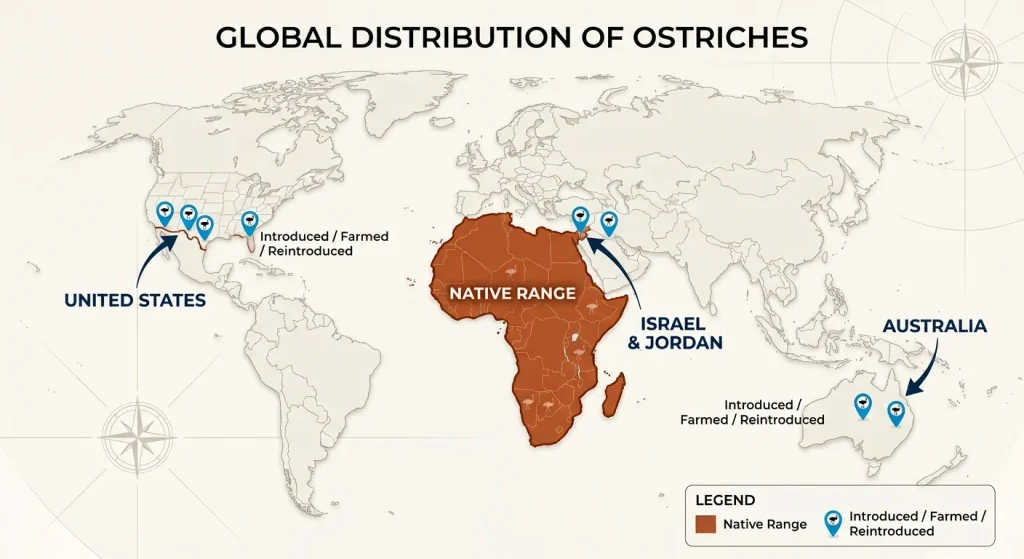
Africa is the ostrich’s sole native continent, but human commerce has transported the species across the global map.
Ostriches have been exported worldwide for their meat, leather, feathers, eggs, and breeding stock. The overwhelming majority of ostriches outside Africa reside on commercial farms or managed reserves rather than forming self-sustaining wild herds.
However, small groups of escaped or released birds have occasionally established localized feral populations. These instances represent human introductions rather than natural geographic expansion.
Australia
Ostriches were brought to Australia during the late 19th and early 20th centuries to build a commercial feather and livestock industry.
Over time, birds escaped or were turned loose from failing farms, leading to scattered sightings of free-ranging ostriches in dry interior regions. However, these birds do not constitute an indigenous Australian species.
This history resolves a widespread geographic question:
Do ostriches live naturally in Africa or Australia?
They are strictly native to Africa. Any ostriches found in Australia today stem directly from historical farm stock transported by humans. Australia is not part of the bird’s original natural range, even though its semi-arid interior offers a climate well suited for farmed populations.
Israel and the Middle East
The history of ostriches in the Middle East is uniquely complex because parts of the region were historically part of the bird’s natural footprint.
Wild Arabian ostriches (Struthio camelus syriacus) once ranged across broad stretches of the Middle East. However, relentless hunting and habitat conversion drove this subspecies to total extinction by the mid-20th century.
Decades later, conservation projects reintroduced common ostriches into protected reserves in Israel and Jordan to restore the ecological role lost with the Arabian ostrich. These managed populations must be distinguished from the continuous, unbroken wild herds of sub-Saharan Africa.
United States
Ostrich farming has a long history in the United States, beginning in the late 1800s for fashion plumage and booming again in the late 20th century for leather and meat.
Occasional free-ranging or feral individuals are reported in states like New Mexico, Arizona, and Texas following farm escapes or collection releases. These scattered sightings are not evidence of natural migration; their presence traces entirely back to domestic farming imports.
Native Range vs. Introduced Population Summary
| Location | Arrival Mechanism | Part of Natural Range? | Primary Modern Context |
| Africa | Indigenous / Native evolution | Yes | Wild populations and natural ecological habitat |
| Australia | 19th/20th-century human import | No | Commercial farming and small feral escapee pockets |
| Israel & Middle East | Historical natural range, modern reintroduction | Historically Yes | Protected conservation enclosures and rewilding projects |
| United States | Commercial agriculture import | No | Livestock farming and isolated farm escapees |
The vast majority of the world’s wild ostriches remain tied to the African continent. Spotting an ostrich outside Africa does not mean the species naturally expanded its territory; understanding how that population arrived is essential to reading its geographic story.
Food, Predators and Survival in the Ostrich Habitat
An ostrich’s natural habitat does far more than provide simple shelter. It dictates what the bird can eat, where it locates water, how easily it spots predators, and how far it must trek between critical resources.
The broad, open landscapes favored by ostriches present both distinct advantages and dangerous threats. While these spaces supply ample room to move and clear 360-degree visibility, they offer virtually zero cover when danger approaches. To thrive in these environments, ostriches have evolved a powerful combination of dietary flexibility, immense stamina, high-speed sprinting, and lethal kicks.
What Do Ostriches Eat in Their Natural Habitat?
Ostriches are primarily herbivorous, but their diet is highly adaptable based on seasonal availability across their habitat.
They regularly feed on native seeds, grasses, tender leaves, flowers, succulent fruits, and hardy roots. In dry biomes, they rely heavily on deep-rooted or moisture-rich vegetation that survives long after rains have vanished.
Additionally, ostriches are opportunistic omnivores. When available, they willingly supplement their plant diet with small invertebrates and small creatures, including insects, lizards, and small rodents.
Because ostriches lack teeth to chew tough plant material, they swallow small stones and coarse grit. These hard pebbles accumulate in their muscular gizzard, mechanically grinding down fibrous vegetation and tough seeds for digestion.
This dietary flexibility explains why ostriches inhabit such diverse biomes. Instead of depending on a single plant species, an ostrich easily transitions its feeding strategy across changing seasons and landscapes.
Predators in the Wild
Living in wide-open African terrain delivers unmatched visibility, but it also leaves ostriches completely exposed to top predators.
Adult ostriches are primarily hunted by large apex carnivores, including lions, leopards, cheetahs, and spotted hyenas. Unhatched eggs and young chicks face far higher mortality rates and are targeted by smaller predators like jackals, eagles, and vultures.
An adult ostrich’s primary defense relies on early awareness and rapid escape. Its elevated eyesight detects movements miles away, while its immense hind legs allow it to accelerate rapidly across open ground.
This is where the direct connection between open terrain and sprinting speed becomes vital. An ostrich’s ability to run at 40 mph is only useful if the landscape provides flat, unobstructed space to sustain that speed.
If backed into a corner, an ostrich becomes a dangerous opponent. A single forward kick delivers immense force, capable of breaking bones or killing large predators instantly with its massive, razor-sharp toe claws.
In this section, we have seen that ostriches are excellent fighters. But do you think an ostrich could kill a lion?
Why Open Habitat Helps Ostriches Survive
The ostrich’s reliance on open space is not a coincidence; it forms the core of its entire survival strategy.
As a flightless bird, the ostrich relies on four primary defensive pillars: early detection, explosive acceleration, long-distance stamina, and defensive force.
Open terrain enables all four:
- Unobstructed sightlines reveal stalking predators long before they strike.
- Open ground allows immediate, maximum acceleration without tripping over dense brush.
- Flat topography lets the bird maintain high-speed endurance over long distances.
- Clear terrain gives the bird room to maneuver and strike back if cornered.
Ultimately, the exact landscape that leaves an ostrich visible is what gives it the physical room needed to survive.
How Habitat Loss Affects Wild Ostriches
Human expansion poses a growing challenge to wild ostrich populations across parts of Africa.
Agricultural development, urban growth, fencing, livestock overgrazing, roads, and habitat conversion continuously shrink unbroken landscapes. For a species engineered to roam across expansive territories, fence lines and roads sever historical migration corridors between seasonal feeding grounds.
While some populations remain stable in protected national parks, preserving large, interconnected swaths of open wilderness remains essential to securing the long-term survival of wild ostriches.
How Long Do Ostriches Live in the Wild?
An ostrich’s natural lifespan varies significantly based on environmental stress, predator density, disease, food stability, and whether the bird lives in the wild or under managed care.
Wild ostriches typically live between 30 to 40 years. Reaching old age in the wild is challenging due to high chick mortality and constant environmental pressures.
In contrast, ostriches living under human care on farms or in sanctuaries can live 50 to 70 years. Managed environments eliminate apex predators, ensure reliable food and water supply, and provide veterinary care.
Frequently Asked Questions
Do ostriches live in Africa or Australia?
Ostriches are strictly native to Africa. Any free-ranging ostriches found in Australia today stem entirely from historical 19th-century farm introductions and escapes. Australia is not part of their original natural range.
What countries do ostriches live in?
Wild ostriches inhabit open biomes across sub-Saharan Africa, including countries across the Sahel, East Africa (such as Kenya and Tanzania), the Horn of Africa (Somalia and Ethiopia), and southern Africa (such as Namibia and South Africa).
What is the natural habitat of an ostrich?
An ostrich’s natural habitat includes open savannas, dry grasslands, semi-deserts, and sparse, open woodlands that offer unobstructed visibility and flat ground to run.
Can ostriches survive in cold climates?
Yes. Ostriches feature dense, insulating feathers that allow them to handle surprisingly cold temperatures. Commercial ostrich farms operate successfully in cold winter climates worldwide, though wild populations remain exclusive to Africa.
What is the main predator of an ostrich in the wild?
Adult ostriches are hunted primarily by lions, leopards, cheetahs, and spotted hyenas. Chicks and eggs are targeted by smaller carnivores, including jackals, baboons, and birds of prey.
What do ostriches eat in their natural habitat?
Ostriches eat grasses, seeds, leaves, fruits, and roots. They opportunistically eat insects and small animals, and swallow small pebbles to grind food inside their gizzard.
What is the lifespan of a wild ostrich?
In the wild, ostriches typically live 30 to 40 years. In captivity or managed farms, they can live between 50 and 70 years.
Are there wild ostriches in the United States or Israel?
Ostriches in the United States exist as livestock or farm escapees. In Israel, ostriches exist within protected nature reserves as part of wildlife conservation and reintroduction programs following the extinction of the native Middle Eastern subspecies.
Why don’t ostriches live in dense forests?
Ostriches avoid dense rainforests because thick timber restricts movement, blocks sightlines, and prevents high-speed running. They require open space to detect danger early and escape efficiently.
Final Verdict
So, where do ostriches live? The simplest answer is Africa, but the complete answer is far richer.
Wild ostriches dominate a diverse range of open African biomes, from sweeping savannas and grassy plains to hyper-arid semi-deserts and open brushlands. While human transport created small introduced populations in places like Australia and North America, Africa remains the true native home of the species.
Every physical trait of the ostrich, including its towering height, long neck, powerful two-toed legs, and flexible digestive system, is engineered specifically for life in the open. Ultimately, the world’s largest bird does not simply require a warm climate; it requires space to see, room to run, and wide-open horizons beneath its feet.