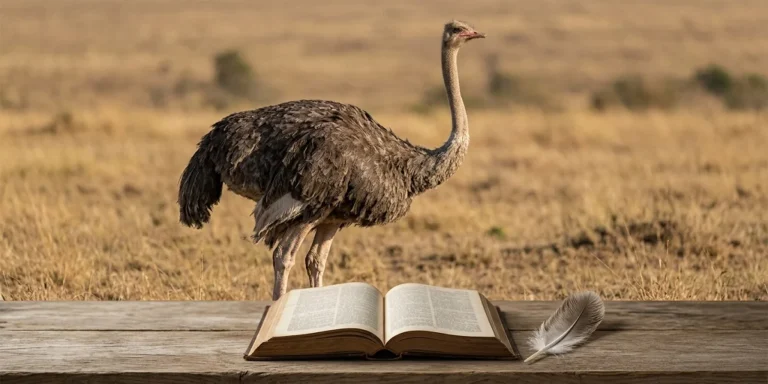

Quick Answer: No. Ostriches do not bury their heads in the sand, even when frightened. The myth most likely comes from three ordinary behaviors: lowering their heads into ground nests to turn their eggs, bending down to feed, and swallowing small stones that help grind food during digestion. When faced with real danger, ostriches rely on their exceptional eyesight, speeds of up to 70 km/h (43 mph), camouflage, or powerful kicks, not hiding underground.
Table of Contents
Do ostriches really bury their heads in the sand? It’s one of the oldest and most widespread wildlife myths, repeated in cartoons, children’s books, and everyday conversation for generations. The phrase has even become a common metaphor for avoiding uncomfortable problems.
The surprising part is that there has never been any scientific evidence that healthy wild ostriches behave this way.
Instead, the myth appears to have grown from a combination of misunderstood observations, centuries of retelling, and a few ordinary behaviors that can easily fool someone watching from a distance. Once you understand what ostriches are actually doing, it’s easy to see how one of the world’s most persistent animal myths was born.
Why Do People Think Ostriches Bury Their Heads in the Sand?
Like many long-lasting myths, this one didn’t appear overnight. It developed gradually as real observations became simplified, exaggerated, and repeated over hundreds of years.
The story can be traced through several stages:
| Time | What Happened |
|---|---|
| 1st century AD | Roman writer Pliny the Elder described ostriches lowering their heads and necks into bushes, not sand. |
| Middle Ages | The description was repeated and gradually became less precise. |
| 18th-19th centuries | Natural history books often repeated earlier accounts without verification. |
| 20th century | Cartoons, advertisements, and popular culture transformed the image into an ostrich burying its head completely underground. |
| Today | The myth is widely accepted despite decades of observations showing the opposite behavior. |
Each retelling made the story a little simpler and a little more dramatic. Eventually, “lowering the head” became “burying the head,” and the image spread faster than the facts ever could.
Did Pliny the Elder Really Say Ostriches Buried Their Heads?
The answer is both yes and no, which is why this myth has survived for nearly two thousand years.
Almost every article mentions Pliny the Elder, the Roman naturalist who wrote Naturalis Historia in the first century AD. He’s often credited with starting the legend that ostriches hide by burying their heads in the sand.
But that’s not exactly what he wrote.
Pliny described ostriches as believing themselves hidden when they pushed their head and neck into a bush. His account never specifically mentioned sand, nor did he describe the behavior as an effective way of escaping predators.
That distinction matters.
Over centuries, later writers gradually replaced bushes with sand, turning a loose observation into a vivid story. Eventually, the rewritten version became so familiar that many people assumed it reflected genuine ostrich behavior rather than a centuries-old misunderstanding.
Interesting Fact
The earliest widely cited description of this myth refers to bushes, not sand. The image of an ostrich with its head buried underground appears to be a later interpretation rather than Pliny’s original observation.
Whether Pliny misunderstood what he saw or simply repeated stories already circulating at the time is impossible to know. What is clear is that modern wildlife observations do not support the popular version of the myth.
The Three Real Behaviors Behind the Myth
If ostriches never bury their heads, why has the story lasted for so long?
The answer is surprisingly simple. Ostriches regularly perform several completely normal behaviors that can look misleading from a distance. When viewed across an open savanna, especially through heat haze or tall grass, these movements can easily create the illusion that the bird’s head has disappeared underground.
1. Turning Their Eggs in the Nest

Unlike most birds, ostriches build their nests directly on the ground. Instead of constructing nests in trees or shrubs, they scrape a shallow depression into the soil where the eggs are laid.
Several times each day, the adults lower their heads into the nest to rotate the eggs with their beaks. This helps distribute heat evenly during incubation and prevents the developing embryo from sticking to the inside of the shell.
From a distance, only the bird’s large body may remain visible while its long neck disappears below the edge of the nest. To someone unfamiliar with ostrich behavior, it can easily appear as though the bird has buried its head in the ground.
In reality, its head is only a few inches below body level as it carefully tends its eggs.
2. Feeding Close to the Ground
Ostriches spend much of the day foraging.
Their diet includes grasses, leaves, seeds, flowers, roots, and occasionally insects or other small animals. Finding this food requires repeatedly lowering the head to ground level, sometimes hundreds of times throughout the day.
Because an ostrich’s body is exceptionally tall while its head is relatively small, the head can seem to disappear completely behind grass or uneven terrain. Viewed from hundreds of meters away, the illusion becomes even stronger.
Many people who briefly observe a feeding ostrich may genuinely believe the bird has pushed its head into the ground, when it’s simply eating.
3. Swallowing Stones to Help Digestion
One lesser-known behavior may also contribute to the misunderstanding.
Like other birds, ostriches have no teeth. Instead of chewing, they swallow food whole before it reaches the muscular gizzard, where digestion takes place.
To help grind tough plant material, ostriches regularly swallow small stones, pebbles, and grit. These remain inside the gizzard and act like natural grinding tools, breaking food into smaller pieces.
Collecting these stones requires the bird to repeatedly inspect the ground with its head lowered, creating yet another posture that can resemble burying its head from a distance.
This behavior has nothing to do with hiding. It’s simply an essential part of how ostriches digest their food.
What Do Ostriches Actually Do When They’re Scared?
If burying their heads isn’t an option, how do ostriches respond to real danger?
The answer is much more impressive than the myth suggests.
Rather than hiding, ostriches rely on a combination of exceptional eyesight, incredible speed, camouflage, and powerful defensive kicks. Which strategy they choose depends on the situation, the distance to the threat, and whether they’re protecting a nest or chicks.
Here’s what actually happens.
1. They Usually Run First
Running is an ostrich’s greatest survival tool.
As the world’s largest living bird, the ostrich is also the fastest bird on land, capable of reaching speeds of around 70 km/h (43 mph). Even more impressive, it can maintain high speeds for much longer than most predators.
Its long, muscular legs allow strides of up to 5 meters (16 feet), helping it quickly put distance between itself and danger. For a healthy adult ostrich in open country, escaping is usually a far safer option than standing its ground.
This is why the idea of an ostrich stopping to bury its head makes little biological sense. Evolution has already given it one of the best escape strategies on the African savanna.
2. They Flatten Against the Ground
Running isn’t always the best choice.
When incubating eggs or protecting young chicks, adult ostriches may remain close to the nest instead of fleeing. In these situations, they often lower their entire body and stretch their neck flat along the ground.
From a distance, the bird’s gray-brown feathers blend remarkably well with dry grass, sand, and rocky terrain. Combined with the flattened neck, the ostrich can resemble nothing more than a small mound or patch of earth.
This posture reduces its visibility without sacrificing awareness. Unlike the popular myth, the bird’s eyes remain fully exposed, allowing it to continue watching for approaching danger. It’s easy to imagine how someone observing this behavior from hundreds of meters away could assume the head had disappeared into the ground.
In reality, the ostrich isn’t hiding underground. It’s using camouflage while continuing to monitor its surroundings.
3. They Fight When They Have To
If escape isn’t possible, ostriches are fully capable of defending themselves.
An adult can stand nearly 2.7 meters (9 feet) tall and weigh well over 100 kilograms (220 pounds). Each leg is heavily muscled and ends in two toes, one of which carries a large, sharp claw.
A forward kick from an ostrich is powerful enough to cause devastating injuries. Wildlife researchers have documented serious injuries to predators, and there are credible reports of lions being fatally wounded after attacking adult ostriches.
This is especially true during the breeding season, when males and females aggressively defend their nests and chicks against lions, hyenas, jackals, and even humans who venture too close.
Far from being timid, ostriches can become one of the most dangerous birds on Earth when cornered. If you’d like to learn more about their defensive abilities, see our guide on Can an Ostrich Kill a Lion?
Why Burying Their Heads Would Make No Sense
One of the easiest ways to debunk this myth is to ask a simple question:
What would an ostrich actually gain by burying its head? From a survival standpoint, the answer is virtually nothing.
In fact, doing so would create several serious disadvantages.
| If an ostrich buried its head… | The result would be… |
|---|---|
| It couldn’t see approaching predators. | It would lose its greatest early-warning system. |
| Its hearing and awareness would be reduced. | Detecting danger would become much harder. |
| It couldn’t react quickly enough to escape. | Valuable seconds would be lost. |
| It would give up its strongest advantages. | Speed and excellent vision would become useless. |
Natural selection rewards behaviors that improve survival.
Ostriches have evolved for millions of years in open landscapes where predators can often be spotted hundreds of meters away. Their large eyes provide exceptional vision, their long legs allow extraordinary speed, and their height helps them scan the surrounding grasslands.
Burying their heads would eliminate many of those advantages in an instant.
Simply put, it would be one of the worst possible survival strategies for an animal that depends on seeing danger before danger reaches it.
Ostriches Are Built to Face Danger, Not Hide From It
The “head in the sand” myth has unintentionally created another misconception: that ostriches are cowardly or unintelligent animals.
The evidence suggests the opposite.
Ostriches are highly adapted for life alongside some of Africa’s most formidable predators. Instead of relying on concealment, they depend on a combination of awareness, speed, and physical strength.
Their eyesight is among the best of any land animal, allowing them to detect movement from remarkable distances. Living in groups also increases their chances of spotting predators early, since multiple birds are constantly scanning the landscape.

When escape isn’t possible, especially around nests, ostriches don’t hesitate to defend themselves.
Adult males have been observed charging at lions, hyenas, and other large predators that approach too closely. While they avoid unnecessary fights whenever possible, they are far from defenseless.
This combination of vigilance and athleticism explains why ostriches have survived for millions of years without needing to hide underground.
Their strategy has always been simple: See danger early. Run if possible. Fight if necessary.
That’s a far more effective survival plan than burying their heads in the sand.
Why the Myth Refuses to Die
If scientists have known for decades that ostriches don’t bury their heads in the sand, why do so many people still believe it?
The short answer is that memorable stories often spread faster than accurate ones.
The myth has been repeated for centuries in books, cartoons, advertisements, television shows, and everyday conversation. Each new retelling reinforces the image, even though few people have ever seen a wild ostrich themselves.
It also survives because it fits a simple and appealing narrative. The idea of a giant bird trying to hide by sticking its head in the sand is easy to picture, easy to remember, and easy to repeat.
Real ostrich behavior is more complicated. Watching an adult rotate eggs in a ground nest or lower its head while feeding doesn’t create the same memorable image, even though those observations explain the myth far better.
Today, the expression has taken on a life of its own.
People use phrases like “burying your head in the sand” to describe someone avoiding a difficult situation instead of facing it. In psychology and business writing, this avoidance behavior is sometimes informally referred to as “ostrich syndrome.”
The irony is that the metaphor has little to do with actual ostriches.
Real ostriches are constantly alert to their surroundings. They survive by noticing danger early and reacting quickly, which is almost the opposite of ignoring a problem.
Myth vs. Reality
| Myth | Reality |
|---|---|
| Ostriches bury their heads in the sand. | No documented evidence shows healthy ostriches doing this. |
| They do it to hide from predators. | They rely on speed, camouflage, and powerful kicks instead. |
| Ostriches are timid birds. | They can aggressively defend themselves, their nests, and their chicks. |
| They panic when threatened. | Their responses are well-adapted survival strategies shaped by evolution. |
| The story is based on scientific observation. | It most likely grew from misunderstood behaviors that were repeated over centuries. |
Frequently Asked Questions
Do ostriches bury their heads in the sand when scared?
No. Ostriches do not bury their heads in the sand, even when frightened. When they detect danger, they usually run away at speeds of up to 70 km/h (43 mph). If they are guarding a nest, they may flatten their necks against the ground to reduce their visibility or defend themselves with powerful kicks if necessary.
Why do ostriches lower their heads?
Ostriches lower their heads for several perfectly normal reasons. They feed on plants and insects close to the ground, pick up small stones that help grind food in their gizzard, and rotate their eggs inside shallow ground nests during incubation. These behaviors likely gave rise to the myth that they bury their heads in the sand.
Where did the myth come from?
The myth is commonly traced back to the Roman writer Pliny the Elder in the first century AD. However, his original description referred to ostriches pushing their heads and necks into bushes, not sand. Over hundreds of years, the story changed through repeated retellings until it became the familiar legend we know today.
What do ostriches do when they sense danger?
Their first response is usually to run. Ostriches have excellent eyesight and can often detect predators long before an attack begins. If escape isn’t possible, particularly near a nest, they may crouch low to blend into the landscape or defend themselves with powerful forward kicks.
Can an ostrich really kill a lion?
Although uncommon, an ostrich’s kick is powerful enough to inflict fatal injuries under the right circumstances. Adult ostriches have exceptionally strong legs and large claws, making them dangerous opponents when defending themselves or their young.
Are ostriches aggressive?
Not usually. Wild ostriches generally prefer to avoid conflict by running away. However, they become highly defensive during the breeding season or whenever they perceive a threat to their nest or chicks. In those situations, they may charge and kick with considerable force.
Why is “bury your head in the sand” associated with ostriches?
The phrase comes from the long-standing myth that ostriches hide from danger by burying their heads in the sand. Although the behavior isn’t real, the expression survived because it became a convenient metaphor for avoiding problems instead of confronting them. Ironically, real ostriches do the opposite: they stay alert, monitor their surroundings, and react quickly to threats.
The idea that ostriches bury their heads in the sand is one of the world’s oldest and most persistent wildlife myths. Despite appearing in popular culture for generations, there is no scientific evidence that healthy ostriches hide this way when frightened.
The legend most likely began with a combination of misunderstood observations. A bird lowering its head to turn eggs in a ground nest, feeding close to the soil, or picking up small stones for digestion can easily appear to have “disappeared” from a distance. Over centuries, those ordinary behaviors evolved into an extraordinary story.
The real ostrich is far more impressive than the myth suggests.
It survives using exceptional eyesight, remarkable speed, effective camouflage, and one of the most powerful defensive kicks in the animal kingdom. Rather than hiding from danger, an ostrich is built to detect threats early, escape when possible, and defend itself when necessary.
Sometimes, the truth is even more fascinating than the legend.