Quick Answer: Adult ostriches can be preyed upon by lions, cheetahs, leopards, spotted hyenas, and African wild dogs, although a healthy adult is difficult and dangerous prey. Ostrich eggs and chicks face a much wider range of predators, including jackals, Egyptian vultures, hyenas, and other opportunistic hunters. Beyond natural predators, ostriches also face human threats such as habitat loss, hunting, and disease.
Table of Contents
Ostriches are the largest living birds in the world, but their size does not make them immune to predators. Across the African savannas and semi-arid landscapes, they share their habitat with some of the continent’s most capable carnivores.
What makes an adult ostrich difficult to kill is not simply its size. Its combination of exceptional speed, 360-degree vision, powerful legs, and a lethal forward kick gives it multiple ways to avoid or resist an attack. According to the Smithsonian’s National Zoo, lions, cheetahs, leopards, and hyenas are the primary predators of adult ostriches, alongside African wild dogs.
The situation changes dramatically earlier in the ostrich’s life cycle. Eggs are completely immobile, and newly hatched chicks are far smaller and more vulnerable than adults. Predators that would have zero chance against a full-grown ostrich become serious threats to a nest or brood.
This guide breaks down ostrich predators by life stage, explains their natural defense mechanisms, and examines environmental threats beyond predation.
Natural Predators of Adult Ostriches
Adult ostriches have natural predators, but few animals can regularly challenge a healthy adult without risking severe injury or death. The main predators capable of hunting adult ostriches include:
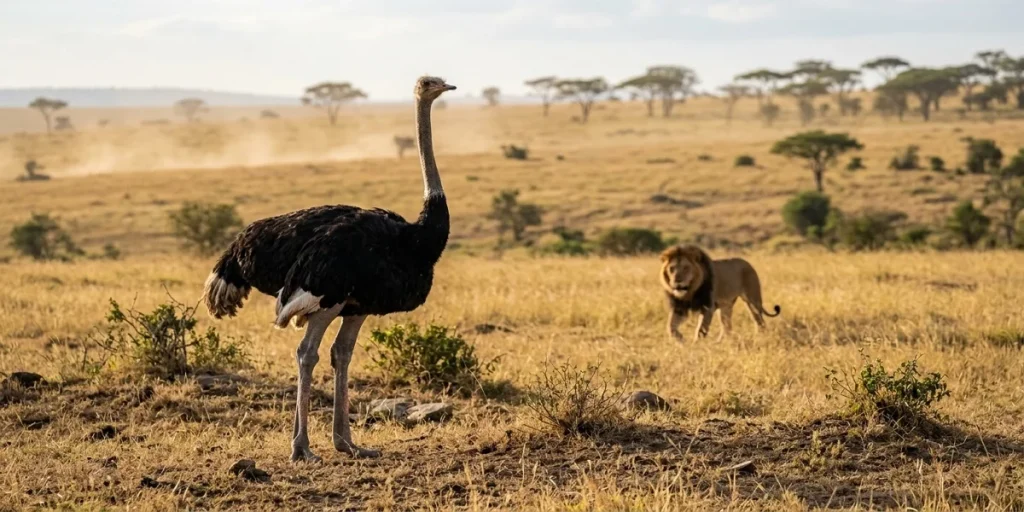
- Lions: The most capable apex predators of adult ostriches, using surprise or coordinated ambush tactics.
- Spotted Hyenas: Opportunistic pack hunters that target ostriches when an individual is vulnerable, injured, or trapped.
- Cheetahs: Rely on extreme initial speed for pursuits, though an adult ostrich’s high-speed stamina makes successful hunts difficult.
- Leopards: Ambush hunters that rely on dense cover, surprise, and lethal close-range strikes rather than prolonged chases.
- African Wild Dogs: Cooperative pack hunting allows them to pressure prey over long distances, though a healthy adult remains a high-risk target.
Being listed as a predator does not mean these species hunt ostriches on a daily basis. Predation frequency varies by region, prey availability, and terrain. In most scenarios, an ostrich’s vigilance allows it to spot danger early and escape before a predator gets within striking distance.
For an adult ostrich, running is always the first line of defense. However, when cornered or defending a nest, those massive legs transform into a powerful last resort.
Predators of Ostrich Eggs and Chicks
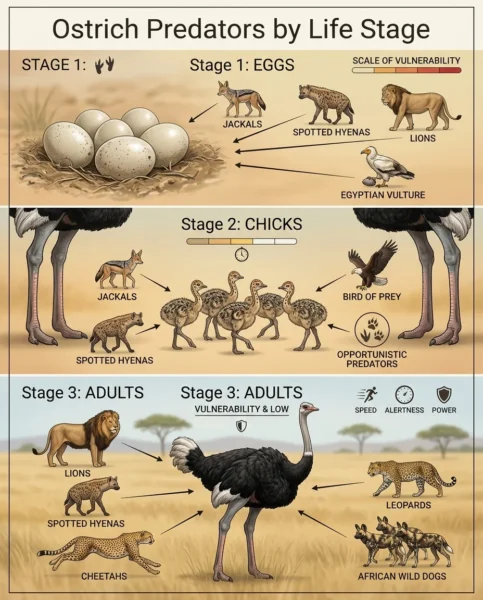
While adult ostriches are difficult prey, their eggs and chicks face a completely different reality. Ostrich eggs cannot escape, while newly hatched chicks are small enough to be targeted by small carnivores that would pose zero threat to a full-grown bird. Research from the Serengeti shows that predation pressure significantly impacts ostrich reproductive success, making early development the most vulnerable stage in the ostrich life cycle.
What Eats Ostrich Eggs?
Ostrich eggs are targeted by a wide range of terrestrial and avian predators, including jackals, hyenas, lions, and Egyptian vultures. Because an egg is completely immobile, any opportunistic predator that finds an unattended nest can raid it.
One of the most notable ostrich egg predators is the Egyptian vulture. These birds use stones as tools to crack open the egg’s thick shell, repeatedly dropping or throwing rocks until the shell gives way. Behavioral studies show that Egyptian vultures can perform this targeted stone-throwing instinctively, even without observing experienced adult birds.
The physical design of an ostrich egg presents an evolutionary trade-off:
- Temperature Control: Pale eggshells reflect intense sunlight, preventing the embryo from overheating in arid environments.
- Predation Risk: The same light coloration makes the eggs highly visible to aerial and ground predators across open savanna landscapes.
Ostrich Eggs and Communal Nests
Ostriches utilize a unique communal nesting system where multiple females lay their eggs in a single shared nest. In East African habitats, particularly the Serengeti, researchers have documented communal nests containing up to 38 eggs.
Parental care is not shared equally among all adults in the group:
- Major Female: The dominant female incubates the central clutch alongside the territorial male.
- Territorial Male: Shares incubation duties (often sitting on the nest at night) and provides active nest defense.
Despite this collective defense, communal nests remain exposed. Predators frequently target eggs located on the outer edges of the clutch or strike when adults temporarily leave the nest to forage.
| Life Stage | Common Predators | Key Vulnerability Factors |
| Eggs | Jackals, hyenas, lions, Egyptian vultures | Immobile and highly visible when the nest is unattended. |
| Newly Hatched Chicks | Jackals, hyenas, birds of prey | Small body size, weak physical defenses, limited mobility. |
| Older Chicks | Larger carnivores, jackals, birds of prey | Mobile but still lack the speed and size of mature adults. |
| Adults | Lions, hyenas, cheetahs, leopards, wild dogs | High speed, massive size, and a lethal defensive kick make them high-risk prey. |
What Eats Ostrich Chicks?
Ostrich chicks are preyed upon primarily by jackals, hyenas, eagles, and other birds of prey. Separated chicks or small broods are particularly vulnerable during their first few months of life.
Unlike adults, a young chick cannot rely on a dangerous kick or sustained high-speed escape. Survival depends on specific defense mechanisms:
- Parental Protection: Adult ostriches actively drive off smaller predators like jackals.
- Camouflage & Creches: Chicks feature mottled brown plumage that blends into dry grass. They also form large communal groups (creches) overseen by adult guardians.
Field observations in Tanzania highlight that survival rates increase drastically when chicks stay in large supervised groups. Studies confirm a major gap between the number of eggs laid and the number of chicks reaching adulthood, with predation being the primary driver of juvenile mortality.
Why Are Eggs and Chicks More Vulnerable Than Adults?
The vulnerability gap comes down to physical capability: an adult ostrich possesses high-speed locomotion, long-range vision, and dangerous kick strength. An egg has none of these traits, and a chick develops them gradually over time.
This variance means the answer to “What is an ostrich’s predator?” depends entirely on the bird’s life stage. While a lion is required to tackle a full-grown adult, a simple jackal or raptor is more than enough to eliminate a chick, and a vulture needs only a rock to consume an egg.
How Do Ostriches Defend Themselves Against Predators?
Ostriches employ a multi-layered defense strategy against natural predators. Their primary defensive line relies on early threat detection and high-speed escape rather than physical combat. Exceptional eyesight allows them to spot danger across vast distances, while specialized leg anatomy enables rapid movement away from threats.
When cornered or forced to defend a nest, however, an adult ostrich transforms into a formidable opponent. Its muscular legs deliver heavy forward strikes, with each inner toe featuring a sharp, knife-like claw capable of inflicting severe or fatal wounds on large carnivores.
Speed: An Ostrich’s First Defense
Running away is the safest and most efficient choice for an ostrich. An adult ostrich can sprint at top speeds around 40 mph (65 km/h), using long strides to maintain high-speed endurance across dry, open savanna terrain.
This locomotion advantage limits the success rate of pursuing predators:
- Distance Advantage: Most savanna carnivores rely on short-burst stalking rather than long-distance high-speed chases.
- Open Terrain Efficiency: Unobstructed vistas allow ostriches to detect movement early, establishing a wide safety buffer long before a predator gets within pouncing range.
Excellent Eyesight and Vigilance
An ostrich’s massive eyes (the largest of any land vertebrate) are central to its survival strategy. Positioned high on the neck, they provide an expansive field of view across flat terrain.
Vigilance operates on both individual and group levels:
- 360-Degree Awareness: High visual acuity enables the bird to detect subtle movements or shadows from extreme distances.
- Early Warning System: Spotting a predator early minimizes the need for high-risk physical defense.
Herd Behavior and Group Protection
Ostriches frequently form fluid flocks or mixed-species groups. Social grouping offers clear biological advantages against apex predators:
- Collective Scanning: Multiple birds monitoring different directions simultaneously increases the likelihood of detecting an ambush.
- Target Dilution: A unified group makes it significantly harder for predators to isolate a specific individual or chick.
- Nursery Protection: Adults collaborate to guard creches, shielding vulnerable young birds from medium-sized predators like jackals.
How Strong Is an Ostrich Kick?
Online sources frequently attribute specific numbers to an ostrich’s strike force, often claiming figures like 500, 1,000, or 2,000 PSI. However, there is no universally accepted scientific standard measuring exact PSI values for an ostrich kick in field conditions.
What biomechanical evidence confirms is:
- Massive Mechanical Force: The heavy thigh muscles generate immense force designed for high-speed running, which translates directly into forward striking power.
- Dual-Threat Impact: The kick combines blunt force impact with sharp, penetrating damage from a 4-inch (10 cm) claw.
The critical factor is not an arbitrary PSI figure, but the practical outcome: a single forward kick carries enough kinetic force to fracture bone or disembowel large predators like lions and hyenas.
What Makes an Ostrich Kick So Dangerous?
An ostrich foot features a unique two-toed design adapted for speed, with weight shifted to the large inner toe. This anatomical structure alters the dynamics of a physical strike:
[Leg Muscle Kinetic Energy] ➔ [Forward Strike] ➔ [Impact via 4-inch Inner Claw]
When kicking, the bird strikes forward and downward. The large inner claw focuses the kinetic energy into a small surface area, turning a blunt force blow into a penetrating slash. Consequently, even apex predators generally avoid attacking healthy adults unless environmental conditions offer a clear surprise advantage.
Do Ostriches Really Bury Their Heads in the Sand?
No, ostriches do not bury their heads in the sand when threatened. This widespread myth stems from a visual misunderstanding of their natural nesting and foraging behaviors.
The origin of the myth comes from distinct behaviors observed in the wild:
- Egg Rotation: Adults use their beaks to turn communal eggs resting in shallow ground scrapes, making their heads disappear from a distance.
- Camouflage Posture: When sitting on a nest during danger, an ostrich flattens its head and long neck close to the dirt to blend in with surrounding vegetation.
In actual predator encounters, an ostrich never hides its head. It relies on immediate visual awareness, rapid locomotion, or active physical defense to ensure survival.
Can Ostriches Kill Their Predators?
Yes, an adult ostrich is physically capable of killing a predator with a single forward kick. However, this is a defensive last resort rather than an offensive strategy. In the vast majority of predator encounters, a healthy adult ostrich prefers high-speed flight over direct confrontation.
The lethal potential comes from a combination of massive thigh muscle mass, rapid kinetic acceleration, and a 4-inch inner claw. Both the American Museum of Natural History and the San Diego Zoo confirm that an ostrich’s defensive kick carries enough kinetic force to be potentially fatal to a full-grown lion.
Despite this capability, ostriches do not actively hunt or routinely defeat lions. While lethal outcome kicks are documented, actual predator deaths remain rare because predators typically abandon the pursuit once their element of surprise is lost.
Can an Ostrich Kill a Lion?
It is biomechanically possible, but ecologically unusual. Lions are specialized apex predators, whereas ostriches are herbivorous birds whose primary survival strategy is early detection and speed.
When cornered, the fight dynamics change significantly:
- Lethal Strike Zone: A well-placed kick directed forward and downward can disembowel an attacking lion or shatter its skull.
- Deterrent Effect: An ostrich does not need to win a sustained fight. It only needs to inflict enough damage to make the lion abandon the hunt.
The predator-prey balance is best summarized simply: a lion can kill an ostrich, but an ostrich possesses enough physical power to critically injure or kill a lion in self-defense.
For a deeper look at this question, our guide to can an ostrich kill a lion examines how an ostrich’s defensive kick compares with a lion’s strength and what we actually know about these rare encounters.
Are Ostriches Dangerous to Humans?
Yes, ostriches can be dangerous to humans, though attacks in the wild are uncommon. Wild ostriches naturally maintain a wide safety buffer and flee from human approach.
The risk of a severe attack increases rapidly under specific environmental conditions:
- Territorial Defense: Male ostriches guarding a nest site or brood display intense territorial aggression.
- Cornered Environments: Birds kept in farm enclosures or restricted spaces cannot exercise their flight response, forcing them into active defense.
- Breeding Season: Hormonal changes during mating cycles lower the threshold for aggressive behavior.
An adult ostrich strikes forward and downward, using its inner claw to slice through tissue. Medical documentation confirms that ostrich kicks can inflict severe blunt-force trauma combined with deep, penetrating lacerations.
How Many People Have Died From Ostrich Attacks?
There is no global database tracking human fatalities caused by ostrich attacks worldwide. Official records remain incomplete because most encounters occur in rural farming contexts or remote wildlife habitats.
Medical literature focuses on case studies involving severe trauma resulting from ostrich strikes:
- Abdominal Trauma: Clinical reports document a case where a 71-year-old man suffered intestinal perforation requiring emergency abdominal surgery after being repeatedly kicked by a territorial ostrich.
- Facial & Eye Injury: Another medical study detailed severe ocular trauma in a patient kicked in the face, leading to permanent vision loss in the affected eye.
These clinical cases highlight why ostriches should never be approached closely, particularly during nesting periods or within captive farm settings.
Non-Predator Threats to Ostriches
Predators are only one part of the survival challenge facing wild ostriches. Human activity, environmental shifts, and health issues pose significant risks to wild populations, often reducing available habitat or increasing individual vulnerability.
An ostrich does not need to be directly hunted to be impacted by human presence. Habitat loss, fencing barriers, and agricultural expansion fundamentally alter how ostriches feed, breed, migrate, and escape predators.
Habitat Loss and Fragmentation
Ostriches depend heavily on vast, open landscapes to detect incoming danger and utilize their speed. Converting natural grasslands and semi-arid scrublands into agricultural fields, settlements, and roads drastically reduces viable habitat.
Habitat fragmentation introduces secondary hazards:
- Restricted Movement: Fences and highways divide contiguous territories, limiting access to seasonal feeding grounds.
- Elevated Predation Risk: Confined or fragmented spaces reduce an ostrich’s escape options, making it easier for predators to corner individual birds.
For a deeper look at the specific ecosystems these birds inhabit, see our guide to ostrich habitat and range.
Hunting and Poaching
Ostriches have been harvested for centuries for their feathers, meat, large eggs, and high-value leather hides. Unregulated hunting and illegal poaching remain persistent threats in areas where wild populations lack formal protection.
Commercial ostrich farming produces leather, meat, and feathers for global markets, reducing pressure on wild flocks. However, illegal harvesting of wild eggs and adult birds still occurs in unprotected regions.
Human-Wildlife Conflict
As human development expands into wildlife corridors, encounters between ostriches and local communities increase:
- Physical Barriers: Fences erected for livestock or farming restrict an ostrich’s primary defense mechanism: uninterrupted running space.
- Behavioral Changes: Birds exposed to human settlements may alter their natural foraging habits or lose their instinctual distance from people.
Disease and Health Problems
Disease acts as a silent survival factor. While an infection or parasite may not directly kill a bird, a weakened ostrich loses the athletic mobility required to outrun savanna predators.
Health factors impacting ostrich survival include:
- Reduced Locomotion: Respiratory or musculoskeletal issues eliminate top-speed performance.
- Secondary Predation: Pathogens lower general immunity, turning a manageable threat into a fatal encounter.
Infectious diseases, nutritional deficiencies, and parasite management are particularly critical in managed flocks. Read our comprehensive guide to common ostrich diseases and health problems for symptoms and treatments.
Climate and Environmental Pressure
Although ostriches possess extreme physiological adaptations for arid environments, severe environmental shifts present real challenges:
- Water & Vegetation Scarcity: Extended droughts reduce nutrient-dense foraging materials and surface water.
- Nesting Impact: Extreme ground temperatures can affect egg viability and chick survival during initial hatching phases.
Are Ostriches Endangered?
No, the common ostrich is not currently classified as endangered. As a global species, it is evaluated as Least Concern on the IUCN Red List of Threatened Species.
However, a global “Least Concern” status does not mean every wild population is safe:
- Regional Declines: Specific sub-populations in North and West Africa face localized pressures from habitat loss and poaching.
- Subspecies Vulnerability: Overall numbers across Africa remain stable, but isolated wild groups face ongoing environmental strains.
For OstrichPro readers, the takeaways are clear: “not endangered globally” does not mean “without threats locally.” Managing wild habitats and protecting natural corridors remain essential for long-term ostrich conservation.
Frequently Asked Questions About Ostrich Predators and Threats
What is an ostrich’s main predator?
Lions are the primary natural predators of adult ostriches, using ambush and coordinated hunting tactics. However, spotted hyenas, cheetahs, leopards, and African wild dogs also hunt ostriches depending on the region, habitat, and individual vulnerability.
Do adult ostriches have any predators?
Yes, adult ostriches face natural predators despite their massive size and speed. While lions, hyenas, leopards, cheetahs, and wild dogs can all hunt them, tackling a healthy, full-grown adult carries a high risk of injury for the predator.
What preys on ostrich eggs and chicks?
Ostrich eggs and chicks face a much broader range of predators than adults, including jackals, hyenas, birds of prey, and Egyptian vultures. Because eggs are immobile and chicks lack full speed and size, early life stages represent the most vulnerable period in the ostrich life cycle.
How fast can an ostrich run to escape a predator?
An ostrich can top speeds of around 40 mph (65 km/h). Its long legs and high-speed stamina allow it to cover open terrain rapidly, making high-speed flight its most effective primary defense.
How hard can an ostrich kick?
There is no single, scientifically verified PSI figure for an ostrich kick. While online estimates vary widely, exact striking force under field conditions remains difficult to measure. However, biomechanical evidence confirms that an adult ostrich generates enough force with its leg muscles and 4-inch inner claw to cause severe or fatal injuries.
What kicks harder, a horse or an ostrich?
There is no reliable scientific test directly comparing the exact striking force of a horse versus an ostrich. Both animals deliver high-impact kicks using different anatomy. An ostrich’s strike carries an additional hazard: a sharp, heavy claw that can cause penetrating or lacerating damage that a smooth horse hoof cannot.
Can an ostrich kill a lion?
Yes, an ostrich can potentially kill a lion with a well-placed defensive kick, though this is an unusual outcome. Lions regularly hunt ostriches, and an ostrich’s primary survival strategy is escape rather than combat. A defensive kick serves as a powerful last resort.
How many people have died from ostrich attacks?
There is no global database tracking exact fatalities from ostrich attacks. While fatal encounters are uncommon and global records remain incomplete, medical literature documents serious consequences from attacks, including severe abdominal trauma and permanent vision loss.
Do ostriches really bury their heads in the sand when a predator approaches?
No, ostriches do not bury their heads in the sand. This myth stems from ostriches lowering their head and long neck close to the ground to turn eggs, forage, or blend into the landscape when blending in with surrounding terrain. From a distance, their head appears to disappear into the earth.
What non-predator threats do ostriches face today?
Wild ostriches face major non-predator threats including habitat loss, habitat fragmentation, hunting, human-wildlife conflict, and infectious diseases. While localized populations face serious pressures, the common ostrich is currently evaluated as Least Concern globally on the IUCN Red List.
How do ostriches protect their eggs and chicks from predators?
Ostriches protect their young through high vigilance, communal nesting, and active nest defense. Adults scan open landscapes for danger, form large chick creches guarded by parent birds, and aggressively kick approaching threats to safeguard vulnerable young.