
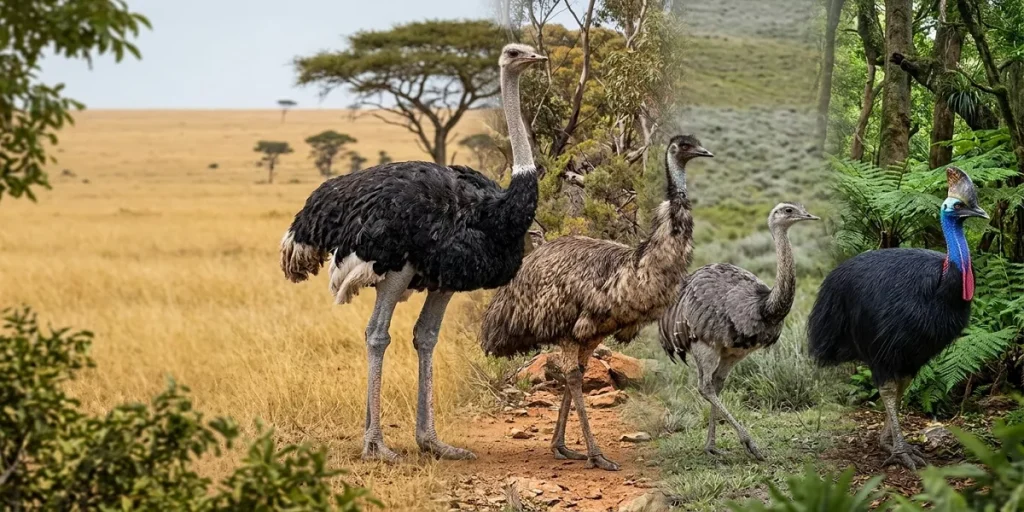
Quick Answer: Ostriches, emus, rheas, and cassowaries are all large flightless birds known as ratites, but they differ significantly in size, habitat, behavior, and evolutionary history. The ostrich is the largest and fastest, the emu is Australia’s tallest native bird, the rhea is South America’s smaller ratite, and the cassowary is widely regarded as the world’s most dangerous bird. Although they share a similar body plan, modern genetic research shows they are not all as closely related as once believed.
Table of Contents
Introduction
At first glance, an ostrich, emu, rhea, and cassowary can look surprisingly similar. They all have long legs, long necks, powerful bodies, and cannot fly, making it easy to assume they are simply different versions of the same bird. In reality, each species evolved on a different continent and adapted to very different environments, from the African savanna to the rainforests of New Guinea.
These birds belong to a group known as ratites, a collection of large flightless birds that share certain physical traits but have followed different evolutionary paths over millions of years. Some are built for incredible speed across open plains, while others rely on camouflage, endurance, or powerful defensive weapons to survive.
At OstrichPro, we’ve compared these four flightless birds using the characteristics people care about most, including size, speed, habitat, eggs, behavior, and evolutionary relationships. Rather than focusing on just ostriches and emus, this guide gives each species the attention it deserves, making it easier to understand what truly sets them apart.
Ostrich vs Emu vs Rhea vs Cassowary: At a Glance
If you’re short on time, here’s the simplest way to compare these four remarkable birds. While they all belong to the ratite group, each species stands out for a different reason. The ostrich dominates in size and speed, the cassowary is unmatched in defensive power, the emu is built for endurance, and the rhea is the smallest and most social of the four.
| If you’re wondering… | The Winner |
|---|---|
| Which is the largest bird? | Ostrich |
| Which runs the fastest? | Ostrich |
| Which is the most dangerous? | Cassowary |
| Which is the smallest? | Rhea |
| Which lays the largest eggs? | Ostrich |
| Which has the darkest eggs? | Emu |
| Which is best adapted to rainforests? | Cassowary |
| Which has only two toes? | Ostrich |
| Which is Australia’s tallest native bird? | Emu |
| Which is native to South America? | Rhea |
Although these quick comparisons highlight each bird’s most distinctive trait, they only tell part of the story. Size, appearance, behavior, habitat, and evolutionary history all reveal important differences that are worth exploring in more detail.
Did You Know?
Despite their similar appearance, the ostrich, emu, rhea, and cassowary evolved on different continents. Today, only the emu and cassowary are considered close living relatives, while the ostrich branched off much earlier in evolutionary history.
Ostrich vs Emu vs Rhea vs Cassowary: Full Comparison Table
At OstrichPro, we reviewed wildlife references, scientific sources, and species profiles to compare these four ratites using the characteristics that matter most. While measurements can vary slightly depending on the individual bird, sex, and source, the values below represent the typical ranges you’ll find across healthy adult birds.
| Feature | Ostrich | Emu | Rhea | Cassowary |
|---|---|---|---|---|
| Height | 6 to 9 ft (1.8 to 2.8 m) | 5 to 6.2 ft (1.5 to 1.9 m) | 4.5 to 5.5 ft (1.4 to 1.7 m) | 4.9 to 5.9 ft (1.5 to 1.8 m) |
| Weight | 139 to 320 lb (63 to 145 kg) | 40 to 132 lb (18 to 60 kg) | 33 to 88 lb (15 to 40 kg) | 66 to 130 lb (30 to 59 kg) |
| Native Region | Africa | Australia | South America | Australia and New Guinea |
| Number of Toes | 2 | 3 | 3 | 3 (with a large inner claw) |
| Top Speed | Up to 43 mph (70 km/h) | Up to 31 mph (50 km/h) | Up to 37 mph (60 km/h) | Up to 31 mph (50 km/h) |
| Egg Color | Cream | Dark green | Yellowish green | Bright green |
| Typical Habitat | Savannas and semi-deserts | Grasslands and scrublands | Grasslands and open woodlands | Tropical rainforests |
| Social Behavior | Usually lives in groups | Often solitary or in loose groups | Generally social | Mostly solitary and territorial |
| Danger to Humans | Powerful defensive kick | Usually shy | Usually shy | Considered the world’s most dangerous bird |
Although these birds share the same flightless body plan, the comparison quickly shows how specialized each species has become. The ostrich is built for speed across open African landscapes, the emu for endurance over vast Australian terrain, the rhea for life in South American grasslands, and the cassowary for navigating dense tropical forests where agility and powerful defense are more important than outright speed.
Quick Observation
Although the ostrich is often grouped with emus, rheas, and cassowaries, modern genetic evidence shows that the emu and cassowary are actually each other’s closest living relatives. Similar appearances across all four species are not always a sign of close evolutionary relationships.
Are They Actually Related?
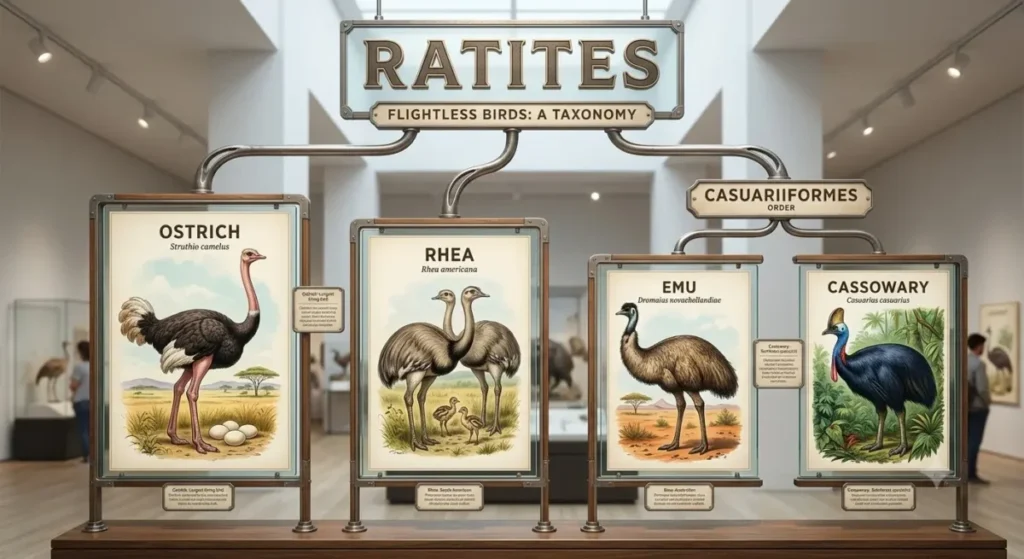
At first glance, it’s easy to assume that ostriches, emus, rheas, and cassowaries are close relatives. After all, they all have long legs, long necks, powerful bodies, and the inability to fly. For many years, scientists believed these similarities were the result of a single flightless ancestor that lived on the ancient supercontinent Gondwana before it split into today’s continents.
Modern genetic research paints a more complex picture.
While all four birds are classified as ratites, they are not equally related to one another. The ostrich branched off from the other ratites much earlier in evolutionary history, making it the most genetically distinct of the four. Emus and cassowaries, by contrast, are true close relatives and belong to the same order, Casuariiformes. Rheas occupy their own evolutionary branch and are more closely related to emus and cassowaries than they are to ostriches.
One reason these birds look so similar is convergent evolution, a process in which unrelated or only distantly related species independently develop similar physical traits because they face comparable environmental pressures. Large bodies, strong legs, and reduced wings proved to be successful adaptations for life without flight, even though these birds evolved separately over millions of years.
So, although ostriches, emus, rheas, and cassowaries are all members of the ratite group, their resemblance doesn’t necessarily mean they are close cousins. In evolutionary terms, the emu and cassowary form the closest pair, while the ostrich represents the earliest branch among today’s living ratites.
Editor’s Note: At OstrichPro, one misconception we see repeatedly is that all ratites are equally related simply because they look alike. Modern DNA evidence shows the story is far more interesting, with appearance and ancestry not always telling the same story.
Meet the Four Birds
While they span different continents from the African savannas to the Australian outback and the South American pampas; the ostrich, emu, rhea, and cassowary all belong to the ratite family. These massive, flightless birds have evolved to trade the skies for incredible land speed, unmatched endurance, and powerful physical adaptations. Though they share a common ancestral lineage, each has carved out its own unique evolutionary story. Here is how these four giants compare.
Ostrich
The ostrich (Struthio camelus) is the largest and heaviest living bird, reaching up to 9 feet (2.8 m) tall and weighing as much as 320 pounds (145 kg). Native to the savannas and semi-arid regions of Africa, it is also the fastest bird on land, capable of running at speeds of up to 43 mph (70 km/h).
One of the ostrich’s most distinctive features is its two-toed foot, a unique adaptation among living birds that helps improve speed and efficiency while running. Its powerful legs are its primary defense against predators, while its large eyes provide excellent vision for spotting danger across open landscapes.
Unlike the other birds in this comparison, ostriches often live in loose social groups and thrive in wide, open habitats where speed is their greatest survival advantage.
Emu
The emu (Dromaius novaehollandiae) is Australia’s tallest native bird and the second-largest bird in the world after the ostrich. Although noticeably smaller than an ostrich, it is an exceptional long-distance runner, capable of covering vast distances in search of food and water across the Australian outback.
Its shaggy brown feathers help regulate body temperature in harsh climates, while its three-toed feet provide stability over a wide variety of terrain. Unlike many bird species, female emus are typically larger than males, and once the eggs are laid, the male takes over nearly all incubation and chick-rearing duties.
Emus are generally curious but cautious around people and usually avoid confrontation unless they feel threatened.
Rhea
The rhea (Rhea americana and Rhea pennata) is South America’s largest bird and the smallest of the four ratites compared in this guide. Found mainly in grasslands, pampas, and open woodlands, rheas resemble smaller ostriches but have proportionally shorter legs and a more compact build.
Like emus, rheas have three toes and rely on speed rather than flight to escape predators. They are also known for their unusual breeding behavior, with a single male often incubating eggs laid by multiple females before raising the chicks on his own.
Although rheas receive far less attention than ostriches or emus, they are highly adaptable birds and play an important ecological role throughout South America’s open landscapes.
Cassowary
The cassowary (Casuarius spp.) is the most visually distinctive of the four species. Native to the tropical rainforests of northern Australia and New Guinea, it has glossy black plumage, a bright blue and red neck, and a prominent casque that sits on top of its head.
Unlike the other ratites, the cassowary is adapted to dense forest rather than open country. Its strong legs allow it to move through thick vegetation with remarkable agility, while its enlarged inner claw serves as a formidable defensive weapon.
Although widely known as the world’s most dangerous bird, cassowaries are not naturally aggressive toward humans. Most serious incidents occur when the birds feel cornered, are protecting chicks, or have become accustomed to being fed by people. In their natural habitat, they usually prefer to avoid human contact whenever possible.
Physical Differences: How to Tell Them Apart
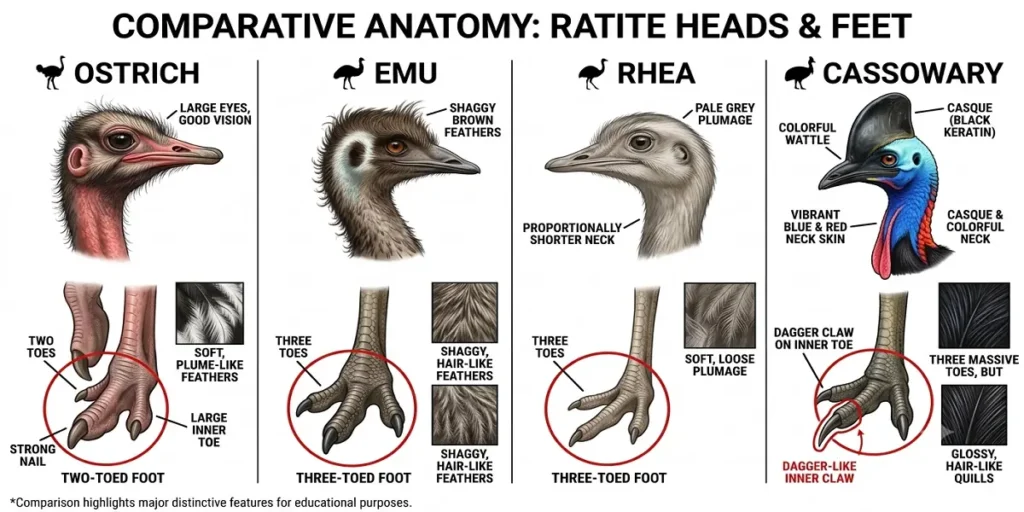
Although ostriches, emus, rheas, and cassowaries all share a similar body shape, a closer look reveals several distinctive features. Their feet, heads, feathers, and overall build make it surprisingly easy to identify each species once you know what to look for.
| Feature | Ostrich | Emu | Rhea | Cassowary |
|---|---|---|---|---|
| Feet | Two toes | Three toes | Three toes | Three toes with a large inner claw |
| Head | Small with large eyes | Small with shaggy feathers | Rounded and lightly feathered | Bright blue head with a prominent casque |
| Neck | Long, mostly bare | Feathered with sparse blue skin | Fully feathered | Bright blue with red wattles |
| Plumage | Black and white (males), gray-brown (females) | Shaggy brown | Gray or brown | Glossy black |
| Overall Build | Tallest and most muscular | Slim and athletic | Smaller and lighter | Compact and heavily built |
The ostrich is the easiest to recognize because it is the only living bird with just two toes on each foot. This unique adaptation improves balance and efficiency at high speeds, helping it become the fastest-running bird in the world.
The emu has a slimmer body covered with loose, shaggy feathers that give it a softer appearance than an ostrich. Its face is relatively plain, lacking the bright colors or distinctive features seen in a cassowary.
The rhea is often mistaken for a young ostrich because of its gray-brown plumage and similar body shape. However, it is noticeably smaller, has three toes instead of two, and carries its wings slightly away from its body, giving it a different silhouette.
The cassowary is unmistakable. Its vivid blue head, red neck wattles, and helmet-like casque make it one of the most striking birds on Earth. Combined with its powerful legs and enlarged inner claw, its appearance reflects its adaptation to life in dense tropical rainforests.
If you only remember one identifying feature, remember this: two toes mean ostrich, while a colorful head and casque mean cassowary. Emus and rheas fall somewhere in between, with the emu appearing taller and shaggier, and the rhea looking lighter and more ostrich-like.
Behavior and Habitat Comparison
While these four birds share a flightless lifestyle, they occupy very different environments and have developed unique survival strategies. From Africa’s open savannas to the rainforests of New Guinea, each species is adapted to the challenges of its habitat.
| Trait | Ostrich | Emu | Rhea | Cassowary |
|---|---|---|---|---|
| Habitat | Savannas and semi-deserts | Grasslands, scrublands, and open woodland | Pampas, grasslands, and open woodland | Tropical rainforests |
| Social Behavior | Often lives in groups | Solitary or in small groups | Usually social | Mostly solitary |
| Territorial | During breeding season | Occasionally | Males defend nests | Highly territorial |
| Primary Defense | Powerful kick and speed | Speed and endurance | Speed and evasive running | Powerful kick and dagger-like claw |
| Parenting | Male guards the nest with females | Male incubates eggs and raises chicks | Male incubates eggs and raises chicks | Male incubates eggs and raises chicks |
The ostrich thrives in wide-open landscapes where visibility is excellent. Rather than hiding from predators, it relies on exceptional eyesight, remarkable speed, and powerful legs to escape danger. During the breeding season, dominant males defend territories and communal nests that may contain eggs from several females.
The emu is highly adaptable and can be found across much of mainland Australia. Instead of remaining in one area year-round, emus often travel long distances in search of food and water after seasonal rainfall. One of their most remarkable traits is parental care, with the male fasting for weeks while incubating the eggs before continuing to protect the chicks.
The rhea occupies South America’s grasslands, where its relatively smaller size and agile movements help it avoid predators. Like the emu, the male takes responsibility for incubating eggs laid by multiple females and caring for the chicks after they hatch. This unusual breeding strategy is one of the defining characteristics of rheas.
The cassowary is the only one of these birds adapted to dense tropical rainforest. Instead of relying on long-distance speed, it moves confidently through thick vegetation using its powerful legs. Cassowaries are also important seed dispersers, swallowing large fruits whole and helping regenerate rainforest ecosystems by spreading seeds over long distances. This ecological role has earned them the nickname “the gardeners of the rainforest.”
Although all four species are flightless, their lifestyles are remarkably different. Ostriches dominate open plains through speed, emus excel at endurance across vast landscapes, rheas combine agility with social behavior, and cassowaries have become highly specialized rainforest birds with an essential role in maintaining forest biodiversity.
Editor’s Note: During our research at OstrichPro, one pattern stood out clearly. The biggest differences between these birds aren’t their appearance, but how they survive in completely different environments. Their habitats have shaped everything from their behavior and parenting strategies to the way they defend themselves against predators.
Which One Is the Most Dangerous?
When it comes to danger, these four birds are far from equal. While all of them can defend themselves if threatened, only one has earned a global reputation as the world’s most dangerous bird.
| Rank | Bird | Why? |
|---|---|---|
| 🥇 | Cassowary | Territorial, equipped with a long dagger-like claw, and capable of inflicting serious injuries. |
| 🥈 | Ostrich | Delivers an extremely powerful forward kick that can seriously injure predators or humans. |
| 🥉 | Emu | Usually shy but may kick or peck if cornered or protecting chicks. |
| 4️⃣ | Rhea | Generally timid and prefers to flee rather than fight. |
The cassowary is widely regarded as the most dangerous bird in the world because of its strength, agility, and large inner claw, which can exceed 4 inches (10 cm) in length. Although attacks on humans are rare, they can result in severe injuries, particularly when the bird feels threatened or has become accustomed to being fed by people.
The ostrich ranks second because of its incredible leg power. A defensive kick can generate enough force to seriously injure large predators, including lions, making it one of the strongest defensive strikes delivered by any living bird. Fortunately, wild ostriches usually avoid confrontation whenever possible.
The emu is generally calm and prefers to walk or run away rather than stand its ground. However, like many wild animals, it may become defensive if cornered or if chicks are nearby.
The rhea is considered the least dangerous of the four. While it may hiss, spread its wings, or kick when threatened, encounters with humans rarely escalate beyond defensive displays.
It’s important to remember that none of these birds actively hunt people. Nearly all documented attacks occur when the birds feel trapped, are protecting eggs or chicks, or have lost their natural fear of humans due to feeding. Observing them from a respectful distance is the safest approach for both people and wildlife.
Editor’s Note: At OstrichPro, we found that many articles describe cassowaries as “aggressive” without proper context. In reality, all four species are defensive rather than aggressive by nature. Respecting their space is usually enough to prevent conflicts.
Ostrich vs Emu: Who Would Win in a Fight?
If an ostrich and an emu were somehow to face each other, the ostrich would have a clear physical advantage. It is significantly taller and heavier, can run faster, and delivers one of the most powerful kicks in the animal kingdom.
An adult male ostrich can stand up to 9 feet (2.8 m) tall and weigh more than 300 pounds (136 kg), while an emu typically reaches 6.2 feet (1.9 m) and weighs up to 132 pounds (60 kg). That difference in size alone gives the ostrich a considerable advantage.
Speed also favors the ostrich. It can sprint at 43 mph (70 km/h), compared with an emu’s top speed of about 31 mph (50 km/h). Although emus are exceptionally agile and capable of covering long distances, they are not built to match the ostrich’s combination of speed, reach, and striking power.
Both birds defend themselves primarily with their legs, but the ostrich’s longer stride, greater body mass, and stronger forward kick would likely determine the outcome in a direct confrontation.
That said, this matchup exists only in theory. Ostriches are native to Africa, while emus live naturally only in Australia, so the two species would never encounter one another in the wild.
Editor’s Note: At OstrichPro, we include this comparison because it’s one of the most frequently searched questions about these birds. In reality, wildlife experts discourage hypothetical animal fights, as they rarely reflect natural behavior and offer little insight into how these species actually live in the wild.
Eggs Compared
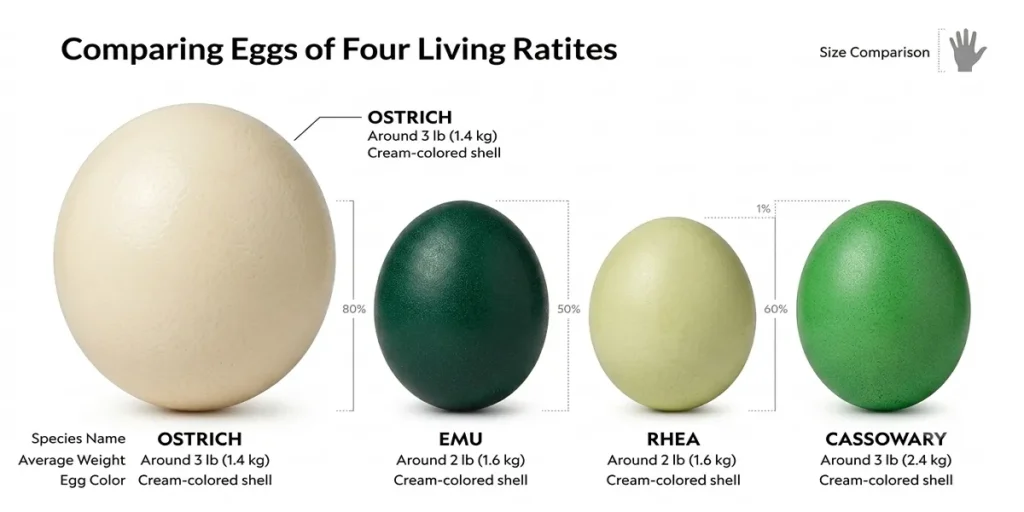
The eggs of ostriches, emus, rheas, and cassowaries differ almost as much as the birds themselves. Color, size, weight, and shell characteristics all vary, making eggs one of the easiest ways to distinguish these four ratites.
| Feature | Ostrich | Emu | Rhea | Cassowary |
|---|---|---|---|---|
| Average Weight | Around 3 lb (1.4 kg) | Around 1.3 lb (600 g) | Around 1.3 lb (600 g) | Around 1.4 lb (650 g) |
| Shell Color | Cream | Dark green | Yellowish green | Bright green |
| Shell Texture | Smooth and glossy | Thick with a textured finish | Smooth | Smooth with a slight sheen |
| Incubated By | Mainly the male | Male | Male | Male |
The ostrich egg is the largest of any living bird, measuring around 6 inches (15 cm) in length and weighing approximately 3 pounds (1.4 kg). Despite its impressive size, it represents only about 1 to 2% of the female’s body weight, making it relatively small compared with her enormous size.
The emu egg is famous for its deep emerald-green shell, one of the most distinctive egg colors found in nature. Although much smaller than an ostrich egg, its thick shell has made it popular for decorative carving and artwork.
Rhea eggs are pale yellowish-green and are often laid in large communal nests, where multiple females contribute eggs that are incubated by a single male.
Cassowary eggs are instantly recognizable thanks to their bright green shells. Like emus and rheas, the male is responsible for incubating the eggs and caring for the chicks after they hatch.
Although ostrich eggs are by far the largest, all four species share an unusual parenting strategy. In each case, the male plays the primary role in incubation and chick care, a trait that is relatively uncommon among birds and one of the defining characteristics of ratites.
Frequently Asked Questions (FAQ)
Are ostriches and emus cousins?
Not exactly. Although both are ratites, modern genetic research shows that emus are more closely related to cassowaries than they are to ostriches. The ostrich branched off earlier in the ratite family tree, making it the most genetically distinct of the four species.
Is an emu more aggressive than an ostrich?
Generally, no. Both species usually avoid conflict with humans. However, an ostrich is capable of delivering a much more powerful defensive kick, while an emu is more likely to retreat unless it is cornered or protecting its chicks.
Who would win in a fight, an emu or an ostrich?
Based on size, weight, speed, and leg strength, the ostrich would likely have the advantage. In reality, this encounter would never happen naturally because ostriches are native to Africa, whereas emus are found only in Australia.
Can emus breed with ostriches?
No. Emus and ostriches belong to different families and have been separated through millions of years of evolution. They are not genetically compatible and cannot produce hybrid offspring.
Does emu meat taste like ostrich meat?
Both meats are lean, red, and often compared to beef rather than chicken. However, emu meat is generally described as having a slightly richer and more pronounced flavor, while ostrich meat is typically milder.
What are the natural predators of an ostrich?
Healthy adult ostriches have relatively few natural predators because of their size and speed. Lions, spotted hyenas, and occasionally cheetahs may prey on adults, while eggs and chicks are vulnerable to jackals, birds of prey, and other carnivores.
How tall can an ostrich get?
A fully grown male ostrich can reach 9 feet (2.8 meters) in height, making it the tallest living bird on Earth.
What does a baby emu look like?
Baby emus hatch with distinctive cream and dark brown stripes that provide excellent camouflage among grass and scrub. These stripes gradually disappear as the chicks mature into the shaggy brown plumage of adult emus.
Although ostriches, emus, rheas, and cassowaries are often grouped together as flightless birds, each species has evolved to thrive in a very different environment. The ostrich dominates Africa’s open savannas with unmatched speed and size, the emu is built for endurance across Australia’s vast landscapes, the rhea has adapted to the grasslands of South America, and the cassowary plays a vital ecological role in the rainforests of Australia and New Guinea.
At OstrichPro, our goal was to go beyond the typical ostrich vs emu comparison by giving all four living ratites the attention they deserve. While they share a common flightless body plan, their differences in anatomy, behavior, habitat, and evolutionary history make each one remarkable in its own way.
Whether you wanted to identify these birds, understand their evolutionary relationships, or simply settle the debate over their similarities and differences, we hope this guide has made it easier to appreciate what makes each species unique.