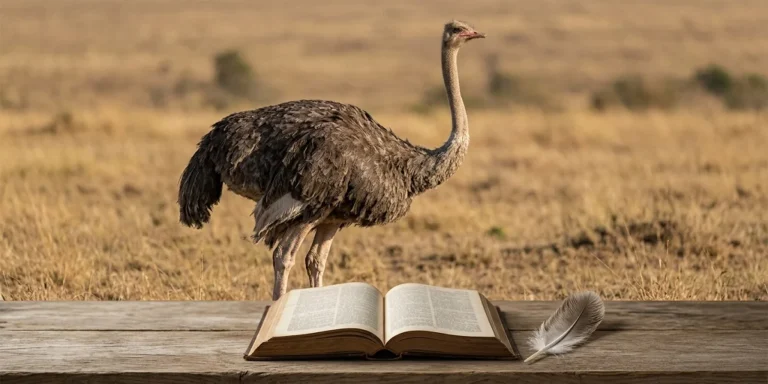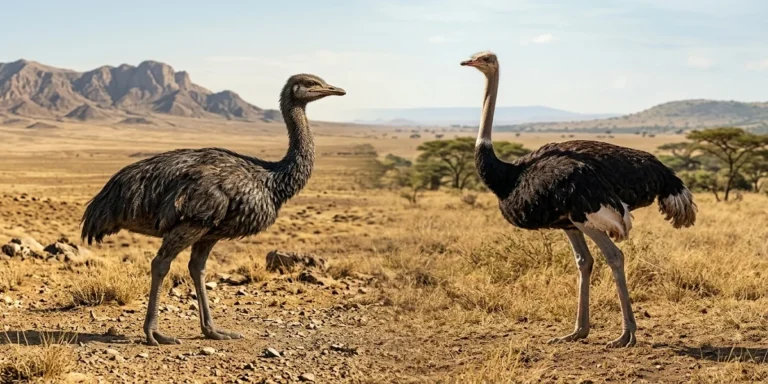
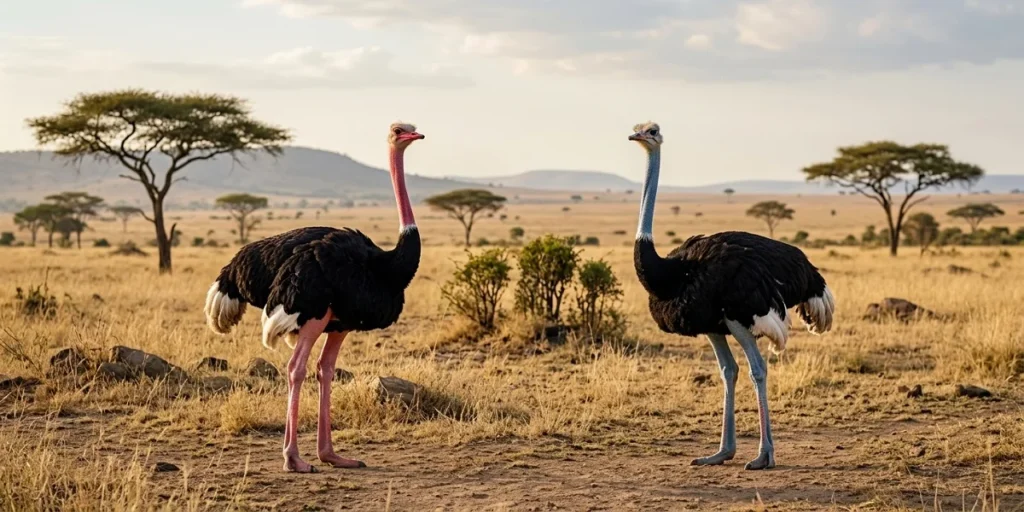
Quick Answer: There are two living species of ostrich: the Common Ostrich (Struthio camelus) and the Somali Ostrich (Struthio molybdophanes). The Common Ostrich has four recognized subspecies, three living and one extinct: the North African, South African, Masai, and Arabian ostriches. The Somali Ostrich was historically treated as a subspecies of the Common Ostrich but was recognized as a separate species in 2014. Current global bird taxonomy also recognizes these two living ostrich species.
If you have seen different numbers online, there is a good reason for the confusion. Older classifications treated the Somali Ostrich as a subspecies, while some sources use the word “type” to describe subspecies rather than species. The fossil record adds another layer because several extinct ostrich species and ostrich-like birds once lived across Africa and Eurasia.
In this guide, we will separate living species, subspecies, and extinct ostrich relatives so you can see exactly how many ostrich species exist today and why different sources sometimes give different answers.
How Many Species of Ostrich Exist Today?
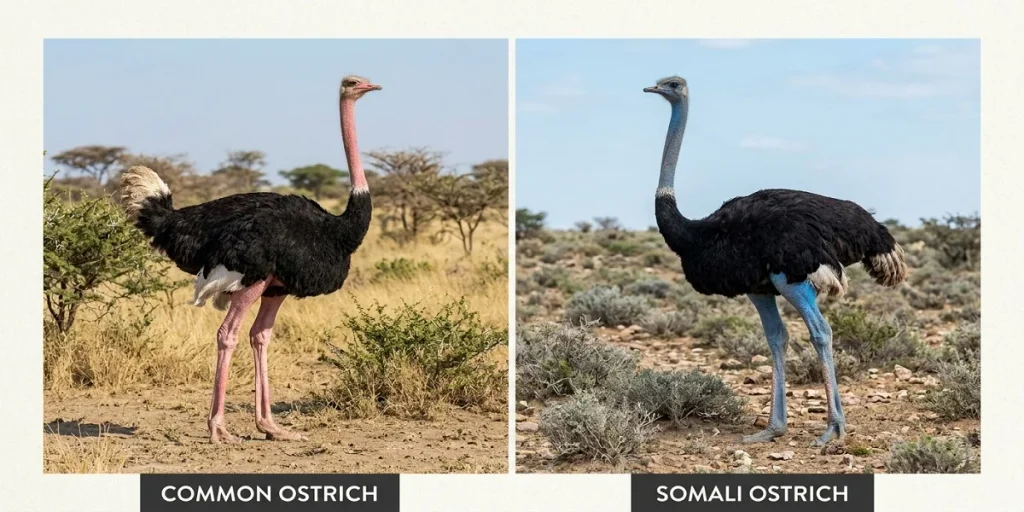
Ostriches belong to the genus Struthio within the family Struthionidae. Today, the genus contains two living species: the Common Ostrich and the Somali Ostrich.
Although both birds are unmistakably ostriches, they differ in geographic range, appearance, ecology, and evolutionary history. The Common Ostrich is widespread across much of sub-Saharan Africa, while the Somali Ostrich is restricted primarily to the Horn of Africa.
The distinction between these two species is also relatively recent. For much of modern ornithological history, the Somali Ostrich was classified as a regional subspecies of the Common Ostrich. Later genetic and morphological research supported treating it as a separate species.
Common Ostrich (Struthio camelus)
The Common Ostrich is the more widespread of the two living ostrich species and the bird most commonly associated with the name “ostrich.” Its range extends across parts of sub-Saharan Africa, where it occupies open habitats including savannas, grasslands, and semi-arid landscapes.
Adult males are recognizable by their predominantly black body feathers and contrasting white wing and tail feathers. Females and immature birds are generally grayish-brown, providing more subdued coloration in open nesting environments.
The Common Ostrich is also the largest living bird species, although body size varies among populations and subspecies. Its broad geographic range has contributed to considerable regional variation, which is reflected in the subspecies traditionally recognized within Struthio camelus.
Somali Ostrich (Struthio molybdophanes)
The Somali Ostrich is the second living ostrich species. It occurs primarily in the Horn of Africa, including Somalia, Ethiopia, Djibouti, and parts of Kenya.
One of its most distinctive features is the coloration of adult males. During the breeding season, the neck and legs can become an intense blue-gray to blue, giving the species its alternative name, the “blue-necked ostrich.” The Common Ostrich, by comparison, develops more reddish or pinkish skin coloration during breeding.
The Somali Ostrich was formerly classified as Struthio camelus molybdophanes, a subspecies of the Common Ostrich. It is now recognized as a separate species, reflecting evidence that accumulated from genetic, morphological, geographic, and ecological differences between the two lineages.
Ostrich Classification at a Glance
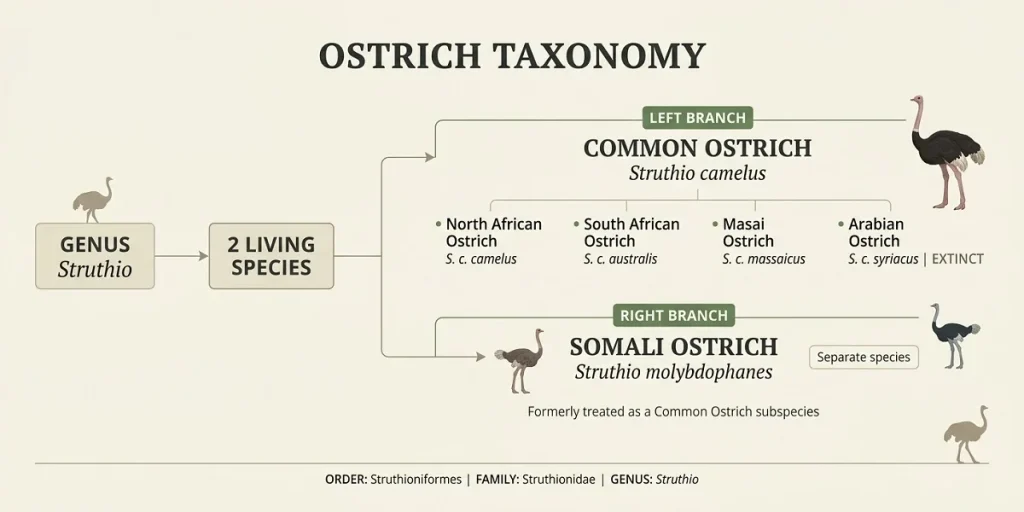
The easiest way to understand ostrich taxonomy is to separate genus, species, and subspecies. A species is a distinct taxonomic group, while a subspecies is a geographically or genetically distinct population within a species.
For living ostriches, the classification can be summarized as follows:
Order: Struthioniformes
Family: Struthionidae
Genus: Struthio
Living species: 2
- Struthio camelus – Common Ostrich
- Struthio molybdophanes – Somali Ostrich
The Common Ostrich is further divided into four recognized subspecies:
- Struthio camelus camelus – North African Ostrich
- Struthio camelus australis – South African Ostrich
- Struthio camelus massaicus – Masai Ostrich
- Struthio camelus syriacus – Arabian Ostrich, extinct
This distinction explains why you may encounter sources that mention “four types of ostriches” while others say there are two species. The two numbers are not necessarily contradictory. In most modern classifications, the four names above represent subspecies of the Common Ostrich, not four separate living species.
Common Ostrich vs. Somali Ostrich: Key Differences
The Common Ostrich and Somali Ostrich are closely related, but they are recognized as separate species. Their geographic ranges and physical characteristics provide some of the easiest ways to distinguish them.
| Feature | Common Ostrich | Somali Ostrich |
|---|---|---|
| Scientific name | Struthio camelus | Struthio molybdophanes |
| Main range | Much of sub-Saharan Africa | Horn of Africa |
| Male neck and leg color | Pinkish to reddish during breeding | Blue-gray to vivid blue during breeding |
| White neck ring | Generally present | Generally absent |
| Recognized subspecies | Four | None currently recognized |
| IUCN Red List status | Least Concern | Vulnerable |
| Taxonomic history | Long recognized as a species | Formerly treated as a Common Ostrich subspecies |
The most noticeable difference is often the color of the male’s skin during the breeding season. Common Ostrich males can develop pink or reddish skin, while Somali Ostrich males develop a much stronger blue coloration on the neck and legs.
Geography is another useful distinction. The Common Ostrich occupies a much broader range across Africa, whereas the Somali Ostrich is concentrated in the Horn of Africa. Their ranges can approach or overlap in parts of East Africa, making physical characteristics and local identification useful when distinguishing the two.
It is important to remember that appearance alone is not what defines the species. The modern distinction between the Common and Somali Ostrich reflects their evolutionary history and evidence from multiple lines of research, including genetics, morphology, geography, and ecology.
The Four Recognized Subspecies of the Common Ostrich
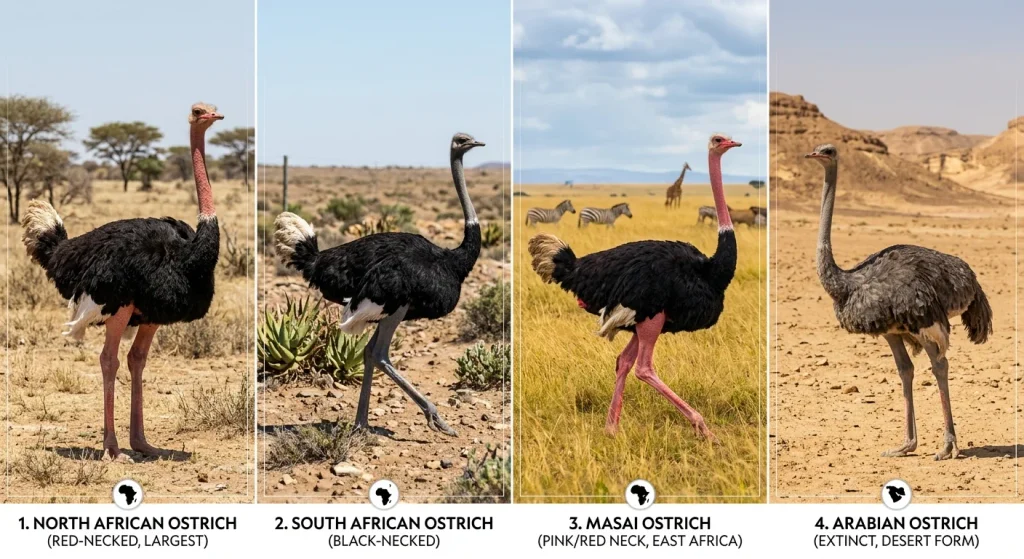
The Common Ostrich is divided into four recognized subspecies, although only three are living today. These populations developed in different geographic regions and show differences in appearance, distribution, and conservation history.
North African Ostrich (Struthio camelus camelus)
The North African Ostrich, also known as the red-necked or Barbary ostrich, is the northernmost form of the Common Ostrich. Its historical range extended across parts of North Africa and the Sahel, although its distribution has become much more restricted.
It is generally regarded as the largest subspecies of the Common Ostrich, with exceptionally large males reaching around 9 feet (2.7 meters) in height. Its reddish skin, particularly in breeding males, gives the subspecies its common name.
Wild populations have declined substantially in parts of their former range because of hunting, habitat loss, and increasing pressure on suitable open habitats. Conservation programs have also attempted to restore the North African Ostrich to areas where it historically occurred.
South African Ostrich (Struthio camelus australis)
The South African Ostrich, sometimes called the black-necked or Cape ostrich, occurs in southern Africa, including parts of South Africa, Namibia, and neighboring countries.
This subspecies has been particularly important to the modern ostrich farming industry. Selective breeding has produced domesticated ostriches used for meat, leather, feathers, and eggs, although farmed birds should not automatically be assumed to represent an unchanged wild population of the subspecies.
Its adaptation to dry, open environments makes it well suited to many of the landscapes where commercial ostrich farming has developed.
Masai Ostrich (Struthio camelus massaicus) (H3)
The Masai Ostrich, also called the East African Ostrich, is native to East Africa, with its recognized range including southern Kenya and eastern Tanzania.
This is particularly interesting from a regional perspective because the Masai Ostrich is associated with the savanna landscapes of East Africa, where ostriches can share their habitat with large grazing mammals such as zebras, wildebeest, and giraffes.
During the breeding season, males develop a noticeable pink or reddish coloration on the neck and thighs. The combination of its distribution, seasonal coloration, and distinctive East African setting makes the Masai Ostrich one of the most recognizable regional forms of the Common Ostrich.
For readers interested in where ostriches naturally live and how their environment shapes their behavior, our guide to ostrich habitat provides a broader look at the landscapes these birds occupy.
Arabian Ostrich (Struthio camelus syriacus) – Extinct
The Arabian Ostrich was the easternmost form of the Common Ostrich. It once occurred across parts of the Arabian Peninsula and surrounding regions, but hunting and other human pressures eventually drove it to extinction.
The Arabian Ostrich disappeared from the wild during the twentieth century, with 1966 generally cited as the year of its last confirmed sighting. It is therefore included in modern taxonomic lists as an extinct subspecies rather than a living ostrich.
Its extinction is an important reminder that the number of living ostrich populations today represents only a fraction of the diversity that existed historically.
Why Was the Somali Ostrich Once Considered a Subspecies?
The Somali Ostrich was not always recognized as a separate species. For many years, scientists classified it as a subspecies of the Common Ostrich under the scientific name Struthio camelus molybdophanes.
That classification changed as researchers accumulated more evidence showing that the Somali Ostrich represents a distinct evolutionary lineage. Differences in morphology, geographic distribution, ecology, and genetics all contributed to the modern separation of the two species.
The Genetic Evidence
Genetic research was particularly important in reassessing the relationship between the Somali and Common Ostrich. Studies of mitochondrial DNA found substantial evolutionary divergence between the two lineages, consistent with a long period of geographic isolation.
The Somali Ostrich lineage appears to have remained separated from populations of the Common Ostrich for millions of years. The complex geography of eastern Africa, including the long-term effects of the East African Rift system, played an important role in shaping this isolation.
This does not mean that a single geographic feature created a new species overnight. Rather, repeated periods of environmental and geographic change separated populations over vast periods, allowing genetic and physical differences to accumulate.
When Did the Somali Ostrich Become a Separate Species?
The taxonomic change became widely recognized in 2014, when BirdLife International treated the Somali Ostrich as a full species rather than a subspecies of the Common Ostrich.
This key distinction explains why older books, websites, and avian references may still describe the bird as Struthio camelus molybdophanes. Both scientific names refer to the same evolutionary lineage, but they reflect different stages of taxonomic consensus.
Current global bird checklists fully recognize the Somali Ostrich (Struthio molybdophanes) as a separate living species.
Why Do Some Sources List Different Numbers of Ostrich Species?
If you search for ostrich species online, you may find answers ranging from two species to several “types.” This apparent disagreement usually stems from differences in taxonomy, terminology, or the time period covered by a source.
The most important distinction is between a species and a subspecies. The Common Ostrich is a single species (Struthio camelus), but it contains four recognized subspecies in current global bird taxonomy. Counting those four subspecies as separate species produces an inaccurate count, as they are not classified at the same taxonomic level.
Historical classifications also matter. Before the Somali Ostrich was widely treated as a distinct species, authoritative sources listed it under Struthio camelus molybdophanes. Modern classifications use Struthio molybdophanes and count it as the second living ostrich species.
The fossil record creates another layer of confusion. Paleontologists have described extinct ostrich species from fossils, meaning a query asking about all ostrich species that have ever existed yields a completely different number than one focused exclusively on living birds.
What Does the Current Classification Say?
The AviList World Bird List provides a reliable modern reference by standardizing global bird taxonomy into a single checklist. In its 2025b version, AviList recognizes two living species in the genus Struthio: the Common Ostrich and the Somali Ostrich.
Under Struthio camelus, it recognizes four subspecies:
- S. c. camelus (North African Ostrich)
- S. c. australis (South African Ostrich)
- S. c. massaicus (Masai Ostrich)
- S. c. syriacus (Arabian Ostrich – Extinct)
So, when asking how many species of ostrich exist today, the definitive answer is: Two living species, alongside four recognized Common Ostrich subspecies (one of which is extinct).
This distinction clarifies why historical and modern references differ without treating every variation in terminology as a direct contradiction.
Were There Other Ostrich Species in the Past?
The answer “two ostrich species” refers to species that are alive today. The fossil record tells a much larger story, with several extinct ostrich species and ostrich-like birds known from Africa, Asia, and parts of Europe.
The genus Struthio has existed for millions of years, and fossil evidence shows that ostriches and their relatives once occupied a much broader geographic range than the two living species do today.
The Asian Ostrich (Struthio asiaticus)- Extinct
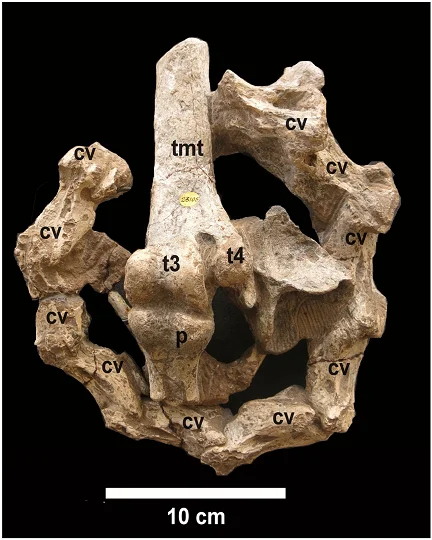
One of the best-known extinct ostrich species is the Asian Ostrich, Struthio asiaticus. Fossil remains and eggshell fragments indicate that ostrich-like birds once lived across parts of Asia and surrounding regions.
Ostrich eggshell is particularly valuable to archaeologists because it can survive for extremely long periods. Fossilized eggshell fragments and artifacts made from ostrich eggshell have been found at prehistoric archaeological sites, providing evidence that ancient humans interacted with these birds.
The Asian Ostrich eventually disappeared, leaving the African continent as the only modern home of living ostriches.
Other Extinct Ostrich Species (H3)
The fossil record includes several other extinct species assigned to the genus Struthio. Their remains have been found across different parts of Africa and Eurasia, showing that the evolutionary history of ostriches was considerably more diverse than the modern picture suggests.
Some fossil classifications remain subject to scientific revision because fragmentary remains can be difficult to distinguish from closely related ostrich species. As new fossils are discovered and older specimens are reassessed, the number and classification of extinct Struthio species can change.
This is another reason it is useful to distinguish between living ostrich species and the broader fossil history of the genus.
What About Pachystruthio?
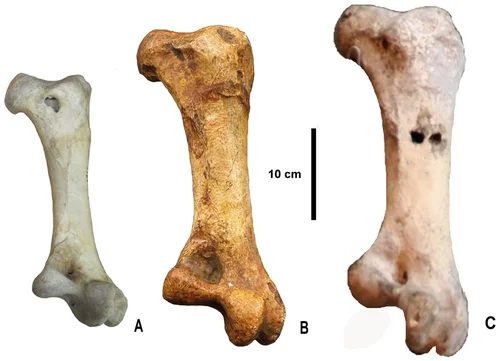
The fossil record also contains very large ostrich-like birds assigned to the extinct genus Pachystruthio. These birds lived during the Pliocene and Pleistocene and were substantially larger and more robust than modern ostriches.
However, Pachystruthio is not one of the two living ostrich species. It represents a separate extinct lineage of giant ostrich-like birds and should not be added to the modern count of Struthio species.
The distinction is important: two living ostrich species exist today, but the evolutionary history of ostrich-like birds includes many extinct forms that are known only from fossils.
Are Emus or Rheas Ostrich Species?
No. Emus, rheas, cassowaries, and kiwis are not ostrich species. They are different birds belonging to separate genera and evolutionary lineages.
The emu, Dromaius novaehollandiae, is native to Australia, while rheas are native to South America. Cassowaries occur in Australia and New Guinea, and kiwis are native to New Zealand. All are large, flightless birds, but none belongs to the genus Struthio.
These birds are often grouped together under the traditional term ratites, a broad group of mostly flightless birds with similar anatomical characteristics. Modern evolutionary research has shown that the relationships among these flightless birds are more complicated than the traditional idea of one simple ratite lineage suggests.
So, although an emu and an ostrich may look like close relatives, an emu is not a type of ostrich. The ostrich genus is Struthio, while the emu belongs to Dromaius.
For a detailed comparison of their size, speed, behavior, and anatomy, see our guide to ostrich vs. emu.
Ostrich Species Conservation Status
The two living ostrich species do not currently have the same conservation status. The Common Ostrich (Struthio camelus) is classified as Least Concern, while the Somali Ostrich (Struthio molybdophanes) is classified as Vulnerable. The Somali Ostrich was assessed separately after being recognized as a distinct species, highlighting how taxonomic changes can also affect conservation assessments.
| Species | IUCN status | Major conservation concerns |
|---|---|---|
| Common Ostrich (Struthio camelus) | Least Concern | Habitat loss, hunting, and local population declines |
| Somali Ostrich (Struthio molybdophanes) | Vulnerable | Habitat loss, hunting, egg collection, and other human pressures |
The Least Concern classification of the Common Ostrich does not mean that every population is secure. The species occupies a very large geographic range, but some regional populations have experienced substantial declines or disappeared from parts of their former distribution. Conservation status at the species level can therefore hide important differences between individual populations.
The Somali Ostrich has a more restricted distribution and faces greater conservation pressure. Its Vulnerable status reflects concerns about declining populations and pressures including habitat degradation and exploitation.
This distinction also helps explain why recognizing the Somali Ostrich as a separate species in 2014 was more than a change in scientific naming. Once it was treated as a distinct species, its conservation situation could be assessed independently rather than being included within the broader Common Ostrich category.
Frequently Asked Questions
How many species of ostrich are there?
There are two living species of ostrich: the Common Ostrich (Struthio camelus) and the Somali Ostrich (Struthio molybdophanes).
How many types of ostriches are there?
If by “types” you mean living species, there are two. The Common Ostrich has four recognized subspecies, three living and one extinct, which is why some sources may use a larger number when discussing different ostrich types.
What is the difference between a Common Ostrich and a Somali Ostrich?
The Common Ostrich (Struthio camelus) has a much broader African distribution and includes four recognized subspecies. The Somali Ostrich (Struthio molybdophanes) occurs mainly in the Horn of Africa and is especially distinctive because adult males develop blue-gray to vivid blue skin on the neck and legs during the breeding season.
Are ostriches and emus related?
Yes, but they are not the same type of bird. Ostriches belong to the genus Struthio, while emus belong to the genus Dromaius. Both are large flightless birds traditionally grouped among the ratites, but they represent separate evolutionary lineages.
How many subspecies of Common Ostrich exist?
There are four recognized subspecies of the Common Ostrich: the North African Ostrich (S. c. camelus), South African Ostrich (S. c. australis), Masai Ostrich (S. c. massaicus), and the extinct Arabian Ostrich (S. c. syriacus).
Is the Arabian Ostrich extinct?
Yes. The Arabian Ostrich (Struthio camelus syriacus) is extinct. It disappeared during the twentieth century, with 1966 generally cited as the year of its last confirmed sighting.
When was the Somali Ostrich classified as its own species?
The Somali Ostrich was recognized as a separate species in 2014, after taxonomic research supported treating it as distinct from the Common Ostrich. BirdLife International subsequently included it as a separate species in its bird taxonomy, and the IUCN assessed it independently as Vulnerable.
What is the largest ostrich subspecies?
The North African Ostrich (Struthio camelus camelus) is generally regarded as the largest subspecies of the Common Ostrich. Individual males can reach around 9 feet (2.7 meters) in height, although body size varies between individuals and populations.
Which ostrich species is endangered or vulnerable?
The Somali Ostrich is classified as Vulnerable on the IUCN Red List. The Common Ostrich is classified as Least Concern, although some regional populations face significant local pressures.
Can Common Ostriches and Somali Ostriches interbreed?
The Common and Somali Ostrich are closely related species whose geographic ranges come close to one another in parts of East Africa. However, they are treated as separate species in modern taxonomy based on accumulated genetic, morphological, geographic, and ecological evidence. There is not enough evidence to describe regular natural interbreeding as a defining feature of their relationship.
Final Answer: How Many Species of Ostrich Are There?
So, how many species of ostrich are there?
There are two living ostrich species recognized in current global bird taxonomy:
- Common Ostrich (Struthio camelus)
- Somali Ostrich (Struthio molybdophanes)
The Common Ostrich has four recognized subspecies, three of which are living and one, the Arabian Ostrich, is extinct.
The confusion comes mainly from older taxonomic classifications, the use of “type” as a general term, and the much larger fossil history of ostriches. Once species, subspecies, and extinct forms are kept separate, the modern picture becomes much clearer.
Ostrich taxonomy is also a good example of how scientific classification can change as genetic, geographic, morphological, and ecological evidence accumulates. What once appeared to be a single widespread species is now understood as two distinct living species with a much deeper evolutionary history behind them.