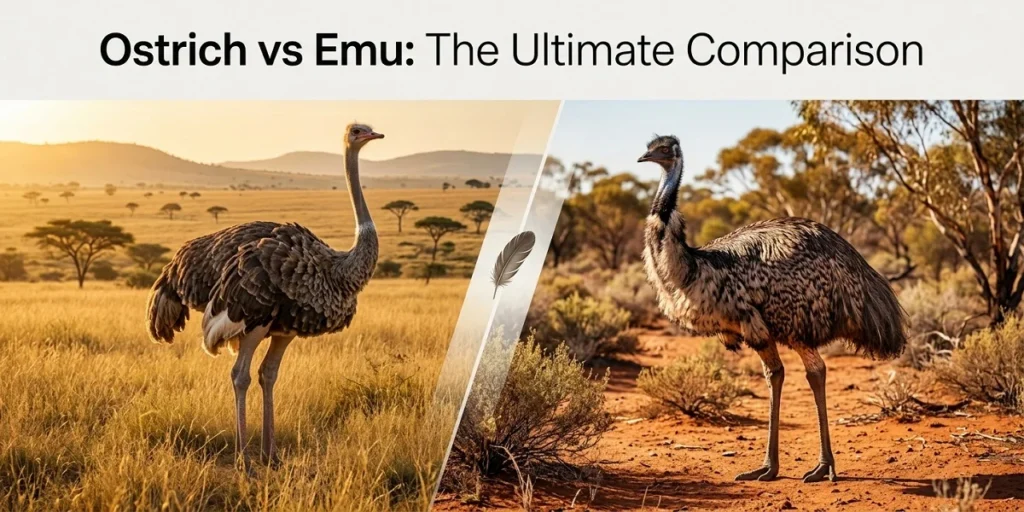
Quick Answer: The ostrich is larger and faster than the emu. An ostrich can reach about 70 km/h (43 mph) and stand up to 2.7 m (8.9 ft) tall, while an emu can reach roughly 50 km/h (31 mph) and grow to nearly 2 m (6.6 ft) in height. Ostriches also have two toes per foot, compared with three on each emu foot, and the two birds belong to different families.
- Ostrich: Native to Africa, up to 2.7 m (8.9 ft), up to 70 km/h (43 mph), 2 toes
- Emu: Native to Australia, nearly 2 m (6.6 ft), roughly 50 km/h (31 mph), 3 toes
Both are large, flightless running birds, but they are not closely related in the way their similar appearance might suggest. There is also no verified evidence of a viable ostrich-emu hybrid.
Table of Contents
Introduction
At first glance, ostriches and emus can look like distant cousins. Both are enormous flightless birds with long legs, long necks, and powerful bodies built for running. They also share a reputation for being unusual compared with most of the birds people encounter.
Look more closely, however, and the differences become much easier to spot. The ostrich is substantially taller and heavier, has only two toes on each foot, and can reach a higher running speed. The emu, native to Australia, is smaller but still stands close to two meters tall and is exceptionally well adapted to life on the ground.
Their differences go beyond size and appearance. Ostriches and emus live on different continents, belong to different bird families, produce very different-looking eggs, and are farmed for somewhat different products. Their behavior and defensive abilities also raise an interesting question: if an ostrich and an emu ever came face to face, which one would have the advantage?
This guide compares the two birds side by side, covering ostrich vs emu size, speed, physical appearance, habitat, behavior, meat, eggs, farming, and their evolutionary relationship.
Ostrich vs Emu: Comparison Table
| Feature | Ostrich | Emu |
|---|---|---|
| Native region | Africa | Australia |
| Maximum height | Up to 2.7 m (8.9 ft) | Nearly 2 m (6.6 ft) |
| Maximum weight | Up to 150 kg (330 lb) | Up to 60 kg (132 lb) |
| Top speed | Up to 70 km/h (43 mph) | Roughly 50 km/h (31 mph) |
| Toes per foot | 2 | 3 |
| Family | Struthionidae | Casuariidae |
| Neck | Mostly bare | Feathered |
| Egg color | Creamy white | Dark green |
| Flight | Flightless | Flightless |
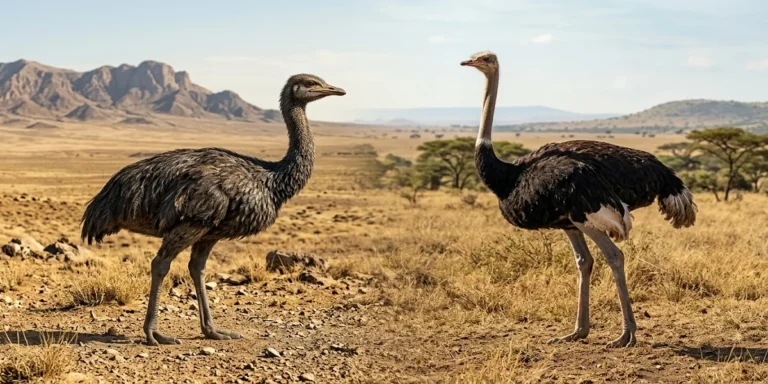
The size difference is one of the easiest ways to distinguish the two birds. An adult ostrich can be considerably taller and heavier than an emu, while the emu still ranks among the largest living birds.
Their feet provide another unmistakable difference. Ostriches have two toes on each foot, an unusual adaptation among living birds, while emus have three. Their necks and eggs are also visually distinct, making it possible to tell the species apart even without knowing their exact size.
Ostrich vs Emu: Physical Appearance
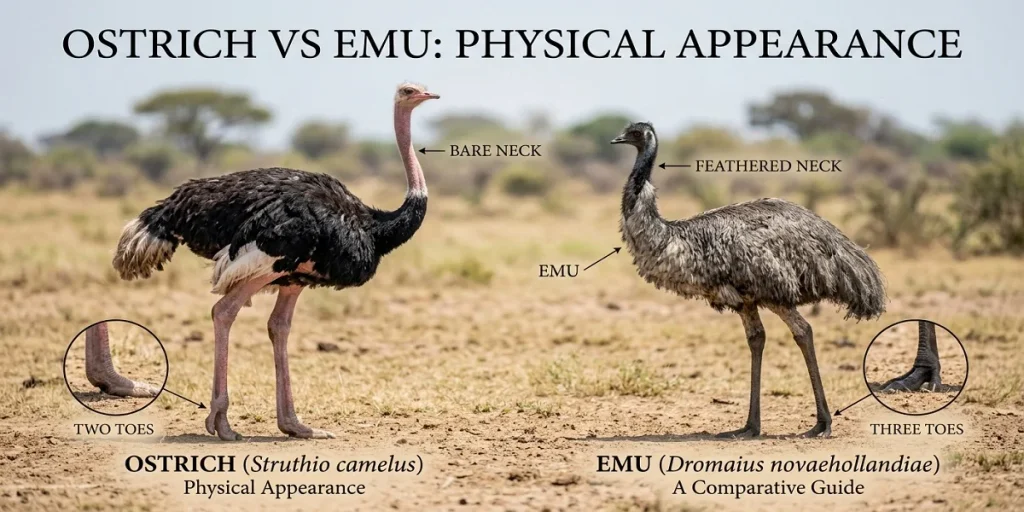
The easiest way to tell an ostrich and an emu apart is to look at their feet, necks, and feathers. Although both birds have long legs and large bodies, their anatomy is noticeably different when you see them side by side.
Feet and Toes
The ostrich has two toes on each foot, while the emu has three. The ostrich’s two-toed foot is particularly distinctive and is closely associated with its ability to run at high speeds. An ostrich’s larger inner toe carries a strong claw that can be used defensively when the bird feels threatened. Emus also have sharp claws and powerful legs, but their three-toed feet give them a distinctly different appearance.
Neck and Head
Ostriches have a relatively long neck with much of the skin exposed, although the exact coloration can vary between males and females. Their heads are comparatively small in relation to their enormous bodies, with large eyes adapted for spotting potential threats from a distance.
Emus have a feather-covered neck and a darker head. Their neck feathers become especially noticeable when compared directly with the ostrich’s more exposed neck. Emus also have a distinctive soft-looking facial appearance, with a small beak and dark eyes.
Feathers and Body Shape
- Male Ostriches: Have predominantly black body feathers with white wing and tail feathers.
- Female Ostriches: Are generally grayish-brown, making adult ostriches relatively easy to distinguish by sex.
- Emus: Have shaggy, double-shafted brown feathers, and males and females look broadly similar. Their feathers give the body a rougher appearance than the smoother plumage of an ostrich.
The overall body shape is different too. Ostriches have a taller, more upright profile with exceptionally long legs, while emus have a more compact body and a slightly lower center of mass. Both designs are highly effective for running, but the ostrich is built on a much larger scale.
Size Comparison: Ostrich vs Emu Size
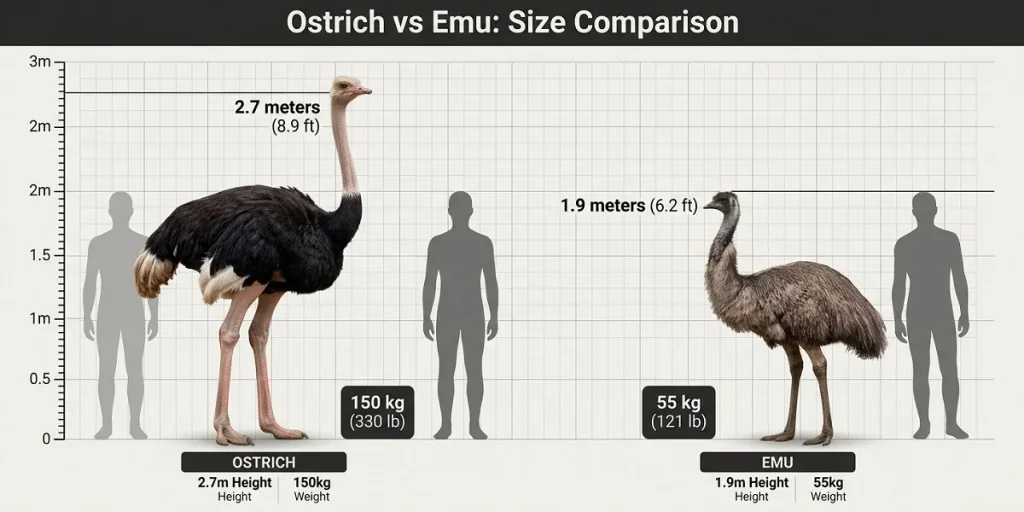
Which is bigger, an ostrich or an emu? The ostrich is significantly larger than the emu. As the largest living bird on Earth, an adult ostrich stands considerably taller and weighs more than twice as much as a large emu.
A large adult ostrich can reach around 2.7 meters (8.9 feet) in height and weigh up to approximately 150 kg (330 lb). Emus can grow to nearly 2 meters (6.6 feet) tall and may weigh up to about 60 kg (132 lb). That means a large ostrich can be more than a foot taller and more than twice the weight of a large emu. The difference is especially noticeable when standing side by side.
Related Guide: For a closer look at ostrich growth, adult measurements, and life cycle details, check out How Big Do Ostriches Get?
Speed Comparison: Which Is Faster?
Is an ostrich faster than an emu? Yes, the ostrich is faster than the emu. An ostrich can reach top speeds of 70 km/h (43 mph) in short bursts, making it the fastest living bird on land.
Emus are also remarkably fast runners, capable of reaching roughly 50 km/s (31 mph) and maintaining a strong pace over long distances. Their long legs and efficient stride allow them to move quickly across Australia’s open landscapes.
However, an ostrich can run about 20 km/h (12 mph) faster than an emu at top speed, giving it a significant advantage when speed is the deciding factor.
Related Guide: For a closer look at ostrich stride, acceleration, and animal speed rankings, read How Fast Can an Ostrich Run?
Where Do Ostriches and Emus Live? (Habitat & Origin)
Do ostriches and emus live in the same place? No, ostriches and emus live on completely different continents and never cross paths in the wild. Ostriches are native to Africa, whereas emus are native to Australia.
Natural Habitat & Climate Differences
While both species are highly resilient flightless birds adapted to open terrain, their natural ecosystems differ:
- Ostriches (Africa): Native to African savannas, open grasslands, and semi-arid regions. Their long legs and keen eyesight are specially adapted for warm, dry, and flat open landscapes where they can spot predators from afar.
- Emus (Australia): Native to Australian woodlands, grasslands, shrublands, and semi-desert regions. Unlike ostriches, emus are also well adapted to more densely vegetated areas and varied Australian climate conditions.
Dietary and Environmental Adaptations
Their distinct habitats also shape their foraging behavior in the wild:
- African Savanna Survival: Ostriches rely heavily on roots, seeds, leaves, and tough plant matter that thrive in dry African climates.
- Australian Bush Foraging: Emus consume a broader mix of native fruits, seeds, insects, and small animals available across Australia’s diverse ecosystems.
In the wild, there is zero geographical overlap between ostrich and emu populations. Any location where both species coexist, such as zoos, wildlife sanctuaries, or commercial farms, is strictly a human-managed environment.
Ostrich vs Emu Temperament: Which Bird Is More Aggressive?
Are ostriches more aggressive than emus? Neither species is naturally aggressive toward humans, but ostriches are generally considered more dangerous due to their massive size and powerful forward kicks. While neither bird actively attacks without cause, both will defend themselves fiercely if threatened, cornered, or protecting their eggs and chicks.
Defensive Abilities and Physical Power
When provoked, both birds rely on powerful legs and sharp claws to defend their territory:
- Ostrich Defensive Power: An ostrich delivers a massive forward kick using its strong legs and sharp two-toed claw. Due to its size, an ostrich kick carries enough physical force to injure or kill large predators.
- Emu Defensive Power: An emu uses a rapid, multi-directional kicking style with its three-toed sharp claws. While smaller than ostriches, a cornered emu can still inflict serious injuries.
Key Differences in Human Encounters
There is no scientific basis to claim one species has a wilder temperament than the other. Individual behavior largely depends on breeding season, territory protection, and human interaction history.
The main distinction comes down to sheer force rather than intent. Because an adult ostrich is twice the weight of an emu, any aggressive encounter with an ostrich involves significantly greater impact and risk. Both species should always be treated as powerful, wild animals.
Related Guide: To learn how an ostrich defends itself against apex predators in the wild, read our full analysis on Ostrich vs Lion: Can an Ostrich Defeat a Lion?
Ostrich vs Emu: Meat and Egg Differences
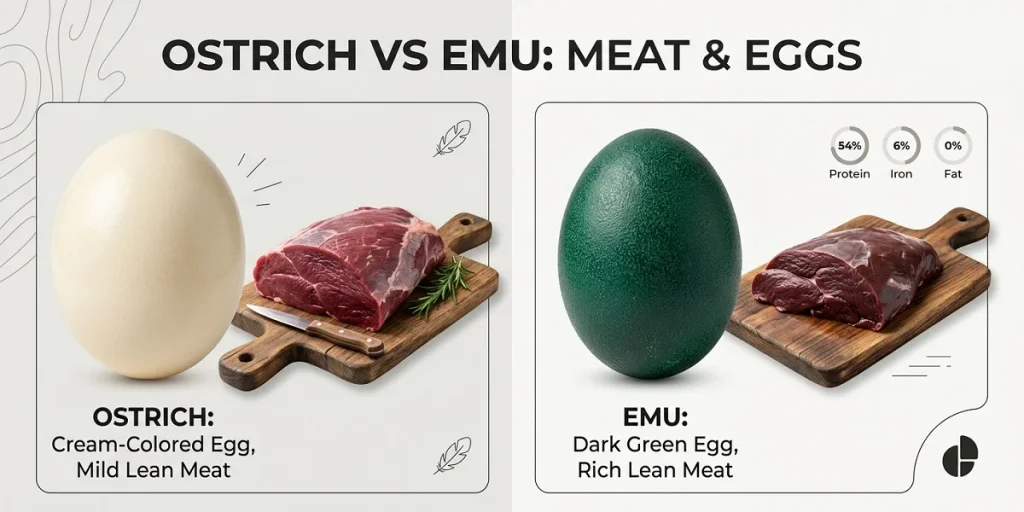
What is the difference between ostrich and emu meat and eggs? Both birds yield lean, red meat similar to beef, but emu meat tends to be slightly gamier while ostrich meat is milder. Visually, ostrich eggs are massive and cream-colored, whereas emu eggs are smaller with a striking dark green shell.
Meat Profile: Taste and Texture
While both species produce healthy, low-fat alternatives to conventional red meat, their culinary characteristics compare as follows:
- Flavor Profile: Ostrich meat is generally described as mild, tender, and very close to high-quality beef fillet. Emu meat is similarly beef-like but often carries a slightly richer, gamier flavor depending on the diet and cut.
- Texture & Leanness: Both meats are exceptionally lean, dark red, and low in cholesterol. Because of their low fat content, both require careful cooking at lower temperatures to prevent drying out.
Related Guide: To discover more about flavor profiles, cooking methods, and nutritional values, read our full article on What ostrich meat tastes like
Egg Profile: Color and Size
The difference between ostrich and emu eggs is one of the easiest ways to distinguish the two species visually:
- Ostrich Eggs: Massive, thick-shelled, and creamy off-white in color. A single ostrich egg weighs around 1.4 kg (3 lb) and is equivalent to roughly 24 chicken eggs.
- Emu Eggs: Moderately large with a highly distinctive deep avocado-green to dark emerald shell. An emu egg weighs around 400 to 650 grams and equals about 10 to 12 chicken eggs.
Can Emus and Ostriches Interbreed? (Ostrich-Emu Hybrids)
Can an ostrich and an emu mate and produce offspring? No, ostriches and emus cannot interbreed to produce viable hybrid offspring. While they share similar physical traits as large flightless birds, they belong to entirely different biological families, making hybridization biologically impossible.
Biological Classification Differences
Their inability to crossbreed comes down to their significant evolutionary separation:
- Ostrich Classification: Belongs to the family Struthionidae, native to Africa.
- Emu Classification: Belongs to the family Casuariidae, native to Australia.
Because they are separated at the family level rather than the species level, their genetic structures are far too different to produce living offspring.
Convergent Evolution vs Genetic Relationship
The similar appearance of ostriches and emus is a result of convergent evolution, a biological process where unrelated species independently evolve similar physical traits to adapt to similar environments. Both species developed long legs, large bodies, and flightless adaptations for running across open plains, but these shared traits do not indicate a close genetic bond.
Unverified Claims and Internet Rumors
While occasional rumors or unverified claims about “ostrich-emu hybrids” surface online, there is zero verified scientific evidence, genetic testing, or documented cases supporting them. Even when kept together in human-managed environments like farms or wildlife parks, ostriches and emus remain genetically distinct species that cannot produce hybrid offspring.
Ostrich vs Emu: Who Would Win in a Fight?
Who would win in a fight between an ostrich and an emu? An ostrich would win a physical confrontation against an emu. While both flightless birds possess strong legs and sharp claws, the ostrich has a massive advantage in weight, height, kick power, and overall physical strength.
Physical Advantage Comparison
When comparing the combat capabilities of both birds on paper, the physical differences become clear:
- Ostrich Battle Attributes: Weighs up to 150 kg (330 lbs) and stands up to 2.7 meters (8.9 ft) tall. Its massive leg power delivers a forward kick capable of exerting over 2,000 psi of force, armed with a sharp four-inch claw.
- Emu Battle Attributes: Weighs up to 55 kg (121 lbs) and stands around 1.9 meters (6.2 ft) tall. While fast and equipped with three sharp toes, its kicks carry significantly less weight and impact force.
Real-World Encounter Dynamics
There is no scientific record of a natural fight between an ostrich and an emu because they live on separate continents. If forced into a confrontation in a human-managed environment, the outcome would favor the ostrich simply due to sheer force.
However, in real-world animal behavior, both birds prefer running or threat displays over physical combat. Unless cornered or protecting offspring, both species usually avoid unnecessary physical fights.
Ultimately, based on body mass, kick strength, and physical reach, the ostrich is the far more formidable opponent.
Ostrich vs Emu Farming: Which Bird Is More Common on Farms?
Which bird is more common on commercial farms, ostriches or emus? Ostriches are more common globally and support a larger commercial farming industry, primarily driven by South Africa’s dominant market. While both birds are farmed commercially, ostrich farming offers a wider range of high-value yields, whereas emu farming operates on a smaller scale with a strong focus on emu oil.
Commercial Products and Market Value
Both species are raised as alternative livestock, but their primary economic drivers differ:
- Ostrich Farming Yields: Highly versatile commercial output including premium leather, high-end feathers, lean red meat, large eggs, and breeding stock.
- Emu Farming Yields: Primarily raised for emu oil, which is widely used in cosmetics and topical skin treatments, as well as lean meat and unique dark green eggshells.
Related Guide: If you are interested in starting a commercial venture, explore the full business setup process in our guide to ostrich farming.
Space and Operational Requirements
Neither species can be managed like standard poultry due to their size, strength, and behavioral needs:
- Ostrich Space Needs: Require extensive pasture area and heavy-duty fencing to accommodate their massive size, high running speeds, and territorial space.
- Emu Space Needs: Require smaller footprints than ostriches, but still need secure fencing and ample space for free movement and foraging.
Ultimately, ostrich farming remains the larger and more established global industry due to the higher commercial value of ostrich leather and feathers.
Explore Further: To see how these two species compare against other giant flightless birds Cassowary, check out our comprehensive Ostriches, Emus, Rheas and Cassowary Comparison.
Frequently Asked Questions (FAQ)
Is an emu more aggressive than an ostrich?
No, emus are not more aggressive than ostriches. In fact, ostriches are generally considered more dangerous during human encounters simply because they are twice as heavy and possess significantly more kicking force. Both birds are naturally timid but will defend themselves if cornered, disturbed, or protecting their young.
Can emus and ostriches breed with each other?
No, emus and ostriches cannot interbreed to produce viable hybrid offspring. They belong to completely different biological families (Casuariidae for emus and Struthionidae for ostriches), making hybridization biologically impossible despite their similar flightless adaptations.
Can emus or ostriches fly?
No, neither emus nor ostriches can fly. Both species are ratites with flat breastbones lacking a keel for flight muscle attachment. However, both birds use their wings for balance while running at high speeds, temperature regulation, and courtship displays.
Does emu meat taste like ostrich meat?
Yes, both emu and ostrich meat taste very similar to lean, high-quality beef rather than conventional poultry. Ostrich meat is widely described as slightly milder and tender, while emu meat offers a slightly richer and gamier flavor profile.
Who would win in a fight, an emu or an ostrich?
An ostrich would win a physical fight against an emu. The ostrich holds a massive physical advantage, weighing up to 150 kg compared to an emu’s 55 kg. An ostrich’s kick delivers over 2,000 psi of force, making it vastly superior in physical combat.
Are ostriches and emus closely related?
No, ostriches and emus are not closely related. While both belong to the broader ratite group of flightless birds, they evolved on separate continents and belong to distinct families (Struthionidae in Africa and Casuariidae in Australia). Their similar physical features are the result of convergent evolution.
What predators hunt ostriches and emus?
Adult ostriches are hunted by apex predators in Africa like lions, leopards, and hyenas, while their eggs and chicks face jackals and birds of prey. Adult emus have few natural predators in modern Australia, though dingoes, feral dogs, and large birds of prey target young or vulnerable emus.
While the ostrich and emu may look similar at first glance, the differences between them are substantial. The ostrich holds the title as the world’s largest and fastest bird with two toes per foot, while the smaller emu features three toes, a feather-covered neck, and unique adaptations for the Australian bush.
Their distinctions go far beyond physical appearance. Ostriches are native to Africa and drive a global commercial industry centered around high-value leather, meat, feathers, and eggs. Emus are native to Australia and are primarily farmed for their unique emu oil, meat, and distinct green eggs.
Neither species is naturally aggressive toward humans, but both are powerful, fast-moving flightless birds capable of delivering serious kicks if threatened. Despite their similar shapes, their distinct family classifications (Struthionidae and Casuariidae) mean they cannot produce viable hybrid offspring.
Ultimately, while the ostrich wins the size, weight, and speed comparison, the emu remains a remarkably resilient and impressive giant bird in its own right. Comparing the two side by side highlights how two distinct species can independently evolve similar body plans to thrive in entirely different environments across the globe.