Quick Answer: Ostrich symbolism varies across cultures and historical periods, with the bird representing everything from truth and justice to fire, trickery, and modern ideas of denial.
- Ancient Egypt: The ostrich feather symbolized truth, justice, balance, and cosmic order through the goddess Maat.
- San mythology: The ostrich is connected with fire and trickery in stories about Mantis stealing fire from beneath its wing.
- Biblical tradition: The bird traditionally identified as an ostrich in Job 39 is associated with unusual nesting behavior and apparent carelessness, although its identification is debated.
- Ancient Near East: Ostriches appear in symbolic and religious imagery, including ancient seals, although the precise meaning of individual scenes is often uncertain.
- Modern Western culture: The ostrich has become a symbol of denial and avoidance, largely because of the false “head in the sand” myth.
- Modern spirituality: Contemporary spiritual interpretations often associate the ostrich with grounding, resilience, awareness, and facing reality.
In short, there is no single universal meaning for the ostrich. Its symbolism changes depending on the culture and historical context.
Table of Contents
The ostrich has been part of human culture for thousands of years. Long before people raised ostriches for meat, eggs, feathers, or leather, the bird appeared in prehistoric art, religious symbolism, oral traditions, and ancient literature.
What makes ostrich symbolism especially interesting is that there is no single meaning attached to the bird. Different societies focused on different characteristics. Its enormous size, speed, unusual feathers, open-country habitat, eggs, and distinctive behavior all provided material for stories and symbolism.
This guide explores the historical and cultural meaning of the ostrich, separating documented mythology and archaeology from modern spiritual interpretations and popular myths.
What Does the Ostrich Symbolize?
There is no universal symbolic meaning for the ostrich. Its significance changed according to the culture, period, and context in which it appeared.
Some of the strongest documented associations include:
- Truth, justice, and balance in Ancient Egyptian religion
- Speed and physical power, reflecting the ostrich’s exceptional running ability
- Fire and trickery in San mythology
- Unusual or vulnerable parenting behavior in a biblical passage traditionally associated with the ostrich
- Life and practical survival, through the use of ostrich eggs and eggshells
- Denial and avoidance in modern Western culture because of the “head in the sand” myth
These meanings often came directly from observations of the real bird. Ancient people did not need to invent the ostrich’s unusual characteristics. A bird standing more than two meters tall, running at extraordinary speeds, producing enormous eggs, and carrying distinctive feathers was already unusual enough to attract attention.
This is also why ostrich symbolism can appear contradictory. The same bird could represent justice in one tradition and foolishness or vulnerability in another.
Ostrich Symbolism in Ancient Egypt
Ancient Egypt provides some of the clearest evidence for the symbolic importance of the ostrich.
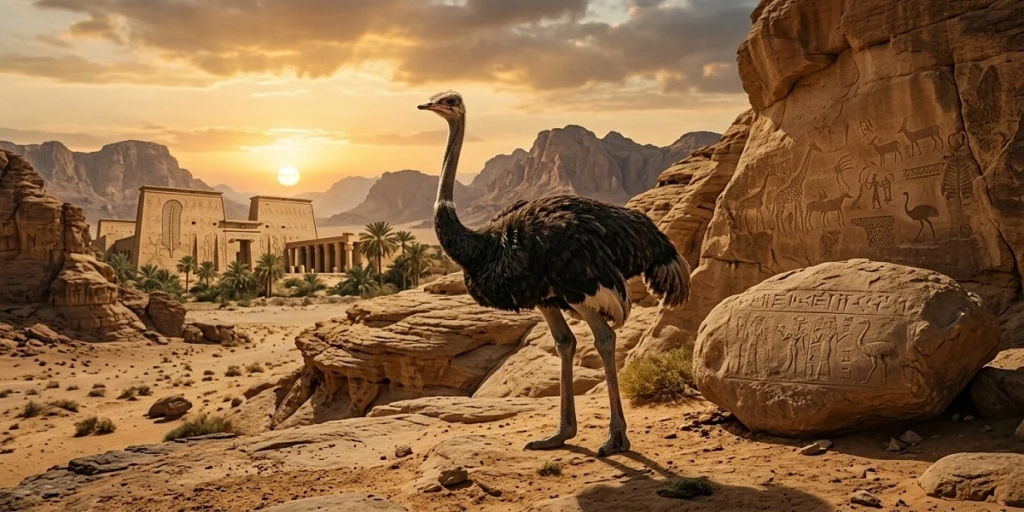
Ostriches were represented in Predynastic Egyptian art, while the bird’s feather eventually became one of the most recognizable symbols associated with the goddess Maat, the personification of truth, justice, balance, and cosmic order.
The distinction between the whole bird and its feather is important. Although ostriches appear in early Egyptian art, it was the ostrich feather that became especially important in later religious symbolism.
The Feather of Maat: Truth and Justice
Maat represented the principle of truth, justice, balance, and proper cosmic order in Ancient Egyptian thought.
The goddess Maat was commonly depicted wearing an ostrich feather on her head. Museum collections from Ancient Egypt preserve this association directly. The Metropolitan Museum of Art, for example, describes Maat as the goddess of truth and justice and notes that the ostrich feather on her head signified her name.
The feather also became a visual representation of Maat herself. Egyptian inscriptions could use the feather as a symbol for the concept of truth and justice without depicting the goddess in human form.
This association became particularly important in Egyptian ideas about the afterlife.
In the famous Weighing of the Heart scene, the deceased person’s heart was symbolically weighed against the feather of Maat. The image represented the judgment of a person’s life according to the principles of truth and cosmic order.
The symbolism therefore went far beyond simply representing an ostrich. The feather became a shorthand for one of the central ideas of Egyptian civilization: that the universe functioned according to an underlying order that humans were expected to respect.
The Metropolitan Museum also records examples in which the ostrich feather represents not only Maat but also Shu, the Egyptian god associated with air and light.
Why Was the Ostrich Feather So Important?
It is tempting to assume that Egyptians selected the ostrich feather because of some scientifically measured property, such as perfect symmetry.
Claims about the feather being uniquely balanced or perfectly symmetrical are frequently repeated online, but the stronger evidence is simply that the feather became an established visual emblem of Maat. We do not need an elaborate biological explanation to understand its importance.
The feather was distinctive, visually recognizable, and associated with a powerful desert bird. Over time, Egyptian religious tradition transformed it into one of the most important symbols of truth and justice.
That distinction matters because much modern writing about ostrich symbolism repeats explanations that are difficult to trace to primary Egyptian evidence.
Ostriches in Predynastic Egyptian Art
The relationship between Egyptians and ostriches goes back much further than the historical worship of Maat.
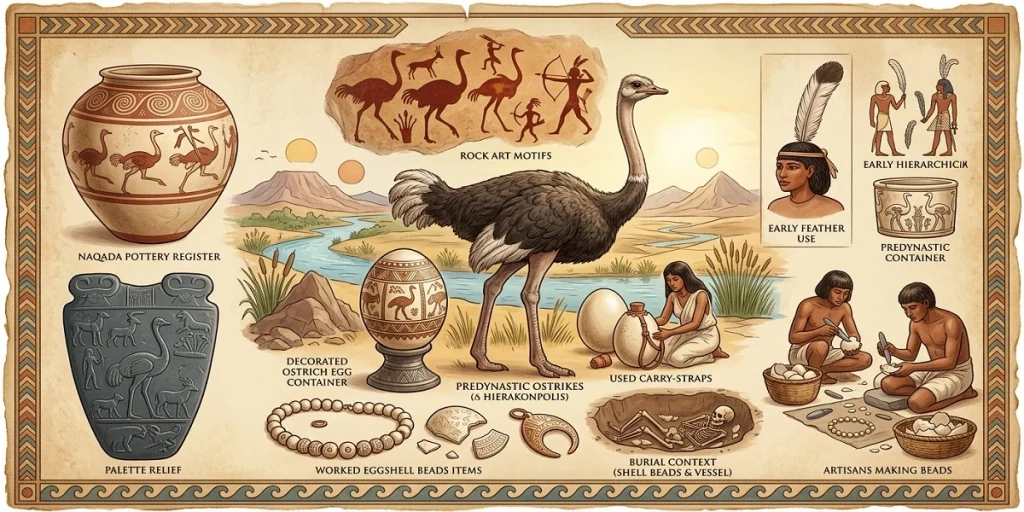
Predynastic Egyptian material culture contains numerous representations of ostriches. Archaeological research has identified ostriches in paintings, pottery decoration, rock art, palettes, vessels, and decorated ivory. Researchers studying this material emphasize that the meaning of an ostrich image cannot automatically be assumed to be the same in every context.
This is an important point.
An ostrich carved into a rock shelter, painted on pottery, or incorporated into a ritual object may not have carried exactly the same meaning. Predynastic Egyptian imagery was diverse, and archaeologists continue to debate how particular animal representations should be interpreted.
Ostrich eggs were also significant archaeological objects. The Metropolitan Museum has a Predynastic ostrich egg dated to approximately 3450 to 3300 BCE, while British Museum collections contain evidence that ostrich eggshells were used as containers and occurred in ancient burials.
Ostrich eggshell was practical as well as visually impressive. Once emptied, whole eggs could serve as containers, while fragments could be worked into beads, ornaments, and other objects.
This gives ostrich symbolism in Ancient Egypt an important practical dimension. The bird was not merely a mythical creature. It was a real part of the landscape and material culture.
The Ostrich in the Bible
The ostrich is traditionally associated with a striking passage in Job 39:13-18, where God describes a bird with unusual wings, nesting behavior, and remarkable speed.
At first glance, the passage seems straightforward. Many English translations identify the bird as an ostrich and describe it as leaving its eggs on the ground and showing little concern for them.
That interpretation has contributed to the ostrich’s long association with carelessness, foolishness, or apparent neglect in Western religious and literary tradition.
However, there is an important scholarly complication.
Is the Bird in Job 39 Really an Ostrich?
Biblical scholarship has questioned whether the bird described in Job 39 is actually an ostrich.
A detailed study by Arthur Walker-Jones in the journal Biblica examined the Hebrew term traditionally translated as “ostrich.” Walker-Jones notes that the Hebrew word does not clearly correspond to the word for ostrich in Hebrew or other Semitic languages and argues that the bird may instead have been a sandgrouse.
That does not mean the traditional ostrich interpretation should simply be discarded. It means the history of the translation is more complicated than many modern articles suggest.
For centuries, readers have understood the passage as referring to an ostrich, and that interpretation has influenced Western perceptions of the bird.
The passage describes a bird that leaves its eggs exposed, appears indifferent to danger, and nevertheless possesses extraordinary speed.
That combination is particularly interesting from a literary perspective. The bird is portrayed as strange and seemingly foolish, yet it also demonstrates an ability that humans would find impressive.
The contrast reinforces one of the recurring themes of ostrich symbolism: the bird is difficult to fit into ordinary categories.
Whether Job’s bird was literally an ostrich or another desert bird, the traditional association between the passage and the ostrich has had a lasting cultural influence.
The Ostrich in San Mythology
Some of the most memorable ostrich mythology comes from the San peoples of Southern Africa.
In several San traditions, the praying mantis, often associated with the trickster and creator figure ǀKaggen, is connected with the origin of fire. The ostrich plays an important role because it is the creature that possesses the fire before humans receive it.
The Mantis Who Stole Fire From the Ostrich
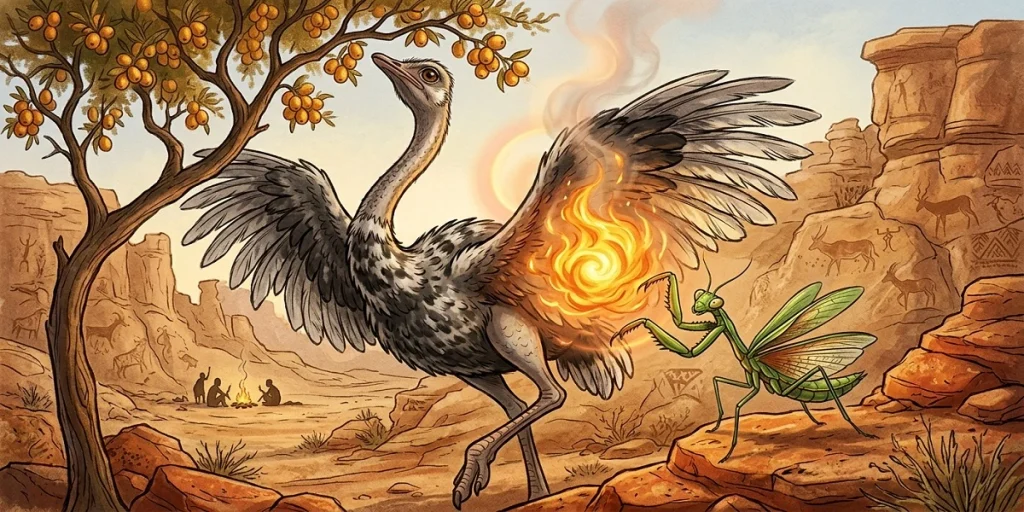
In one widely recorded version of the story, Mantis discovers that Ostrich has fire hidden beneath his wing.
Ostrich uses the fire to cook food and then carefully hides it again. Mantis wants to obtain the fire for people, but Ostrich will not willingly give it away.
So Mantis uses trickery.
He tells Ostrich about a tree covered with delicious fruit and encourages the bird to reach higher and higher for the best fruit. When Ostrich stretches upward and opens his wings for balance, Mantis sees the hidden fire and steals it.
Mantis then takes the fire to the people, giving them the ability to cook food and stay warm.
Versions of this story have been recorded and retold in different forms, so individual details vary. The central relationship between Mantis, Ostrich, and fire is nevertheless well established in collections of Southern African folklore.
The story is especially interesting because it does more than explain where fire came from.
It also provides a mythological explanation for the ostrich’s modern anatomy.
In versions of the story, Ostrich is embarrassed after being tricked and thereafter keeps his wings close to his body. The story therefore turns a real characteristic of the flightless bird into a consequence of a mythical event.
This is a common feature of animal mythology. A real physical characteristic is observed first, and a story is then created to explain why the animal looks or behaves that way.
What Does the Ostrich Represent in the Fire Myth?
The ostrich is not simply a foolish victim.
It is the keeper of a powerful resource.
Fire represents cooking, warmth, light, and survival. By keeping fire beneath its wing, the ostrich occupies a position between the natural world and human technology.
Mantis, meanwhile, represents intelligence and trickery. He cannot defeat Ostrich through physical strength, so he uses observation and deception.
The story therefore creates an interesting contrast:
Ostrich has the resource. Mantis has the strategy.
That makes the ostrich a much more interesting mythological character than the simplistic “foolish bird” interpretation found in many modern symbolism articles.
Ostriches in Southern African Folklore
The ostrich appears in Southern African folklore beyond the famous fire story.
Animal stories frequently use creatures as characters with recognizable personalities. Large and powerful animals can be portrayed as proud or vulnerable, while smaller animals often survive through intelligence and trickery.
This makes the ostrich particularly useful as a folklore character. It is physically imposing but can still be outsmarted.
However, it is important not to treat all African traditions as one unified mythology.
Africa contains thousands of cultural traditions, languages, and historical communities. A story recorded among one San community cannot automatically be presented as a belief shared by every African society.
For that reason, it is more accurate to speak about specific San traditions or Southern African folklore rather than claiming that “African culture” gives the ostrich one universal meaning.
Ostrich Symbolism in the Ancient Near East
The ostrich was not culturally important only in Africa.
The bird lived across parts of the ancient Near East and appears in archaeological and artistic material from the region.
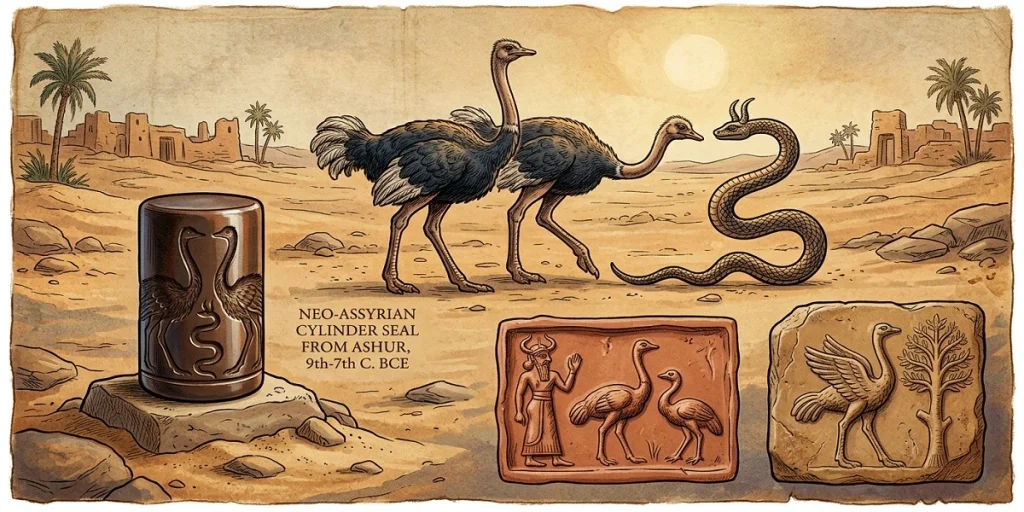
Ostriches appear on seals and other objects from the ancient Near East, including scenes in which the bird is shown alongside other animals.
One particularly interesting example comes from Assyrian glyptic art, where an ostrich appears together with a serpent. The University of Zurich’s Iconography of Deities and Demons project records a Neo-Assyrian cylinder seal from Ashur depicting two ostriches and a serpent. It also documents ostrich imagery on seals from the Southern Levant.
The presence of an ostrich and serpent together is intriguing, but this is where interpretation requires caution.
We can document the imagery.
We cannot confidently say that the ostrich universally “symbolized” a specific concept represented by the serpent, because the surviving evidence does not provide a clear explanation of the artists’ intentions.
That uncertainty is important.
Ancient symbolism is not a dictionary in which every animal automatically has one fixed meaning. The same animal could represent different ideas depending on the object, location, period, and cultural context.
Research on Iron Age Southern Levantine seals shows that ostriches could appear in religious or symbolic contexts, including scenes with anthropomorphic figures. One study notes that ostriches were used as divine attributes in some earlier Levantine glyptic traditions, although their popularity changed over time.
The evidence therefore supports a broad conclusion: the ostrich had a recognized visual and symbolic presence across parts of the ancient Near East, even though the precise meaning of individual images often remains uncertain.
Where Does the “Head in the Sand” Myth Come From?
Perhaps the most famous modern symbol associated with the ostrich is also the least accurate.
The popular image shows an ostrich burying its head in the sand to hide from danger. The story has become a metaphor for denial, avoidance, and refusing to acknowledge an obvious problem.
The problem is that real ostriches do not behave this way.
An ostrich may lower its head toward the ground while tending its nest, turning eggs, feeding, or responding to its surroundings. From a distance, its head can also become difficult to distinguish from the surrounding landscape.
The bird’s real behavior was gradually transformed into a much more memorable story: the ostrich supposedly believes that if it cannot see the predator, the predator cannot see it.
That interpretation has nothing to do with the actual survival strategy of an ostrich.
The history of this misconception and the real reasons ostriches lower their heads are explained in our dedicated guide, Do Ostriches Really Bury Their Heads in the Sand?.
The myth is nevertheless important to ostrich symbolism because it created a completely new modern meaning.
An animal that once represented truth and justice in Ancient Egypt eventually became a Western metaphor for denial and willful ignorance.
That is one of the clearest examples of how animal symbolism can change dramatically over time.
Ostrich Symbolism Across Cultures
The history of ostrich symbolism becomes easier to understand when the traditions are placed side by side.
| Culture or Tradition | Symbolic Meaning | Historical Context |
|---|---|---|
| Ancient Egypt | Truth, justice, balance, cosmic order | The ostrich feather was associated with the goddess Maat |
| Predynastic Egypt | Varies by context | Ostriches appear in pottery, rock art, palettes, vessels, and other objects |
| San traditions | Fire, trickery, transformation | Mantis steals fire kept by Ostrich |
| Hebrew Bible tradition | Apparent carelessness or vulnerability | Job 39 is traditionally interpreted as describing an ostrich, although the identification is debated |
| Ancient Near East | Symbolic or religious significance, exact meaning uncertain | Ostriches appear on seals and in other ancient imagery |
| Modern Western culture | Denial, avoidance | Based largely on the false “head in the sand” story |
| Modern spirituality | Grounding, awareness, resilience, facing reality | Contemporary spiritual interpretations rather than one documented ancient tradition |
The table also reveals an important pattern.
There is no single “ostrich meaning.”
Instead, ostrich symbolism developed from different characteristics of the bird and different concerns of the societies that observed it.
Ostrich Symbolism in Modern Spirituality and Popular Culture
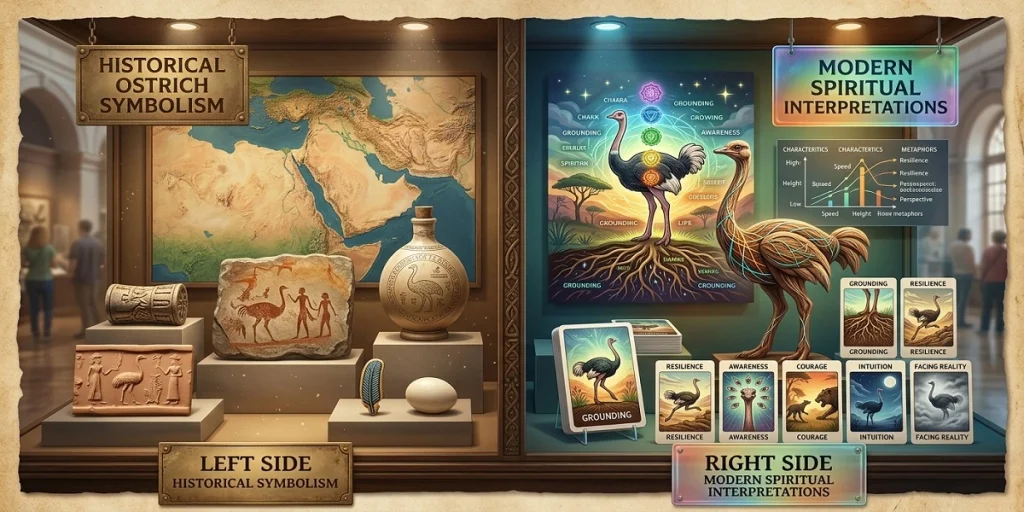
Search results for “ostrich symbolism” are now dominated by modern spiritual websites that describe the ostrich as a spirit animal, totem, or power animal.
These sources commonly associate the ostrich with ideas such as grounding, resilience, awareness, courage, intuition, and facing reality.
Such interpretations can be meaningful to people who use modern spiritual frameworks, but they should be separated from documented ancient traditions.
There is no single historical belief system in which all of these modern meanings were universally assigned to the ostrich.
Instead, modern spirituality often takes observable characteristics of the bird and turns them into personal metaphors.
For example, the ostrich’s ability to run at high speed can be interpreted as resilience or forward movement. Its height can become a metaphor for seeing the world from a broader perspective. Its ground-based lifestyle can be associated with grounding and connection to the earth.
These are modern symbolic interpretations, not established facts about Ancient Egyptian, San, biblical, or Near Eastern religion.
That distinction allows us to appreciate modern spiritual symbolism without confusing it with archaeology or history.
Why Does the Ostrich Have So Many Different Meanings?
The answer lies in the biology and behavior of the bird itself.
The ostrich is a living study in contradictions. It is a bird that cannot fly, yet it can outrun top land predators. It is physically massive and formidable, yet it nests openly on the ground. It possesses enormous, elaborate wings, but uses them for balance, courtship, and thermal regulation rather than flight. It appears vulnerable when tending ground nests, yet a single kick from its powerful legs can be lethal.
These striking paradoxes provided ancient observers with rich raw material for storytelling and symbolism. Different societies simply chose to emphasize different facets of the same extraordinary creature:
- Ancient Egyptians looked at the distinctive structure of the plumage and transformed the feather into the ultimate symbol of truth and cosmic order.
- San Storytellers observed its wing posture and physical dominance, casting the bird as the formidable original keeper of fire.
- Biblical Traditions focused on its exposed ground nesting and sudden bursts of speed, interpreting its behavior as a symbol of apparent carelessness balanced by unmatched swiftness.
- Modern Western Culture misconstrued its natural nesting posture, turning a grounded survival behavior into a universal metaphor for denial.
In the end, the ostrich never had a single fixed meaning. Its symbolic history is as varied as its physical traits, reflecting humanity’s enduring fascination with a creature that defies ordinary categorization.
Frequently Asked Questions
What does the ostrich symbolize?
The ostrich has different meanings in different cultures. In Ancient Egypt, its feather represented truth, justice, and cosmic order through the goddess Maat. In San mythology, the ostrich is associated with fire and trickery, while modern Western culture often uses it as a symbol of denial or avoidance.
What does an ostrich symbolize spiritually?
Modern spiritual traditions commonly associate the ostrich with ideas such as grounding, resilience, awareness, and facing reality. These are contemporary spiritual interpretations rather than a single documented ancient belief about the ostrich.
Why is the ostrich associated with truth and justice?
The association comes primarily from Ancient Egypt, where the ostrich feather was the emblem of Maat, the goddess and personification of truth, justice, balance, and cosmic order. The feather became an important symbol in Egyptian religious imagery.
What is the Feather of Maat?
The Feather of Maat is an ostrich feather associated with the Egyptian goddess Maat. It represented truth, justice, and cosmic order and became particularly famous through Egyptian depictions of the judgment of the dead.
What does the ostrich represent in the Bible?
The answer is more complicated than many modern articles suggest. Job 39:13-18 has traditionally been translated as describing an ostrich, and the passage portrays the bird as exhibiting unusual nesting behavior. However, biblical scholarship has questioned whether the original Hebrew text actually refers to an ostrich, with some scholars proposing a sandgrouse instead.
What is the San myth about the ostrich and fire?
In a well-known San tradition, the ostrich keeps fire beneath its wing. The trickster figure Mantis observes this and eventually tricks Ostrich into opening its wings, allowing Mantis to steal the fire and bring it to the people. Versions of the story vary in their details.
Does the ostrich really bury its head in the sand?
No. Ostriches do not bury their heads in sand to hide from predators. The famous image is a myth that became a metaphor for denial and avoidance. Ostriches may lower their heads toward the ground for normal behaviors around their nests and surroundings.
What does an ostrich feather symbolize?
Historically, the most important documented meaning of the ostrich feather comes from Ancient Egypt, where it represented Maat and the principles of truth, justice, balance, and cosmic order.
What does an ostrich egg symbolize?
Ostrich eggs have carried practical and potentially symbolic importance in several ancient cultures. In Ancient Egypt and neighboring regions, ostrich eggshells were used as containers, ornaments, beads, and other objects. Their enormous size also made them visually distinctive objects in prehistoric and ancient material culture.
Why is the ostrich associated with denial?
The modern association comes from the false idea that ostriches bury their heads in sand when threatened. Because the bird supposedly “hides” by making itself unable to see danger, the ostrich became a metaphor for denial and refusing to face reality.
Ostrich symbolism is far more complicated than the modern “spirit animal” articles appearing throughout today’s search results.
The historical evidence reveals a bird that has been interpreted in dramatically different ways. In Ancient Egypt, the ostrich feather became a symbol of truth and justice. In San mythology, the ostrich became the keeper of fire, only to lose it through the cleverness of Mantis. In biblical tradition, a bird traditionally identified as an ostrich became associated with unusual behavior and vulnerability, although that identification itself remains debated.
Across the ancient Near East, ostriches also appeared in artistic and symbolic contexts, demonstrating that the bird’s cultural importance extended well beyond Egypt and Southern Africa.
And in the modern world, an inaccurate story about burying its head in the sand transformed the ostrich into a symbol of denial.
Perhaps that is the most fitting lesson of ostrich mythology.
The ostrich has never had just one meaning. Its symbolism has always reflected what people found most remarkable about the bird itself: its size, speed, feathers, eggs, behavior, and strange position between the familiar world of birds and something much more unusual.