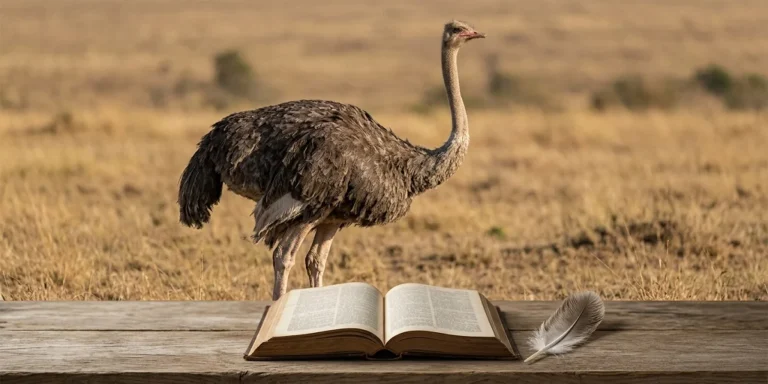
Quick Answer: Ostriches once roamed the desert landscapes of ancient Egypt, serving as far more than a source of meat, eggs, and feathers. Over time, the bird’s distinctive plumage became deeply tied to Maat (the goddess of truth and cosmic order) and Shu (the god of air). Ostrich eggs were crafted into everyday tools and placed in burials to signify rebirth, while feather fans evolved into prominent symbols of pharaonic power.
Table of Contents
Few animals filled as many roles in ancient Egypt as the ostrich. To prehistoric hunters, it was a prized desert game animal. To artisans, its thick eggshells offered raw material for beads, containers, and ornaments. In royal courts, its plumes were woven into ceremonial fans and regalia. And within Egyptian theology, a single ostrich feather came to embody one of the civilization’s core ideals: Maat, the principle of truth, justice, and universal harmony.
The story of the ostrich in Egypt stretches far beyond mythology. Long before the first pyramids were built, communities along the Nile Valley were encountering and depicting these giant flightless birds. Predynastic rock art and decorated pottery offer some of the earliest proof, showing that the connection began as an authentic interaction between humans and local wildlife.
As pharaonic civilization matured, this relationship evolved. Ostrich plumes began appearing in religious iconography, royal regalia, and sacred hieroglyphs, while the ostrich hunt turned into a ritualized display of kingly dominance. Centuries later, magnificent artifacts recovered from the tomb of Tutankhamun would preserve some of the finest physical evidence of this royal association.
Simultaneously, the ostrich egg charted its own distinct path. Beyond practical applications as vessels or trade goods, eggs were frequently deposited in funerary contexts, where their enclosed form and impressive size naturally symbolized creation, origin, and eternal renewal.
Ultimately, the history of the ostrich in ancient Egypt is a story of conceptual transformation. Depending on the setting, a single creature could represent a wild desert quarry, a source of luxury materials, an emblem of cosmic order, or a supreme display of regal power.
To fully grasp why this bird became so deeply woven into Egyptian culture, we must first look back to a time before pharaohs and temples, when wild ostriches still roamed the open desert frontiers of the Nile Valley.
Did Ancient Egypt Have Ostriches?
Yes. Ostriches were a natural part of the ancient Egyptian landscape thousands of years before the pharaonic state was established. Archaeological finds place them across the dry regions bordering the Nile, where early communities hunted them for meat and repurposed their thick eggshells long before the bird’s feathers carried religious meaning.
Ostriches Before the Pharaohs
The relationship between Egyptians and ostriches began long before the first dynasties unified the land. Fossilized ostrich bones recovered from Upper Paleolithic sites confirm their presence, while eggshell fragments have been excavated from both Paleolithic and Neolithic settlements across the region. These physical remains prove that the bird was no rare anomaly or abstract myth to early inhabitants. It was a familiar staple of the regional wildlife and a vital source of raw materials.
The archaeological record becomes even clearer as ostriches enter early visual art. A comprehensive study of early Egyptian artifacts identifies the ostrich as the very first bird species represented in pictorial form in ancient Egypt, appearing frequently in rock carvings and Predynastic pottery.
One particularly striking image comes from Silwa Bahari, near Aswan. A Predynastic rock carving depicts a hunter drawing a bow toward an ostrich, capturing a straightforward scene of daily survival. This artifact matters because it shows the bird not as a divine symbol, but as an active target for local hunters.
Rock art discovered near Aswan offers an even older window into this interaction. Archaeologists from the University of Bonn documented roughly 6,000-year-old engravings showing a bow-wielding hunter, a masked or dancing figure, and a massive flightless bird clearly identifiable as an ostrich. Researchers link this scene directly to Neolithic hunting rituals practiced long before the rise of the pharaohs.
What Did Ancient Egypt’s Landscape Look Like?
The presence of ostriches makes complete sense when considering that prehistoric northeastern Africa looked vastly different from modern Egypt. Climatic conditions fluctuated dramatically over the millennia, turning areas that are now arid desert into lush savannas and grassy scrublands capable of supporting diverse wildlife.
The Nile Valley and its surrounding borders were not isolated from the broader African ecosystem. Ostriches freely roamed the dry pastures edging the river, sharing the terrain with other large mammals that eventually vanished from the region as the climate dried up. Prehistoric rock art functions as a visual record of this lost environment, capturing animals that would soon disappear from Egyptian territory.
For early hunter-gatherers, the ostrich was an exceptionally high-value resource:
- Meat: Provided a massive yield of lean protein for local communities.
- Feathers: Gathered for personal adornment, shelter insulation, or early tools.
- Eggs & Shells: Offered nutritious food, while the thick shells were fashioned into durable water canteens, bowls, and decorative beads.
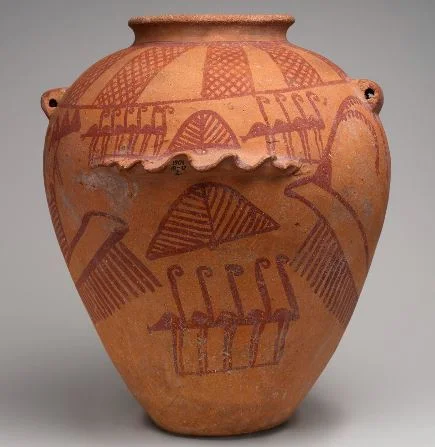
This practical versatility explains why ostriches featured so heavily in early visual culture of Ancient Egypt. A celebrated Predynastic ceramic vessel in the British Museum showcases a painted procession of long-legged ostriches alongside antelopes and riverboats, proving how deeply embedded the bird was in the mental landscape of early Egyptians.
From Wild Animal to Cultural Symbol
At this stage in history, there was no mysticism surrounding the ostrich. It was simply a large, fast desert bird that humans tracked, harvested, and utilized for everyday survival.
What makes the Egyptian narrative remarkable is the conceptual shift that followed. As society centralized and religious iconography grew more sophisticated, the ostrich’s physical traits took on meanings far beyond their practical utility. Eventually, its plumes would come to represent truth, air, royal authority, and cosmic harmony, while its eggs were incorporated into sacred burial rites and creation myths.
This transformation unfolded gradually over centuries as the bird transitioned from the physical desert into formal art, royal ceremony, and hieroglyphic writing.
Before a single feather could represent the goddess Maat, however, the act of confronting the bird itself had to evolve. In ancient Egypt, hunting an ostrich soon became much more than a quest for food.
Ostrich Hunting in Ancient Egypt
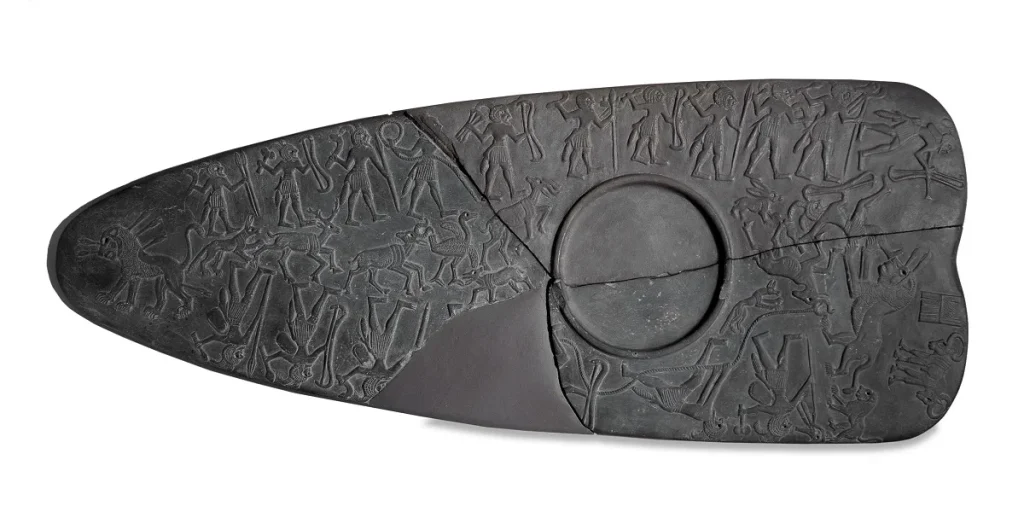
In ancient Egypt, ostrich hunting was far more than a practical pursuit for meat and feathers. As the pharaonic state emerged, hunting fast and elusive desert game became a ceremonial assertion of royal authority. Successfully capturing an ostrich demonstrated the king’s ability to subdue the unpredictable wilderness and impose order (Maat) over chaos.
Hunting Ostriches Before the Pharaohs
The tradition of pursuing ostriches far predates the Egyptian monarchy. As documented in Predynastic rock art, communities were tracking these giant birds thousands of years before the land was unified under a single ruler.
These early hunting scenes establish a crucial baseline: long before the feather became a high religious motif, the ostrich was valued for its immediate physical resources. Its meat yielded substantial food, its massive eggs served as versatile containers, and its durable plumes were preserved for local use.
Over time, however, the dynamic shifted from survival to social distinction. Desert game hunting became a platform for elite members of society to prove their courage and control over powerful, swift creatures. The ostrich, with its impressive speed and keen senses in open terrain, was the ultimate test of a hunter’s skill.
Why Did Pharaohs Hunt Ostriches?
Royal hunts carried deep political and theological meaning. While a successful outing yielded luxury goods, depicting the king mid-hunt delivered a powerful public message: the pharaoh possessed the divine strength needed to conquer nature’s unpredictability.
This motive echoes throughout pharaonic art. Reliefs and painted chest scenes frequently depict kings battling lions, wild bulls, hippopotamuses, and ostriches. These compositions were not always literal records of a specific afternoon; they functioned as symbolic propaganda, reinforcing the king’s role as guardian of cosmic order.
Pursuing an ostrich presented unique challenges:
- Extreme Speed: Ostriches could easily outrun a human on foot, requiring organized tactics, hunting dogs, or high-speed chariots.
- Zero Cover: Living in flat, open desert expanses, the birds could spot approaching predators from vast distances.
- Prized Trophy: The bird’s pristine white and dark plumes were among the most coveted luxury materials in the ancient Near East.
Thus, when a pharaoh took to the desert in pursuit of ostriches, the narrative transcended simple sport. It was a formal display of regal dominance over the untamed frontier.
Tutankhamun’s Ostrich Hunt
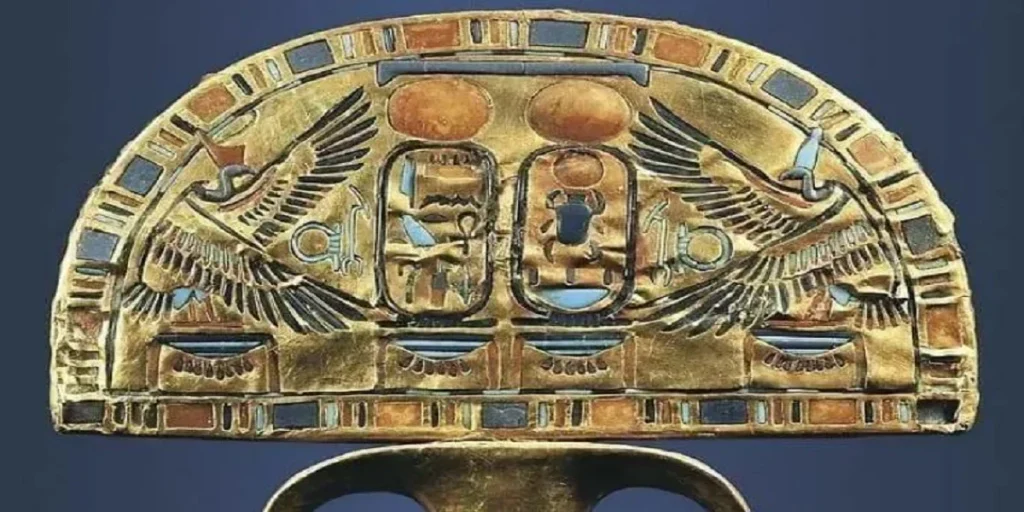
The most pristine archaeological proof of this royal tradition comes from the tomb of Tutankhamun (KV62), which contained a magnificent golden fan directly commemorating an ostrich hunt.
Discovered between the shrine doors of the burial chamber, the fan’s original ostrich plumes had mostly decayed over the millennia, though enough fragments remained to show alternating brown and white feathers. cataloged as an 18th-Dynasty masterpiece, its golden palm displays intricate embossed reliefs paired with detailed hieroglyphic inscriptions.
The artwork captures a complete narrative:
- The Pursuit: On one face of the fan, a young Tutankhamun speeds across the desert floor in his horse-drawn chariot, drawing his bow toward fleeing ostriches alongside his hunting hound.
- The Triumph: On the reverse side, the king returns victorious as attendants carry the harvested ostriches.
The accompanying inscription explicitly notes that the plumes decorating the fan were obtained by the king himself during a hunt in the desert east of Iwnw (Heliopolis). This direct pairing of visual art, text, and physical object offers rare, undisputed historical context.
The Hunt Becomes a Royal Object
Tutankhamun’s fan was much more than a tool to beat the desert heat. It transformed the raw yield of a high-stakes hunt into a permanent emblem of royal prestige, designed to protect the king both in life and in the afterlife.
This trajectory illustrates a classic pattern within ancient Egyptian material culture:
- Wild Fauna: The living bird roaming the desert border.
- Harvested Resource: Raw meat, eggshell, and loose plumes.
- Luxury Commodity: Tanned hides and curated feathers traded among elites.
- Regal Symbol: Plumes crafted into royal ceremonial fans.
- Funerary Artifact: Sacred grave goods ensuring eternal rebirth.
Once the ostrich plume entered the formal visual vocabulary of Egyptian religion, its meaning expanded further. The very same feather featured on pharaonic fans would soon become the universal signifier of Maat, the goddess of truth, balance, and universal justice.
Why Was the Ostrich Feather Sacred in Ancient Egypt?
The ostrich feather became one of the most enduring sacred symbols in Egyptian iconography. Because of its perfect natural symmetry, it was chosen to represent Maat (the goddess of truth, cosmic balance, and universal justice). It also symbolized Shu (the god of air and light), embodying both physical weightlessness and divine order across royal, religious, and funerary art.
From Desert Feather to Religious Symbol
The ostrich feather is visually unmistakable. Its long central shaft, broad vanes, and natural plume structure made it a striking choice for ceremonial regalia.
Egyptian artists systematically incorporated the feather into contexts where complex abstract ideas, such as cosmic equilibrium, air, and divine legitimacy, needed a clear visual shorthand. Whether resting atop a deity’s headdress, crowning a royal staff, or serving as a hieroglyphic phonogram, a physical object from the desert wilderness was woven into the core of Egypt’s sacred language.
This versatility explains why the feather holds such a prominent place in Egyptian theology. Its role was never confined to a single myth or localized cult. Instead, it functioned as a foundational symbol that endured and evolved across thousands of years of pharaonic history.
Why an Ostrich Feather?
Egyptologists have long explored why the ostrich feather, rather than that of a falcon, heron, or vulture, was selected to represent the ultimate principle of cosmic truth.
While several factors interacted, three distinct features stand out:
- Symmetry and Equilibrium: Unlike most bird feathers, whose vanes are unevenly distributed along the shaft, an ostrich plume features remarkably equal, balanced vanes on both sides. This natural symmetry made it a perfect visual metaphor for balance, fairness, and truth.
- Material Value and Prestige: Due to the danger and difficulty of desert hunts, pristine plumes were prized luxury items associated with elite status and royal display.
- Airiness and Association with Light: The soft, flexible texture of the plume visually communicated weightlessness, connecting it directly to breath, air, and the atmosphere.
The Metropolitan Museum notes that Maat was the embodiment of an ideal world in equilibrium. The natural architecture of the ostrich plume provided ancient artists with a ready-made physical representation of that perfect state.
The Feather of Maat
Maat was more than a deity; she represented the fundamental principle that kept the universe from dissolving into primordial chaos (Isfet). She personified truth, moral justice, social order, and the natural cycles of the sun and the Nile.
Her primary attribute was the ostrich feather (shu plume), worn upright on her head. Frequently, the feather alone could stand in for the goddess herself, acting as a complete ideogram for justice and order.
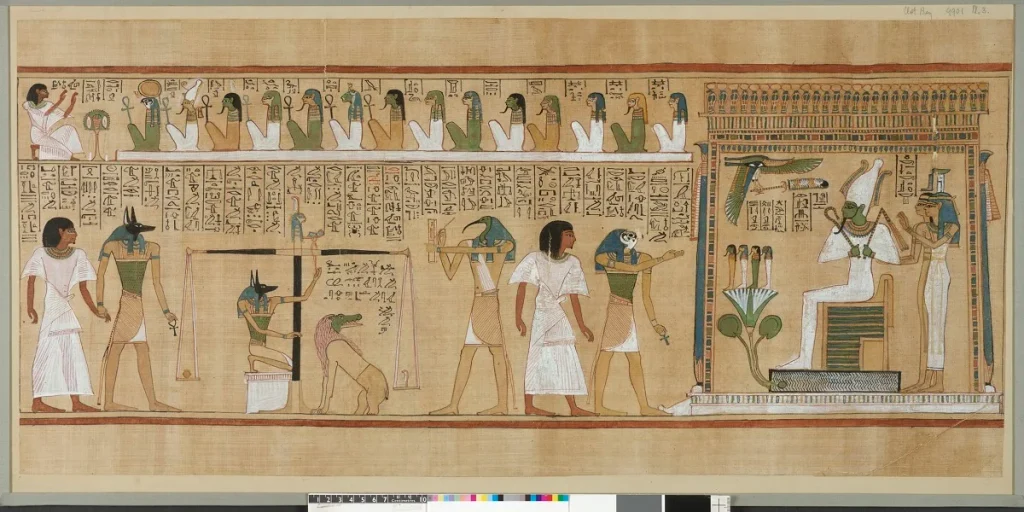
This symbol reached its emotional peak in ancient Egyptian funerary beliefs, most notably in the Weighing of the Heart (Psychostasia) scene found in the Book of the Dead:
- The Test: The heart (ib) of the deceased, regarded as the seat of human emotion, memory, and morality, was placed on one side of the divine scales.
- The Standard: The feather of Maat was placed on the opposite scale.
- The Outcome: To enter the eternal afterlife (Aaru), the heart had to be as light as the feather, proving the individual had lived a life aligned with truth and harmony.
A single desert feather thus served as the ultimate moral standard against which an entire human life was evaluated before the gods.
Maat and the Balance of the Universe
The concept of Maat extended far beyond individual judgment after death; it was the foundation of daily societal stability and statecraft.
Pharaohs bore the divine obligation to maintain Maat throughout Egypt. Royal reliefs often depict the king presenting a small statue or emblem of Maat to the gods, signifying that the state was governed justly and the cosmic balance remained intact.
The ostrich feather therefore carried a heavy ideological load. It signaled a world functioning as intended, where political governance, social ethics, and cosmic forces remained in flawless harmony.
Yet, Maat was not the only divine figure defined by this versatile plume.
Another primordial deity wore the ostrich feather for a fundamentally different reason: Shu, the god of air, wind, and the atmosphere.
Shu and the Ostrich Feather
Maat was not the only major Egyptian deity associated with the ostrich feather. The same distinctive plume was also one of the defining attributes of Shu, the god associated with air, atmosphere, and light.
At first glance, this can seem confusing. If Maat’s feather represented truth, justice, and cosmic balance, why would another god wear essentially the same symbol? The answer is that Egyptian symbolism was not always built around one object having only one meaning. The ostrich feather could express different ideas depending on the deity, scene, and religious context.
Who Was Shu?
Shu was one of the primordial gods of Egyptian cosmology and was closely associated with air and the space between the earth and sky. In Egyptian mythology, he was the son of the creator god Atum and the brother and partner of Tefnut, the goddess associated with moisture.
Shu’s most important mythological role was maintaining separation between Geb, the earth god, and Nut, the sky goddess. Egyptian representations of the cosmic order often show Shu standing between them, holding the sky apart and creating the space in which the world could exist.
The ostrich feather became one of Shu’s most recognizable visual attributes. Egyptian objects and inscriptions could use the feather as a sign referring to Shu, and the Metropolitan Museum explicitly identifies the ostrich feather as a symbol associated with both Maat and Shu.
Why Did Shu Wear an Ostrich Feather?
The exact reason the ostrich feather became Shu’s attribute cannot be reduced to a single explanation. Its lightness and association with air make the symbolism intuitive, especially when the feather is imagined moving in a breeze.
There was also a linguistic and visual dimension to Egyptian writing and iconography. The feather sign could represent Shu, allowing the image of a feather to function not merely as decoration but as part of the Egyptian system of religious and written symbols.
This created an interesting overlap with Maat. Both deities could be represented through the same basic feather form, yet the underlying ideas were different. For Maat, the feather expressed truth, justice, and the proper balance of existence. For Shu, it pointed toward air, light, and the space that allows the ordered universe to exist.
The connection between the two ideas is not accidental. Egyptian religion frequently linked different aspects of cosmic order rather than treating them as completely separate concepts.
Maat’s Feather vs. Shu’s Feather
The easiest way to avoid confusion is to focus on context rather than the feather itself.
When the feather appears with Maat or in a judgment scene, its meaning centers on truth, justice, and cosmic order. When it appears as Shu’s characteristic headdress or as a sign referring to him, the emphasis shifts toward air, atmosphere, and light.
The feather itself does not need to change for its meaning to change. Egyptian artists relied heavily on surrounding figures, crowns, inscriptions, and religious context to tell viewers how a symbol should be understood.
This becomes especially important when looking at Egyptian crowns, because several different headdresses contain feathers that can appear surprisingly similar to modern eyes.
Egyptian Ostrich Symbols Explained
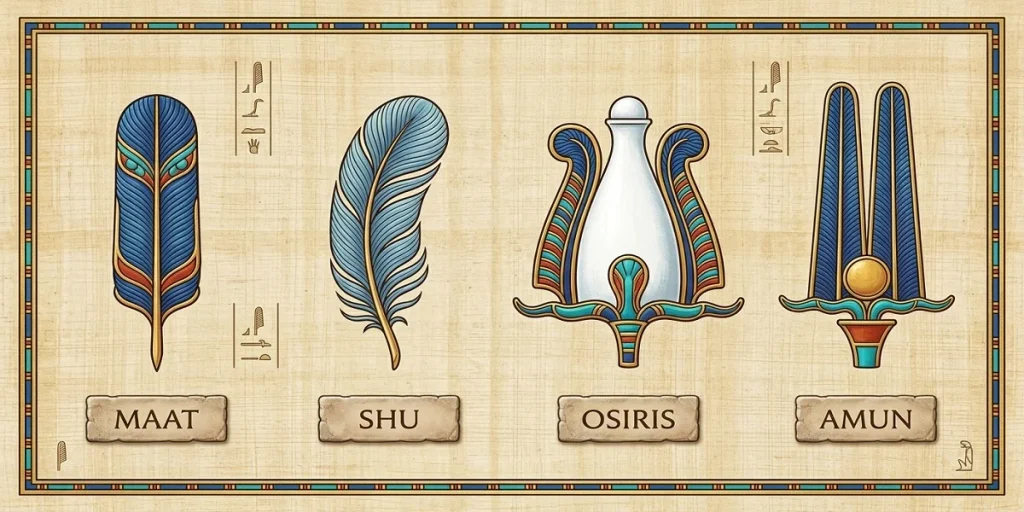
Ancient Egyptian feather symbolism becomes much easier to understand once the major forms are separated. Maat’s single feather, Shu’s feather, Osiris’s Atef crown, and the Shuti crown all belong to the same broad visual world, but they should not be treated as interchangeable symbols.
| Symbol | Associated Figure | Feather Form | Main Association |
|---|---|---|---|
| Maat’s feather | Maat | Single ostrich feather | Truth, justice, balance, cosmic order |
| Shu’s feather | Shu | Ostrich feather used as a divine attribute | Air, atmosphere, light |
| Atef crown | Osiris | White crown flanked by ostrich plumes | Osiris, kingship, afterlife |
| Shuti crown | Amun and other deities | Two tall plumes, often with additional elements | Divine identity and solar associations |
The Feather of Maat
Maat’s feather is the simplest of these symbols. It is usually shown as a single ostrich feather and serves as the defining emblem of the goddess Maat.
Its importance extends beyond the goddess herself. In funerary scenes, the feather becomes the standard against which the deceased’s heart is judged, turning a physical feather into a representation of the moral and cosmic order known as maat.
This is why the feather is sometimes encountered without an accompanying figure of Maat. Egyptian artists and scribes could use the feather itself to communicate the concept.
Shu’s Feather
Shu’s feather is similarly recognizable but carries a different emphasis. Rather than representing the moral standard of Maat, it identifies Shu with air, atmosphere, and light.
Egyptian inscriptions and objects demonstrate this association directly. The Metropolitan Museum, for example, describes the ostrich feather as a symbol of Shu and notes that the feather sign could refer to the god in Egyptian imagery and writing.
The important lesson is simple: same feather, different divine context.
The Atef Crown of Osiris
The Atef crown is one of the most recognizable feathered crowns in Egyptian art. It consists primarily of the tall white crown associated with Upper Egypt, flanked by ostrich plumes. Some versions also include ram’s horns and uraei.
The crown became strongly associated with Osiris, the god of the dead and ruler of the underworld. The Metropolitan Museum describes the side plumes specifically as ostrich feathers and notes their connection with maat and cosmic order.
The Atef therefore should not be confused with simply “the Feather of Maat.” It is a complete divine headdress whose ostrich plumes form part of a larger symbolic composition.
The crown could also be worn by kings in particular ritual contexts, reinforcing the connection between kingship, Osiris, and the maintenance of cosmic order.
The Shuti Crown
The Shuti crown is another feathered headdress that can cause confusion because it may look superficially similar to other Egyptian feather crowns.
In its most recognizable form, it consists of two tall plumes, often accompanied by other elements such as a sun disk and, in some representations, ram’s horns. Museum examples identify these plumes as ostrich feathers, making it unsafe to describe the Shuti simply as a crown made from falcon tail feathers.
The crown is particularly associated with Amun and with composite divine forms such as Ptah-Sokar-Osiris. Its meaning therefore depends heavily on the deity wearing it and the complete arrangement of the crown.
This is precisely why Egyptian feather symbolism can be misleading when individual elements are isolated from their original context. A modern viewer may see “two feathers” and assume that they represent the same thing every time. Ancient Egyptian artists did not necessarily intend that.
Why These Symbols Are So Easy to Confuse
The confusion becomes understandable when we look at how Egyptian religious art worked. Feathers were valuable materials in real life, powerful visual forms in art, and established symbols in religion and writing.
A single ostrich feather could therefore appear on the head of Maat, identify Shu, form part of Osiris’s Atef crown, or appear in another divine headdress without carrying exactly the same meaning in every case.
The safest approach is to identify who is wearing the feather, what other elements appear with it, and what scene it belongs to.
Once those details are considered, the apparent overlap becomes much easier to understand. What initially looks like a collection of similar feather symbols turns out to be a carefully structured visual language.
And nowhere is that language more important than in the Egyptian belief that the feather could serve as the ultimate standard of truth itself.
The Feather of Maat
The ostrich feather became one of ancient Egypt’s most powerful religious symbols through its association with Maat, the goddess and personification of truth, justice, balance, and cosmic order. Maat was not simply a deity who rewarded honest people. The concept of maat described the proper order of the universe itself, from the movement of the heavens to the stability of society and the behavior expected of individuals.
Maat was therefore fundamental to Egyptian ideas about how the world should function. Chaos and disorder represented the opposite principle, while maintaining maat meant preserving the balance that allowed both the natural and human worlds to continue.
What Did the Feather of Maat Represent?
The ostrich feather was Maat’s most recognizable attribute. Egyptian representations commonly show the goddess wearing a feather on her head, while the feather could also appear independently as a visual representation of the concept she embodied.
Its symbolism centered on truth, justice, and balance. The feather was not merely a symbol of telling the truth in the modern sense. It represented the larger idea that a person’s actions should remain in harmony with the proper order of the world.
This distinction is important when interpreting Egyptian mythology. The Feather of Maat was not simply an ancient Egyptian version of a modern symbol for honesty. It represented an entire system of moral, social, and cosmic order.
The association was so strong that Maat could be represented by the feather itself. In inscriptions and funerary scenes, viewers did not necessarily need a complete image of the goddess to recognize the concept.
The Weighing of the Heart
The most famous appearance of the Feather of Maat comes from Egyptian funerary scenes showing the weighing of the heart.
According to Egyptian beliefs about the afterlife, the heart of a deceased person was placed on one side of a balance, while the Feather of Maat was placed on the other. The scene represented the judgment of the deceased and whether the person’s life had remained compatible with maat.
The judgment was therefore presented visually as an act of balance. The scale itself reinforced the central idea: the deceased person’s moral state had to be measured against the established standard of Maat.
Other divine figures could participate in the scene. Anubis, associated with funerary rites and the dead, is frequently shown overseeing or operating the scales, while Thoth, the god associated with writing and knowledge, records the result. The monstrous creature Ammit waits nearby to consume the heart of someone who fails the judgment.
The symbolism is remarkably direct. A physical ostrich feather becomes the standard against which an entire human life is measured.
What Happened If the Heart Failed the Test?
Popular descriptions sometimes reduce the judgment to the idea that the heart had to be “lighter than the feather.” The ancient Egyptian imagery is better understood as a balance between the heart and Maat’s feather.
If the deceased was judged to be incompatible with maat, the heart could be devoured by Ammit, preventing the person from achieving the desired afterlife. If the judgment was favorable, the deceased could continue toward the blessed existence associated with the afterlife.
The scene therefore transformed the ostrich feather into something far more important than a decorative object. It became a symbol of the standard by which a person’s existence could be judged.
This is one reason the feather appears so frequently in funerary art and texts. Its presence could communicate the hope that the deceased had lived in accordance with truth and order.
Maat and the Pharaoh
The importance of Maat extended beyond individual souls. Egyptian kings were expected to preserve maat during their reign, maintaining order within the kingdom and fulfilling their role within the cosmic system.
Royal inscriptions and temple scenes sometimes show the king presenting a small figure of Maat to a deity. This ritual image symbolized the king’s responsibility to uphold the proper order of the world.
The connection between the king and Maat also helps explain why ostrich feathers could appear in royal contexts without being purely decorative. The feather carried associations with divine order and legitimate authority as well as with luxury and prestige.
In this sense, the ostrich feather connected several levels of Egyptian society. It could belong to a hunted desert bird, become a valuable royal material, represent a goddess, and ultimately stand as the standard of truth in the judgment of the dead.
Why the Ostrich Feather Mattered So Much
The power of the symbol lies partly in its simplicity. Egyptians did not need a complicated object to represent Maat. A single feather could communicate the idea of balance, justice, and the correct order of existence.
Its meaning also demonstrates how closely the natural and religious worlds were connected in ancient Egypt. The feather came from a real animal that lived in the surrounding landscape, yet its symbolic importance eventually extended into royal ceremony, temple religion, funerary belief, and written language.
The journey of the ostrich feather is therefore a journey from nature to symbolism.
And while Maat gave the feather its most famous connection with truth and judgment, another Egyptian deity used the same distinctive plume to express a very different aspect of the cosmos: Shu and the air that separates earth from sky.
Shu and the Ostrich Feather
The ostrich feather had another vital theological role through Shu, one of ancient Egypt’s primordial deities. While Maat’s feather represented truth, moral justice, and universal balance, Shu’s feather signified air, wind, light, and the expansive void separating earth and sky. Egyptian iconographic symbols were rarely single-use logos; the same natural object could express completely different concepts depending on the god, text, or scene.
Who Was Shu?
Shu was the Egyptian god of air and atmosphere, a primordial deity charged with structuring the physical universe. In the Heliopolitan creation theology, Shu emerged from Atum alongside his twin sister Tefnut (moisture). He subsequently fathered Geb (the earth) and Nut (the sky).
His central mythological act was the physical separation of earth and sky. Standard Egyptian reliefs depict Shu standing between Geb and Nut, holding the sky goddess aloft on his fingertips to create the breathable space in which life could flourish.
This cosmic role made the ostrich plume a natural emblem for him:
- Lightness and Drift: A plume naturally moves with the breeze, defying gravity with effortless grace.
- Atmosphere and Wind: The soft, floating structure of the feather physically mimicked air currents.
While modern viewers should avoid over-simplifying ancient art, the visual logic connecting a light desert plume with the god of air is immediate and striking.
The Feather as Shu’s Divine Attribute
Shu was routinely depicted wearing a single ostrich feather or a feathered headband, making the plume his primary visual identifier across Egyptian art.
This emblem extended directly into the written script. Egyptian scribes utilized the feather sign (shu) in sacred texts and hieroglyphic inscriptions, linking the physical feather to both the name of Shu and the concept of Maat.
This shared sign created a fascinating dynamic in Egyptian iconography: a single feather glyph could point to either Maat’s moral and cosmic order or Shu’s atmospheric space.
Context was everything. The deity’s identity, the position of the headdress, the accompanying text, and the surrounding scene were all required to decipher the symbol’s precise intent.
Maat and Shu: Two Meanings of One Feather
Understanding the relationship between Maat and Shu becomes straightforward once we treat the feather as a versatile symbol rather than a rigid definition:
- For Maat: The feather was the standard of moral truth, righteousness, and cosmic equilibrium, functioning as the ultimate weight against which human hearts were measured in the afterlife.
- For Shu: The feather was a divine attribute marking air, breath, sunlight, and the physical space between earth and sky.
Despite these differing roles, a profound conceptual connection bound them together. Both deities maintained the architecture of the cosmos: Maat preserved the moral and temporal balance of existence, while Shu maintained the physical separation necessary for life to survive.
Why the Distinction Matters
Modern retellings of Egyptian mythology frequently label every single ostrich feather as a “symbol of Maat.” While Maat’s feather is undeniably famous, that oversimplification ignores a major pillar of Egyptian visual art.
Recognizing Shu’s plume explains why ostrich feathers frequently appear in creation myths, temple reliefs, and cosmological scenes that have no connection to funerary judgment.
Furthermore, it prevents confusion when examining divine crowns. The Atef crown of Osiris and the Shuti crown of Amun might look superficially similar, but they belong to distinct religious traditions with unique symbolic structures.
Egyptian Ostrich Symbols Explained
Ancient Egyptian visual culture features several prominent feathered symbols. Distinguishing between them is key to understanding the full scope of the ostrich in ancient religion.
| Symbol | Associated Figure | Visual Form | Core Meaning |
| Maat’s Feather | Maat | Single upright ostrich plume | Truth, justice, moral balance, cosmic order |
| Shu’s Feather | Shu | Ostrich plume worn on headband | Air, atmosphere, light, separation of earth and sky |
| Atef Crown | Osiris | Tall white crown flanked by two side ostrich feathers | Osiris, divine kingship, resurrection, afterlife |
| Shuti Crown | Amun and other deities | Two tall parallel ostrich plumes (often paired with a sun disk) | Divine authority, solar energy, royal majesty |
The Feather of Maat
Maat’s feather is the most direct of these symbols. It typically appears as a single, perfectly balanced ostrich plume resting atop the goddess’s headdress or standing independently in sacred art.
Its meaning extends beyond the goddess herself to embody maat as a universal principle. This independent usage explains why the single plume appears on amulets, funerary papyri, and tomb walls without requiring a full depiction of the goddess.
The Feather of Shu
Shu’s feather looks visually identical to Maat’s because both rely on the ostrich plume. However, its function is fundamentally different.
Rather than serving as a scale weight for moral judgment, it identifies the primordial deity who holds up the sky and provides the breath of life. Maat’s feather measures order; Shu’s feather identifies the god who physically sustains the universe.
The Atef Crown of Osiris
The Atef crown is the signature headdress of Osiris, lord of the underworld. Its centerpiece is the tall, conical white crown of Upper Egypt (Hedjet), flanked by two majestic, curving ostrich feathers.
These lateral ostrich plumes link the crown to kingship, resurrection, and cosmic balance (maat). The Atef is not simply “the feather of Osiris,” but a complex composite crown where ostrich plumes enhance the symbolism of divine rule over the dead.
The Shuti Crown
The Shuti headdress is another widely depicted royal and divine crown, most famously worn by Amun, the king of the gods.
Its key feature is a pair of towering, vertical plumes rising above a base, often combined with a solar disk or ram horns. While older sources occasionally mislabel these as falcon feathers, museum analysis confirms their identity as ostrich plumes. The Shuti crown communicates supreme solar power and divine majesty.
How to Tell the Symbols Apart
To correctly identify Egyptian feather iconography, evaluate the complete visual context rather than isolating the feather alone:
- Single Feather in Funerary Context: Points directly to Maat, truth, and the Weighing of the Heart.
- Single Feather on a Standing/Seated Male God: Identifies Shu, indicating air, atmosphere, and cosmic separation.
- Flanking Plumes on a Tall White Crown: Represents the Atef Crown of Osiris and the promise of rebirth.
- Twin Vertical Plumes with Solar Elements: Represents the Shuti Crown of Amun, symbolizing divine power and royal status.
Through this adaptable visual system, ancient Egyptian artists transformed a simple desert feather into a multi-layered language capable of bridging nature, religion, statecraft, and eternity.
Ostrich Feathers in Royal Life
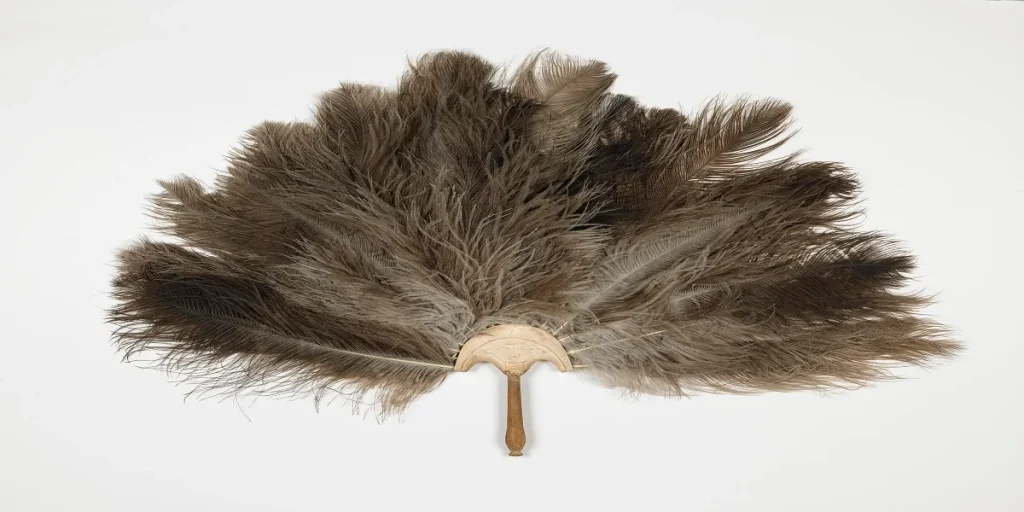
Beyond their religious and cosmological weight, ostrich feathers were integral to ancient Egyptian royal courts. Assembled into elaborate ceremonial fans (khu), they provided shade and ventilation while serving as high-status symbols of royal proximity, court hierarchy, and elite prestige.
Ostrich Feather Fans and the Egyptian Court
Feather fans feature prominently across New Kingdom royal reliefs, papyri, and tomb paintings. Long-handled ceremonial fans were carried alongside the pharaoh during public processions, visually framing the ruler and asserting their absolute status.
The raw plumes were highly prized commodities. Because wild ostriches had to be hunted in the harsh eastern or western deserts, securing pristine feathers in the quantities required for royal regalia demonstrated immense wealth and trade reach.
In the New Kingdom (circa 1550–1077 BCE), these fans became an indispensable element of royal court etiquette. A fan held near the king was far more than an instrument for comfort; it was a visible badge of authority and royal favor.
The Fan-Bearer on the Right Side of the King
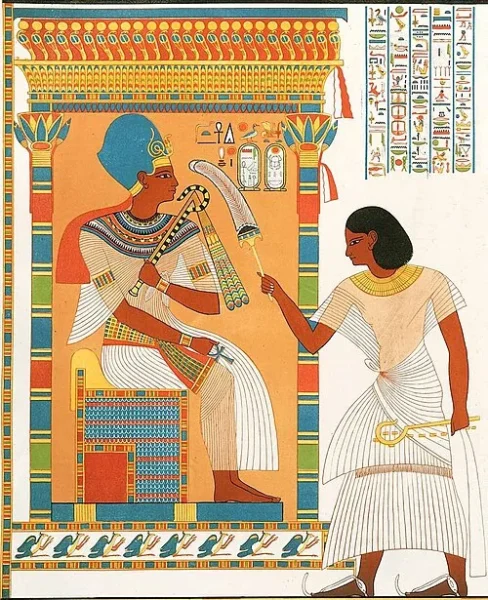
The political importance of these objects is reflected in one of the court’s highest honorary titles: Fan-Bearer on the Right Side of the King (Tjay-khu-kher-wenemy-nesu).
This title was bestowed upon high-ranking officials, including royal princes, military generals, viziers, and trusted advisors. The role transcended physical service:
- Political Proximity: Holding the fan during official ceremonies positioned the courtier directly next to the pharaoh, signaling supreme royal confidence.
- Administrative Power: Many fan-bearers governed entire provinces (such as Nubia) or managed state treasuries.
- Ceremonial Stature: Carrying the royal fan signified that the official was actively protecting and presenting the divine monarch.
In Egyptian art, an official holding an ostrich plume fan is not performing domestic labor; he is exercising delegated royal authority.
The Fans of Tutankhamun
The 1922 discovery of Tutankhamun’s tomb (KV62) by Howard Carter yielded direct physical proof of these courtly objects.
Archaeologists unearthed eight distinct fans within the burial chambers. These varied in size, material, and function:
- The Golden Ostrich-Hunt Fan: Crafted from gilded wood, depicting the young king hunting ostriches in the Heliopolis desert, originally holding 30 alternating brown and white plumes.
- Ebony and Gold Processional Fans: Featuring long handles inlaid with semi-precious stones and ivory, designed for formal court appearances.
- Handheld Ivory Fans: Smaller, lightweight fans intended for personal use within the royal palace.
Although the organic feather vanes had largely deteriorated over 3,000 years, preserved quills, golden mountings, and explicit hieroglyphic labels enabled precise reconstruction of their original magnificence.
More Than a Way to Stay Cool
Viewing ancient Egyptian feather fans merely as functional tools overlooks their complex cultural role.
In pharaonic society, physical objects constantly reinforced social hierarchy. The choice of material, decorative motif, and handle length communicated explicit rank. Ostrich feathers were uniquely suited for royal display because they bridged physical luxury with cosmic symbolism:
- The Hunt: Recalled the king’s physical prowess over wilderness and chaos.
- The Atmosphere: Evoked the cooling breath of the air god Shu.
- Cosmic Truth: Represented the divine order of Maat.
A single royal fan harmonized physical function, regal propaganda, and divine protection.
From the Royal Court to the Tomb
The inclusion of fans in Tutankhamun’s burial equipment demonstrates how seamlessly court objects transitioned into the realm of the dead. Items used by the king during life were placed in his tomb to preserve his royal identity in the afterlife (Aaru).
The ostrich feather naturally navigated this boundary, moving effortlessly between different spheres:
- Natural World: Wild game harvested in the open desert.
- Royal Realm: Luxury regalia carried by elite courtiers.
- Sacred Realm: Funerary offerings ensuring divine order and eternal breath.
In the royal tomb, these spheres converged, providing the deceased pharaoh with both physical comfort and cosmic legitimacy for eternity.
Yet, feathers were not the only valuable resource harvested from the desert bird. The ostrich provided another material that left an equally profound mark on Egyptian culture: the massive ostrich egg.
Ostrich Eggs in Ancient Egypt
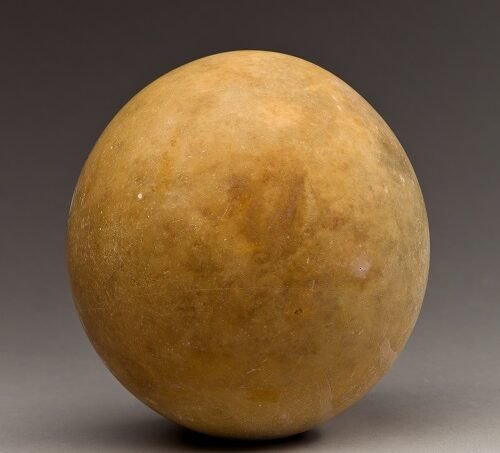
Alongside feathers, the massive ostrich egg was an indispensable resource in ancient Egypt. From the Predynastic Period onward, ostrich eggs served as nutritious food, durable water canteens, intricately carved containers, and finely ground eggshell beads. When deposited in graves, their enclosed form and natural durability connected them to ritual purity and craftsmanship.
Ostrich Eggs Before the Dynasties
Evidence of ostrich egg use in Egypt long predates the pharaonic state. A notable Predynastic ostrich egg in the collection of the Metropolitan Museum, excavated from a cemetery at el-Amra in northern Upper Egypt, dates to approximately 3450–3300 BCE. This artifact confirms that ostrich eggs were integrated into funerary practices long before the first dynasty unified Egypt.
Archaeological finds from this era reveal that Egyptians rarely treated these massive shells as disposable waste. Once emptied, the thick, durable shell was routinely repurposed as raw material for artisan crafts.
As documented by the UCLA Encyclopedia of Egyptology, ostrich eggshells were routinely crafted into beads, pendants, and functional vessels. Decorated eggshells featuring incised patterns appear consistently from the Predynastic Period onward, carrying evident cultural and aesthetic significance.
Just as feathers moved from the desert hunt into royal courts, eggshell transitioned effortlessly from a raw natural yield into refined Egyptian material culture.
What Did Egyptians Use Ostrich Eggs For?
The primary practical utility of the egg began as a rich source of food. A single ostrich egg contains the volume of roughly 24 domestic chicken eggs, making it a high-yield dietary resource for ancient desert foragers.
Once consumed, the empty shell offered exceptional versatility:
- Storage Containers and Canteens: A single hole drilled at one end transformed the thick, impervious shell into an ideal flask for water or oils. The British Museum holds an Early Dynastic ostrich egg container recovered from a grave at Faras in Nubia, prepared specifically for this purpose.
- Daily Ornaments: Shell fragments were shaped, smoothed, and perforated into durable disc-shaped beads, bracelets, and pendants.
- Decorated Art Objects: Skilled artisans incised eggshells with geometric patterns, animals, riverboats, and hunting scenes, converting raw material into luxury trade goods.
Ostrich Eggshell Beads and Ornaments
The widespread production of eggshell jewelry highlights how a hunted resource infiltrated daily Egyptian life.
Eggshell fragments were sliced into uniform chips, drilled through the center, strung together, and ground against stone palettes to form smooth, circular disc beads. The British Museum records extensive collections of disc-shaped ostrich eggshell beads recovered from Amara West in Nubia and various New Kingdom sites.
Importantly, not all eggshell beads carried sacred meaning. Many were simply attractive, durable items of personal adornment. Recognizing this distinction prevents over-interpreting every piece of ancient jewelry: sometimes an eggshell necklace was simply a well-crafted piece of personal attire.
Decorated Ostrich Eggs
A smaller, elite category of eggs received high-level artistic treatment. Incised and painted eggshell fragments from the Predynastic period display sophisticated geometric motifs alongside depictions of gazelles, antelopes, and ostriches.
These objects prove that the egg could function as an artistic canvas in its own right, rather than merely serving as raw material for smaller items.
Because decorated eggs appear in both domestic settlements and funerary environments, archaeologists evaluate each find within its specific context to distinguish between daily domestic use, trade value, personal wealth, and ritual function.
Did Ostrich Eggs Symbolize Rebirth?
It is tempting to view every ancient egg as an automatic symbol of creation, cosmic origin, or eternal rebirth. However, archaeological evidence demands a more nuanced approach.
While decorated ostrich eggs held sacred or symbolic significance in certain ritual contexts, the archaeological record does not support labeling every egg in an ancient tomb as a guaranteed emblem of resurrection.
What the evidence directly confirms:
- Eggs were practical grave goods providing food or water canteens for the deceased’s journey in the afterlife (Duat).
- Eggs functioned as high-value grave items signaling the status of the deceased.
- In specific funerary settings, the egg’s enclosed nature may have evocative links to life emerging from stillness.
This measured interpretation reflects the practical mind of the ancient Egyptian: an ostrich egg could be breakfast, a water canteen, a piece of jewelry, a luxury trade good, or a funerary offering depending entirely on who held it.
Ostrich Eggs in Tombs and Funerary Contexts
The frequent recovery of eggshell fragments from burials across Egypt and Nubia demonstrates how thoroughly the bird entered the funerary sphere.
When analyzed alongside feather iconography, the complete picture of the ostrich emerges:
- The Hunt: Connected humans to the raw, wild power of the desert environment.
- The Feather: Elevated the bird into the ultimate theological symbol of truth (Maat) and air (Shu).
- The Egg: Grounded the bird in daily craft, practical utility, personal adornment, and grave provisions.
The desert bird supplied ancient Egyptian society with two radically different materials that shaped its culture: a feather that became one of history’s most recognized symbols of divine order, and an egg that served human needs from the kitchen to the tomb.
Yet, the ostrich’s impact did not stop with physical objects. Its famous plume also entered the Egyptian writing system itself, becoming an integral glyph in written hieroglyphs.
The Ostrich Feather in Egyptian Hieroglyphs
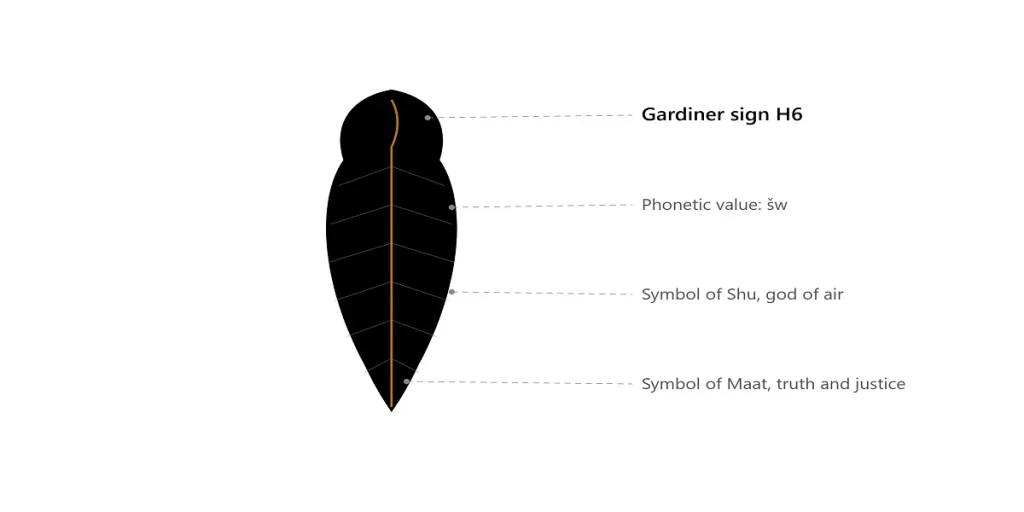
The ostrich feather was not merely an object to be worn or used in rituals; it was deeply embedded in ancient Egypt’s writing system. Cataloged by modern Egyptologists as Gardiner Sign H6, the feather sign functioned as a phonogram, ideogram, and determinative, bridging spoken language, scribe literacy, and divine symbolism.
What Does the Feather Hieroglyph Mean?
Ancient Egyptian hieroglyphs functioned through a sophisticated combination of phonetic sounds, ideograms (signs representing whole words), and determinatives (signs indicating a word’s category).
The feather sign was exceptionally versatile:
- Phonetic Value (shu): Represented the consonant sound combination šw (shu), used to write words related to air, dryness, lightness, and feathers.
- Ideogram for Maat: Functioned as a direct shorthand sign for the word mꜥꜣt (Maat), signifying truth, justice, and cosmic equilibrium.
- Determinative: Placed at the end of written words to clarify meaning, particularly for terms denoting plumes, birds, air, and justice.
A single plume carved onto a temple wall carried profound linguistic and theological information. To an untrained eye, it might look like a simple decorative accent; to an ancient scribe, it was a precise element of a complex written language.
The Feather, Shu, and Maat in Writing
The feather glyph sat at the exact intersection where grammar, theology, and art overlapped:
- Writing Shu: Because the phonetic sound of the feather matched the name of the air god Shu, scribes routinely used the feather glyph to write the deity’s name.
- Writing Maat: Because the feather was the physical attribute of Maat, the sign alone could represent the concept of divine truth, cosmic order, and righteousness.
This dual utility made the ostrich plume one of the most efficient shorthand symbols in Egyptian iconography. A scribe did not need to draw the full figure of a goddess or a god; rendering a single, elegant ostrich plume conveyed the full conceptual weight of truth or air instantly.
How to Recognize an Ostrich Feather in Egyptian Art
Recognizing the feather hieroglyph (Gardiner H6) is straightforward once its defining features are understood:
- Symmetrical Vanes: Broad, equal vanes spreading evenly from both sides of the central shaft.
- Slightly Curved Tip: A gentle curve at the very top, mimicking the natural drape of a fresh ostrich plume.
- Proportional Stems: A long, slender quill base anchored into a baseline or held upright on a headdress.
Egyptian artists grounded their writing system in natural observations. Flora, fauna, body parts, and tools were stylized into standardized glyphs. The ostrich feather was particularly effective because its distinct natural shape was already universally recognized across elite and sacred culture.
Why the Hieroglyph Matters to the Story of the Ostrich
The presence of the feather in formal hieroglyphic writing completes a remarkable cultural trajectory for the desert bird:
- Prehistoric Wilderness: A wild game animal hunted for survival across the Nile Valley pastures.
- Material Commodity: A prized luxury material yielding meat, durable eggshell flasks, and ceremonial fans.
- Sacred Attribute: A divine emblem of air (Shu), royal authority, and cosmic truth (Maat).
- Linguistic Sign: A standardized glyph woven directly into the written language of pharaonic statecraft.
Few natural objects illustrate the synthesis of environment and culture so clearly. A plume harvested from a wild desert bird could ultimately be sculpted onto a granite wall to record a sound, name a god, or spell out the concept of eternal truth.
The ostrich had moved seamlessly from the physical landscape of Egypt into the permanent language of its civilization.
Yet, as dynasties rose and fell, the natural world itself began to shift. The very environmental and human pressures that transformed Egypt’s ancient pastures would eventually lead to the disappearance of wild ostriches from the Nile Valley.
The Disappearance of Ostriches from Ancient Egypt
The wild ostrich that features so prominently across ancient Egyptian art no longer roams the country today. Its gradual extinction from the Nile Valley and surrounding deserts was driven by a combination of severe regional aridification (the desertification of the Sahara) and centuries of human pressure, including hunting and habitat disruption.
From Green Sahara to Desert
The long relationship between Egyptians and ostriches began when northeastern Africa looked radically different from modern topography.
During the early Holocene epoch, vast stretches of what is now the Sahara experienced a “Green Sahara” period characterized by savannah grasslands, lakes, and seasonal wetlands. Megafauna, including massive wild ostrich populations, occupied regions that are today hyper-arid wastelands.
As climate patterns shifted over millennia, environmental conditions dried up:
- Habitat Contraction: Grasslands retreated, forcing ostriches into increasingly isolated pockets of vegetation.
- Ecological Division: The region hardened into two distinct zones: the fertile, densely farmed Nile Valley corridor and the bone-dry surrounding deserts.
This ecological history explains why ostriches feature so heavily in early Egyptian rock art and Predynastic archaeological finds. The bird was not an exotic import from distant lands; it was a native resident of the local landscape.
Hunting and Human Pressure
Environmental drying was only one driver of the species’ decline. The immense material value of the bird placed it under continuous pressure from human communities.
The commercial and ritual incentives were relentless:
- Meat Yield: Provided substantial protein for desert expeditions and local settlements.
- Egg Harvests: Collected continuously for food, water flasks, and luxury bead crafting.
- Plume Extraction: Escalated dramatically as pharaonic statecraft and temple cults demanded vast quantities of pristine feathers for royal fans, elite regalia, and ceremonial displays.
While a single royal hunt did not wipe out the species, centuries of systematic harvesting paired with progressive habitat loss systematically shrank the bird’s viable breeding range.
When Did Ostriches Disappear from Egypt?
Pinpointing the exact decade of the ostrich’s final extinction in Egypt is challenging, as wild populations survived in remote desert margins long after disappearing from the Nile Valley itself.
By the modern era, zoological surveys confirmed that wild ostriches were completely extirpated from Egypt’s native fauna.
This historical reality adds immense value to ancient Egyptian visual art. The ostriches depicted in Predynastic pottery or New Kingdom tomb paintings were not mythological creatures conceived by temple artists. They were direct visual documentation of a real species that once thrived across North African ecosystems.
The North African Ostrich
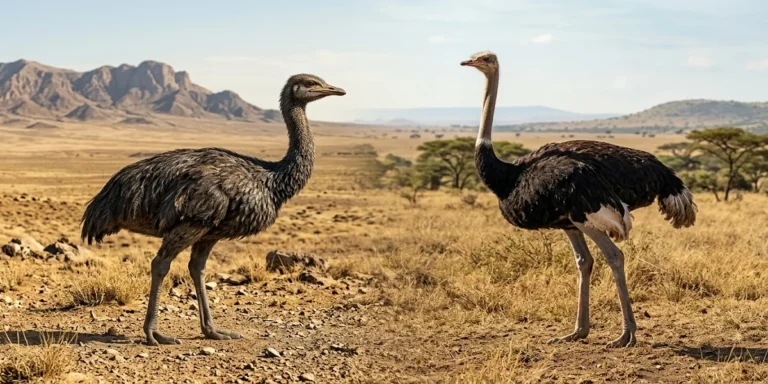
The ostriches known to ancient Egyptians belonged to the North African subspecies of the common ostrich, scientifically classified as Struthio camelus camelus (also known as the red-necked ostrich).
Historically distributed across the entire Sahara and northern Africa, this subspecies is today critically endangered in the wild, with surviving fragments restricted to narrow bands of the Sahel and southern Saharan borders.
Ancient Egyptian artifacts therefore preserve vital historical evidence of this native population at its historical peak, offering a clear record of its former geographical range.
A Bird That Outlived Its Egyptian Landscape
The physical disappearance of wild ostriches from the Egyptian landscape did not diminish their cultural legacy.
Long after the last wild bird vanished from the desert borders, its feather remained an enduring symbol across temple walls, funerary papyri, royal regalia, and sacred hieroglyphs. The living animal vanished from the landscape, but its image secured immortality within Egyptian culture.
The ostrich occupies an extraordinary place in ancient history. It completed a full journey:
- Wild Fauna: Tracked by prehistoric hunter-gatherers across open savannahs.
- Essential Resource: Yielded meat, durable eggshell flasks, and trade beads.
- Elite Trophy: Pursued by pharaohs in high-speed chariot hunts.
- Royal Regalia: Transformed into golden ceremonial fans for court elites.
- Divine Attribute: Embodied Maat (truth and justice) and Shu (air and atmosphere).
- Linguistic Sign: Standardized into written hieroglyphic script (Gardiner H6).
Few creatures traveled so completely from the wild physical environment into the sacred visual language of a civilization. From prehistoric rock art to the golden treasures of Tutankhamun’s tomb, the ostrich remains one of the most versatile, powerful, and iconic symbols of ancient Egypt.
Ostriches in Ancient Egypt: A Timeline
The cultural journey of the ostrich in Egypt spans over 5,000 years. It began as a practical relationship between prehistoric hunter-gatherers and wild desert fauna, evolving through the dynasties into a complex system of royal prestige, sacred theology (Maat and Shu), written script (Gardiner H6), and immortal funerary regalia.
| Period | Approximate Date | Evolution of the Ostrich’s Cultural Role |
| Predynastic Period | c. 6000–3100 BCE | Wild ostriches roamed the Nile margins. Early communities hunted them for meat and repurposed eggshells for canteens and beads, documenting encounters in rock art. |
| Early Dynastic Period | c. 3100–2686 BCE | As Egypt unified under the first pharaohs, ostrich eggshells and feathers entered elite tombs as high-status provisions and trade goods. |
| Old Kingdom | c. 2686–2181 BCE | Ostrich plumes became standardized in religious iconography, divine headdresses, and early hieroglyphic writing traditions. |
| Middle Kingdom | c. 2055–1650 BCE | Plumes and eggshell objects circulated widely across trade networks; feather iconography anchored core theological concepts of cosmic balance. |
| New Kingdom | c. 1550–1070 BCE | Peak of royal ostrich-hunting symbolism, ceremonial feather fans (khu), and high-status court titles (Fan-Bearer on the Right Side of the King). |
| 18th Dynasty | c. 1550–1290 BCE | Tutankhamun’s burial equipment preserved supreme examples of golden ostrich-hunt fans and processional regalia. |
| Late Period & Beyond | c. 664–332 BCE | Symbolic and religious use of ostrich feathers flourished in temples and papyri, even as wild bird populations shrank in Egypt. |
| Modern Period | 19th–21st Centuries | Wild ostriches (Struthio camelus camelus) became extinct in Egypt, leaving behind an extraordinary 5,000-year archaeological and visual record. |
Before the Pharaohs: The Predynastic Ostrich
The relationship between humans and ostriches long predates the first unified dynasties.
Predynastic communities encountered ostriches as familiar, native residents of the ancient North African grasslands. Hunters pursued them across open savannas for protein, while artisans carved their thick eggshells into water flasks and polished beads. Prehistoric rock drawings, such as those at Silwa Bahari, provide direct visual proof of these early interactions.
At this stage, the ostrich was primarily a physical resource: a large desert bird hunted for survival. The complex religious and moral meanings later attached to its feather would develop gradually as Egyptian culture centralized.
The Dynastic Period: From Animal to Symbol
Following the unification of Egypt around 3100 BCE, ostrich products transitioned from local utilities into high-status trade goods and sacred emblems.
The plume became an increasingly essential element in elite statecraft and religious art. Meanwhile, eggshells continued to serve both practical functions as containers and aesthetic functions as carved trade items.
As Egyptian scribes standardized hieroglyphic writing and temple artists established artistic cannons, the ostrich feather took on permanent symbolic meanings, evolving from a physical trophy into a recognized emblem of cosmic order.
The New Kingdom and Royal Ostrich Hunting
The New Kingdom represents the golden age of ostrich iconography in pharaonic culture.
Pharaohs were frequently depicted charging across desert terrains in high-speed chariots to hunt ostriches. This was not simple sport; subduing the swift, powerful bird symbolized the monarch’s ability to conquer wilderness and maintain cosmic harmony over chaos.
Simultaneously, pristine ostrich plumes were woven into magnificent ceremonial fans, framing the king during public state appearances and establishing court hierarchies through prestigious titles.
Tutankhamun: The Ostrich at the Height of Royal Symbolism
The 1922 discovery of Tutankhamun’s tomb (KV62) yielded an unparalleled collection of royal ostrich artifacts.
Among his grave goods were eight distinct fans incorporating ostrich plumes. The famous gilded “Ostrich-Hunt Fan” directly connected the young king to the desert chase, capturing the exact moment the raw plumes were harvested for royal regalia.
By the 18th Dynasty, the ostrich was far more than wild game. Its physical yield was seamlessly woven into royal ritual, elite craftsmanship, divine theology, and funerary preparation, representing thousands of years of cultural evolution gathered within a single pharaonic tomb.
The Final Centuries of the Egyptian Ostrich
While the cultural authority of the ostrich feather remained undiminished through the Ptolemaic and Roman periods, the living bird faced an escalating struggle for survival.
Driven by progressive desertification of the Sahara, expanding agricultural settlements, continuous hunting, and habitat fragmentation, wild ostrich populations gradually retreated southward toward the Sahel.
Eventually, the species vanished completely from Egypt’s wild frontiers.
Yet, while the living animal vanished from the physical terrain, its sacred image remained permanently etched into temple reliefs, papyri, and monumental inscriptions.
Thousands of Years, One Feather
Viewed across its entire historical trajectory, the story of the ostrich in Egypt exhibits remarkable continuity:
- The Prehistoric Hunter: Tracked the bird across open savannas for food and durable eggshell containers.
- The New Kingdom Artisan: Transformed harvested plumes into golden ceremonial fans for the pharaoh.
- The Temple Priest & Scribe: Elevated the plume into the divine emblem of Maat (Truth), Shu (Air), and the hieroglyphic script (Gardiner H6).
The feather crossed every boundary of ancient Egyptian society. It moved from the wild desert wilderness into royal courts, sacred theology, written language, and eternal funerary shrines.
The wild bird eventually disappeared from Egypt’s physical landscape, but its feather secured immortality within the visual heritage of human civilization.
Frequently Asked Questions About Ostriches in Ancient Egypt
Did ancient Egypt have ostriches?
Yes. Wild North African ostriches (Struthio camelus camelus) roamed parts of ancient Egypt and the surrounding Saharan grasslands. Predynastic rock art and early tomb goods confirm that local communities hunted them and processed their eggs and feathers long before the pharaonic era.
What is the Feather of Maat?
The Feather of Maat is a single ostrich plume associated with Maat, the ancient Egyptian goddess of truth, justice, balance, and cosmic order. In afterlife judgment scenes (The Weighing of the Heart), this plume was placed on one side of the sacred scale to measure against the heart of the deceased (ib).
Why is the ostrich feather a symbol of truth in Egyptian mythology?
The ostrich plume became associated with Maat to symbolize justice, balance, and cosmic truth. Its symmetrical vanes, equal width on both sides of the central quill, and lightweight nature made it an ideal visual metaphor for perfect equilibrium and impartiality.
What is the ostrich feather fan found in Tutankhamun’s tomb?
Tutankhamun’s tomb contained eight distinct fans incorporating ostrich plumes. The most famous is the gilded “Ostrich-Hunt Fan,” decorated with relief scenes depicting the young king hunting wild ostriches in the desert to harvest plumes for court regalia.
Did pharaohs hunt ostriches?
Yes. Royal ostrich hunting was an established tradition in ancient Egypt. Pursuing the swift desert bird demonstrated the king’s physical prowess and symbolized his divine duty to conquer wild wilderness and maintain order over chaotic forces.
What is the difference between the Feather of Maat and the Shuti crown?
Feather of Maat: A single, unadorned ostrich feather representing truth, balance, justice, and moral rectitude.
Shuti Crown: A high ceremonial headdress featuring two tall, paired ostrich plumes, most famously worn by Amun-Ra and ruling pharaohs to express solar authority and divinity.
What did ancient Egyptians use ostrich eggs for?
Ostrich eggs had wide practical and artistic uses:
Dietary Resource: The contents provided rich protein for desert foragers.
Containers & Canteens: Emptied shells were drilled at one end to store water, oils, and wine.
Crafts & Jewelry: Broken shells were ground into disc beads, pendants, and delicate trade ornaments.
Ritual & Funerary Goods: Intact shells were incised with geometric patterns or animals and placed in tombs.
What does the ostrich feather represent in hieroglyphs?
Cataloged as Gardiner Sign H6, the feather sign acted as a phonogram for the sound šw (shu), an ideogram for the word “feather,” and a direct shorthand glyph for the goddess Maat and the concept of truth.
What bird was sacred in ancient Egypt?
While birds like the falcon (Horus), ibis (Thoth), and vulture (Nekhbet) were worshipped as direct living manifestations of specific gods, the ostrich played a unique conceptual role: its feather became the primary theological attribute for both Maat (Truth) and Shu (Air).
Why the Ostrich Mattered in Ancient Egypt
The story of the ostrich in ancient Egypt extends far beyond the history of a single desert bird.
It begins with a living animal navigating the prehistoric grasslands of northeastern Africa. Early Egyptians hunted it, consumed its meat, collected its eggs, carved its shell into trade beads, and treasured its plumes. As pharaonic civilization matured, these natural yields entered the sophisticated realms of royal statecraft, high artistry, sacred theology, and formal writing.
The feather emerged as the most enduring outcome of that cultural transformation.
It decorated golden processional fans, identified air deities, crowned divine monarchs, spelled out words on granite walls, and served as the absolute moral standard against which human souls were weighed in the afterlife. Few natural objects made such a successful transition from the wild landscape into the realm of the divine.
While wild ostriches eventually vanished from Egypt’s physical landscape, their symbolic presence never faded.
Thousands of years later, surviving rock art, carved eggshell flasks, golden fans, double-plumed crowns, and tomb reliefs allow us to reconstruct a profound connection between an animal and one of history’s greatest civilizations.
The ancient Egyptians did not merely observe the ostrich in the wild.
They turned its feather into an eternal idea.