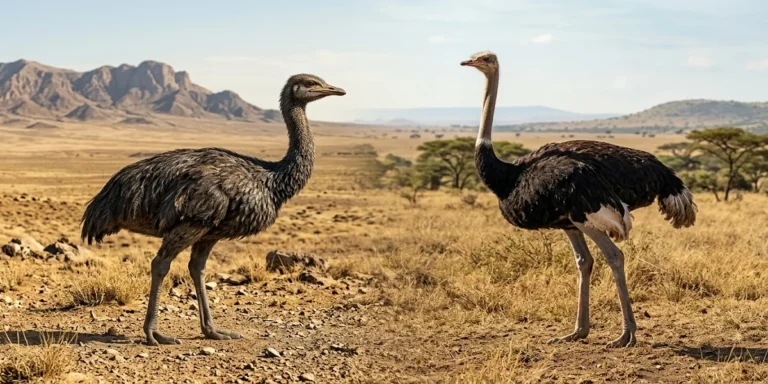

Quick Answer: Yes, ostriches can swim. Despite the common myth that they cannot, ostriches are capable of floating and moving through water using their powerful legs. However, they are not aquatic birds, and swimming is rare because they naturally live in dry grasslands, savannas, and semi-arid regions where they seldom need to enter deep water. Although people often ask can ostriches swim, documented observations show that they certainly can.
Table of Contents
Can Ostriches Swim? What the Evidence Actually Shows
If you’ve searched this question online, you’ve probably found conflicting answers.
Some websites confidently claim ostriches cannot swim at all. Others say they are surprisingly good swimmers. So which is correct?
The evidence points to a simple conclusion:
Ostriches are capable swimmers, but they are not water birds. Swimming is an occasional behavior rather than a normal part of their lifestyle.
The confusion largely comes from their habitat. Because ostriches spend almost their entire lives on land, many people assume they are physically incapable of swimming. In reality, documented observations show they can cross water and stay afloat when the situation calls for it.
Can Ostriches Actually Swim?
Yes.
An ostrich entering deep water doesn’t immediately sink. Like many large terrestrial animals, its body provides enough buoyancy to remain afloat while its long, muscular legs generate forward movement.
Unlike ducks or swans, ostriches don’t swim gracefully. Their movement is more like a steady paddle powered almost entirely by alternating leg strokes. Their long neck naturally keeps the head well above the water, making breathing easy while swimming.
What’s important is distinguishing between being able to swim and being adapted for swimming.
Ostriches evolved for life on land. Nearly every part of their anatomy favors speed, endurance, and stability while running rather than efficiency in water. Swimming is simply a capability they retain, not one they regularly depend on.

Why Don’t We See Ostriches Swimming Very Often?
This is one of the biggest reasons the myth exists.
Wild ostriches primarily inhabit:
- African savannas
- Open grasslands
- Semi-desert regions
- Dry shrublands
Many of these environments contain very little permanent deep water. An ostrich may drink from watering holes or walk through shallow streams, but it rarely encounters situations where swimming becomes necessary.
Even when water is available, running is almost always the safer and more efficient option.
Since most people never see an ostrich swimming, it’s easy to assume they simply can’t.
How Do They Swim Without Webbed Feet?
One surprising fact is that webbed feet are not required for swimming.
Ostriches propel themselves using the same muscles that make them the fastest-running birds on Earth. Their powerful legs push backward against the water, creating enough force to move the bird forward.
Their rounded body also provides natural buoyancy, while the long neck acts almost like a snorkel, allowing the head to remain comfortably above the surface.
Although they lack specialized aquatic adaptations such as webbed feet or waterproof plumage, they are still capable of swimming over short distances when necessary.
Real Case: Ostriches Spotted Swimming in the Atlantic Ocean
One of the best-documented examples occurred near Yzerfontein, South Africa, where the National Sea Rescue Institute (NSRI) published photographs of two ostriches swimming in the Atlantic Ocean.
Two female ostriches were spotted swimming in the Atlantic Ocean after apparently escaping from a nearby farm. Local fishermen reported the birds had traveled a considerable distance offshore before helping guide them safely back toward land.
Interestingly, local reports suggested this wasn’t the first time ostriches had been seen swimming in the area.
This observation is important because it demonstrates that ostriches are capable of swimming not only in calm ponds or rivers, but also in coastal seawater under the right circumstances. While this doesn’t mean they regularly enter the ocean, it clearly contradicts the claim that ostriches are physically unable to swim.
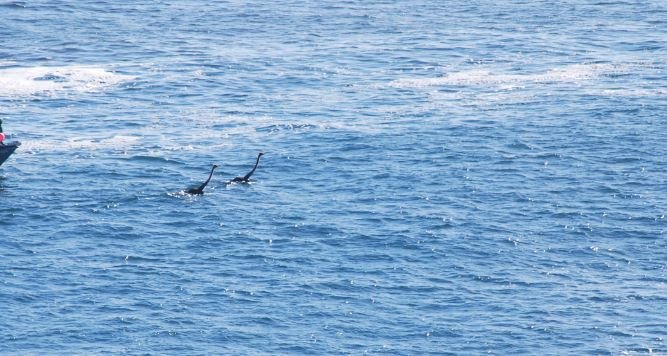
Image Source: National Sea Rescue Institute (NSRI), photos courtesy of Harbour View.
Why Do Ostriches Enter Water in the First Place?
Swimming is unusual, so why would an ostrich do it?
Possible reasons include:
- Cooling off during extremely hot weather.
- Crossing rivers or flooded areas while moving through their habitat.
- Escaping danger if water offers a safer route.
- Accidental entry after wandering into deeper water than expected.
Captive ostriches have also been observed voluntarily entering pools to cool themselves during hot days, suggesting they are not naturally afraid of water. Their large body size also makes managing body temperature important during hot weather, especially in exposed habitats.
Do Other Flightless Birds Swim?
Not all flightless birds interact with water in the same way.
| Bird | Can Swim? | How Common? | Typical Habitat |
|---|---|---|---|
| Ostrich | Yes | Rare | Savannas, grasslands |
| Emu | Yes | Common | Woodlands, rivers, wetlands |
| Cassowary | Yes | Common | Tropical rainforests |
| Penguin | Excellent swimmer | Constant | Marine environments |
This comparison shows that being flightless does not determine whether a bird can swim.
Instead, swimming ability depends on the environment each species evolved in.
For example, penguins evolved almost entirely for aquatic life, while ostriches evolved for speed across open landscapes. Emus and cassowaries fall somewhere in between, frequently crossing rivers and swimming when needed.
Can Ostriches Drown?
Yes.
Like virtually any terrestrial animal, an ostrich can drown if it becomes exhausted, trapped, injured, or unable to keep its head above water.
However, there is no evidence that healthy ostriches are unusually prone to drowning simply because they enter water.
In fact, documented observations suggest healthy adults are generally capable of floating and swimming short distances successfully.
Frequently Asked Questions
Can ostriches float?
Yes. Their body provides enough buoyancy to remain afloat while they paddle with their legs.
Can ostriches cross rivers?
Yes. They can swim across rivers when necessary, although this is not a routine behavior.
Are ostriches afraid of water?
There is no evidence they have an innate fear of water. Wild and captive ostriches have both been observed entering water voluntarily.
Can baby ostriches swim?
There is very little scientific documentation on this. Chicks are likely more vulnerable than adults and should not be assumed to be capable swimmers.
How fast can an ostrich swim?
No reliable scientific measurements exist. Unlike their well-studied running speed, swimming speed has not been formally documented.
Why do people think ostriches can’t swim?
Mostly because they live in dry habitats and are rarely seen in deep water, leading many people to assume they are incapable of swimming.
Do ostriches have webbed feet?
No. Ostriches have two large toes designed for efficient running rather than swimming.
Can ostriches swim in deep water?
Healthy adults can remain afloat and swim for a time, but they are not adapted for prolonged swimming or life in deep water.
Are ostriches better swimmers than emus?
Probably not. Emus encounter rivers and waterways much more frequently and are generally regarded as more regular swimmers than ostriches.
If someone asks can ostriches swim, the short answer is yes. The idea that ostriches cannot swim is one of the internet’s most persistent myths.
The available evidence tells a different story. Ostriches can swim, using their powerful legs to propel themselves through the water while their buoyant bodies and long necks help keep them afloat. What they are not is an aquatic species.
Because ostriches evolved in some of Africa’s driest landscapes, swimming simply isn’t a behavior they need very often. That’s why documented cases, such as the famous Yzerfontein sighting, attract so much attention. They remind us that an animal doesn’t have to live in water to be capable of swimming.