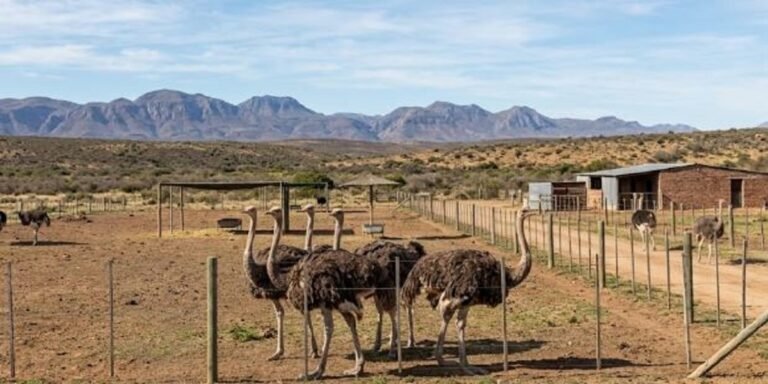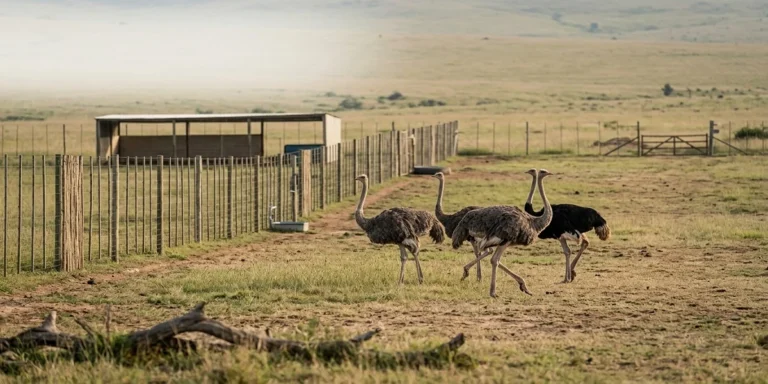
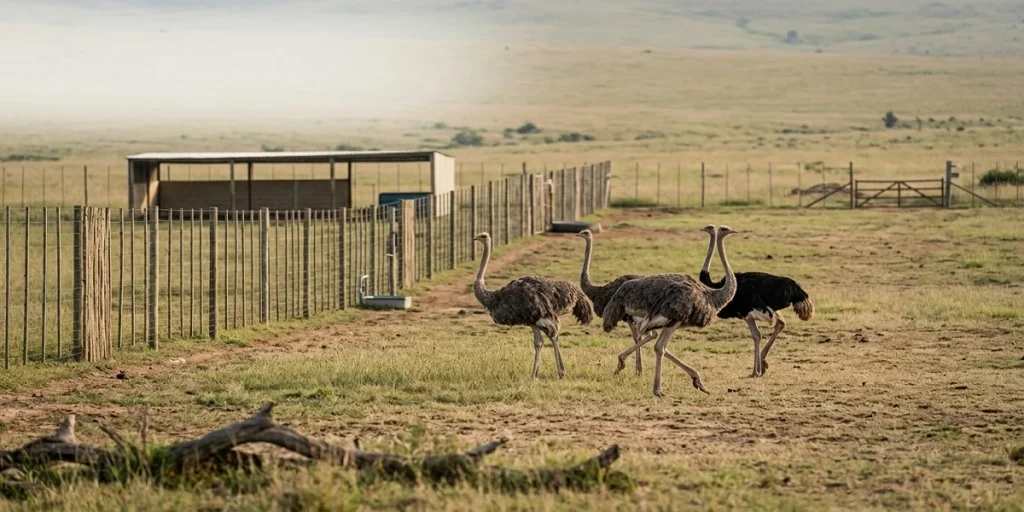
Quick Answer: There is no single universal standard for ostrich enclosure requirements. Recommended enclosure sizes vary by management system and purpose:
- Licensing minimums: Around 0.25 acres (1,012 m²) per adult.
- Breeding pairs (UK/Scottish standards): Minimum 15 × 40 m (600 m²), though 25 × 80 m (2,000 m²) is strongly recommended.
- Breeding groups (Agricultural extension): 1 to 3 acres (4,047 to 12,141 m²).
Beyond square footage, proper ostrich enclosures require secure, high fencing, unobstructed running space, shade, good drainage, and safe handling access.
Table of Contents
Building an ostrich enclosure differs significantly from fencing a cattle paddock. Ostriches are large, high-speed birds that need ample space to sprint safely. Their height, kick force, and tendency to reach through fencing demand specialized design choices.
The most common planning mistake is asking, “How many ostriches can fit on this land?” A better question is: “How much space does each group need to run, breed, and remain safely separated?”
Regulatory guidelines, breeding paddocks, commercial farms, and temporary pens all serve distinct purposes. Treating a single regulatory minimum as a universal standard creates misleading enclosure designs.
Planning a broader operation? Enclosures are just one piece of the puzzle. Land layout, permits, feed storage, and local zoning all play vital roles. For comprehensive planning, explore our beginner’s guide to starting an ostrich farm.
How Much Space Do Ostriches Need?
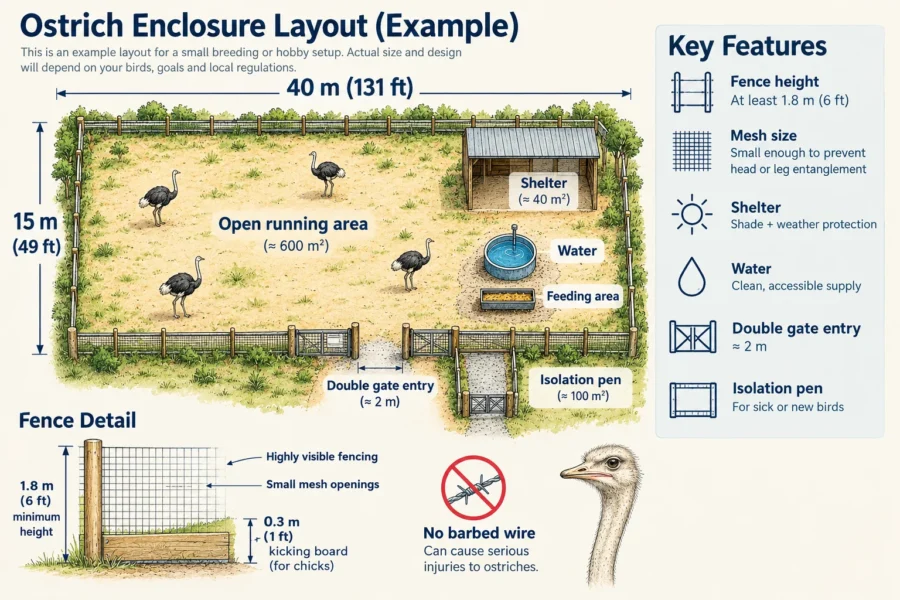
Published space recommendations vary widely because different sources address different management systems. Regulatory minimums set lower limits for animal keeping, while agricultural extensions design recommendations for optimal welfare, foraging, and breeding behavior. Therefore, smaller figures should serve as absolute baselines rather than standard targets.
| Source / Context | Management Purpose | Published Space Requirement |
| UK Licensing Guidance | Adult ostrich (Minimum) | 0.25 acre (~1,012 m²) |
| Scottish Government | Breeding pair (Minimum) | 15 × 40 m (600 m²) |
| Scottish Government | Breeding pair (Recommended) | 25 × 80 m (2,000 m²) |
| Agricultural Extension | Breeding group | 1 to 3 acres (~4,047 to 12,141 m²) |
Enclosure Geometry and Safety
Scottish guidance highlights a crucial design principle: enclosures must feature long, unobstructed running channels and avoid sharp fence angles. Because ostriches accelerate rapidly, straightaways allow safe deceleration and reduce fence collisions.
Pet, Breeding, or Commercial: How Space Needs Change
Enclosure dimensions directly reflect your operation’s goal:
- Pet or Small Private Groups: Ostriches are social animals; keeping a solitary bird is strongly discouraged. Private setups require enough shared space for fluid group dynamics without overcrowding.
- Breeding Groups: Breeding triggers territorial behavior and hen aggression. Larger paddocks allow subordinate birds to retreat safely from dominant pairs.
- Commercial Farms: Commercial sites require space beyond main paddocks, including brooder housing, grower yards, handling chutes, quarantine quarters, and vehicle access.
Because land layout depends on operational purpose, there is no fixed answer to “How many ostriches per acre?”
Young Ostriches Need Their Own Space Plan
Chicks and juveniles should never be managed under adult spatial assumptions. Overcrowding growing birds severely impacts health and development.
A 2025 study evaluating growing ostriches (6 to 15 months old) across different stocking densities demonstrated clear performance differences:
| Space per Bird | Study Finding |
| 2.5 m² | Reduced growth rate and poorer overall performance |
| 5.0 m² | Significantly improved growth compared to 2.5 m² |
| 10.0 m² | Optimal growth and behavioral development |
While researchers note these figures are not universal minimums, the operational lesson is clear: overcrowding directly hinders juvenile development.
Safety Tip: Scottish guidelines recommend installing a 0.3 m (1 ft) kicking board along the bottom of juvenile fencing to prevent chicks from pushing their legs through the mesh and injuring themselves.
Think About Total Land, Not Just Pen Size
Calculating paddock dimensions covers only part of a functioning farm layout. A practical operation must also reserve acreage for:
- Shade structures and weather shelters
- Catching pens and chute systems
- Quarantine and isolation facilities
- Property line setbacks and access roads
- Feed/water infrastructure and drainage
First design the complete site infrastructure, then calculate how many birds your total land area can safely accommodate.
When planning an ostrich enclosure, the most useful number is not simply the total size of the property, but how much usable enclosure space is available for each bird. The calculator below lets you test different group sizes and enclosure areas without treating any single figure as a universal minimum.
Ostrich Enclosure Area Calculator
Enter the number of ostriches and your planned enclosure area to see how much space is available per bird.
Ostrich Fencing Requirements: Height, Mesh & Safety
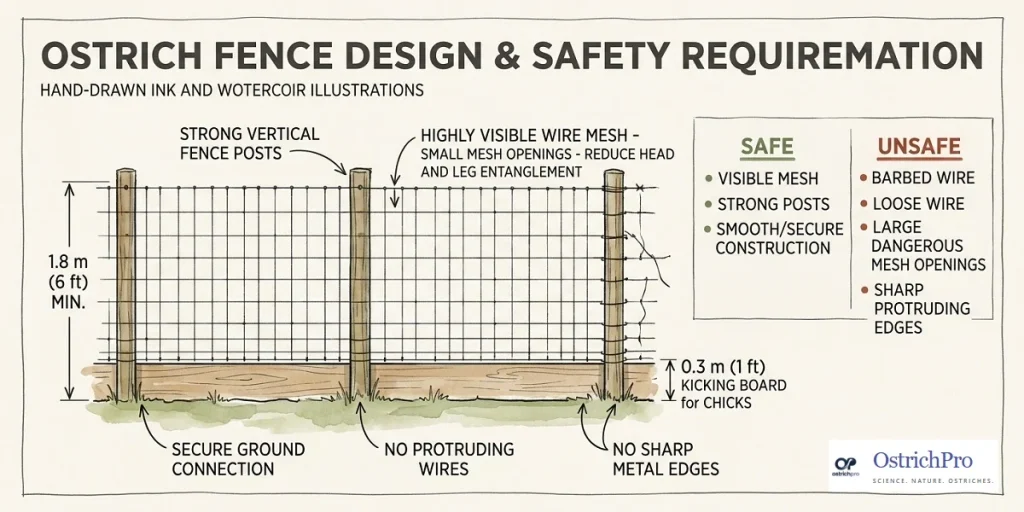
Key ostrich fencing requirements include secure, visible mesh, safe construction and a minimum 1.8 m fence height in applicable guidance.Ostrich fencing serves two primary functions: keeping birds safely contained and protecting them from external hazards or predators. Because ostriches are massive, high-speed runners with powerful kicks, a fence must be engineered to prevent collisions, entanglement, and physical injury.
How Tall Should an Ostrich Fence Be?
Official welfare standards, including Scottish Government guidelines, recommend a fence height of at least 1.8 m (6 ft). Since adult males can exceed 2 m in height, fencing must prevent birds from hopping over or reaching their long necks into adjacent paddocks.
Beyond height, fence visibility is critical. Fast-moving ostriches can fail to see thin wire barriers, creating severe collision risks.
| Fence Feature | Recommended Specification | Operational Purpose |
| Minimum Height | 1.8 m / 6 ft | Prevents escape and restricts neck reaching |
| Mesh Openings | Small, woven aperture | Prevents head, neck, and leg entanglement |
| Visibility | High-visibility materials / top rails | Prevents high-speed fence collisions |
| Chick Protection | 0.3 m / 1 ft bottom kicking board | Stops chicks from pushing legs through mesh |
| Hazard Materials | Avoid barbed wire completely | Prevents severe skin lacerations and leg injuries |
What Type of Mesh Is Best for Ostriches?
Mesh selection should prioritize bird safety over generic livestock containment:
- Aperture Size: Openings must be small enough to prevent an ostrich from pushing its head or legs through. Commercial standards often favor 2 × 4 inch woven mesh.
- Juvenile Safety: Small mesh size is doubly critical for chicks, which routinely attempt to reach through lower fence sections.
- Structural Strength: Choose heavy-gauge, high-tensile wire capable of absorbing impact without sagging.
Can You Use Barbed Wire or Electric Fencing?
Once the perimeter materials and heights are selected, equal attention must be given to entry points and daily farm management. A secure fence line is only as effective as the gates and access systems built into it.
Barbed Wire: Strictly Avoid
Barbed wire should never be used in ostrich enclosures. Running collisions or simple preening against barbed wire causes catastrophic skin tears and structural leg damage.
Electric Fencing: Proceed with Caution
Guidance on electric fencing varies:
- Some commercial suppliers endorse electric strands for perimeter deterrence.
- Regulatory bodies (including Scottish guidance) advise against electric fencing due to welfare risks and potential collision panics.
Regulatory Tip: Before installing electric fencing, verify local welfare codes and consult an avian veterinarian. A secure, high-visibility physical barrier remains the safest industry baseline.
Gates and Handler Safety
Gate layout must protect both stock and handlers during daily management:
- Double-Gate Entry (Air-Lock System): Install a double-gate entry system (creating a ~2 m² containment zone). This allows keepers to enter and secure one gate before opening the second, eliminating direct escape paths.
- Emergency Escape Gaps: For adult-only paddocks, Scottish guidelines recommend a 0.4 m (16 in) ground gap along handler corridors. This allows a keeper to slide underneath to safety during an aggressive encounter while blocking adult birds. (Do not use in chick paddocks.)
- Public Stand-Off Barriers: If visitors access the perimeter, install a secondary stand-off barrier at least 1 m away from the main fence line to prevent direct contact.
Fence Layout and Geometry: Preventing Collisions
Fence shape directly influences bird behavior and safety:
- Long Straightaways: Provide long, unobstructed running lanes so birds can reach speed and decelerate naturally.
- Rounded Corners: Avoid sharp 90-degree or acute angles. Sharp corners trap fleeing or dominant-driven birds, leading to sudden wall collisions or trampling.
- Smooth Boundaries: Ensure all posts, latches, and wire ends face outward from the paddock interior.
Shelter and Housing Requirements
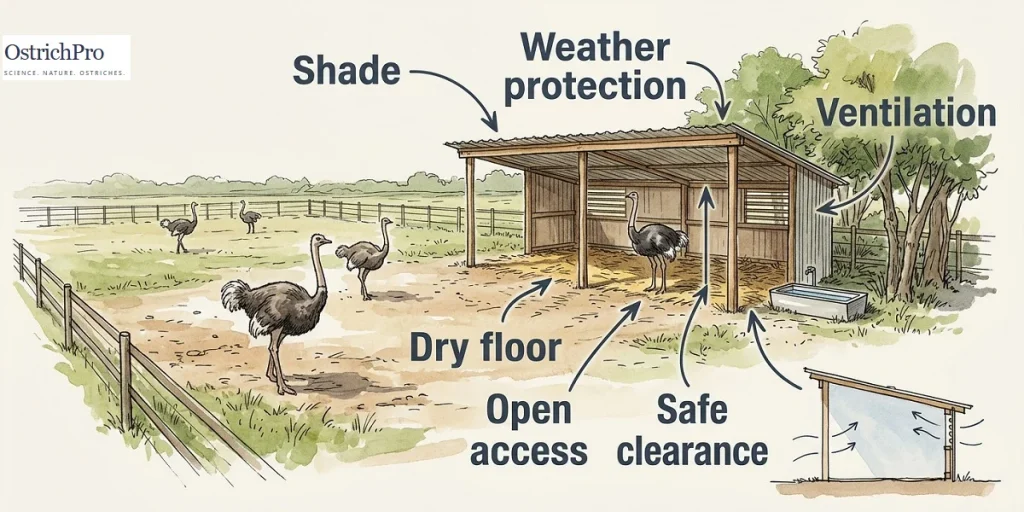
Ostriches are adapted to outdoor life, so their housing does not need to resemble a conventional livestock barn. Instead, an enclosure must balance open range with protection from severe weather, extreme temperatures, and heavy rainfall.
Do Ostriches Need a Barn?
Yes, ostriches require shelter access, but they do not need to be locked indoors full-time.
Unlike many waterfowl and poultry species, ostriches lack a preen gland, meaning their feathers cannot be waterproofed with oil. Prolonged exposure to cold, heavy rain can saturate their plumage and cause severe hypothermia.
Climate Considerations:
- Rain and Cold: Enclosures must provide dry refuges. In regions with freezing winters, radiant heating may be necessary to protect legs and respiratory systems from frostbite.
- Ice Hazards: Icy ground severely threatens ostriches; slipping can cause fatal leg fractures. Shelters provide safe indoor retreat during icy spells.
Ostrich Shelter Checklist
A practical, welfare-compliant shelter must meet key structural standards:
| Requirement | Design Specification | Purpose |
| Indoor Footprint | Minimum 6 m² (~65 sq ft) per adult | Provides baseline space for temporary indoor holding |
| Vertical Clearance | 2.5 m to 3 m minimum height | Prevents head injuries when birds stand erect |
| Flooring | Non-slip, well-drained surface | Prevents slips, joint injuries, and splay leg |
| Ventilation | High-level passive airflow | Prevents ammonia buildup without creating cold drafts |
| Safety Features | Recessed fixtures, smooth walls | Eliminates sharp edges, exposed bolts, or tight traps |
Chick Care Tip: Young birds require dry, highly absorbent bedding. Avoid fine wood shavings or small straw pieces, as chicks frequently ingest litter, leading to fatal impaction.
Shade Management in Hot Climates
Direct sun exposure over large open paddocks can lead to heat stress. Shade structures must be integrated into initial paddock layouts rather than added as an afterthought.
- Placement: Position natural trees or shade sails so birds can move between sun and shade without congregating in tight, aggressive bottlenecks.
- Structural Safety: Keep support beams well above head height and ensure tension wires or brackets remain completely out of reach.
Ground Conditions and Drainage
Persistent mud, standing water, and slippery terrain cause serious foot infections, fungal diseases, and fatal slips.
Drainage Best Practices
Water must shed quickly from high-traffic zones. Scottish Government guidance highlights that open drainage ditches must always be installed outside the fence line to prevent birds from tripping or breaking legs in hidden trenches.
High-Traffic Area Reinforcement
Gates, feeding stations, and fence lines deteriorate rapidly. Protect these zones by:
- Grading paddocks to promote natural water runoff
- Adding crushed gravel or soil-stabilization grids around gate entrances
- Filling deep depressions and ground holes immediately
Hygiene and Foreign-Body Hazard Control
Ostriches are notoriously curious foragers that ingest bright or unusual objects. Swallowing metal, plastic, or debris leads to hardware disease, intestinal blockage, and death.
Daily Enclosure Inspection Checklist
Walk paddock boundaries daily and remove:
- Wire scraps, loose nails, or fence staples
- Plastic wrappings, feed bag strings, and trash
- Sharp stones or metal fragments
- Moldy feed and excessive fecal accumulation around waterers
A clean, clear paddock directly reduces preventable mortality and makes behavioral changes easier to spot early.
Daily Safety and Management
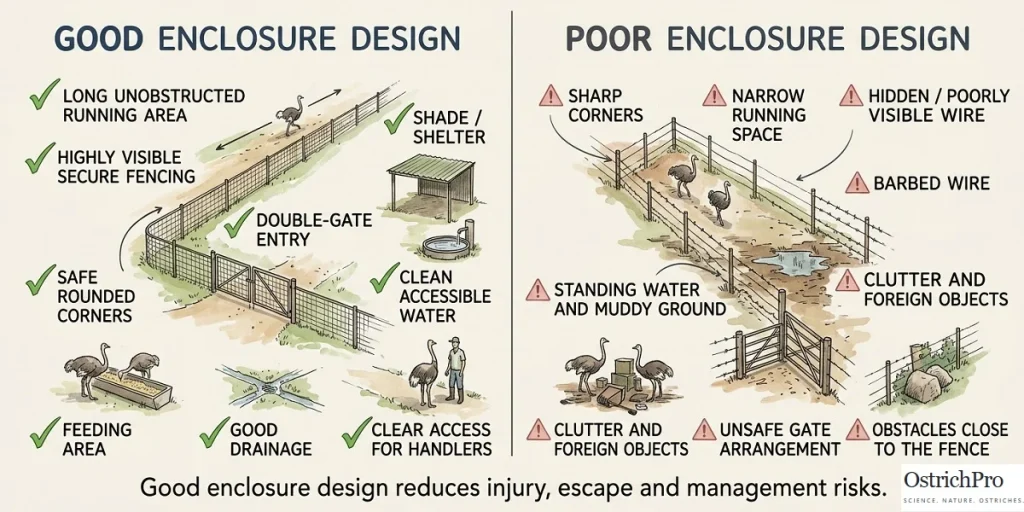
A well-engineered enclosure requires active daily management. Ostriches are large, powerful, and fast-moving; minor issues like a loose wire, standing water, or an unlatched gate can quickly escalate into serious injuries or escapes.
Daily Enclosure Inspection Checklist
Inspect paddocks regularly for structural damage, ground deterioration, and foreign debris. Official standards (such as UK/Scottish guidelines) recommend checking birds and perimeter fences at least twice every 24 hours.
A comprehensive daily inspection should cover:
- Fencing Integrity: Check for loose mesh, broken posts, missing staples, or protruding wire ends.
- Gate Security: Verify latches, locks, and double-gate airlock systems.
- Ground and Drainage: Inspect for standing mud, waterlogging, or eroded fence lines.
- Foreign Object Sweep: Remove plastic wrap, metal scraps, feed bag strings, or trash. Ostriches swallow shiny objects, leading to fatal hardware disease.
- Shelter and Shade: Confirm clean bedding, proper ventilation, and shade availability.
- Health and Behavior: Watch for signs of aggression, limping, lethargy, or dominant harassment.
Handling Facilities and Emergency Planning
Enclosure layouts must accommodate routine capture, medical isolation, and emergency procedures:
- Capture Races and Chutes: Design a narrow funnel chute leading to a small capture pen with solid sides and non-slip flooring. This ensures handler safety during health checks or transport.
- Isolation Yards: Maintain dedicated separation pens for sick, injured, or newly introduced stock.
- Written Emergency Protocols: Establish clear, step-by-step responses for site flooding, wildfires, escaped birds, or handler injuries.
Legal and Zoning Checks Before You Build
Local planning, zoning, public safety, and animal welfare regulations dictate whether keeping ostriches is legally permitted on your land.
Local rules vary drastically across jurisdictions:
- United Kingdom: Ostriches are classified under Dangerous Wild Animals (DWA) licensing rules. Local authorities strictly evaluate fence height, drainage, escape prevention, and handler safety before issuing permits.
- Queensland, Australia (Logan City Council): Properties under 4,000 m² are prohibited from keeping ostriches or emus. Properties over 4,000 m² allow a maximum of three birds subject to specific approval and setback rules from neighboring boundaries.
Before-You-Build Checklist
Before construction begins, confirm that you have answers to all of the following:
| Question | What to confirm |
|---|---|
| Is ostrich keeping allowed? | Zoning and local animal-keeping rules |
| Do I need a licence? | Animal, wildlife, or dangerous-animal requirements |
| How many birds can I keep? | Local stocking or approval limits |
| How much land is required? | Legal minimum and practical enclosure size |
| Where can the enclosure go? | Property boundaries, roads, homes, and setbacks |
| What fence is required? | Height, mesh, visibility, gates, and security |
| What shelter is required? | Weather protection, shade, ventilation, and flooring |
| How will drainage work? | Surface water, mud control, and waste management |
| How will birds be handled? | Race, capture pen, isolation area, and safe access |
| What happens during an emergency? | Escape, fire, flood, injury, or severe weather plan |
Checking these details before construction is usually much cheaper than rebuilding an enclosure after discovering a planning or welfare requirement.
| Evaluation Area | What to Confirm |
| Zoning & Permitting | Are ostriches allowed on this parcel? Is a Dangerous Wild Animal licence required? |
| Stocking & Land Limits | What is the maximum bird count permitted based on total acreage? |
| Setback Distances | What distance must fencing maintain from roads, property lines, and neighboring homes? |
| Building Specifications | Do shelters, tall perimeter fencing, or handling sheds require local building permits? |
| Environmental & Waste | What are local regulations regarding manure management and surface drainage runoff? |
| Emergency Infrastructure | Are double-door entry systems and isolation yards legally mandated in your jurisdiction? |
What Drives Ostrich Enclosure Costs?
Total enclosure costs depend far more on site layout and infrastructure than on raw acreage price.
Primary Cost Factors:
- Fencing Infrastructure: High-tensile mesh, post frequency, corner bracing, and specialized double-gate systems.
- Ground Preparation: Grading, installing gravel in high-traffic zones, and setting up external drainage channels.
- Shelters and Shade: Frame structures, non-slip flooring, and weather-proof cladding.
- Handling Facilities: Capture chutes, solid-walled sorting pens, and isolation housing.
- Rotational Paddocks: Dividing total land into multiple yards to allow pasture recovery, wet-season resting, and breeding pair separation.
Frequently Asked Questions about Ostrich Enclosure Requirements (FAQ)
How Much Space Does an Ostrich Need?
There is no single space requirement for ostriches. Published standards range from 0.25 acres (1,012 m²) per adult for general licensing up to 1 to 3 acres (4,047 to 12,141 m²) for a breeding group under agricultural extension guidance. Additionally, Scottish Government rules set a minimum of 600 m² for a breeding pair and recommend 2,000 m² for optimal welfare. Exact land needs depend on age, group size, breeding status, and local regulations.
How Many Acres Do You Need to Raise Ostriches?
A standard breeding group generally requires 1 to 3 acres of land. Commercial operations should allocate extra acreage beyond main paddocks to accommodate shelters, handling chutes, isolation yards, vehicle access routes, and future site expansion.
How Tall Should an Ostrich Fence Be?
An ostrich fence must be at least 1.8 m (6 ft) tall. Fencing should utilize high-visibility materials and a tight mesh pattern to prevent birds from stretching their necks or pushing legs through openings.
Can Ostriches Jump Over Fences?
While ostriches can clear lower obstacles when panicked, enclosure design focuses on containment and visual clarity rather than raw jump height. A secure, highly visible fence of at least 1.8 m (6 ft) combined with long, uninterrupted running channels prevents birds from charging toward boundaries.
Can You Use Barbed Wire for Ostriches?
No, barbed wire should never be used for ostriches. Collisions or preening against sharp wire causes severe skin lacerations and permanent leg injuries. Welfare guidelines explicitly require smooth, woven, high-tensile mesh systems.
Do Ostriches Need a Shelter or Barn?
Ostriches require access to shade and weather protection, but they do not need full-time barn confinement. Because ostriches lack a preen gland and cannot oil-proof their feathers, dry shelters are critical during heavy rain, extreme cold, or freezing weather.
Can You Keep Just One Ostrich?
Keeping a solitary ostrich is strongly discouraged. Ostriches are highly social birds that thrive in group structures. Enclosure planning should accommodate group behavior and provide separate isolation paddocks when temporary medical separation is needed.
Do You Need a Permit to Keep Ostriches?
Permit requirements depend on your location. Many jurisdictions regulate ostriches under dangerous wild animal laws, agricultural zoning codes, or specific livestock licensing rules. Always consult local municipal and veterinary authorities before building or purchasing stock.
What Are the Requirements to Start an Ostrich Farm?
Starting an ostrich farm requires suitable land, perimeter fencing, shelters, feed/water systems, handling chutes, quarantine yards, biosecurity protocols, and legal licenses.
Is an Ostrich Farm Profitable?
Ostrich farming can be profitable, but success depends on managing feed costs, mortality rates, breeding productivity, and local market demand for meat, premium leather, feathers, and fertile eggs. Profitability relies as much on market access and business planning as it does on enclosure layout.
Final Thoughts
Designing an effective ostrich enclosure comes down to three priorities: adequate space, structural safety, and operational practicality. Ostriches require room to sprint safely, high-visibility perimeter fencing, secure double-gate entries, well-drained ground, and reliable weather shelter.
Because space standards vary across commercial, breeding, and private management systems, published numbers should always serve as baseline reference points rather than absolute upper limits.
Verify your local zoning and licensing requirements before construction begins.