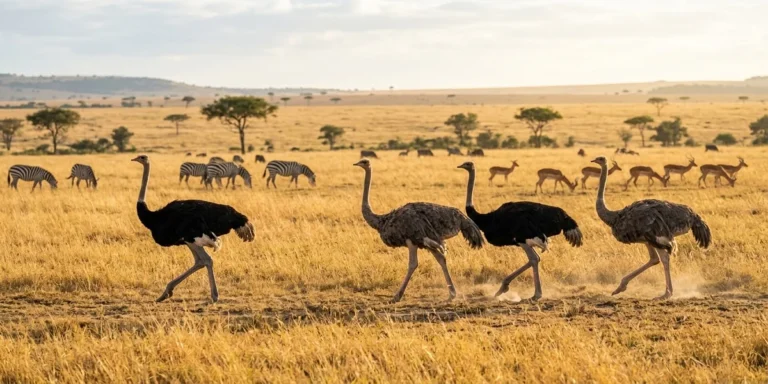
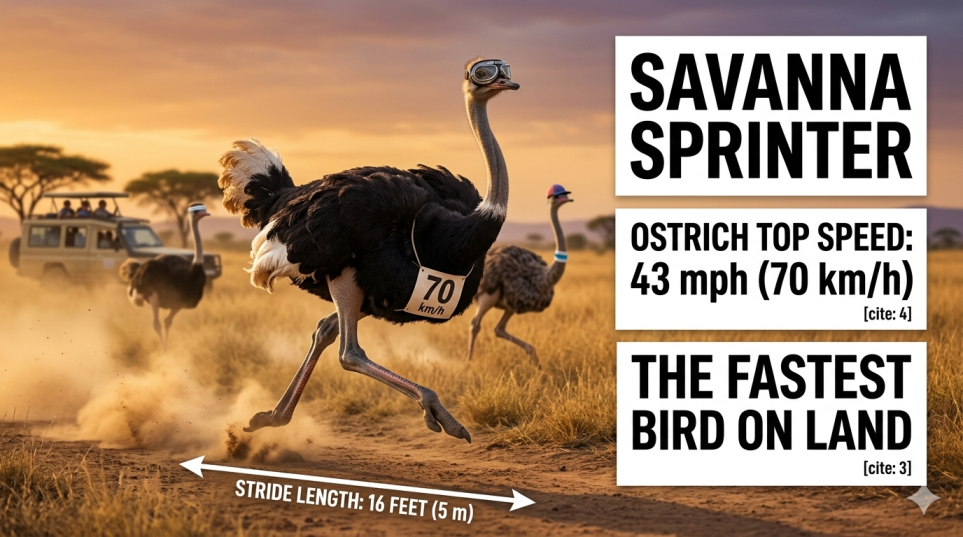
Quick Answer: An ostrich can run up to 43 mph (70 km/h), making it the fastest running bird on Earth. It can also maintain speeds of around 30–37 mph (48–60 km/h) over long distances, giving it exceptional endurance. While some sources claim ostriches can reach 50–60 mph, the strongest available evidence supports a top speed of about 43 mph (70 km/h).
Ostriches are remarkable animals that combine size, speed, and endurance in a way few other land animals can. Although they cannot fly, they have evolved into exceptional runners, using their long legs, powerful muscles, and unique two-toed feet to travel across the open African savanna with remarkable efficiency.
During my time in Tanzania, watching wild ostriches cross open grasslands completely changed my perspective on these birds. At first they appear calm and almost effortless in their movements. Then, within just a few strides, they accelerate with surprising power, covering several meters with each step while using their wings to maintain balance at high speed.
In this guide, you’ll learn how fast an ostrich can run, how its top speed compares with humans, horses, lions, and cheetahs, what allows it to maintain such impressive endurance, and whether popular claims about ostriches reaching 50–60 mph are actually supported by scientific evidence.
Table of Contents
Key Facts About Ostrich Speed
| Fact | Value |
|---|---|
| Top speed | Up to 43 mph (70 km/h) |
| Sustained running speed | 30–37 mph (48–60 km/h) |
| Stride length | Up to 16 ft (5 m) |
| Fastest running bird | Yes |
| Top recorded human speed | About 27 mph (44 km/h) |
| Can outrun most predators? | Often, through speed and endurance |
The Top Speed of an Ostrich
An ostrich can reach a top running speed of about 43 mph (70 km/h), making it the fastest running bird on Earth. This figure is widely accepted by wildlife organizations and scientific references and represents the maximum speed an adult ostrich can achieve under ideal conditions.
However, one reason people are often confused about ostrich speed is that different numbers appear online. While 43 mph (70 km/h) is the value most commonly supported by reliable sources, you may also see claims of 45 mph or even 50–60 mph (80–97 km/h). These higher figures are frequently repeated but are rarely backed by published measurements or scientific evidence.
In other words, there is an important difference between a widely accepted top speed and an unverified claim. Based on the strongest available evidence, 43 mph (70 km/h) remains the most reliable estimate of an ostrich’s maximum running speed.
Measured Speed vs. Common Claims
| Reported Speed | Evidence Level | Notes |
|---|---|---|
| 43 mph (70 km/h) | ⭐⭐⭐⭐⭐ High | Widely accepted top speed reported by major wildlife references |
| 45 mph (72 km/h) | ⭐⭐⭐ Moderate | Occasionally reported by reputable wildlife sources |
| 50–60 mph (80–97 km/h) | ⭐ Low | Frequently repeated online but lacks strong published evidence |
Although an ostrich’s maximum speed is impressive, its greatest advantage is not simply how fast it can sprint. What truly sets this bird apart is its ability to maintain 30–37 mph (48–60 km/h) over much longer distances than most other fast-running animals.
Ostrich Running Speed at a Glance
| Speed Type | Speed |
|---|---|
| Top speed | Up to 43 mph (70 km/h) |
| Sustained running speed | 30–37 mph (48–60 km/h) |
| Sprint capability | Short bursts at maximum speed |
| Long-distance running | High endurance over extended distances |
Why Are Ostriches So Fast?
An ostrich’s remarkable speed isn’t the result of a single adaptation. Instead, it’s the combination of specialized legs, powerful muscles, unique feet, flexible tendons, and excellent balance that allows these birds to run faster than any other bird on Earth.
Unlike many animals that rely on short bursts of speed alone, ostriches are built for both rapid acceleration and long-distance endurance. Every part of their anatomy works together to reduce energy loss and maximize forward movement across open landscapes.
Long Legs Create Longer Strides
One of the biggest reasons ostriches run so fast is their exceptionally long legs. An adult ostrich can cover 10 to 16 feet (3 to 5 meters) in a single stride, meaning it travels much farther with each step than most other animals.
Rather than increasing speed by taking more steps, ostriches increase speed by covering more ground with every stride. This makes their running style both fast and energy efficient.
Powerful Leg Muscles Generate Explosive Speed
An ostrich’s legs contain some of the strongest muscles found in any bird. These muscles generate the force needed for rapid acceleration while supporting a body that can weigh well over 300 pounds (136 kg).
Unlike flying birds, ostriches invest far more muscle mass in their legs than in their chest, allowing them to convert nearly all of their power into forward movement.
Two-Toed Feet Act Like Natural Running Shoes
Most birds have three or four toes. Ostriches have only two.
The larger toe supports most of the bird’s weight and ends in a thick nail that functions almost like a hoof, providing excellent traction on firm ground. The smaller outer toe helps maintain balance, especially when turning at high speed.
This unusual foot structure reduces weight at the end of each leg while improving stability and running efficiency.
Elastic Tendons Help Save Energy
Running isn’t only about muscle power. Ostriches also rely on long, elastic tendons that store and release energy with every stride.
As the foot lands, these tendons briefly stretch before springing back, helping propel the bird forward with less muscular effort. This natural “spring” effect reduces fatigue and contributes to the ostrich’s impressive endurance over long distances.
Wings Provide Balance Instead of Flight
Although ostriches cannot fly, their wings still play an important role while running.
When sprinting or changing direction, they spread their wings slightly to stabilize their bodies, much like a tightrope walker uses their arms for balance. This helps maintain control during sharp turns and sudden changes in direction while running across uneven terrain.
Physical Adaptations That Make Ostriches Fast
| Adaptation | How It Helps |
|---|---|
| Long legs | Increase stride length and ground covered per step |
| Powerful leg muscles | Generate rapid acceleration and high top speed |
| Two-toed feet | Improve traction, balance, and running efficiency |
| Elastic tendons | Store and release energy to reduce fatigue |
| Large wings | Provide balance and stability during high-speed running |
How Does an Ostrich’s Speed Compare to Other Animals?
Running at 43 mph (70 km/h) is impressive on its own, but comparing an ostrich’s speed with other animals makes its athletic ability even easier to understand.
Although the ostrich is the fastest running bird in the world, it is not the fastest land animal. Some mammals can reach higher peak speeds, while others rely on short bursts of acceleration rather than endurance.
The table below compares the ostrich’s speed with several well-known runners.
Ostrich Speed Comparison
| Animal | Top Speed | Faster Than an Ostrich? | Key Advantage |
|---|---|---|---|
| Ostrich | 43 mph (70 km/h) | — | Excellent endurance |
| Cheetah | 70 mph (113 km/h) | ✅ Yes | Fastest land animal |
| Lion | 50 mph (80 km/h) | ✅ Slightly | Powerful short bursts |
| Horse | 40–55 mph (64–88 km/h) | Sometimes | Depends on breed |
| Greyhound | 45 mph (72 km/h) | Slightly | Sprint speed |
| Human (Usain Bolt) | 27 mph (44 km/h) | ❌ No | World’s fastest recorded human |
Can an Ostrich Outrun a Human?
Absolutely.
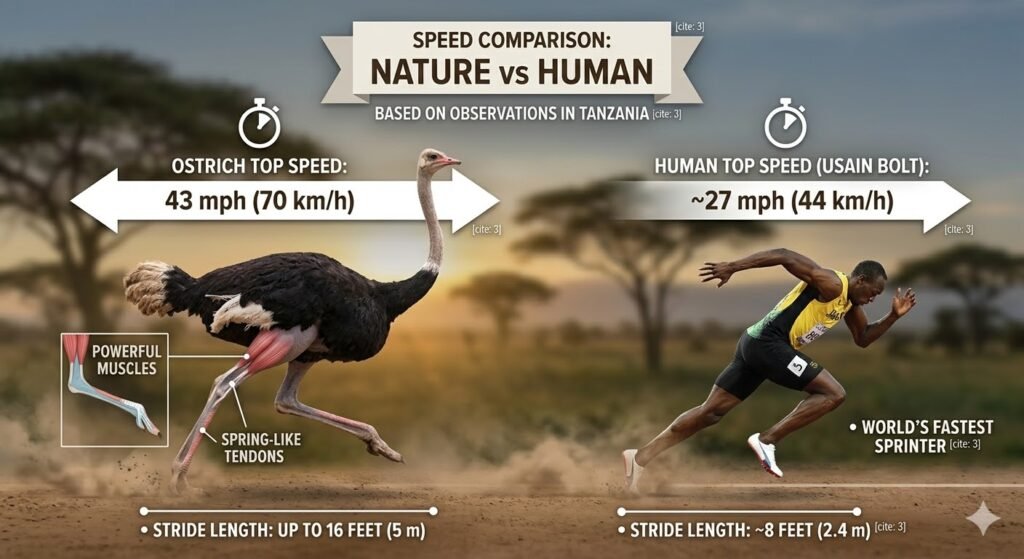
Even the fastest human ever recorded, Usain Bolt, reached a peak speed of about 27 mph (44 km/h). An ostrich can exceed 43 mph (70 km/h) while also taking strides up to 16 feet (5 meters) long.
In a race across open ground, an ostrich would quickly leave even an Olympic sprinter behind.
Can an Ostrich Outrun a Horse?
It depends on the distance.
Many horses can reach speeds between 40 and 55 mph, meaning some breeds are capable of running faster than an ostrich during a sprint.
However, ostriches are exceptional endurance runners. They can maintain high speeds for much longer than many animals, making them surprisingly competitive over extended distances.
Can an Ostrich Outrun a Lion?
Often, yes.
Although lions can briefly reach speeds of around 50 mph (80 km/h), they usually maintain those speeds for only a short distance before tiring.
Ostriches rely on endurance rather than explosive acceleration. By maintaining a fast, steady pace and making quick changes in direction, they can often escape lion attacks before the predator closes the gap.
Can an Ostrich Outrun a Cheetah?
No.
The cheetah remains the fastest land animal, capable of reaching speeds of around 70 mph (113 km/h).
However, cheetahs can sustain these speeds for only a short time. Ostriches cannot match a cheetah’s maximum speed, but they can continue running long after a cheetah has slowed down.
Can an Ostrich Outrun a Car?
Not under normal conditions.
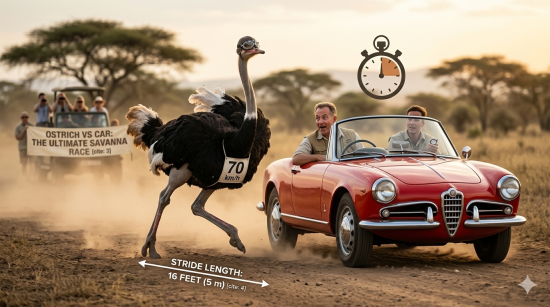
Even a small passenger car can easily exceed an ostrich’s top speed on a paved road.
However, this comparison changes on rough terrain. Ostriches are built for uneven ground, where their balance, agility, and long strides allow them to move efficiently across grasslands and loose soil conditions that can challenge vehicles.
How Long Can an Ostrich Run?
An ostrich isn’t just one of the fastest runners in the animal kingdom, it’s also one of the most impressive endurance athletes among birds. While many animals rely on brief bursts of speed, ostriches are capable of maintaining 30–37 mph (48–60 km/h) for extended periods, allowing them to cover long distances without tiring as quickly.
Unlike sprint specialists such as cheetahs, which rapidly overheat after a short chase, ostriches combine speed with stamina. This endurance is one of the main reasons they have survived for millions of years in the open African savanna, where escaping predators often depends on maintaining a fast pace rather than achieving the highest possible speed.
Why Can Ostriches Run for So Long?
Several adaptations allow ostriches to sustain high running speeds for much longer than most animals.
Their long legs reduce the number of strides needed to cover a given distance, making each step more efficient. Elastic tendons store and release energy like natural springs, reducing the amount of muscular effort required with every stride. Powerful leg muscles provide continuous forward propulsion, while an efficient cardiovascular and respiratory system delivers the oxygen needed to support prolonged exercise.
Together, these adaptations make the ostrich an exceptionally efficient long-distance runner rather than just a fast sprinter.
Top Speed vs. Endurance
Reaching maximum speed and maintaining it are two very different things.
An ostrich can briefly reach its top speed of about 43 mph (70 km/h), but it typically runs at a slightly lower pace when covering longer distances. This strategy conserves energy while still allowing the bird to stay well ahead of most predators.
| Running Style | Typical Speed | Purpose |
|---|---|---|
| Maximum sprint | Up to 43 mph (70 km/h) | Escaping immediate danger |
| Sustained running | 30–37 mph (48–60 km/h) | Covering long distances with less fatigue |
Why Endurance Matters More Than Top Speed
In the wild, survival rarely depends on reaching a record-breaking speed for a few seconds. Instead, it depends on staying fast long enough for predators to give up the chase.
Large predators such as lions rely on explosive acceleration but tire relatively quickly. Ostriches use a different strategy: maintaining a high, sustainable pace while covering large distances across open grasslands. This combination of endurance, efficient movement, and excellent balance makes them difficult targets despite being unable to fly.
Can an Ostrich Really Run 60 mph?
One of the most common claims online is that an ostrich can reach speeds of 60 mph (97 km/h). While this figure appears on countless websites and social media posts, it is not well supported by scientific literature or primary wildlife references.
Most authoritative sources consistently report a maximum running speed of around 43 mph (70 km/h) for a healthy adult ostrich under ideal conditions. Some wildlife references mention speeds of up to 45 mph (72 km/h), but reliable evidence for speeds approaching 60 mph is extremely limited.
This doesn’t mean an ostrich is slow. In fact, even at 43 mph, it remains the fastest running bird on Earth and one of the fastest bipedal animals ever recorded.
Why Does the 60 mph Myth Exist?
There is no single source responsible for the claim. Instead, the figure appears to have spread as websites repeatedly copied one another over time without citing original research or measured observations.
This is a common example of how unsupported numbers can become accepted online through repetition rather than evidence.
When comparing wildlife facts, it’s always worth asking whether a number comes from a measured observation, a scientific publication, or simply another website repeating the same claim.
What Does the Evidence Suggest?
Based on the strongest available evidence, the following estimates are the most reliable.
| Reported Speed | Confidence | Interpretation |
|---|---|---|
| 43 mph (70 km/h) | High | Best-supported maximum speed |
| 45 mph (72 km/h) | Moderate | Occasionally reported by reputable wildlife sources |
| 50–60 mph (80–97 km/h) | Low | Frequently repeated but not consistently supported by published evidence |
Until stronger published measurements become available, 43 mph (70 km/h) remains the most credible estimate of an ostrich’s top running speed.
Why Did Ostriches Evolve to Run So Fast?
Unlike most birds, ostriches gave up the ability to fly millions of years ago. As flight became less important, natural selection favored birds that could survive by running instead.
Living in the open grasslands and semi-arid regions of Africa meant predators could often be spotted from a distance—but escaping them required speed rather than flight. Over countless generations, ostriches evolved longer legs, stronger muscles, and more efficient running mechanics, allowing them to outrun danger across wide, open landscapes.
Today, this evolutionary strategy has made the ostrich the fastest running bird on Earth.
Built for Life on the African Savanna
The African savanna offers few places to hide.
Without dense forests or rocky shelters, large birds must rely on early detection and rapid escape. Ostriches have excellent eyesight that helps them spot predators from long distances, giving them valuable time to start running before an attack begins.
Instead of depending on camouflage or flight, they depend on speed, endurance, and awareness.
Speed Saves Energy Too
Running fast isn’t only about escaping predators.
An efficient running style also allows ostriches to travel long distances while searching for food, water, and suitable nesting areas. Covering more ground with less energy is especially valuable in habitats where resources can be widely scattered.
Their long strides and energy-efficient biomechanics make long-distance travel much less demanding than it would be for many other large animals.
Evolution Turned a Flightless Bird Into a Running Specialist
Many flightless birds became isolated on islands where predators were scarce.
Ostriches followed a very different evolutionary path.
Because they continued living alongside large carnivores, they developed into highly specialized runners instead of becoming slow-moving ground birds. Their anatomy reflects this trade-off: reduced flight muscles, exceptionally powerful legs, long elastic tendons, and a body designed for speed rather than flight.
Evolutionary Adaptations for Speed
| Adaptation | Survival Benefit |
|---|---|
| Long legs | Longer strides and higher speeds |
| Powerful leg muscles | Rapid acceleration and sustained running |
| Two-toed feet | Better traction and lower energy cost |
| Excellent eyesight | Earlier predator detection |
| Large body size | Longer stride length and stability |
| Reduced flight muscles | More energy invested in running |
Interesting Facts About Ostrich Speed
Ostriches are famous for their speed, but several lesser-known facts make their running ability even more impressive.
An Ostrich Can Cover Up to 16 Feet in a Single Stride
At top speed, an adult ostrich can take strides measuring up to 16 feet (5 meters). This exceptional stride length allows it to cover large distances with fewer steps, improving both speed and energy efficiency.
They Are the Fastest Two-Legged Animals on Earth
Many animals can outrun an ostrich, but none do it on two legs.
With a top speed of around 43 mph (70 km/h), the ostrich is the fastest bipedal runner ever recorded, outperforming every other bird and every human.
Their Wings Still Play an Important Role
Although ostriches cannot fly, their wings are far from useless.
While running, they extend and adjust their wings to improve balance, stabilize their bodies during sharp turns, and help control direction at high speed.
Baby Ostriches Can Run Surprisingly Fast
Young ostriches begin running shortly after hatching and develop impressive speed within their first few months of life. Although they cannot match the pace of healthy adults, rapid growth allows them to escape predators much earlier than many other large birds.
Speed Is Only Part of Their Survival Strategy
Running is an ostrich’s primary defense, but it isn’t the only one.
Excellent eyesight allows ostriches to detect danger from long distances, giving them valuable time to flee before predators get close. If escape is impossible, they can also defend themselves with powerful forward kicks capable of seriously injuring an attacker.
Ostrich Speed at a Glance
| Question | Answer |
|---|---|
| Fastest running bird? | ✅ Yes |
| Fastest two-legged animal? | ✅ Yes |
| Top speed | 43 mph (70 km/h) |
| Sustained speed | 30–37 mph (48–60 km/h) |
| Longest stride | Up to 16 ft (5 m) |
| Can it fly? | ❌ No |
FAQ
Can an ostrich run faster than a horse?
Some horses can reach higher top speeds than an ostrich, particularly over short distances. However, ostriches combine impressive speed with exceptional endurance, allowing them to maintain a fast pace for much longer.
Can an ostrich really run 60 mph?
There is little reliable scientific evidence supporting a top speed of 60 mph (97 km/h). Most authoritative references place an adult ostrich’s maximum speed at around 43 mph (70 km/h).
How far can an ostrich run without stopping?
There is no universally accepted maximum distance because it depends on factors such as terrain, temperature, and the bird’s condition. However, ostriches are well adapted for endurance and can maintain high running speeds over long distances compared with most other birds.
Why are ostriches so fast?
Their speed results from a combination of long legs, powerful muscles, elastic tendons, two-toed feet, and efficient biomechanics that reduce energy loss while running.
What is the fastest bird on land?
The ostrich is the fastest running bird on Earth, capable of reaching speeds of up to 43 mph (70 km/h).
Can a human outrun an ostrich?
No. Even the fastest recorded human is significantly slower than a healthy adult ostrich at full speed.
The ostrich isn’t simply the fastest running bird. It’s one of nature’s most efficient runners. Its combination of speed, endurance, long strides, and specialized anatomy allows it to thrive in environments where survival depends on covering vast distances quickly. While exaggerated claims of 50–60 mph continue to circulate online, the strongest available evidence supports a top speed of about 43 mph (70 km/h). Understanding the difference between measured facts and popular myths helps paint a far more fascinating picture of this remarkable bird.