

Quick Answer: A whole ostrich egg contains roughly 1,300 calories and 130 to 135 grams of protein, not the 2,000+ calories and 235 grams of protein you’ll see repeated across social media. Per 100 grams, it’s roughly comparable to chicken egg in protein and fat, with meaningfully higher vitamin A, vitamin E, and mineral content according to at least one peer-reviewed comparison study.
Table of Contents
Ostrich egg nutrition numbers get exaggerated online more than almost any other food fact in this space. The real numbers are still impressive, they just aren’t the ones going viral on social media. As you know, social media often spreads misleading claims and information that cannot be verified. At OstrichPro, we take a different approach. We research each topic carefully, consult academic literature and reliable sources, and do our best to provide information that is accurate, evidence-based, and trustworthy.
Complete Nutrition Breakdown: Per 100g and Per Whole Egg
Based on standard nutrient data for raw whole egg, here’s what 100 grams actually contains:
| Nutrient (per 100g raw ostrich egg) | Amount |
|---|---|
| Calories | 118 kcal |
| Protein | 12.2g |
| Total Fat | 9.2g |
| Carbohydrates | 0.7g |
| Cholesterol | 373mg |
| Vitamin A | High (37,004 IU per whole egg, per peer-reviewed study) |
| Vitamin E | High (significantly above hen’s egg) |
| Iron | 4.43mg (dry weight basis) |
| Zinc | 1.64mg (dry weight basis) |
| Selenium | 1.09mg (dry weight basis) |
Note: Reliable data for sodium, potassium, calcium, and vitamin D specific to ostrich egg is limited and inconsistent across sources, ranging so widely between references that we can’t confidently cite a single figure. If you’re tracking these specific nutrients closely, USDA-verified data isn’t yet as established for ostrich egg as it is for more common foods.
Scaled up to a full egg, with an edible portion (yolk and albumen, shell removed) of roughly 1.1kg a size we break down in detail in our guide on how big an ostrich egg actually is
| Nutrient (per whole ostrich egg) | Amount |
|---|---|
| Calories | ~1,300 kcal |
| Protein | ~134g |
| Total Fat | ~101g |
| Cholesterol | ~4,100mg |
These figures line up closely with an independent peer-reviewed comparison of ostrich and hen’s eggs published by researchers at Zagazig and Mansoura Universities, which found ostrich egg protein content on a dry weight basis of 44.6%, translating to a similar overall protein yield once you account for the egg’s moisture content.
Ostrich Egg Nutrition Myths: Where Does the “2,000 Calorie” Claim Come From?
This is one of the more persistent exaggerations in the ostrich egg conversation. Search almost any social platform and you’ll find the same figures repeated: 2,000 to 2,300 calories, 235 grams of protein, none of it clearly sourced.
Tracing it back leads nowhere solid. No cited study, no named database, just the same numbers copied across blogs and short-form videos. Based on actual nutrient data, both from USDA-style figures and the peer-reviewed study mentioned above, the real numbers land closer to 1,300 calories and 130 to 135 grams of protein.
That’s still remarkable for a single food item. It just isn’t the number currently going viral.
OstrichPro Note
We reviewed multiple published datasets while preparing this guide. Nutrient values vary slightly between studies because egg size, moisture content, and laboratory methods differ. For that reason, we report ranges where appropriate instead of repeating a single number without context.
Is Ostrich Egg High in Protein?
When people search for ostrich egg nutrition, protein content is usually the first thing they want to know. Yes, genuinely. At roughly 12g of protein per 100g, it’s in the same range as chicken egg, and the complete amino acid profile means it delivers everything the body needs for muscle repair and maintenance.
The peer-reviewed comparison study found ostrich egg actually came out ahead of hen’s egg in total essential amino acids on a dry weight basis. That’s a meaningful finding, though worth flagging that the study tested a small sample, just 5 ostrich eggs against 120 hen’s eggs, so it’s a data point worth knowing rather than a settled fact.
How Many Ostrich Eggs Would It Take to Hit 100g of Protein?
Less than one. A single ostrich egg delivers well over 100 grams of protein on its own, which means a small fraction, roughly three quarters of one egg, covers that target entirely.
For context, hitting 100g of protein from chicken eggs would require around 16 eggs. This is the practical upside of ostrich egg’s size: portioning a fraction of one egg replaces a genuinely large number of smaller eggs for anyone tracking protein intake closely.
The Cholesterol Question: Why Studies Disagree
This is worth addressing directly, because the numbers genuinely conflict depending on the source and method.
USDA-style data on raw whole egg puts ostrich and chicken egg cholesterol at roughly the same level, both around 370mg per 100g. But the peer-reviewed Egyptian study referenced earlier found something very different: on a dry weight basis, ostrich egg cholesterol measured 25.83mg per 100g, compared to 212mg per 100g in hen’s egg, an eightfold difference in the opposite direction.
The likely explanation is methodology. Wet weight versus dry weight measurement, different egg samples, different testing labs, and natural variation between individual birds can all shift results meaningfully. Neither number is necessarily wrong, they’re measuring things slightly differently. It’s a good reminder that nutrition data, especially for less common foods, isn’t always as settled as a single number implies.
Vitamins and Minerals: Where Ostrich Egg Really Stands Out
This is where ostrich egg nutrition actually pulls ahead of expectations. The peer-reviewed comparison gets genuinely interesting here. The study found ostrich egg contained dramatically higher vitamin E and vitamin A than hen’s egg, along with higher levels of zinc, copper, iron, manganese, and selenium. Magnesium was the one mineral where hen’s egg came out ahead.
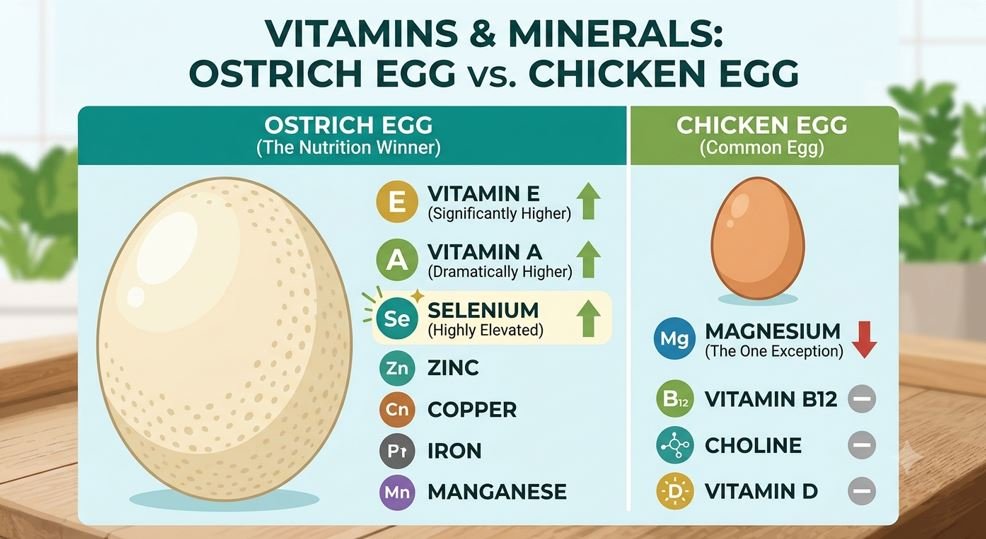
Selenium in particular stood out, with the study’s findings aligning with separate research showing significantly higher selenium content in ostrich eggs compared to chicken eggs. Selenium plays a role in thyroid function and antioxidant activity, making this one of the more genuinely notable nutritional differences between the two.
Can You Eat Ostrich Eggs Every Day?
There’s no specific reason you couldn’t, but portion size matters more than it does with chicken eggs. A single ostrich egg contains as much food as roughly two dozen chicken eggs, so eating one daily isn’t really comparable to eating a couple of chicken eggs each morning.
For most people, ostrich egg works better as an occasional, shared meal rather than a daily staple, simply because of the sheer volume involved. The same microbial safety study found pathogens like Salmonella and Listeria were only detected on the eggshell, not in the egg white or yolk, which supports the idea that a properly handled, fully cooked ostrich egg carries the same everyday safety profile as a chicken egg.
Frequently Asked Questions
Is an ostrich egg really 2,000 calories?
No, this figure is widely repeated online but doesn’t hold up against actual nutrient data. A whole ostrich egg contains closer to 1,300 calories.
Are ostrich eggs high in protein?
Yes, a whole egg delivers roughly 130 to 135 grams of protein, and per 100 grams it’s comparable to chicken egg.
How many eggs does it take to hit 100 grams of protein?
Less than one ostrich egg, roughly three quarters of one, compared to around 16 chicken eggs.
Can I eat ostrich eggs daily?
There’s no safety concern with regular consumption, but the sheer size means one egg goes a very long way, making it more practical as an occasional meal than a daily habit.
Where can I buy an ostrich egg?
Specialty butchers, ostrich farms, and online retailers are the most common sources. For pricing details, see our full guide on how much ostrich eggs cost.
Are ostrich eggs safe to eat?
Yes, when fully cooked. For a complete breakdown of safety considerations, see our guide on whether ostrich egg is good to eat.
Do supermarkets sell ostrich eggs?
Rarely. Most standard grocery chains don’t stock them, making specialty retailers and direct farm purchases the more reliable route.
Is ostrich egg cholesterol higher or lower than chicken egg?
It depends on the study and measurement method. Some data shows them roughly equal, while at least one peer-reviewed comparison found ostrich egg significantly lower on a dry weight basis.
Which animal egg is considered the healthiest?
When it comes to ostrich egg nutrition specifically, this depends on which nutrient you’re prioritizing. Ostrich egg performs well on vitamin A, vitamin E, and several minerals, while remaining comparable to chicken egg on core macronutrients.
The real story behind ostrich egg nutrition is less dramatic than social media makes it sound, and arguably more interesting. A whole egg delivers roughly 1,300 calories and well over 100 grams of protein, genuinely impressive numbers without needing to round them up to something more viral.
Where ostrich egg actually distinguishes itself is in the details: a peer-reviewed comparison found meaningfully higher vitamin A, vitamin E, and mineral content than hen’s egg, along with a cholesterol picture that depends heavily on how it’s measured. These are the kinds of nuances that get lost when a single inflated number spreads faster than the research behind it.
If you’re deciding whether the size and price make sense for your kitchen, ostrich egg vs chicken egg breaks down the practical comparison, and is ostrich egg good to eat covers safety and taste in full.