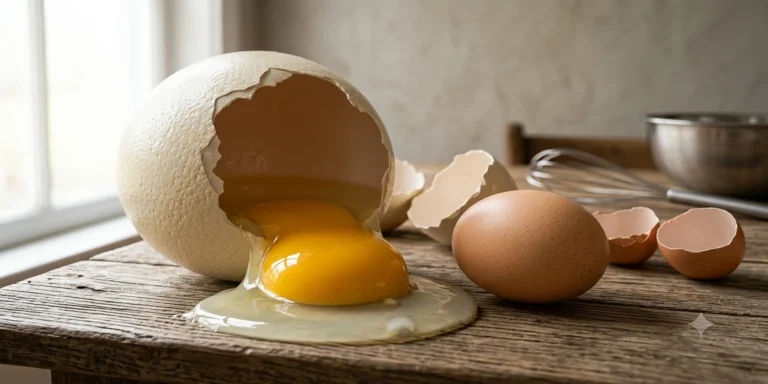
Quick Answer: Learning how to cook an ostrich egg is less about skill and more about understanding the scale of the ingredient. One ostrich egg is roughly equivalent to 24 chicken eggs and weighs around 3 pounds (1.4 kg). Cooking times for ostrich egg depend heavily on the method: once cracked open, scrambling or making an omelette takes about 10 to 15 minutes, while boiling a whole ostrich egg can take around 90 minutes or longer. The most practical ways to cook one are scrambling, making an omelette or quiche, and boiling.
Table of Contents
Cooking an ostrich egg is not particularly difficult, but everything is bigger than what you are used to with a chicken egg. The shell is much harder to crack, the contents can fill a large bowl, and a single egg can provide enough food for a group.
The good news is that you do not need any unusual cooking skills. With the right equipment and a little patience, you can turn an ostrich egg into scrambled eggs, an omelette, quiche, or even a large boiled egg for sharing.
This guide explains how to open an ostrich egg, how long different cooking methods take, which recipes work best, and how to plan portions when cooking for a group.
Before You Cook an Ostrich Egg
Before putting an ostrich egg in a pan or pot, the first challenge is getting through the shell.
An ostrich eggshell is much thicker and stronger than a chicken eggshell, so tapping it lightly on the edge of a bowl usually will not work. You need a little more force and, depending on how you want to open it, the right tool.
What You’ll Need
For most cooking methods, you only need a few basic items:
- A hammer or small mallet for breaking the shell
- A large bowl to hold the egg once it is opened
- A towel or cloth to keep the egg from rolling
- A large whisk for mixing the yolk and white
- A large frying pan or skillet for scrambled eggs or an omelette
- A large pot if you plan to boil the egg whole
If you want to open the egg while keeping the shell relatively intact, a small drill or fine saw can make a much cleaner opening than a hammer. This is especially useful if you want to save the shell as a decoration or craft material.
Because one ostrich egg contains roughly the equivalent of two dozen chicken eggs, ordinary kitchen equipment can quickly become the limiting factor. A large mixing bowl and a wide cooking surface make the process much easier.
For a closer look at the egg itself, including its size and dimensions, see our guide to how big an ostrich egg is.
How to Crack an Ostrich Egg
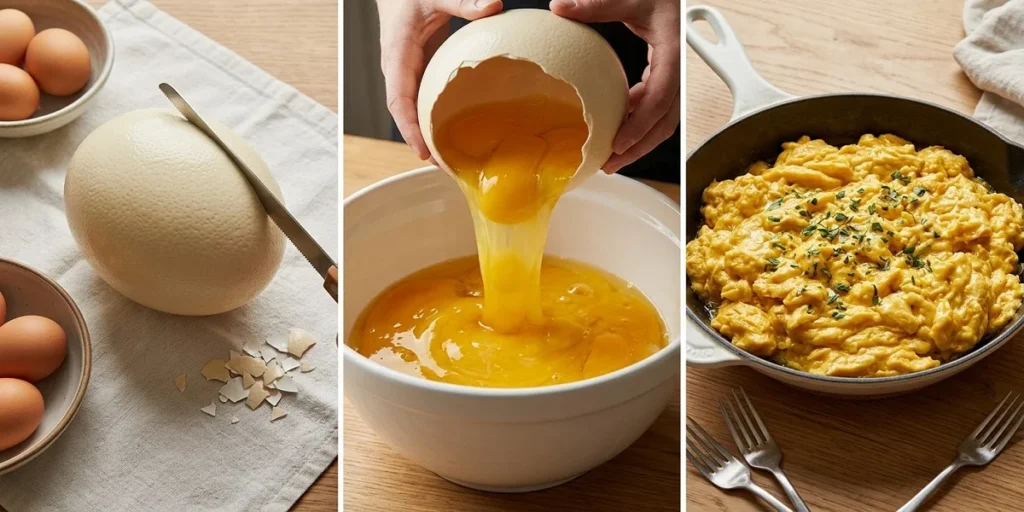
To crack an ostrich egg, use a hammer or small mallet to gently tap around one end until a hole forms, then pour the contents into a large bowl.
Step-by-Step Guide
- Whisk thoroughly: Due to the large volume, use a heavy-duty whisk instead of a fork to combine the yolk and whites evenly before cooking.
- Secure the egg: Place the ostrich egg horizontally on a folded towel to keep it from rolling and to cushion the shell.
- Tap the shell gently: Using a hammer or small mallet, tap firmly around one end of the egg in a circular motion until a crack develops. Avoid one extremely hard blow.
- Widen the opening: Carefully chip away the cracked shell pieces to create a hole large enough for the thick yolk to pass through.
- Drain into a bowl: Hold the egg vertically over a large bowl and allow the whites and yolk to pour out completely.
How to Open an Ostrich Egg Without Breaking the Shell
To open an ostrich egg while keeping the shell intact, use a small drill or handsaw to create a precise opening at one end, then drain the contents into a bowl.
Recommended Tools:
- Small electric drill (with a masonry or diamond bit) or fine-tooth handsaw
- Folded towel or egg holder (for stability)
- Straw or thin skewer (to break the yolk inner membrane)
- Large mixing bowl
Step-by-Step Method:
- Drain and inspect: Turn the egg upside down over a large bowl and shake gently to drain. Check the edges of the opening to remove any sharp shell fragments before cooking.
- Stabilize the egg: Place the egg on a folded towel to prevent slipping while drilling or sawing.
- Create a pilot hole: Using a small drill or fine handsaw, slowly work on one end of the egg until you breach the outer shell.
- Enlarge the opening: Gradually expand the hole to at least 0.5–1 inch (1.5–2.5 cm) so the thick yolk can pass through without clogging.
- Break the inner membrane: Insert a clean skewer or straw into the hole to puncture the yolk membrane inside; this allows the contents to flow smoothly.
How Long Does It Take to Cook an Ostrich Egg?
Cooking an ostrich egg takes 10 to 15 minutes when scrambled, 45 to 60 minutes when baked, and 60 to 90 minutes when boiled whole in its shell.
If you are learning how to cook an ostrich egg below table will help you. Cooking time depends heavily on whether the egg is cracked open beforehand or boiled whole.
| Cooking Method | Approximate Time | Ideal Consistency / Best For |
|---|---|---|
| Scrambled | 10–15 mins | Soft, creamy curds over medium-low heat |
| Omelette | 10–15 mins | Thick, filling meals (best cooked in batches) |
| Soft-Boiled (Whole) | 50–60 mins | Runny, warm center inside shell |
| Hard-Boiled (Whole) | 80–90 mins | Completely firm yolk and white |
| Baked / Quiche | 45–60 mins (375°F / 190°C) | Firm, set custard center for groups |
These times are practical starting points rather than exact rules. An ostrich egg can vary in size, and a refrigerated egg will take longer to heat through than one that has been allowed to warm slightly before cooking.
Boiling an Ostrich Egg Whole
Boiling is the slowest method due to the thick, porcelain-like shell and immense yolk volume.
- Maintain a steady simmer: Keep the egg completely submerged in water. Avoid a rapid boil to keep the shell from cracking against the pot.
- Internal temperature: For absolute food safety, ensure the internal temperature reaches (160°F / 71°C).
- Pro Tip: Immediately transfer the boiled egg into an ice bath for 15 minutes to make peeling the thick shell manageable.
Scrambling and Omelettes (Cracked Egg)
Once removed from the shell, an ostrich egg cooks similarly to a chicken egg, just in a larger volume (equivalent to ~24 chicken eggs).
- Use low heat: Stir continuously in a wide skillet over moderate-to-low heat to prevent burning before the center sets.
- Batch cooking: If making an omelette, divide the mixture into two or three batches rather than filling one pan.
Baking an Ostrich Egg
- Let the dish rest for 10 minutes after removing it from the oven so the center can fully set before slicing.
- Bake at (375°F / 190°C) in a shallow dish for even heat distribution.
The key lesson is simple: cracked ostrich egg cooks in roughly the same way as chicken egg, but a whole ostrich egg requires dramatically more time because of its size and shell.
Easy Ostrich Egg Recipes
Once an ostrich egg has been cracked open, you can cook it using many of the same methods you would use for chicken eggs. The main difference is the quantity. One ostrich egg contains roughly the equivalent of two dozen chicken eggs, so these recipes are best suited to families, brunches, parties, or other group meals.
Scrambled Ostrich Egg
Scrambled ostrich egg is one of the easiest preparations for beginners because you can control the texture throughout the cooking process.
- Servings: About 8 to 10 people
- Prep Time: 5 minutes
- Cook Time: 10 to 15 minutes
- Key Tools: Large bowl, wide skillet, large spatula or wooden spoon
Ingredients:
- 1 ostrich egg
- 2 to 3 tablespoons butter or cooking oil
- ¼ cup milk or heavy cream (optional)
- Salt and black pepper to taste
- Optional add-ins: Shredded cheese, diced peppers, mushrooms, onions, or cooked bacon
Instructions:
- Whisk: Crack the ostrich egg into a large bowl and whisk the yolk and white together thoroughly. Add the milk or cream if using, then season with salt and pepper.
- Heat: Melt the butter or heat the oil in a wide skillet over medium-low heat.
- Cook: Pour in the egg mixture and stir continuously with a large spatula as the curds begin to form. Keep the heat moderate so the outside does not overcook before the center is set.
- Finish: Cook for about 10 to 15 minutes, or until the egg is fully set but still moist. Remove it from the heat immediately to prevent it from becoming dry.
- Serve: Stir in cheese, herbs, or other cooked ingredients if desired, then serve while hot.
Because of the large volume, do not worry if the egg takes longer to set than a typical pan of scrambled chicken eggs. If your skillet is not large enough, cook the mixture in two batches.
Ostrich Egg Omelette
An ostrich egg can make a substantial omelette, but trying to cook the entire egg in one layer can make it difficult to achieve an even texture. Dividing the mixture into two or three batches is usually easier.
- Servings: About 6 to 8 people
- Prep Time: 5 minutes
- Cook Time: 10 to 15 minutes per batch
- Key Tools: Large bowl, wide skillet, spatula
Ingredients:
- 1 ostrich egg
- 1 to 2 tablespoons butter or cooking oil
- Salt and black pepper to taste
- Optional fillings: Sautéed onions, spinach, mushrooms, peppers, shredded cheese, or cooked bacon
Instructions:
- Prepare: Whisk the ostrich egg thoroughly in a large bowl and season with salt and pepper.
- Heat: Melt butter or heat oil in a wide skillet over medium heat.
- Batch Cook: Pour a manageable amount of egg mixture into the skillet, spreading it into an even layer.
- Add Fillings: Once the bottom begins to set, add your chosen fillings over one half of the omelette.
- Fold: Gently fold the omelette over the fillings and continue cooking until the center is fully set.
- Repeat: Transfer the finished omelette to a plate and repeat with the remaining egg mixture.
Cooking several smaller omelettes gives you more control than trying to flip one enormous omelette. For a group breakfast, cut each omelette into portions and serve with toast, potatoes, vegetables, or a fresh salad.
Ostrich Egg Quiche
Quiche is particularly well suited to an ostrich egg because the mixture can be divided between baking dishes and cooked gradually until the center sets.
- Servings: About 10 to 12 people
- Prep Time: 15 minutes
- Bake Temperature: 375°F (190°C)
- Bake Time: About 45 to 60 minutes
- Key Tools: Large mixing bowl, whisk, two standard pie dishes
Ingredients:
- 1 ostrich egg
- 1 to 1½ cups heavy cream
- 1 cup shredded Gruyère, cheddar, or another firm cheese
- 6 to 8 ounces cooked bacon, chopped
- 1 medium onion, sautéed and chopped
- Salt and black pepper to taste
- A small pinch of nutmeg
- 2 standard pie crusts
Instructions:
- Prepare the Custard: Whisk the ostrich egg thoroughly with the heavy cream. Season with salt, pepper, and a small pinch of nutmeg.
- Add the Fillings: Stir in the cooked bacon, sautéed onion, and shredded cheese.
- Fill the Crusts: Divide the mixture evenly between two standard pie crusts. Do not overfill them, as the custard expands slightly while baking.
- Bake: Place the quiches in a preheated oven at 375°F (190°C). Bake for approximately 45 to 60 minutes, checking toward the end of the cooking time.
- Check: The center should be set rather than liquid. If the crust is browning too quickly, cover the edges loosely with foil.
- Rest: Remove the quiches from the oven and let them rest for about 10 minutes before slicing.
The exact baking time depends on the depth of the dishes and how much filling you add. A shallower quiche will generally cook more evenly than one made in a very deep dish.
Boiled Ostrich Egg
Boiling an ostrich egg whole is the most unusual preparation in this guide. It also takes considerably longer than boiling a chicken egg because the large egg has to heat all the way through while still inside its thick shell.
- Servings: About 8 to 12 people
- Prep Time: 5 minutes
- Cook Time: About 90 minutes or longer
- Key Tools: Large stockpot, tongs, large bowl
Instructions:
- Submerge: Place the whole ostrich egg carefully in a large stockpot and cover it completely with water.
- Heat: Bring the water to a boil, then reduce the heat to maintain a steady simmer. Keep the egg submerged throughout cooking.
- Cook: Continue simmering for approximately 90 minutes or longer for a fully cooked center. The exact time can vary with the egg’s size and starting temperature.
- Cool: Carefully remove the egg with tongs and allow it to cool before handling. You can also place it in cold water to speed up the cooling process.
- Peel: Tap the shell carefully to create cracks, then remove the shell in sections. Take extra care because the thick shell can produce sharp fragments.
- Serve: Slice the cooked egg into wedges and season with salt and pepper, or serve it with sauces and other accompaniments.
Boiling is the least predictable method because the center cannot be checked during cooking. For that reason, scrambled eggs, omelettes, and quiche are generally easier choices if you are cooking an ostrich egg for the first time.
How Many People Does One Ostrich Egg Feed?
One ostrich egg contains roughly the same amount of egg as 24 chicken eggs, making it large enough to serve a group rather than a single person.
As a practical guide, one ostrich egg can provide:
- 6 to 8 people when served as a substantial main breakfast
- 8 to 12 people as part of a larger breakfast or brunch
- 10 to 12+ people when used in quiche, frittata, or another dish with additional ingredients
The actual number depends on portion size and what else is being served. A plate of scrambled ostrich egg served with bread, potatoes, vegetables, and other breakfast foods will stretch much further than the same amount served on its own.
How to Scale a Chicken Egg Recipe
The simplest rule is to treat 1 ostrich egg as roughly 24 chicken eggs when adapting a recipe.
For example, if a standard quiche recipe calls for 4 chicken eggs, you would use roughly one-sixth of an ostrich egg. If a recipe calls for 12 chicken eggs, you would need approximately half an ostrich egg.
In practice, you do not have to use the entire egg at once. Once cracked and whisked, the raw egg can be measured and divided according to the recipe you are preparing.
A kitchen scale makes this much easier. Weigh the combined egg contents, then portion out what you need rather than trying to estimate the volume by eye.
What to Do With the Leftover Egg
If you crack an ostrich egg and do not want to cook everything at once, the remaining raw egg should be transferred to a clean, covered container and refrigerated promptly.
You can then use the remaining mixture for scrambled eggs, omelettes, quiche, frittata, or other cooked dishes. This is often more practical than trying to find one recipe large enough to use the entire egg.
If you are cooking for a group, however, using the whole egg at once can be the easiest option. An ostrich egg is naturally suited to meals where several people are eating from the same dish.
For more information about the nutritional value of this unusually large egg, see our guide to ostrich egg nutrition
Food Safety When Cooking Ostrich Eggs
Ostrich eggs are handled much like other shell eggs, but their unusual size makes proper storage, handling, and cooking especially important. The large volume also means that an ostrich egg can take longer to heat through, so cooking by time alone is not always the best way to judge whether an egg dish is ready.
For egg dishes such as scrambled eggs and quiche, the USDA recommends cooking the mixture to an internal temperature of 160°F (71°C). A food thermometer is the most reliable way to check this, particularly when cooking a large amount of egg at once.
Start With a Clean, Fresh Egg
Choose an ostrich egg with an intact shell and avoid eggs that are visibly cracked, dirty, or damaged. Keep the egg refrigerated according to the storage instructions provided by the farm or seller.
Once you begin handling the egg, wash your hands and clean any bowls, utensils, countertops, and other surfaces that come into contact with the raw egg. Keeping raw egg separate from ready-to-eat foods also helps reduce the risk of cross-contamination.
Do Not Rely on Cooking Time Alone
The cooking times in this guide are useful starting points, but they should not be treated as guarantees of doneness.
This is particularly important when boiling an ostrich egg whole. The egg’s size, starting temperature, water temperature, and cooking equipment can all affect how quickly heat reaches the center.
For cracked and cooked preparations, check the thickest part of the dish with a food thermometer when possible. Egg dishes should reach 160°F (71°C) for a reliable safety check.
Refrigerate Leftovers Promptly
Large ostrich egg recipes can produce far more food than you intend to eat in one sitting. Divide leftovers into smaller, shallow containers and refrigerate them promptly rather than leaving a large dish at room temperature to cool for an extended period.
The FDA recommends refrigerating cooked eggs and egg dishes within 2 hours, or within 1 hour when temperatures are above 90°F (32°C). A refrigerator should be kept at 40°F (4°C) or below.
For cooked egg dishes, the USDA recommends using refrigerated leftovers within 3 to 4 days.
Be Careful With Raw or Undercooked Ostrich Egg
Because an ostrich egg is so large, it can be tempting to leave the center partially cooked. However, raw or undercooked shell eggs can carry harmful bacteria, including Salmonella.
If you want a softer texture, using a pasteurized egg product where appropriate can provide an alternative for preparations that would otherwise contain raw or undercooked egg. For ordinary ostrich egg dishes, thorough cooking is the safer approach.
The safest mindset is simple: treat an ostrich egg as a large raw egg, not as a novelty food that is automatically safe because of its size or thick shell. Good hygiene, proper refrigeration, and thorough cooking matter just as much as they do with ordinary eggs.
Tips for Cooking an Ostrich Egg
Cooking an ostrich egg is mostly a matter of adapting ordinary egg techniques to a much larger volume. Apply these essential tips to ensure even cooking and avoid common mistakes.
Use a Large Cooking Surface
Do not underestimate how much space a single ostrich egg takes up once cracked.
- Choose wide cookware: Use a large skillet or wide flat pan so the mixture cooks evenly without building up too thick a layer.
- Batch cooking: If your pan is too small, cook the egg in two or three batches rather than crowding the skillet.
Cook Gently over Moderate Heat
High heat will scorch the outside of your egg while leaving the dense center runny and cold.
- Temperature: Keep heat at medium-low to medium for scrambled eggs and omelettes.
- Patience: Allow the egg to set gradually while stirring continuously for soft, creamy curds.
Whisk the Large Yolk Completely
An ostrich egg yolk is dense and thick compared to a chicken egg yolk.
- Use a large wire whisk rather than a fork to break the yolk completely.
- Thorough whisking creates a uniform texture and ensures seasonings distribute evenly throughout the massive volume.
Measure for Precise Recipe Conversion
One ostrich egg is roughly equivalent to 24 chicken eggs, but exact volume varies.
- For baking & quiches: Crack and whisk the egg into a large bowl first, then measure out the exact liquid volume required by your recipe.
- Storage: Store any leftover whisked egg in an airtight container in the refrigerator for up to 2 days.
Inspect for Hard Shell Fragments
Ostrich eggshells are exceptionally thick and can break into sharp, porcelain-like shards.
- Crack the egg over a wide bowl so you have plenty of room to inspect the liquid.
- Remove any stray shell pieces using a clean spoon rather than your fingers.
Season Generously Throughout
A small pinch of salt will disappear completely in a liquid volume this massive.
- Season early: Whisk salt, black pepper, and herbs directly into the raw mixture rather than seasoning only the surface after cooking.
- Enhance flavor: Bold ingredients like shredded cheese, sautéed onions, mushrooms, bacon, and fresh herbs pair exceptionally well with ostrich egg.
Let Baked Dishes Rest Before Slicing
- Allow quiches and frittatas to rest for 10 to 15 minutes after taking them out of the oven.
- Resting lets the custard center finish setting completely and makes slicing clean, presentable portions much easier.
Ostrich Egg Serving Ideas
An ostrich egg is naturally designed for group dining. Because a single egg produces such a large volume, the best serving ideas focus on family-style presentation and shared platters.
Serve Scrambled Ostrich Eggs Family-Style
Transform a massive batch of scrambled eggs into an inviting brunch platter.
- Toppings: Garnish the cooked egg with fresh chopped herbs, grated Gruyère or cheddar, sliced green onions, or sautéed mushrooms.
- Side Pairings: Serve alongside thick-cut toasted sourdough, roasted baby potatoes, grilled tomatoes, and crispy bacon.
Cut Omelettes Into Brunch Wedges
Instead of struggling to serve one massive omelette intact, present it as individual portions.
- Platter Display: Cut the large omelette into triangular wedges and arrange them on a wooden board or platter.
- Multiple Varieties: If batch-cooking, make two distinct variations (such as Spinach & Feta alongside Bacon & Cheddar) so guests have choices.
Portion Quiche for Buffets and Gatherings
Quiche made from an ostrich egg easily feeds 10 to 12 people and holds its shape exceptionally well.
- Serving Temperature: Slice into thin wedges and serve warm or at room temperature alongside a crisp green salad or fresh fruit.
- Meal Prep Advantage: Since one ostrich egg typically yields two full quiches, serve one fresh and refrigerate the second for up to 3 days.
Arrange Boiled Egg Wedges on a Shared Platter
A boiled ostrich egg makes a visually stunning centerpiece when sliced cleanly.
- Presentation: Slice the hard-boiled egg into thick rounds or wedges using a sharp chef’s knife. Arrange on a platter with flaky sea salt, cracked pepper, and a side of Dijon mustard or aioli.
- Visual Touch: Leave a few cleaned pieces of the porcelain-like shell on the platter as a decorative natural bowl or garnish.
The Ultimate Ostrich Egg Brunch Menu

When hosting a special occasion around an ostrich egg, build a balanced buffet spread:
- Main: Scrambled or baked ostrich egg
- Carbs: Artisanal toast, croissants, or roasted breakfast potatoes
- Proteins: Thick-cut bacon, breakfast sausages, or smoked salmon
- Fresh Sides: Sliced avocados, vine-ripened tomatoes, and fresh berries
- Beverages: Freshly brewed coffee, herbal tea, or mimosas
Frequently Asked Questions
How long does it take to cook an ostrich egg?
It depends on the cooking method. Once cracked open, scrambled ostrich egg or an omelette usually takes about 10 to 15 minutes, while a whole ostrich egg can take around 90 minutes or longer to boil.
How many people does one ostrich egg feed?
One ostrich egg contains roughly the equivalent of 24 chicken eggs. Depending on the recipe and portion size, it can generally feed 8 to 12 people, particularly when served as part of a larger breakfast, brunch, quiche, or shared meal.
What’s the best way to crack open an ostrich egg?
For the quickest method, place the egg on a towel and carefully tap around one end with a hammer or small mallet until a crack forms. If you want to preserve the shell, a small drill or fine saw can create a more controlled opening.
Can you eat ostrich eggs?
Yes. Ostrich eggs are edible and can be cooked using many of the same methods as chicken eggs, including scrambling, frying, baking, and boiling. If you want to learn more about their nutritional value and whether they are suitable for eating, see our guide to whether ostrich eggs are good to eat.
Is it legal to eat ostrich eggs in the US?
Ostrich eggs are generally legal to eat in the United States, although availability, sales, and local regulations can vary. If you are buying one, check the rules that apply in your state and purchase from a reputable farm or supplier.
What does an ostrich egg taste like?
Ostrich egg tastes broadly similar to a chicken egg, although many people describe the flavor and texture as somewhat richer or denser. For a more detailed comparison, see our guide to what ostrich eggs taste like
How much does an ostrich egg cost, and where can I buy one?
Prices vary considerably depending on the farm, location, season, and whether the egg is sold for eating, hatching, or decorative purposes. For current price ranges and buying options, see our guide to how much an ostrich egg costs.
Can you boil an ostrich egg like a chicken egg?
Yes, but the cooking time is dramatically longer. A whole ostrich egg can require around 90 minutes or longer for a fully cooked center, compared with roughly 10 to 12 minutes for a typical hard-boiled chicken egg.
What’s the best ostrich egg recipe for beginners?
Scrambled ostrich egg is probably the easiest option for a first attempt. Once the shell is opened, you can control the cooking process directly, and the egg does not have to be heated evenly through its shell as it does when boiling.
What temperature should an ostrich egg dish reach?
For cooked egg dishes such as scrambled eggs, quiche, and omelettes, using a food thermometer is the most reliable way to check doneness. USDA guidance recommends cooking egg dishes to an internal temperature of 160°F (71°C).
Final Thoughts
Cooking an ostrich egg may look intimidating at first, but the process is surprisingly straightforward once you account for its size. The shell takes more effort to open, the cooking equipment needs to be larger, and whole-egg preparations require considerably more patience than a chicken egg.
For a first attempt, scrambled ostrich egg or an omelette is probably the easiest place to start. You have direct control over the cooking process, and you can divide the mixture into batches if your pan is not large enough.
If you are cooking for a larger gathering, quiche and other baked dishes make excellent use of the egg’s enormous volume. And if the goal is simply to experience the novelty of cooking one whole, boiling it and serving the slices family-style makes for a memorable meal.
The real trick is not a special cooking technique. It is choosing the right equipment, planning how much food you need, and giving the egg enough time to cook properly. Once you do that, an ostrich egg becomes less of a novelty and more of an unusually large ingredient that can feed an entire table.