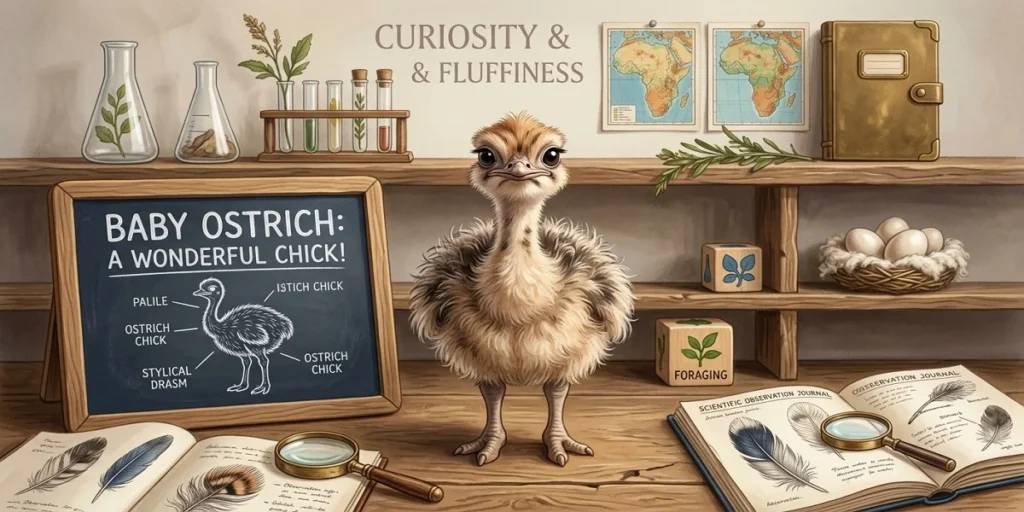
Quick Answer: A baby ostrich is called a chick. A newly hatched ostrich chick stands about 25 cm (10 inches) tall and weighs roughly 1 to 1.4 kg (2 to 3 lb). Unlike many baby birds, ostrich chicks are precocial, meaning they hatch with open eyes, a covering of down, and the ability to walk and feed shortly after hatching.
Table of Contents
Ostriches are famous for being the largest living birds, but their babies are remarkable in their own right. An ostrich chick is already surprisingly large when it emerges from its egg, and it begins growing almost immediately.
From the terminology used to describe a newborn chick to its rapid growth during the first year, understanding the early life of an ostrich reveals just how unusual this bird is.
What Is a Baby Ostrich Called?
The standard term for a baby ostrich is chick. The word applies to a young ostrich from hatching through the early stages of development.
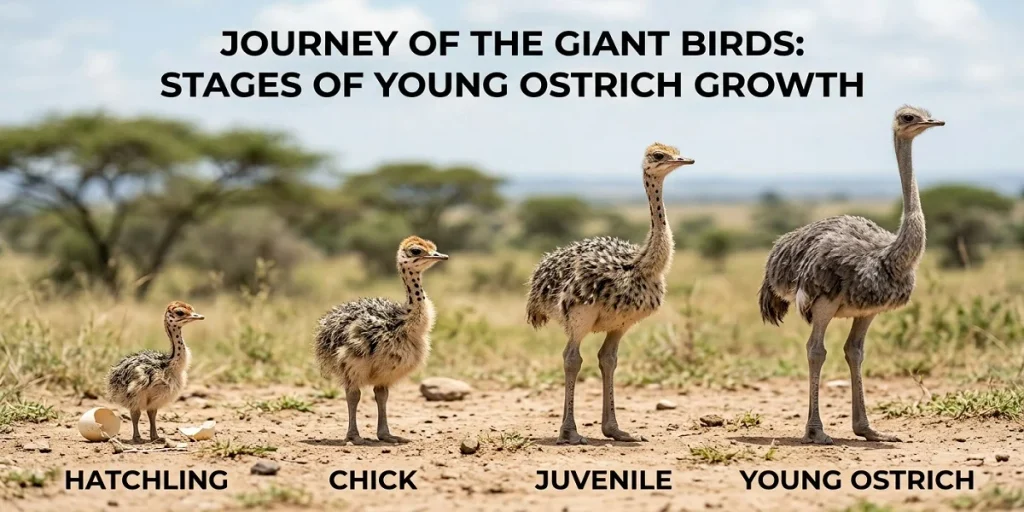
You may also encounter several other terms when reading about young ostriches. Some describe a particular stage of development, while others are simply general descriptions:
- Chick: The standard and most accurate term for a young ostrich.
- Hatchling: A chick that has recently emerged from its egg.
- Juvenile: A young ostrich that has moved beyond the earliest chick stage but has not reached adulthood.
- Young ostrich: A general descriptive term for an immature bird.
If you are wondering what a baby ostrich is called, the simplest and most accurate answer is a chick. The terminology becomes even clearer when comparing terms such as nestling and fledgling.
Chick vs. Hatchling vs. Nestling vs. Fledgling
Not every term commonly used for young birds fits an ostrich equally well.
Ostriches are precocial birds. Their chicks hatch relatively well developed, with open eyes, down covering their bodies, and the ability to stand and walk shortly after emerging from the egg. This is very different from altricial birds such as songbirds, whose young hatch helpless and remain dependent on the nest for an extended period.
| Term | Appropriate for Ostriches? | Meaning & Context |
| Chick | Yes | The standard term for a young ostrich. |
| Hatchling | Yes | A newly hatched chick, especially during its first few days. |
| Nestling | Generally No | Refers to a young bird that remains dependent inside a nest. |
| Fledgling | No | Refers to a young bird developing or possessing the ability to fly. |
| Juvenile | Yes | A young ostrich that has grown past the initial chick stage. |
This distinction matters because ostrich chicks do not spend weeks helplessly waiting in a nest for their parents to bring them food. They are mobile from the beginning and quickly begin traveling alongside adults. Calling an ostrich a chick is not merely the simplest option, it is also the term that best fits the bird’s developmental strategy.
What Is a Group of Baby Ostriches Called?
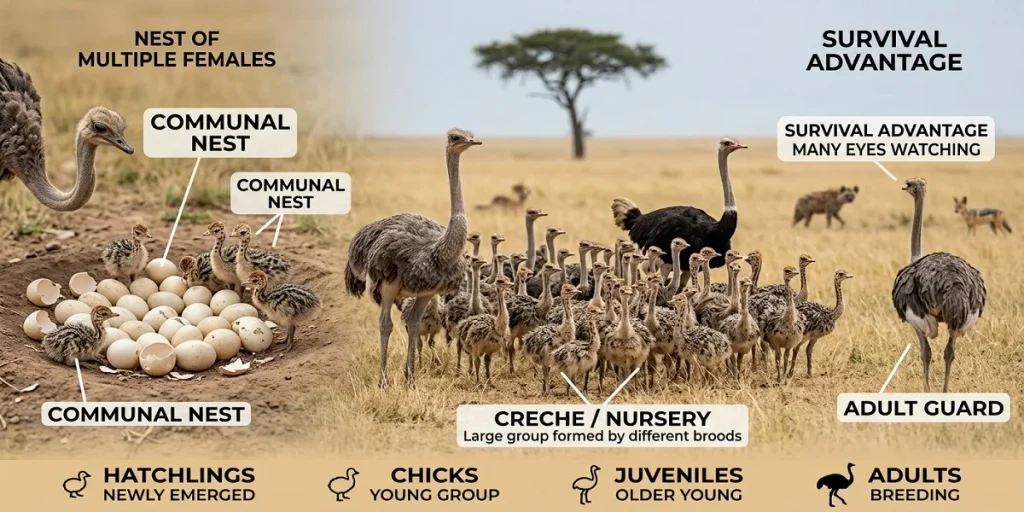
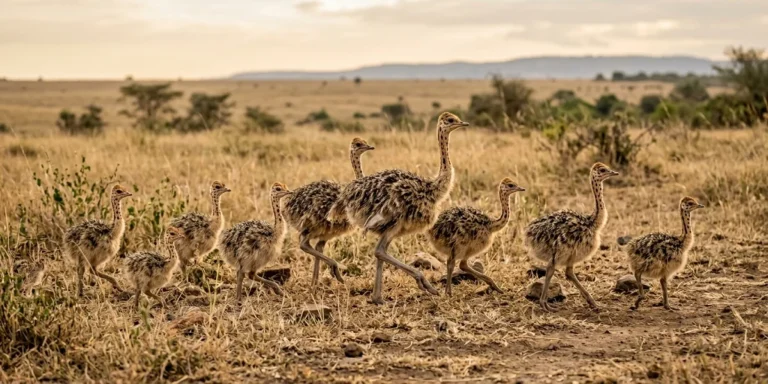
A group of baby ostriches is called a brood, especially when referring to chicks associated with the same nesting group. As multiple broods combine, a larger group of young ostriches is referred to as a creche.
Ostrich social structures make this dynamic particularly interesting:
- Communal Nests: Several females may lay their eggs in a shared communal nest. Because multiple females contribute, the chicks that hatch together may not all share the same mother.
- Creches (Nursery Groups): As chicks grow, different broods often merge into larger nursery groups known as creches.
This nursery system provides a critical survival advantage. A larger group contains more eyes watching for potential predators while adult ostriches remain nearby to guard and guide the young.
What Does a Baby Ostrich Look Like?
A newly hatched ostrich chick looks surprisingly different from the sleek, black-and-white adult male. Instead of prominent adult feathers, the chick is covered in short, stiff-looking down with a brownish, beige, or fawn color pattern featuring darker spots. This coloration provides vital camouflage in open grasslands and savannas.
Key physical characteristics of a newly hatched ostrich chick include:
- Height: Approximately 25 cm (10 inches) tall
- Weight: 1 to 1.4 kg (2 to 3 lb)
- Plumage: Covered in mottled down feathers rather than true feathers
- Mobility: Fully mobile with open eyes, able to stand and walk within hours
A chick only about the height of a standard ruler can weigh more than the newborns of most other bird species. Its body is built for mobility from day one, featuring long legs and a long neck. The dramatic black-and-white adult plumage appears much later as the bird approaches sexual maturity.
For a deeper look at the environments where these independent chicks grow up, their early development is closely tied to ostrich habitat.
How Fast Do Baby Ostriches Grow?
Ostrich chicks are among the fastest-growing birds in the animal kingdom. During their first few months, an ostrich chick can gain roughly 30 cm (1 foot) in height per month.
Approximate Baby Ostrich Growth Timeline
| Age | Approximate Height | Approximate Weight | Key Developmental Milestones |
| Hatching | ~25 cm (10 in) | ~1–1.4 kg (2–3 lb) | Covered in camouflage down; fully mobile. |
| 1 Month | ~55 cm (22 in) | Several kg | Rapid early growth and steady foraging. |
| 3 Months | ~1.2 m (4 ft) | Varies | Clear juvenile body development. |
| 6 Months | ~1.5 m (5 ft) | Tens of kg | Height increases rapidly; adult-like shape. |
| 12 Months | Near adult height | Approaching adult mass | Feather structure transitions toward adulthood. |
| 18 Months | Adult proportions | Full adult mass | Mature feathering and reproductive development. |
Note: Growth rates vary based on sex, genetics, nutrition, overall health, and whether the bird is in the wild or raised in a managed environment.
Starting life at roughly 1 kg and reaching well over 100 kg as an adult, the ostrich represents one of the most dramatic physical transformations in the avian world.
How Big Is a Baby Ostrich Compared With Other Baby Animals?
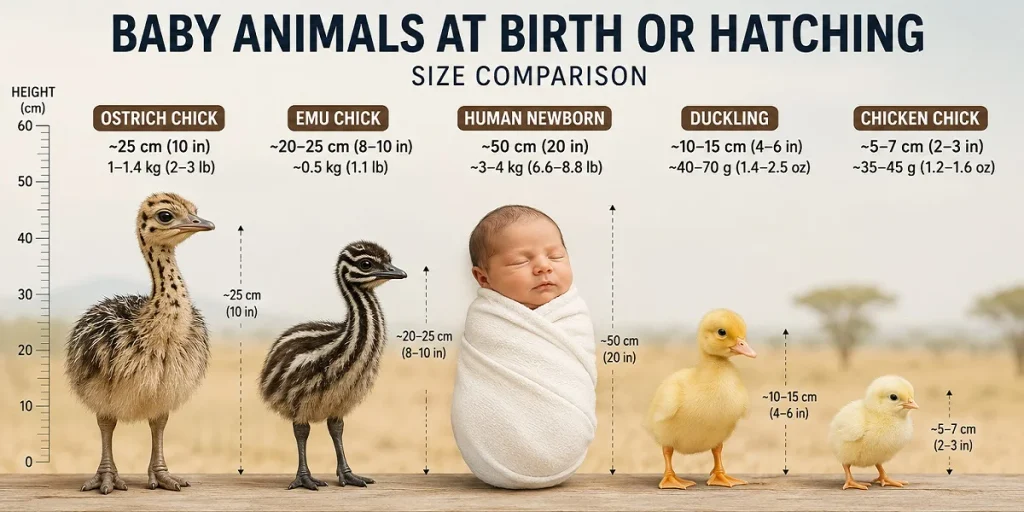
A newly hatched ostrich may look small next to its parents, but it is enormous compared with most other baby birds. At around 25 cm (10 inches) tall and weighing 1 to 1.4 kg (2 to 3 lb), an ostrich chick starts life at a size that would be surprising for almost any other avian species.
To truly appreciate the scale of a newly hatched ostrich, it helps to look at how it compares with other young animals:
| Baby Animal | Approximate Size at Birth or Hatching | How It Compares with an Ostrich Chick |
| Ostrich chick | ~25 cm (10 in), 1–1.4 kg (2–3 lb) | Baseline for comparison |
| Chicken chick | ~5–7 cm (2–3 in), ~35–45 g | Ostrich chicks are dramatically heavier and larger |
| Emu chick | ~20–25 cm (8–10 in), ~0.5 kg | Similar in height, but the ostrich chick is much heavier |
| Duckling | ~10–15 cm (4–6 in), ~40–70 g | Significantly smaller and lighter |
| Human newborn | ~50 cm (20 in), ~3–4 kg | Taller and heavier overall, but functionally very different |
The comparison with a chicken is particularly striking. A newly hatched ostrich chick can weigh dozens of times more than a typical chicken chick, even though both are technically called chicks.
Comparing an ostrich chick with a human newborn highlights functional development. While a human baby is roughly twice as long and heavier, an ostrich chick is born with something a human infant lacks: the ability to stand and walk almost immediately.
An emu provides another useful point of comparison as a fellow ratite. While emu chicks are large compared to most wild birds, an ostrich chick still enters the world with substantially greater overall mass.
Why Is an Ostrich Chick So Large?
An ostrich chick is born exceptionally large because it hatches from the largest egg of any living bird, providing abundant space and nutrients for advanced embryo development.
This advanced developmental strategy defines the species:
- Precocial Independence: An ostrich chick does not hatch as a tiny, helpless animal waiting for food to be delivered into its mouth. It emerges with open eyes, downy feathers, and legs strong enough to walk and forage within hours.
- Massive Growth Gap: Despite its impressive hatching size, the chick is still tiny compared to what it will become. An adult ostrich can exceed 2.5 meters (8 feet) in height, meaning a chick must increase its height by nearly ten times before reaching full size.
For a closer look at just how dramatic that physical transformation is, our guide to ostrich size down adult height and weight metrics in greater detail.
When Can You Tell a Baby Ostrich’s Sex?
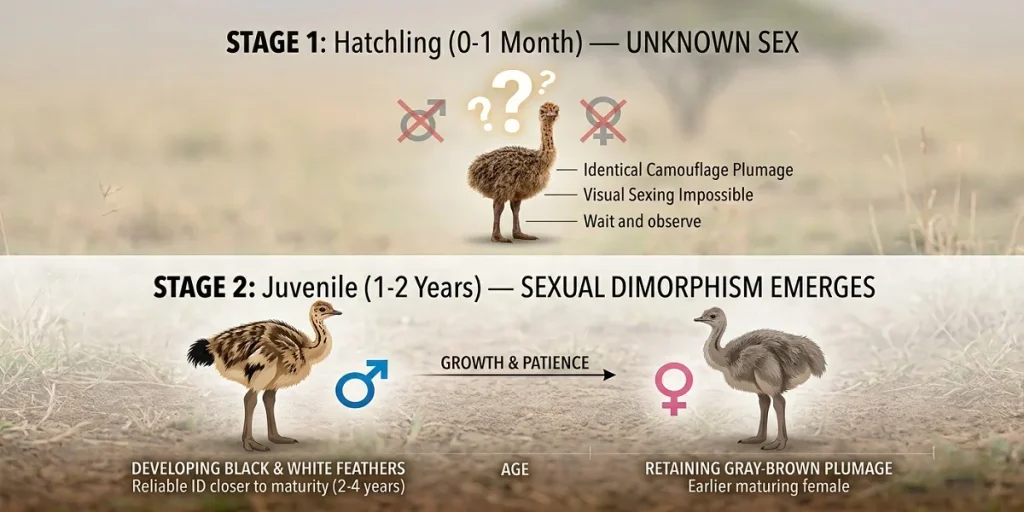
It is nearly impossible to visually determine the sex of an ostrich chick immediately after hatching because young males and females possess identical camouflage feathering.
Physical differences gradually emerge as the bird matures:
- Plumage Differences: As young ostriches mature, males begin developing bold black-and-white feathers, whereas females retain predominantly grayish-brown plumage.
- Maturation Timeline: Visual identification becomes reliable only as birds approach physical maturity. Ostriches generally reach sexual maturity between 2 and 4 years of age, with males typically maturing slightly later than females.
Because an ostrich chick does not hatch as a miniature version of an adult, patience is essential when determining its sex based on physical appearance.
What Do Baby Ostriches Eat?
Baby ostriches begin foraging remarkably early because they are precocial and mobile soon after hatching. Rather than relying entirely on adults for feeding, chicks follow their parents and actively seek out food.
Their omnivorous diet includes a variety of plant and animal material:
- Plant matter: Grasses, tender leaves, seeds, and roots
- Invertebrates: Small insects, beetles, and other small organisms encountered while foraging
- Gastroliths (Gizzard Stones): As they grow, chicks intentionally swallow small stones. These gastroliths sit in the gizzard to mechanically grind down tough plant material since ostriches lack teeth.
This early ability to ingest and mechanically process solid food is another factor separating ostrich chicks from the dependent hatchlings of smaller bird species. For a broader overview of adult feeding habits, visit our page on what ostriches eat.
How Many Baby Ostriches Survive the First Year?
Despite their large size at birth, baby ostriches are extremely vulnerable, with wild survival rates often estimated at around 15% during their first year of life.
Young ostriches face heavy predation pressure from jackals, hyenas, lions, leopards, cheetahs, and large birds of prey. To protect their broods, adult ostriches employ several survival strategies:
- Defensive Aggression: Adult ostriches will actively fight off predators to safeguard their young.
- Distraction Displays: A parent ostrich may fake an injury or move away from the group, luring predators away from hiding chicks.
- Communal Creches: By joining large nursery groups (creches), multiple adults can keep watch, increasing the ratio of protective eyes on the lookout for danger.
Surviving the first year represents the most critical milestone in an ostrich’s life. Once a chick gains full body size and adult running speed, its chances of evading predators increase dramatically.
Do Baby Ostriches Leave the Nest Right Away?
Yes, baby ostriches leave the nest within a few days of hatching because they are precocial birds built for immediate mobility.
Remaining in a ground nest would expose chicks to severe predator risks. Instead, they leave the nesting ground to follow adults across open habitats, learning to forage while continuously building muscle strength.
While ostrich chicks are mobile early on, independence should not be confused with total self-sufficiency. They remain reliant on adult guidance and defense throughout the early months of life.
Baby Ostrich vs. Adult Ostrich
The difference between a newly hatched ostrich and a fully grown adult is extraordinary. A chick begins life at only about 25 cm (10 inches) tall and around 1 to 1.4 kg (2 to 3 lb), yet it eventually grows into the largest bird species on the planet.
| Trait | Baby Ostrich (Chick) | Adult Ostrich |
| Height | ~25 cm (10 in) at hatching | Up to ~2.7 m (9 ft) |
| Weight | ~1–1.4 kg (2–3 lb) | Exceeds 100 kg (220 lb); large males weigh more |
| Body Covering | Soft, mottled down | Fully developed flightless feathers |
| Coloration | Brownish or fawn with camouflage spots | Bold black and white (males); gray-brown (females) |
| Mobility | Walks within hours of hatching | Extremely fast runner, reaching up to 70 km/h (45 mph) |
| Diet | Forages early on plants and small insects | Primarily herbivorous with opportunistic animal intake |
| Sexual Maturity | Not sexually mature | Reached at approximately 2 to 4 years of age |
One of the greatest differences lies in developmental trajectory rather than simple size. A hatchling can walk and follow adults within hours, while an adult ostrich possesses the physical power and speed needed to defend itself and its offspring against apex predators.
This physical transformation happens with remarkable speed. Within its first year, a young ostrich often reaches close to adult height, though developing full muscle mass and reproductive maturity requires additional time.
Frequently Asked Questions
What is a baby ostrich called?
A baby ostrich is called a chick. This term applies to a young ostrich from the moment it hatches through its early growth stages.
What is a newborn ostrich called?
A newly emerged baby ostrich can be called a hatchling or a chick. The term hatchling specifically highlights that the bird has recently broken out of its shell.
What is a group of baby ostriches called?
A group of baby ostriches from the same nest is called a brood. When multiple broods merge into larger nursery groups managed by adults, the group is called a creche.
How big is a baby ostrich at birth?
At birth, a newly hatched ostrich chick stands approximately 25 cm (10 inches) tall and weighs between 1 and 1.4 kg (2 to 3 lb).
How fast do baby ostriches grow?
Ostrich chicks grow very rapidly, gaining roughly 30 cm (1 foot) in height per month during their first few months of life under favorable conditions.
What do baby ostriches eat?
Baby ostriches forage for grasses, leaves, seeds, roots, and small insects. They also swallow small stones called gastroliths, which sit in the gizzard to help grind up tough plant material.
When can you tell a baby ostrich’s gender?
You can reliably tell an ostrich’s gender as it approaches physical maturity, when males develop black-and-white plumage and females retain muted gray-brown feathers. Newly hatched chicks of both sexes look identical.
What is the survival rate of ostrich chicks in the wild?
In wild populations, only about 15% of ostrich chicks survive their first year, with heavy predation by big cats, hyenas, and birds of prey being the primary cause of mortality.
Do baby ostriches leave the nest right away?
Yes, ostrich chicks leave the nest within a few days of hatching. Because they are precocial, they can stand, walk, and follow adult birds to forage almost immediately.
How long does it take a baby ostrich to reach adult size?
An ostrich reaches near-adult height in approximately 12 to 18 months, while achieving full body mass and sexual maturity takes between 2 and 4 years.
Can I own a pet ostrich?
Ostriches are generally not suitable as traditional household pets due to their massive size, strength, potential aggression, and specialized space and fencing requirements. Anyone looking into keeping ostriches for agricultural purposes should review local zoning regulations and management guides, such as our comprehensive guide on how to start an ostrich farm.
Final Thoughts
What is a baby ostrich called? The answer is simple: a chick.
However, what makes ostrich chicks fascinating is everything following that basic term. Hatching at around 25 cm tall and weighing up to 1.4 kg, they stand and forage alongside adults almost immediately.
Their growth rate is equally staggering. A chick starting life at just over one kilogram expands into a towering juvenile within months, ultimately reaching a height over two meters and a weight well over 100 kg.
Early survival is challenging. High predation rates mean that parental protection and communal creche structures are essential to reaching adulthood. From precocial hatching to rapid physical development, baby ostriches are just as remarkable as their massive adult counterparts.