Quick Answer: Yes, ostrich leather is widely considered a top-tier premium exotic leather due to its unique combination of durability, softness, flexibility, and distinctive quill texture. Its high quality stems from the dense criss-cross structure of the hide, its rich natural oils, and specialized chrome-tanning processes. However, because individual hides vary in follicle density and cosmetic condition, understanding what actually determines ostrich leather quality is essential before making a purchase.
Table of Contents
Ostrich leather has been a staple material for luxury bags, wallets, boots, watch straps, and high-end upholstery for decades. While its characteristic quill pattern makes it instantly recognizable, aesthetics are only part of its appeal. The hide possesses exceptional physical properties that allow it to remain soft and supple while withstanding heavy daily wear.
What Makes Ostrich Leather High Quality?
Several key physical characteristics contribute to ostrich leather’s reputation as a world-class exotic material. Unlike standard leathers that force a compromise between toughness and flexibility, high-grade ostrich leather offers a versatile balance of both.
Full-Grain Structure
Ostrich leather is almost exclusively produced as a full-grain leather. This means the outermost layer of the hide is retained rather than sanded down or split to erase imperfections. Preserving this natural grain surface maintains the structural integrity and high tear strength of the hide while keeping its distinctive follicle pattern intact.
Because it retains the full natural surface, genuine ostrich leather may show subtle markings. Small natural scars, minor variations in texture, and distinct follicle spacing between hides are not quality defects. Instead, they serve as proof of authentic full-grain material.
Natural Oils and Superior Flexibility
One of the defining features of genuine ostrich leather is its remarkably supple hand feel. The hide contains natural oils that prevent it from drying out or becoming stiff over time, even after intensive tanning processes.
This inherent elasticity is particularly valuable for items subjected to frequent bending and handling, such as wallets, footwear, and luxury handbags. A well-crafted ostrich leather product offers a buttery soft touch without sacrificing long-term shape retention or strength.
From a biological standpoint, the skin structure reflects evolutionary adaptations that support these large birds. The feather follicles responsible for the iconic texture are deeply embedded in the dermal layer. To learn more about how bird biology influences hide characteristics, explore our complete guide to ostrich anatomy and physiology.
High Resistance to Cracking
Thanks to its multidirectional fiber weave and natural fat liquors, properly tanned ostrich leather boasts high resistance to cracking and splitting. When maintained correctly, it outlasts many traditional cowhide leathers under similar usage conditions.
However, optimal durability still requires care. Prolonged exposure to direct sunlight, extreme heat, standing water, or harsh chemical cleaners can degrade the protective finish and natural oils. The longevity of ostrich leather relies on a combination of proper tanning craftsmanship and routine care.
The Distinctive Quill Pattern
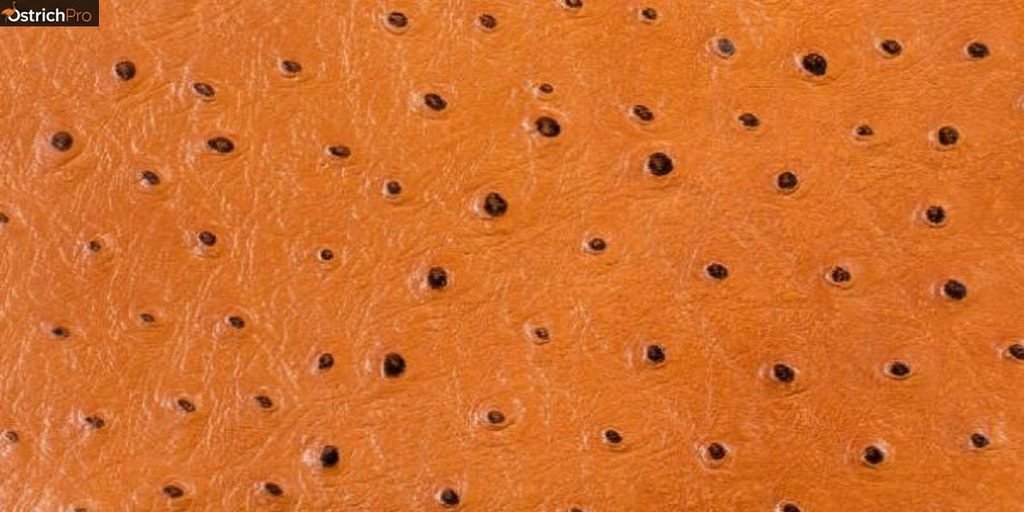
The most recognizable feature of ostrich leather is its raised quill pattern, formed by the hair follicles where large feathers once grew. These raised bumps, or “quills,” create the iconic tactile surface unique to ratite leathers.
No two hides share the exact same follicle layout. Quill size, density, and spacing vary depending on the specific region of the body and the individual bird. This natural irregularity makes authentic ostrich leather exceptionally difficult to replicate convincingly with synthetic embossing.
It is crucial to note that a dense quill pattern does not automatically indicate higher structural durability. The visual layout of the quills and the actual cosmetic grade of the hide are distinct factors. Confusing aesthetic quill distribution with physical leather quality often leads buyers to overpay.
To make an informed purchase, it is important to evaluate these criteria separately when comparing ostrich leather grades and quill types.
Is Ostrich Leather Real Leather?
Yes, ostrich leather is 100% genuine animal leather crafted from the hide of farmed ostriches. It is an authentic exotic leather material, not a synthetic substitute, faux leather, or a pattern embossed onto standard cowhide. The raw hide undergoes specialized soaking, tanning, dyeing, and finishing processes to create the durable leather used in high-end footwear, luxury handbags, wallets, belts, and watch bands.
Much of the confusion regarding its authenticity comes from the dramatic texture variations across a single hide. Some sections feature the famous raised quill pattern, while other parts appear smooth. These are not different materials, but rather different anatomical sections of the very same hide.
Where Does the Ostrich Leather Pattern Come From?
The distinctive raised bumps found on quilled ostrich leather are created by feather follicles. When feathers are removed during hide preparation, the empty follicle bases remain as raised nodules in the skin, giving authentic ostrich leather its signature tactile appearance.
Not every area of an ostrich hide contains the same density or prominence of follicles. The crown area (the back of the bird) features the most dramatic and dense pattern, whereas the flanks and belly have fewer visible follicles and a much smoother surface.
This natural variation is key to identifying genuine material. Follicle size, spacing, elevation, and shading vary naturally across the skin. These subtle irregularities help distinguish natural ostrich leather from machine-embossed synthetic imitations.
Ostrich Leather Grades vs. Quill Types
Understanding the difference between leather grade and quill type is essential for any buyer. Buying guides and sellers frequently misuse terms like “full quill,” “premium,” and “high grade” as if they mean the same thing, but they refer to completely different attributes.
- Quill Type describes the visual pattern and anatomical origin of the follicle layout on the hide.
- Leather Grade measures the cosmetic condition, surface purity, and lack of defects across the skin.
A hide can feature a highly sought-after full-quill layout while still carrying natural marks that place it in a lower cosmetic grade.
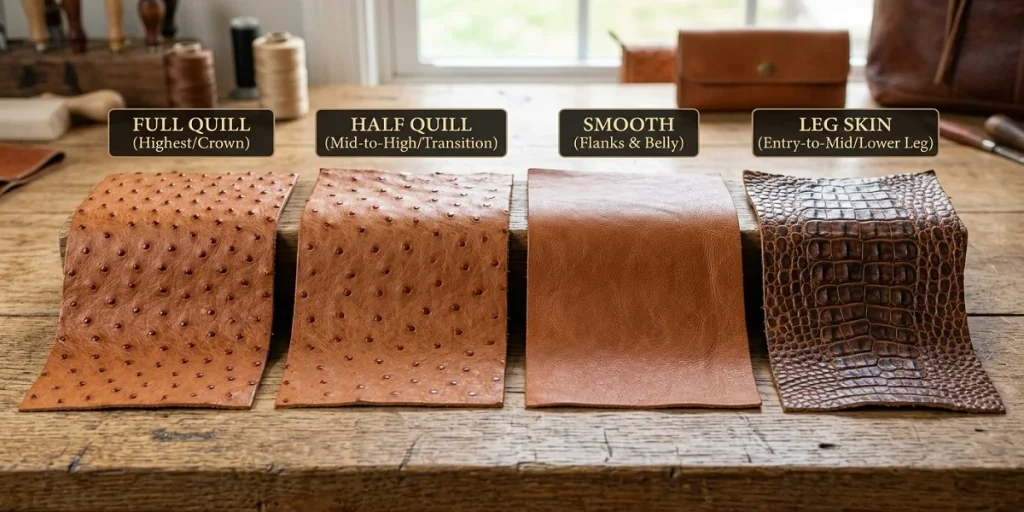
Common Ostrich Leather Types
| Leather Type | Typical anatomical region | Visual appearance | Relative price point |
| Full Quill | Crown and central back area | Dense, prominent follicle bumps | Highest |
| Half Quill | Transition zones away from the crown | Fewer, widely spaced follicles | Mid to High |
| Smooth Ostrich | Flanks, belly, and outer sides | Minimal to no visible quill pattern | Mid-tier |
| Leg Skin | Lower legs and feet | Distinct scale-like, reptilian texture | Entry to Mid |
Full quill is the most iconic and prized format. It comes from the crown section where feather roots are largest and most densely populated, creating the rounded bumps synonymous with exotic luxury goods.
Smooth ostrich leather comes from hide sections where follicles are faint or absent. It retains the same structural strength, breathability, and suppleness as full-quill areas, but carries a lower price tag simply because it lacks the signature bumped pattern.
Ostrich leg skin offers a completely different aesthetic. Its surface features tight, overlapping scales similar to reptile leather, making it exceptionally popular for exotic cowboy boots, watch straps, and small leather accessories.
What Does Leather Grade Actually Mean?
Leather grade reflects the cosmetic purity of the hide rather than its underlying physical strength.
A top-grade hide exhibits minimal surface scars, zero parasite marks, uniform follicle distribution, and no tanning flaws. A lower-grade hide may display natural wire scratches, healed wounds, uneven follicle depth, or color variations.
This distinction leads to a critical rule for buyers:
A lower-grade ostrich hide is not structurally weaker than a top-grade hide.
For example, a lower-grade full-quill hide possesses the same tight fiber structure and tear resistance as a pristine hide. Its lower price tag simply reflects cosmetic imperfections, not a compromise in durability.
Conversely, a cosmetically flawless hide does not guarantee superior longevity. Tannery expertise, oil replenishment, finishing techniques, and product craftsmanship dictate actual real-world performance far more than cosmetic grading alone.
Why Is Full Quill Ostrich Leather More Expensive?
Full-quill ostrich leather commands a high price premium primarily because the dense follicle layout is restricted to a small portion of the overall hide (the crown). Supply is naturally limited per bird, while market demand for full-quill luxury bags, boots, and wallets remains high.
However, higher cost should not be mistaken for higher physical toughness. The price gap is driven by visual appeal, yield per hide, material rarity, and consumer demand.
Knowing this distinction allows buyers to select the right ostrich leather type based on actual needs rather than assuming the most expensive option is automatically the longest-lasting.
How to Tell If Ostrich Leather Is Real
Genuine ostrich leather possesses a unique tactile texture that is exceptionally difficult to replicate perfectly. However, visual appearance alone is not enough to guarantee authenticity. To accurately spot genuine material, you should combine physical inspection with an evaluation of price points, seller transparency, and sourcing documentation.
Because authentic ostrich leather commands a high price premium, embossed cowhide and synthetic imitations are common in the market.
Quick Authentication Checklist:
- 3D Follicle Depth: Genuine quills are raised, pliable nodules, not flat printed dots.
- Natural Asymmetry: Real hides feature organic variation in follicle size, angle, and spacing.
- Pore Texture: Look for fine dermal pores around the base of each quill bump.
- Backing and Grain: Authentic full-grain ostrich displays a soft suede-like flesh side, not fabric backing.
1. Inspect the Quill Follicles (Tactile Test)
On genuine quilled ostrich leather, the raised bumps are an integral part of the hide’s dermal structure rather than a surface-stamped pattern. Gently run your fingers over the bumps and examine individual follicles from different light angles.
Authentic follicles vary naturally in height, circumference, spacing, and angle. They never form a rigid, mathematically uniform grid across the panel. Excessively symmetrical or repeated bump patterns are a clear red flag that standard leather or plastic has been machine-embossed.
A light fingernail test can also offer a helpful clue. On genuine quilled hide, the follicles have a flexible, raised physical depth with a faint central pore where the feather shaft once sat. Embossed leather usually presents rigid, completely solid bumps without true follicular pores.
2. Look for Natural Surface Variations
Real ostrich skin is an organic material, meaning complete uniformity across a full hide is virtually impossible. Natural variations in dye absorption, follicle density, and surface grain are standard characteristics of authentic products.
Minor healed scars, scratch marks, or slight texture shifts are common. These natural markings do not indicate inferior material. In fact, an entirely flawless, mechanically flat surface on a large leather item often warrants extra scrutiny when sold as natural ostrich hide.
That said, high-end tanneries use advanced dyeing and finishing techniques to produce very clean panels. A polished appearance alone does not automatically make a product synthetic, but it should be cross-referenced with other physical traits.
3. Examine Pattern Interactions Carefully
One of the most frequent buying errors is assuming that any material with raised bumps must be genuine ostrich. Standard cowhide, calfskin, and synthetic leather can all be heat-embossed with an ostrich-like texture at a fraction of the cost.
Observe how the raised quills interact with the surrounding grain surface:
- On genuine ostrich leather, the smooth skin between the quills features a distinct, natural grain texture with soft pore structures.
- On embossed imitations, the space between bumps is often unnaturally flat, smooth, or carries a generic leatherette texture.
Be particularly cautious with product listings that use marketing phrases like “ostrich style,” “ostrich grain,” or “ostrich finish.” These terms usually indicate embossed cowhide or synthetic alternatives rather than genuine ratite leather.
4. Evaluate Price Point and Seller Transparency
While a high price tag does not absolute guarantee authenticity, an extraordinarily low price should serve as an immediate warning sign. Genuine full-quill ostrich leather is a rare, high-cost raw material. If a brand offers a “full-quill ostrich leather bag” for the price of standard cowhide, it is almost certainly embossed.
Seller documentation is often more reliable than a quick home test. Reputable luxury brands and leather specialists provide clear details regarding:
- Material composition (100% Genuine Ostrich Leather vs. Embossed Leather).
- The specific quill type used (Full Quill, Half Quill, or Smooth).
- The origin of the hide and tannery certification.
For major purchases, buying directly from established leather artisans or authorized luxury retailers provides significantly more security than relying on product photographs alone.
Can Genuine Ostrich Leather Look Perfectly Uniform?
A common misconception among buyers is that every minor flaw proves authenticity, while any degree of visual uniformity proves a fake. Neither statement is completely true.
Master tanneries sort, cut, dye, and finish top-grade ostrich hides to achieve remarkably clean, elegant leather panels. Conversely, modern heat-embossing technology can create surprisingly sophisticated texture patterns.
Because no single physical test is 100% foolproof on its own, high-value purchases should always be backed by seller reputation, clear material specification, and official sourcing documentation. Understanding the technical distinctions between quill types and cosmetic grades ensures you pay for true material value rather than misleading marketing terms.
How Much Does Ostrich Leather Cost?
Ostrich leather is significantly more expensive than conventional leathers, but there is no single benchmark price. Cost fluctuates substantially depending on hide section, quill density, cosmetic grade, hide size, tanning quality, color finishing, and whether you are purchasing raw leather panels, a whole tanned hide, or a finished luxury product.
Understanding ostrich leather pricing requires proper context. A small panel of smooth ostrich leather and a large, top-grade full-quill hide carry vastly different price tags, even though both represent 100% genuine ostrich leather.
Key Factors That Determine Ostrich Leather Price
| Pricing Factor | Impact on Cost | Why It Matters |
| Quill Type | Highest Premium | Full-quill areas are limited to the crown section of the bird. |
| Cosmetic Grade | High Premium | Hides with zero scars, scratches, or damaged follicles command top market value. |
| Usable Panel Size | Moderate to High | Large, unbroken sections of full-quill leather are rare and harder to harvest. |
| Tanning & Finishing | Moderate Premium | Specialized chrome tanning, custom dyeing, and oil infusion add processing costs. |
| Craftsmanship & Branding | Major Impact | Hardware quality, hand-stitching, brand equity, and retail markups heavily drive final product prices. |
Why Is Ostrich Leather So Expensive?
The high price tag of ostrich leather is not simply a reflection of superior toughness over other materials. Instead, its cost is driven by material rarity, limited usable hide yields, specialized processing, and luxury market demand.
The iconic full-quill pattern is concentrated exclusively on the crown area of the bird rather than distributed evenly across the entire skin. Once a hide is inspected and cut for manufacturing, only a small percentage yields true full-quill leather suitable for flagship luxury goods.
Furthermore, there is a massive price gap between raw hide costs and finished retail products. A luxury handbag price reflects extensive artisan labor, precision pattern cutting, high-end hardware, hand-painted edges, and brand positioning in addition to the raw leather cost.
A higher retail price does not automatically guarantee proportional increases in structural durability. Much of the price premium pays for aesthetic uniqueness, limited yield per bird, and elite craftsmanship.
Is Ostrich Leather More Expensive Than Cow Leather?
Yes, genuine ostrich leather is significantly more expensive than standard cowhide. While cowhide is mass-produced globally at scale, ostrich hide originates from specialized farming operations and occupies a much smaller, high-end niche market.
However, direct price comparisons become nuanced when evaluating finished goods:
- A high-end, artisan-crafted cowhide briefcase from a luxury fashion house can easily cost more than an entry-level ostrich leather wallet.
- Raw material cost is only one component of the final price tag; design, brand prestige, and construction complexity often carry greater weight.
When comparing prices, evaluate items with similar levels of craftsmanship rather than assuming the raw material alone dictates the final retail price.
Is Expensive Ostrich Leather Always Better?
No, a higher price tag does not automatically make an ostrich leather product better suited for your specific needs. Price and practical utility are related, but they are not identical.
A premium full-quill hide commands a higher price due to visual demand and scarcity. However, a smooth ostrich panel shares the exact same underlying skin structure, flexibility, and natural oil balance at a noticeably lower price point.
Likewise, an expensive, pristine hide can still suffer if subjected to poor tanning techniques or low-quality product assembly.
- For buyers prioritizing daily durability and subtle luxury: Smooth or half-quill ostrich leather offers outstanding strength and value.
- For buyers seeking iconic exotic styling and maximum resale prestige: Investing in a top-grade full-quill product makes complete sense.
Ostrich Leather vs. Other Types of Leather
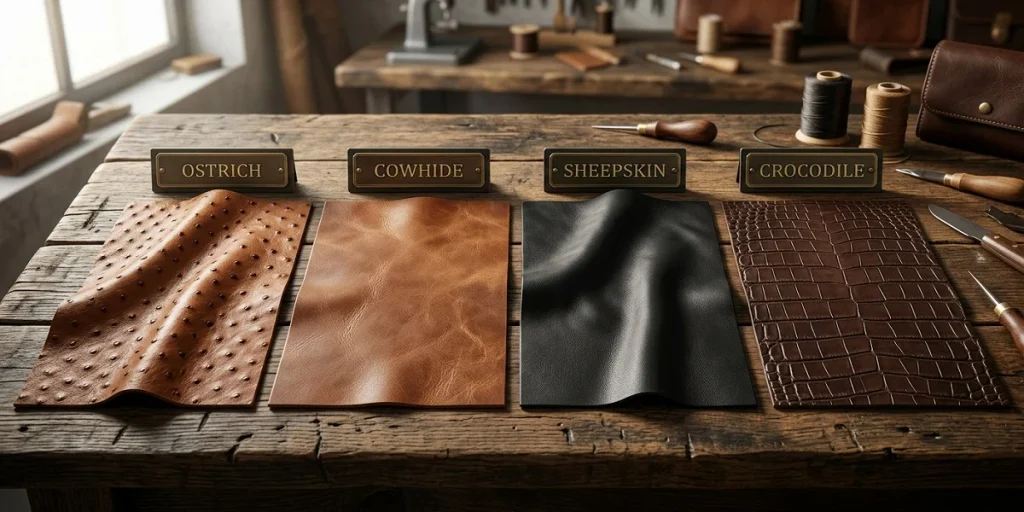
Ostrich leather is widely celebrated as one of the most distinctive premium exotic materials, but it is not automatically the ideal choice for every single product. Different animal leathers are valued for unique combinations of tensile strength, softness, flexibility, visual pattern, and price point.
Selecting the right leather ultimately depends on your functional expectations, budget, and desired aesthetic for the finished product.
Exotic and Traditional Leather Comparison
| Leather Type | Hand Feel | Physical Durability | Visual Appearance | Typical Price Tier |
| Ostrich | Exceptionally soft and flexible | High (resistant to cracking) | Distinctive raised follicle quills | Luxury / Premium |
| Cowhide | Firm to moderate suppleness | High (abrasion resistant) | Smooth to full grain variations | Entry to Luxury |
| Sheepskin | Extremely soft and lightweight | Moderate (delicate surface) | Fine, smooth, uniform grain | Mid-range |
| Crocodile | Rigid and highly structured | High (tough exterior) | Dramatic, segmented scale layout | Ultra-Luxury |
Ostrich Leather vs. Cowhide
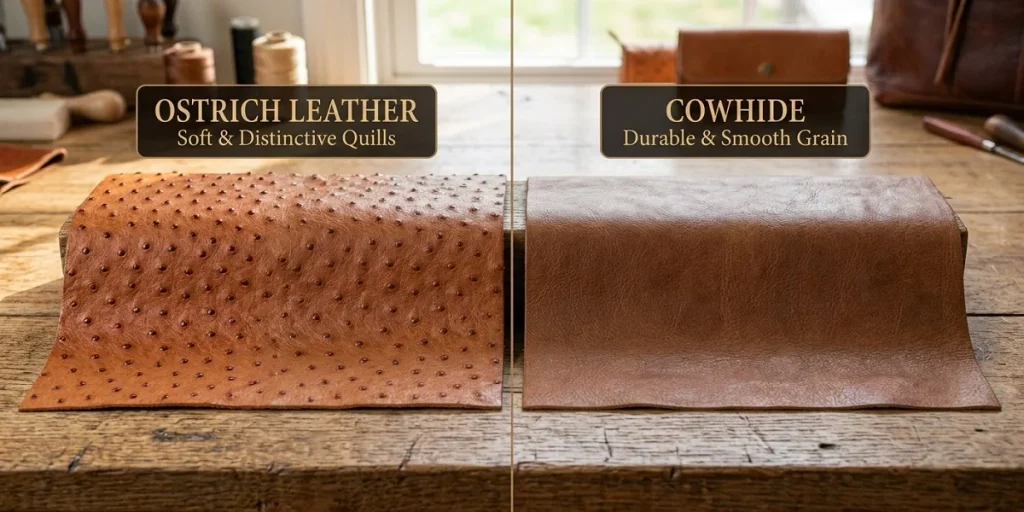
Cowhide is the global standard for traditional leather because it offers an unbeatable balance of durability, broad availability, and versatile applications. Produced in countless weights, finishes, and grades, cowhide powers everything from heavy-duty work boots and upholstery to everyday wallets and luxury handbags.
By contrast, ostrich leather is valued for its rare combination of immediate suppleness, high tear strength, and iconic tactile pattern. Because ostrich hide originates from a much smaller supply chain, it commands a significantly higher price point than mass-produced cowhide.
- Choose Cowhide for heavy-use everyday items where utility, uniform appearance, and budget efficiency are top priorities.
- Choose Ostrich Leather for exclusive luxury pieces that require a soft touch, unique visual texture, and high resistance to cracking over time.
The structural secret behind ostrich hide lies in its multidirectional criss-cross collagen fibers.
Ostrich Leather vs. Sheepskin
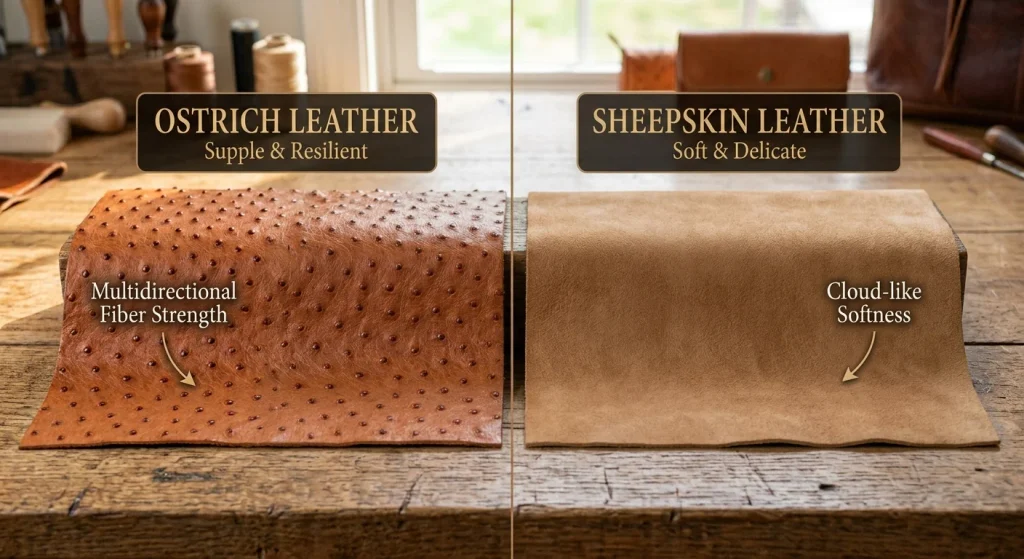
Sheepskin is famous for its cloud-like softness and delicate hand feel, making it a popular choice for garment linings, lightweight gloves, and luxury jackets where comfort reigns supreme. However, its fine grain structure offers lower resistance to surface abrasion and mechanical stress.
Ostrich leather delivers a comparable level of velvety softness while offering significantly higher structural strength and wear resistance. It provides the ideal middle ground for items like wallets, footwear, and travel bags that require flexibility without sacrificing daily toughness.
- Choose Sheepskin if maximum softness and lightweight comfort are your sole criteria.
- Choose Ostrich Leather if you want long-lasting suppleness combined with a tough, wear-resistant hide structure.
Ostrich Leather vs. Crocodile Leather
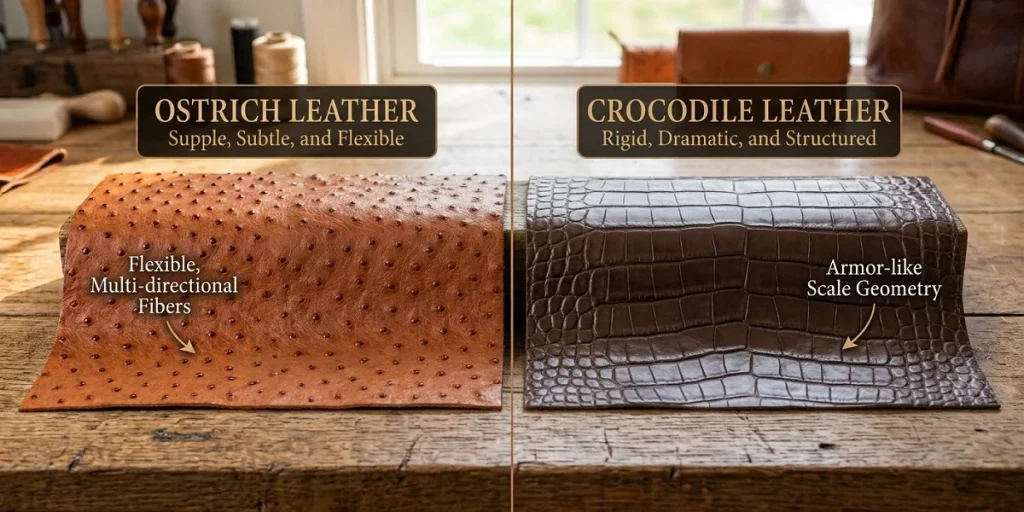
Both ostrich and crocodile leather occupy the pinnacle of the luxury exotic market, but their visual and physical appeals differ sharply. Crocodile leather is prized for its rigid, armor-like structure and bold scale geometry, whereas ostrich leather is naturally softer, lighter, and far more flexible.
Neither material can be universally labeled as “superior quality.” A expertly tanned hide from either species will produce a world-class luxury accessory. The choice comes down to personal taste and structural requirements:
- Crocodile leather offers a firm, structured silhouette with dramatic, large-scale luxury styling.
- Ostrich leather provides a supple, subtle texture with its raised quill dots, making it ideal for items that require flex and movement.
Which Animal Leather Is the Highest Quality?
There is no single animal leather that objectively ranks as the highest quality across every measurable category. True leather quality depends on specific criteria like fiber density, tensile strength, abrasion resistance, flexibility, tanning expertise, and end-use application.
Ostrich leather stands out because it combines multiple premium traits in a single material rather than excelling at just one. It provides exceptional durability without feeling stiff or heavy, and maintains long-term flexibility while featuring an iconic natural texture that synthetic processes cannot match.
When evaluating materials, consumers should ask: Which leather offers the precise physical properties I need for my product? For luxury goods where flexibility, durability, comfort, and exclusivity all matter, ostrich leather remains one of the strongest materials in the world.
Is Ostrich Leather Worth the Price?
For the right buyer, yes. Genuine ostrich leather is well worth its price premium because it uniquely combines long-term durability, natural flexibility, rich suppleness, and a distinctive quill texture that mass-produced leathers cannot replicate. Whether that cost is justified ultimately depends on your functional needs, aesthetic preferences, and budget priorities.
One of the greatest advantages of ostrich leather is that it does not force a choice between a soft touch and heavy-duty wear. Properly tanned ostrich hide remains buttery smooth while handling frequent daily use, making it ideal for items that are constantly handled, worn, or flexed.
The iconic quill pattern adds substantial emotional and material value. Full-quill ostrich leather possesses an exclusive, high-end visual identity that immediately stands out from ordinary cowhide, while organic variations ensure every finished product is completely one-of-a-kind.
When Is Ostrich Leather Worth Buying?
Investing in genuine ostrich leather makes the most sense if you prioritize:
- Long-Term Durability: Properly tanned and conditioned hides resist cracking and splitting for decades.
- Distinctive Aesthetic Appeal: The raised follicle bumps offer a unique tactile surface unmatched by traditional leathers.
- Suppleness and Comfort: It offers immediate soft flexibility without requiring an extended break-in period.
- Exclusivity and Prestige: Sourced from specialized supply chains, ostrich hide remains a hallmark of high-end luxury goods.
- Master Craftsmanship: Premium products highlight artisan pattern-cutting, precision edge-painting, and expert tanning skills.
When Might Ostrich Leather Not Be Worth It?
Paying a premium for ostrich leather may not make practical sense if:
- Affordability is your top priority: High-grade cowhide delivers excellent functional durability at a much lower cost when exotic texture is not required.
- You do not care for the quill texture: Paying for full-quill leather is unnecessary if you only want the physical strength of the bird hide. Smooth ostrich leather provides the same underlying durability at a lower price point.
The most expensive full-quill option is not automatically the right choice for every buyer. The best purchase is the one where hide grade, quill distribution, tanning quality, and construction match your actual daily usage.
How to Care for Ostrich Leather
While ostrich leather is naturally tough, routine maintenance preserves its soft feel, vibrant finish, and rich natural oils over time. Like all exotic materials, it requires protection from extreme moisture, heat, harsh chemicals, and UV exposure.
1. Protect It From Excessive Moisture
Ostrich leather handles minor splashes well, but it is not waterproof. Prolonged soaking can ruin protective finishes, strip natural fat liquors, and cause dark water spots or texture changes.
If your leather gets wet, gently dab excess water away with a dry microfiber cloth and let it dry naturally at room temperature. Never use direct heat sources like hair dryers, radiator units, or direct sunlight, as rapid drying causes fibers to shrink and crack.
2. Apply Leather-Specific Conditioners
Occasional conditioning restores essential natural oils and keeps the hide pliable. However, standard heavy conditioners can clog pores or darken lighter exotic dyes. Always use a formula designed specifically for exotic leathers or test a tiny amount on a hidden area first.
Avoid over-conditioning. Applying heavy waxes or excessive oils leaves a greasy film, attracts dirt, and degrades the natural breathability of the hide.
3. Avoid Direct Heat and Prolonged Sunlight
Extended exposure to UV rays degrades leather dyes, causing rich colors to fade unevenly. High heat also dries out the internal fiber network, leading to stiffness.
Store ostrich leather goods in a cool, dry place away from direct sunlight. Using breathable dust bags and maintaining original shapes with tissue paper padding prevents unwanted creasing during off-season storage.
4. Treat It as a Fine Exotic Material
Optimal maintenance requires a simple, consistent routine: keep the hide clean, store it properly, avoid extreme moisture and heat, and condition sparingly with correct products.
With minimal care, the soft hand feel, rich patina, and distinctive texture that make ostrich leather so prized will endure for generations.
Is Ostrich Leather Legal and Ethical to Buy?
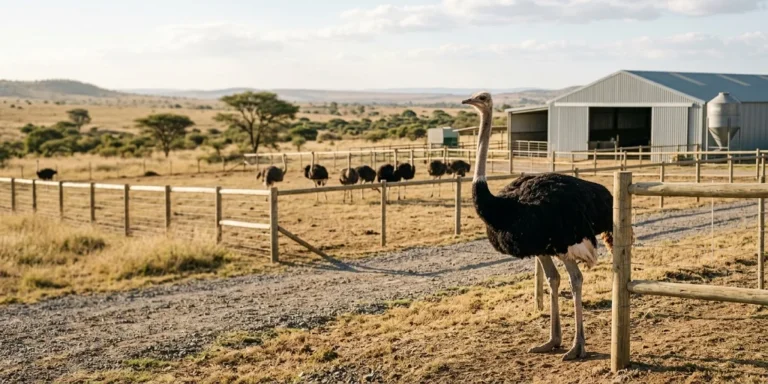
Yes, genuine ostrich leather can be legally bought, sold, and traded internationally. However, specific legal requirements depend on the hide’s geographic origin, export-import documentation, and destination country regulations. Commercial ostrich farming is a fully established global industry, particularly in southern Africa, supplying the vast majority of hides used in the luxury leather trade.
Legal status should never be assumed solely based on an item being exotic. Responsible buyers must consider species identification, farm origin, official documentation, and applicable wildlife import regulations before purchasing.
Is Ostrich Leather Legal in the US?
Yes, commercially farmed ostrich leather is legal to purchase, own, and import into the United States. However, international shipments must comply with standard U.S. Fish and Wildlife Service (USFWS) declarations and origin verification rules.
Understanding CITES (Convention on International Trade in Endangered Species) regulations is key:
- The common ostrich, Struthio camelus, has specific CITES listings that protect certain wild populations in specific regions of North and West Africa.
- Commercially farmed ostriches raised outside these protected wild zones operate under a completely different regulatory framework and are legal for commercial trade.
For buyers, the takeaway is straightforward: do not assume all ostrich leather is either unrestricted or banned. Always verify hide origin and seller paperwork, especially when ordering expensive goods internationally.
For current regulatory compliance, buyers should reference the official CITES species database and USFWS import guidelines prior to completing international transactions.
Is Ostrich Leather Ethical?
Whether ostrich leather is considered ethical depends on individual animal welfare standards, farm management practices, hide sourcing transparency, and supply chain traceability.
Because commercial ostrich leather originates almost exclusively from farmed birds rather than wild-caught animals, the supply chain offers significantly higher traceability. However, farming practices vary between regions, making farm-level welfare standards the primary ethical consideration.
Key ethical factors to consider include:
- Industry By-Product Status: Ostrich leather is a primary co-product of the broader ostrich agricultural industry. A single farmed bird provides meat, leather, oil, and feathers, meaning hides are not harvested solely for skin.
- Traceability and Transparency: Reputable tanneries and brands trace their hides directly back to certified farms that adhere to strict humane handling standards.
Rather than relying on vague marketing terms like “ethical” or “sustainable,” buyers should look for verifiable supply chain transparency from the manufacturer.
What Should Responsible Buyers Look For?
When purchasing ostrich leather products, particularly from international or unfamiliar sellers, look for these key transparency indicators:
- Clear Species Identification: The seller should explicitly state the hide is genuine ostrich (Struthio camelus).
- Verifiable Origin: Clear labeling regarding the country or farm region where the hide was harvested.
- Transparent Supply Chain: Reputable brands can readily explain where tanning, processing, and product assembly took place.
- Proper Import Documentation: International orders should include necessary customs permits and wildlife declaration forms.
- Substantiated Farming Claims: Specific welfare certifications rather than generic, unsupported ethical claims.
Ultimately, responsible purchasing relies on traceability. A seller who provides clear documentation regarding hide origin and tannery processing inspires far more buying confidence than one relying solely on luxury marketing terms.
What Is Ostrich Leather Used For?
Ostrich leather is utilized across a broad range of high-end consumer goods where durability, immediate suppleness, and distinctive visual aesthetics are required. Its unique combination of soft hand feel and iconic follicle bump patterns makes it a flagship choice for luxury accessories, bespoke footwear, fine watchmaking, and specialty upholstery.
Because different anatomical regions of an ostrich hide exhibit distinct follicle densities, thicknesses, and textures, master craftsmen select specific hide sections for specific product applications.
Application by Leather Type & Anatomical Region
| Product Category | Preferred Ostrich Leather Type | Key Material Advantages |
| Luxury Handbags & Totes | Full Quill (Crown section) | Iconic raised texture, high prestige, supple hand feel |
| Wallets & Small Accessories | Full Quill or Smooth Ostrich | Excellent flexibility, high tear strength, long-term durability |
| Boots & Fine Footwear | Full Quill or Ostrich Leg Skin | Superior resistance to cracking, unique scale-like reptilian texture |
| Belts & Watch Straps | Full Quill, Half Quill, or Leg Skin | High flex tolerance, comfortable wrist contouring, subtle exotic luxury |
| Custom Upholstery | Full Tanned Hides (Mixed sections) | Rare, high-end interior styling with high breathability |
Handbags, Wallets, and Small Leather Goods
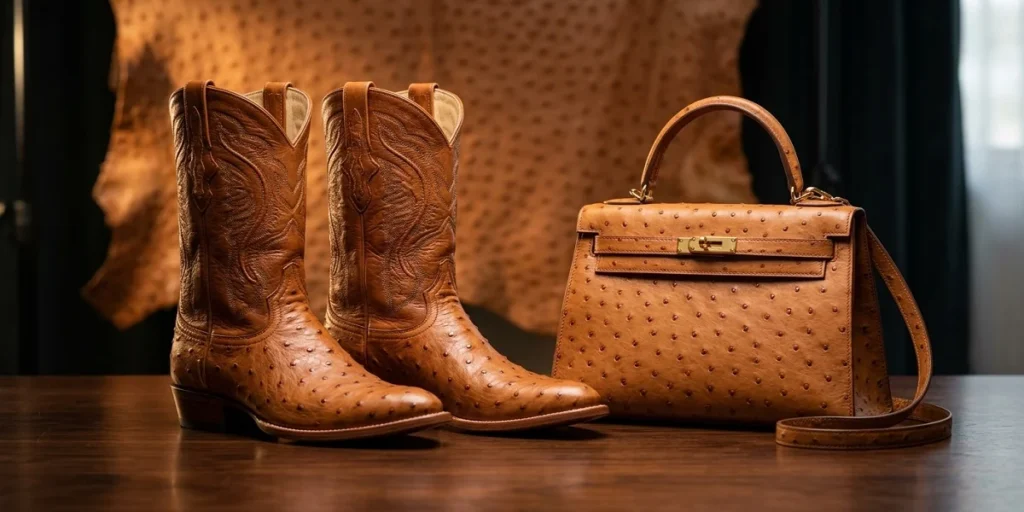
Luxury handbags, shoulder totes, and wallets represent the most famous commercial uses of ostrich leather. Full-quill hides are prized for flagship bag designs because their prominent raised follicles create an instantly recognizable signature surface that sets the item apart from standard calfskin or cowhide.
For wallets, cardholders, and passport covers, ostrich leather offers major practical benefits:
- The hide remains supple and pliable despite constant daily handling, flexing, and pocket friction.
- Smooth ostrich leather (from the flanks or belly) provides an understated, subtle option for buyers who prefer genuine exotic durability without the raised bump aesthetic.
Cowboy Boots and Fine Footwear
Ostrich leather is a classic standard in premium footwear, particularly for Western-style cowboy boots, luxury loafers, and custom dress shoes.
Footwear manufacturers take advantage of two distinct hide areas:
- Full-Quill Sections: Used on the vamp (boot front) to create a bold, high-contrast exotic look.
- Ostrich Leg Skin: Features a tight, overlapping, scale-like texture that closely resembles reptile skin. It is exceptionally popular for boot vamps, toe caps, and accent overlays requiring a structured, scaled appearance.
However, real-world boot performance relies heavily on total craftsmanship. Tannery oil balance, precision welt stitching, counter reinforcement, and sole construction dictate long-term performance alongside raw leather quality.
Belts and Luxury Watch Straps
The high natural flexibility and tear resistance of ostrich leather make it an ideal candidate for belts and watch bands, where material must withstand tight bending and friction without cracking or splitting.
For watch straps in particular, ostrich leather delivers an elevated exotic aesthetic without the rigid, stiff breaking-in period often required by crocodile or alligator bands. The follicle distribution provides a refined, textured look that contours comfortably around the wrist.
Furniture and High-End Upholstery
Ostrich leather is occasionally selected for bespoke interior design, luxury automotive cabins, private jet seating, and high-end furniture upholstery.
However, this represents a niche segment of the market. Because clean, unbroken panels of top-grade full-quill hide are limited in size, upholstering large surfaces requires multiple hides and entails significantly higher material costs than traditional cowhide upholstery. Consequently, its application in furniture is reserved primarily for custom, high-luxury projects.
Why Does the Same Hide Produce Entirely Different Products?
An ostrich hide is far from uniform. Follicle size, skin thickness, fiber density, and surface grain shift dramatically from the crown to the flanks and down to the legs. This structural variation allows tanneries and artisans to allocate specific hide cuts to matching product requirements:
- Crown Area (Full Quill): High-visibility luxury bags, boot vamps, and flagship wallets.
- Flanks & Sides (Smooth Ostrich): Wallet interiors, handbag linings, garment accents, and understated accessories.
- Leg Skin (Scaled Texture): Exotic boot accents, watch bands, belts, and small leather goods.
Understanding how hide origin impacts final appearance explains why a full-quill handbag, a smooth leather wallet, and a pair of leg-skin boots can vary so drastically in texture, hand feel, and retail price while all being crafted from genuine ostrich leather.
Frequently Asked Questions (FAQ)
Is ostrich a good leather?
Yes, ostrich is an exceptional high-quality leather. It is widely regarded as a top-tier material because it uniquely combines high tear strength, long-term flexibility, natural oil richness, and a distinctive raised follicle texture.
Is ostrich leather real leather?
Yes, genuine ostrich leather is authentic animal leather crafted from the hide of farmed ostriches (Struthio camelus). Its famous raised quill bumps are natural feather follicles embedded in the skin structure, not synthetic patterns stamped onto the surface.
Is ostrich leather expensive?
Yes, ostrich leather is significantly more expensive than standard leathers like cowhide or sheepskin. The high cost reflects specialized farming, intricate chrome tanning processes, limited full-quill yield per hide, and strong demand within the luxury market.
Why is ostrich leather so expensive?
Ostrich leather commands a premium because desirable full-quill patterns occur on only a limited portion of the hide (the crown). Additionally, high processing costs, specialized hand-craftsmanship, and strict luxury market standards drive up retail prices.
How can you tell if ostrich leather is real?
Check for three-dimensional, flexible quill bumps with visible pore centers, organic variation in bump spacing, and soft dermal grain between quills. For high-value items, verifying seller sourcing documentation is more reliable than home tests.
What is full-quill ostrich leather?
Full-quill ostrich leather originates from the crown section of the hide, where feather follicles are largest and most densely distributed. It is the most recognizable, sought-after, and expensive style of ostrich leather.
Does a higher grade mean stronger ostrich leather?
No, leather grade refers to cosmetic appearance rather than physical strength. A lower-grade full-quill hide carries more natural marks or scars, but retains the exact same fiber density, flexibility, and tear resistance as a flawless top-grade hide.
Is ostrich leather durable?
Yes, ostrich leather is exceptionally durable and highly resistant to cracking. Its multidirectional fiber weave contains natural oils that keep the leather supple and flexible through decades of regular use and proper maintenance.
Is ostrich leather better than cow leather?
Not universally; it depends on your priorities. Ostrich leather offers superior suppleness, a unique exotic pattern, and high resistance to cracking, while cowhide offers lower cost, massive availability, and heavier rigidity for structural goods.
What is the toughest leather in the world?
There is no single leather that is universally the toughest in every physical category. Toughness depends on whether you measure tensile strength, puncture resistance, or abrasion resistance. Kangaroo leather, crocodile, and ostrich all rank among the strongest per millimeter of thickness.
Which animal leather is the highest quality?
Quality depends entirely on the intended application and tanning expertise. Ostrich, crocodile, alligator, and full-grain calfskin are all considered top-tier materials, each excelling in different combinations of softness, structure, and visual prestige.
What is the lowest quality of leather?
Bonded leather is widely considered the lowest quality leather product. Made from shredded leather scraps held together with synthetic polyurethane binders, it lacks the fiber integrity, breathability, and durability of real full-grain hide.
Is ostrich leather legal in the US?
Yes, commercially farmed ostrich leather is completely legal to buy, sell, and import in the United States. However, international shipments must comply with U.S. Fish and Wildlife Service (USFWS) declarations and CITES origin verification guidelines.
Is ostrich leather ethical?
Ethical status depends on individual farm practices and welfare standards. Because commercial ostrich leather comes almost exclusively from farmed birds where hides are a co-product alongside meat and feathers, supply chains offer high traceability and accountability.
Does Hermès use ostrich leather?
Yes, Hermès regularly uses premium ostrich leather for flagship handbags, wallets, and small leather accessories alongside other exotic materials like crocodile and lizard.
How much does an ostrich Birkin cost?
An ostrich Hermès Birkin generally ranges from $20,000 to over $40,000+ depending on bag size, color rarity, hardware type, age, condition, and whether it is purchased directly from boutique retail or through the luxury secondary resale market.
Final Thoughts on Ostrich Leather
Genuine ostrich leather is undeniably a world-class material, but its high retail price does not automatically guarantee that every hide or finished product offers equal quality. Its outstanding global reputation stems from a unique biological balance: exceptional tensile durability, long-term flexibility, natural oil replenishment, and the iconic raised follicle texture that defines full-quill panels.
For buyers, the most critical distinction to master is between quill type and cosmetic grade:
- Quill Type describes the visual layout and anatomical origin of the feather follicles.
- Cosmetic Grade evaluates surface purity, measuring the presence of scars, scratches, or natural blemishes.
Full-quill leather commands top market prices due to aesthetic demand and limited yield per bird. However, a lower cosmetic grade full-quill hide possesses the exact same underlying strength, softness, and longevity as a flawless panel.
Price must always be evaluated alongside tannery craftsmanship, hide selection, stitching quality, and intended daily use. If you value exotic prestige, a velvety soft touch, and high resistance to cracking, ostrich leather fully justifies its price premium. If budget efficiency is your primary focus, premium cowhide provides excellent functional utility at a fraction of the cost.
Always buy with authenticity and traceability in mind. Look beyond luxury marketing terms, inspect follicle depth and pore structures, request hide origin documentation, and deal with reputable leather specialists. When properly sourced and cared for, ostrich leather is a long-lasting, heirloom-quality material rather than just an expensive luxury trend.