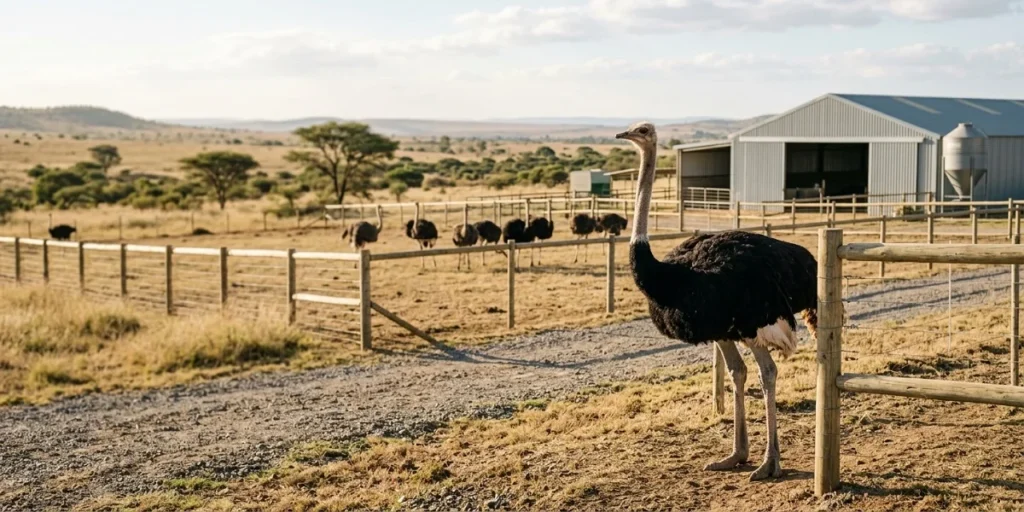
Quick Answer: An ostrich farming business plan is a structured document that outlines your farm strategy, legal framework, land requirements, production timeline, startup costs, operating expenses, revenue channels, risk factors, and long-term financial projections.
To build a viable business plan, base your projections on verified local demand for commercial end-products like meat, leather, feathers, eggs, and chicks. Never rely solely on high breeding-stock valuations.
Table of Contents
| OSTRICH FARMING BUSINESS PLAN AT A GLANCE | |
|---|---|
| Key Focus | Market-driven revenue, verified processing routes |
| Core End-Products | Leather, meat, feathers, hatching eggs, chicks |
| Major Cost Drivers | Land, specialized fencing, feed, processing fees |
| Primary Risk Factor | Market saturation and lack of slaughter facilities |
Ostrich farming offers impressive potential because a single bird yields multiple high-value outputs. However, these products do not automatically ensure profitability. A well-crafted plan requires you to answer essential operational questions before committing capital:
- Who are your verified buyers for meat and hide?
- What are the precise local market prices for your end-products?
- Which certified facilities will handle slaughtering and processing?
- What are your exact recurring expenses for feed, labor, fencing, veterinary care, and transport?
Stress-testing your financial model matters far more than presenting optimistic profit calculations. Before launching, you must confirm that your operation stays solvent if market prices drop, growth cycles run long, or yield targets fall short.
Why an Ostrich Business Plan Is Different From a Regular Farm Plan
A standard livestock business plan provides a helpful basic template, but ostrich farming presents distinct market dynamics that require dedicated planning.
The ostrich sector operates as a specialized niche market within commercial agriculture. According to data from the Agricultural Marketing Resource Center, there is no single comprehensive national database tracking production, current market prices, or distribution channels for ostriches in the United States. Furthermore, USDA Census of Agriculture figures record a steady consolidation in active commercial operations over recent decades.
This concentration does not mean an ostrich venture cannot succeed. Instead, it means your business plan cannot rely on broad agricultural averages. Success requires hyper-local market research, confirmed buyers, and precise site-specific expense tracking.
Key Lessons From Historical Ostrich Industry Cycles
The economic history of commercial ostrich farming highlights why thorough financial planning is critical before building pens or purchasing stock.
During the late 1980s and early 1990s, the global industry experienced a rapid speculative surge. Breeding-stock prices climbed steeply before dropping sharply mid-decade. Economic analyses from Applied Economic Perspectives and Policy attribute this crash to inflated productivity projections, speculative investing, and overvalued breeding birds.
As farm entries increased, the supply of breeding birds rapidly surpassed consumer market demand for ostrich leather and meat. The resulting oversupply led to a sudden market adjustment, closing operations that were dependent on high stock resale values.
Crucial Financial Directives for Your Plan
- Avoid speculative valuation: Do not project core revenue around inflated or temporary breeding-bird prices.
- Secure direct buyers: Establish written intent or supply agreements with real buyers before purchasing stock.
- Model downside scenarios: Run financial projections that account for lower product selling prices and higher feed costs.
- Confirm processing infrastructure: Secure access to certified slaughter and processing plants capable of handling large ratites before scaling your flock.
Access to processing facilities remains one of the primary operational bottlenecks in modern ostrich farming. If your revenue model only works when live stock commands high prices, you do not yet have a durable agricultural business. A strong business plan demonstrates profitability through stable end-product sales, accurate cost management, and realistic market demand.
What Your Ostrich Farming Business Plan Must Include
A useful ostrich farming business plan should do more than describe your farm idea. It should explain how the farm will operate, who will buy its products, how much it will cost to run, when revenue will begin, and what could cause the business to lose money.
The exact format can vary depending on whether you are preparing the plan for yourself, a bank, an investor, or a business partner. However, the core sections should remain similar.
| Section | What to include | Common mistake |
|---|---|---|
| Executive summary | Business model, location, goals, and funding needs | Writing it first and never updating it |
| Business description | Ownership, farm concept, products, and objectives | Being vague about what the farm will actually sell |
| Market analysis | Target customers, competitors, local demand, and pricing | Assuming that a niche market automatically means strong demand |
| Land and legal requirements | Land, fencing, housing, zoning, permits, and applicable regulations | Buying birds before confirming local requirements |
| Operations plan | Feeding, veterinary care, labor, breeding, processing, and transport | Leaving day-to-day operating costs out of the plan |
| Production plan | Breeding, incubation, chick survival, growth, and sale timing | Assuming every egg or chick becomes a saleable bird |
| Revenue plan | Meat, leather, feathers, eggs, chicks, breeding stock, and other products | Using optimistic prices without confirming buyers |
| Risk analysis | Market, health, production, feed, processing, and regulatory risks | Treating risk as an afterthought |
| Financial plan | Startup costs, operating costs, cash flow, break-even, and scenarios | Showing only one optimistic forecast |
| Appendix | Supplier quotes, buyer information, permits, research, and supporting documents | Having no evidence behind the assumptions |
You do not need to make every section equally long. The amount of detail should match the decisions you need to make. A small farm starting with a few birds may need a much simpler plan than a commercial operation seeking outside investment.
What matters most is that every major assumption can be traced back to something you have actually researched, quoted, or verified.
A Simple Rule for Building Your Plan
For every important number in your business plan, ask three questions:
- Where did this number come from?
- Can I verify it locally?
- What happens to my business if the number is wrong?
For example, if you estimate that you can sell an ostrich for a certain price, do not simply copy that figure from another farm’s website. Find out what comparable birds or products are actually selling for in your market and whether you have a realistic buyer.
The same principle applies to feed, fencing, labor, veterinary care, land, transport, slaughter, processing, and every other major expense.
A business plan becomes much more useful when it shows how confident you are in each assumption, rather than presenting estimates as facts.
You may also find our detailed guide on ostrich enclosure requirements helpful in gaining a clearer understanding of the major cost components involved.
Build the Plan Around Your Primary Business Model
Before filling in the financial tables, decide what your farm is primarily going to do.
Common models include:
- Breeding and chick sales: producing chicks or young birds for other farms and buyers
- Grow-out for meat: raising birds for slaughter and meat sales
- Integrated production: combining breeding, grow-out, meat, and by-products
- Breeding-stock sales: producing mature birds for other producers
- Agritourism: generating additional income through visitors, farm experiences, or direct sales
You can combine several of these activities, but your plan should clearly identify the primary source of revenue.
That distinction matters because the infrastructure, cash-flow timing, labor requirements, and risks can be very different from one model to another.
For example, a farm that primarily sells chicks depends heavily on fertility, hatchability, chick survival, and local demand for young birds. A meat-focused farm has different requirements, including grow-out costs, processing access, transportation, and reliable meat buyers.
Do not build the financial section until you know which business model you are actually testing.
How to Write an Ostrich Farming Business Plan Step by Step
Once you have the basic structure, the next step is to fill each section with information that can actually be tested. Start with your business model and work through the market, operations, production, risks, and financials before writing the final executive summary.
1. Executive Summary and Business Model
Write the executive summary last, even though it appears at the beginning of the finished business plan.
Keep it concise and explain what the farm will do, where it will operate, who its customers will be, and how much funding or investment it requires.
At a minimum, include:
- Business name and location
- Primary ostrich farming model
- Products you intend to sell
- Target customers
- Main competitive advantage
- Startup investment required
- Expected funding sources
- Long-term business goals
Your business model should be specific enough that someone reading the plan can understand how money will flow through the operation.
For example, a meat-focused farm might purchase or hatch young birds, raise them to market age, arrange processing, and sell meat and usable by-products to identified buyers.
A breeding operation follows a different model. It may generate revenue from fertile eggs, chicks, or young birds, while carrying different production and market risks.
You can combine activities, but identify one primary business model and treat the others as secondary revenue streams.
Do not write the executive summary around how exciting ostrich farming sounds. Write it around how the business is expected to work.
2. Market Research and Product Mix
Your market analysis should answer a simple question:
Who is going to pay for what your farm produces?
Ostriches can potentially generate revenue from several products, including meat, leather, feathers, eggs, chicks, breeding birds, and other by-products. However, the existence of a product does not automatically mean there is a profitable market for it.
For each product, identify the potential customer, expected price, sales channel, and evidence that demand exists.
| Product | Potential buyers | What to research |
|---|---|---|
| Meat | Restaurants, specialty butchers, retailers, direct customers | Local demand, selling price, processing access |
| Leather | Tanneries, leather manufacturers, specialty buyers | Whether buyers accept ostrich hides and how they are priced |
| Feathers | Craft, costume, fashion, cleaning and specialty markets | Local demand and realistic sales volume |
| Eggs | Food buyers, hatcheries, craft buyers, visitors | Local regulations, seasonality and intended use |
| Chicks | Farmers, hobby operations, new producers | Number of potential buyers and local competition |
| Breeding birds | Established farms and producers | Demand and historical price volatility |
| Oil and other by-products | Specialty and processing businesses | Whether processing and buyers exist in your region |
The Agricultural Marketing Resource Center identifies meat, leather, feathers, eggs, and oil among the potential ostrich products, while also highlighting the importance of developing viable markets for those products.
Research Buyers Before You Forecast Revenue
One of the most useful things you can do before completing the financial section is talk to potential buyers.
Contact restaurants, specialty meat businesses, processors, leather buyers, other farms, or relevant distributors depending on your business model.
Ask practical questions:
- Would you buy this product?
- What specifications do you require?
- How much could you realistically purchase?
- What price range do you normally pay?
- How often would you buy?
- Would you collect the product, or would the farm need to deliver it?
- Are there minimum quantities?
- What certifications, inspection, or documentation do you require?
You do not need a signed contract from every potential customer before starting a farm. But a business plan based on actual conversations is much stronger than one based entirely on internet price estimates.
A buyer who has expressed genuine interest is more useful to your business plan than a random price you found online.
Do Not Count Every Bird or Egg as Revenue
This is one of the easiest ways to make an ostrich business plan look profitable on paper.
If a breeding flock produces 100 eggs, your financial model should not automatically treat those 100 eggs as 100 saleable chicks or 100 profitable birds.
Egg fertility, incubation results, chick survival, replacement stock, breeding requirements, and market demand can all reduce the number of birds that eventually generate revenue.
Research on ostrich incubation has reported substantial variation in hatchability, which is another reason to avoid assuming perfect production in your financial model.
Instead, build your forecast around realistic production rates and include losses in your calculations.
3. Land, Housing, and Legal Requirements
Your business plan should explain where the farm will operate and what infrastructure the birds will require.
Do not simply write:
“The farm will be located on 20 acres.”
Explain why that amount of land is appropriate for your planned flock and production system.
Your research should cover:
- Land purchase or lease cost
- Fencing requirements
- Shelters and handling areas
- Breeding and grow-out areas
- Chick and incubation facilities
- Feed and water infrastructure
- Storage
- Vehicle access
- Waste management
- Veterinary access
- Processing and transport arrangements
There is no single acreage figure that automatically works for every ostrich farm. Requirements depend on flock size, production system, climate, land characteristics, local regulations, and how the birds are managed.
Your plan should therefore use local requirements and your intended stocking system, rather than copying an acreage number from another farm.
Legal and Regulatory Research
Legal requirements are another area where copying information from another farm can create problems.
Depending on your location, you may need to investigate:
- Livestock or animal ownership rules
- Zoning and land-use restrictions
- Farm registration
- Animal health requirements
- Transport regulations
- Slaughter and meat-processing requirements
- Food-safety regulations
- Environmental requirements
- Local permits and inspections
For U.S. operations, ostriches are classified as ratites under USDA Food Safety and Inspection Service (FSIS) regulations, so meat-processing arrangements need to be considered as part of the business plan rather than after the birds are ready for market.
Requirements outside the United States can be very different. If you are developing a farm in another country, check the applicable national, regional, and local authorities before purchasing birds or committing to a production site.
Never treat legal requirements as a box to check after the business is already operating. They can directly affect where you can farm, what you can sell, and how you can sell it.
4. Startup and Operating Costs
An ostrich farming business plan should separate startup costs from ongoing operating costs. This makes it easier to understand how much capital you need before the farm begins generating meaningful revenue and how much cash the business will require to keep operating.
The exact numbers will vary significantly by location, flock size, production model, and whether you buy or lease land. Instead of copying cost estimates from another farm, use the following categories as a checklist and replace them with current local quotes.
| Cost category | One-time or ongoing | Your estimate | How to verify |
|---|---|---|---|
| Land purchase or lease | Both | Local property/land listings | |
| Fencing and gates | Mostly one-time | Local contractors and suppliers | |
| Shelters and handling facilities | One-time + maintenance | Local construction quotes | |
| Breeding stock or chicks | Usually one-time initially | Local farms and breeders | |
| Incubator and brooder equipment | One-time | Equipment suppliers | |
| Feed | Ongoing | Local feed suppliers | |
| Veterinary care | Ongoing | Local veterinarian | |
| Labor | Ongoing | Local wage rates | |
| Water and electricity | Ongoing | Utility estimates | |
| Transport | Ongoing | Local transport providers | |
| Processing and slaughter | Ongoing | Approved/appropriate processors | |
| Insurance and licenses | Ongoing or periodic | Local authorities and insurers | |
| Marketing and sales | Ongoing | Your planned sales channels | |
| Contingency reserve | Reserve | Percentage of projected costs |
Startup Costs vs. Operating Costs
Startup costs are expenses you generally need to incur before or during the launch of the farm. These can include land preparation, fencing, shelters, equipment, initial livestock, water infrastructure, and other capital investments.
Operating costs continue after the farm is running. Feed, labor, veterinary care, utilities, transport, maintenance, insurance, and processing are examples.
This distinction matters because a farm can have enough money to build the operation but still fail because it does not have enough working capital to operate until revenue arrives.
For an ostrich farm, that gap can be particularly important because birds require time to mature and production does not immediately translate into saleable products.
Build a Cost Per Bird
Once you have collected your local prices, turn the information into a cost-per-bird estimate.
A simple starting point is:
Cost per bird = total relevant production costs ÷ number of saleable birds
But be careful with the denominator. If you hatch 100 chicks and only 80 eventually become saleable birds, dividing your costs by 100 will make the business look cheaper than it really is.
Your model should account for:
- Hatchability
- Chick mortality
- Birds retained as breeding stock
- Feed consumption
- Veterinary costs
- Labor
- Housing and fencing maintenance
- Transport
- Processing
- Other variable costs
This is one reason a realistic financial model is more useful than a simple “cost to raise one ostrich” figure copied from another farm.
Add a Contingency Reserve
Do not build your startup budget down to the last dollar.
Construction costs can change, equipment may need replacing, feed prices can increase, birds may require unexpected veterinary treatment, and revenue may arrive later than expected.
A contingency reserve gives the business some room to absorb these events without immediately requiring additional financing.
The exact reserve percentage should depend on your location, project size, and the reliability of your cost estimates. The important point is to include a reserve in the plan rather than assuming every estimate will be exact.
Get Real Quotes Before Finalizing the Plan
Before you present the business plan to a lender, investor, or business partner, replace estimates with actual quotes wherever possible.
At minimum, try to obtain current pricing for:
- Breeding birds or chicks
- Feed
- Fencing
- Construction
- Veterinary services
- Transport
- Processing
- Land
Your first version can use estimates while you research the project. Your final financial plan should use the most recent and location-specific information you can obtain.
A conservative cost estimate is usually more useful than an impressive profit forecast based on unrealistically cheap inputs.
5. Revenue Streams and Pricing
An ostrich farm can potentially generate revenue from several products, but your business plan should not assume that every possible product will become a meaningful source of income.
Start by identifying which products you actually intend to sell, who will buy them, and how you will reach those buyers.
Potential revenue streams include:
| Revenue stream | Potential buyers | Key planning question |
|---|---|---|
| Meat | Restaurants, specialty butchers, retailers, direct customers | Can you access appropriate processing and reliable buyers? |
| Leather | Tanneries, leather manufacturers, specialty buyers | Is there a buyer for your hides in your region? |
| Feathers | Craft, costume, fashion and specialty markets | Is the local market large enough to justify production? |
| Eggs | Food buyers, hatcheries, craft buyers, visitors | What percentage can realistically be sold? |
| Chicks | Farmers, hobby operations and new producers | Is there sustainable demand for young birds? |
| Breeding stock | Other ostrich producers | Would the business still work if breeding-bird prices declined? |
| Oil and other by-products | Specialty and processing businesses | Is processing commercially available? |
| Agritourism | Farm visitors and tourists | Is there enough visitor demand at your location? |
Ostrich industry resources identify meat, leather, feathers, eggs, and other products as potential sources of value, but the availability of a product does not guarantee a profitable market. Your business plan should therefore distinguish between potential revenue and verified revenue opportunities.
Build Revenue From Buyers, Not From Internet Prices
The easiest way to make an ostrich business plan look profitable is to choose an attractive selling price and multiply it by an optimistic production estimate.
Avoid that approach.
Instead, research the price you could realistically receive from an actual buyer or sales channel in your market.
For each revenue stream, record:
- Product
- Expected annual quantity
- Conservative selling price
- Expected revenue
- Processing or preparation costs
- Transport costs
- Sales or marketing costs
- Buyer or sales channel
- Evidence supporting the price
A simple calculation is:
Gross revenue = units sold × selling price per unit
But gross revenue is not the same as profit. If you sell processed meat, for example, the price received from the customer needs to be considered alongside processing, packaging, transport, and other costs.
Use Conservative, Expected, and Optimistic Prices
Rather than putting one price into your financial model, create at least three scenarios.
| Scenario | Selling price | Production volume | Purpose |
|---|---|---|---|
| Conservative | Lower realistic price | Lower realistic output | Tests whether the business can survive difficult conditions |
| Expected | Most likely price | Most likely output | Main planning scenario |
| Optimistic | Higher achievable price | Strong production | Shows potential upside without making it the base case |
Your business should not depend on the optimistic scenario to remain viable.
This is especially important for ostrich farming because the U.S. industry has previously experienced severe price declines after speculative expansion. A business model that depends on unusually high prices carries much more risk than one that remains viable at conservative prices.
Account for Production Losses
Revenue forecasts should be based on saleable output, not theoretical production.
For a breeding operation, that means considering factors such as:
- Number of breeding females
- Eggs produced
- Fertility
- Hatchability
- Chick survival
- Birds retained for replacement or breeding
- Birds reaching the intended sale age
- Market demand
For example, if your breeding flock produces 200 eggs, you should not automatically forecast revenue from 200 chicks. Some eggs may be infertile, some embryos may fail to hatch, and some chicks may not survive to the stage at which they can be sold.
The same principle applies to meat production. Your plan needs to distinguish between the number of birds entering the production system and the number that actually reach the market.
Do Not Make Breeding Birds Your Only Safety Net
Selling chicks or breeding stock can be a legitimate part of an ostrich business model. The problem arises when the entire business depends on other farmers continuing to pay high prices for breeding birds.
The history of the U.S. industry shows why this can be dangerous. When expectations of future demand proved unrealistic, breeding-stock prices fell sharply and many operations could not maintain their previous economics.
A more resilient plan asks:
Would this business still work if breeding-bird prices fell substantially?
If the answer is no, your business plan needs another revenue strategy or a much more conservative cost structure.
Separate Revenue From Cash Flow
One final distinction is important: revenue does not necessarily arrive when you incur the cost of producing it.
You may spend money on feed, labor, veterinary care, and infrastructure for months before a bird generates a sale.
Your financial plan should therefore record not only how much revenue you expect, but also when you expect to receive it.
That timing will become especially important when you build the cash-flow and break-even sections later in the plan.
6. Production Timeline
An ostrich farming business plan should show when production starts, when birds or other products become saleable, and when the business can realistically generate cash. This is especially important because ostrich production is not a quick-turnover livestock business.
For example, domesticated ostriches generally reach sexual maturity at around 2 to 3 years, while incubation takes about 42 days. Meat production operates on a much shorter cycle, with birds commonly marketed at roughly 10 to 14 months depending on the production system and target market.
Map the Production Cycle
Your business plan should turn biological production into a practical farm timeline.
| Production stage | What to estimate |
|---|---|
| Breeding | Breeding age, mating season, expected egg production |
| Egg collection | Number of eggs collected and collection frequency |
| Incubation | Incubation period and expected hatchability |
| Hatching | Chicks hatched from fertile eggs |
| Brooding | Feed, labor, heating and early mortality |
| Grow-out | Feed, veterinary care, labor and growth period |
| Breeding replacement | Birds retained instead of sold |
| Market preparation | Transport, processing and other requirements |
| Sale | Expected age, weight, product and selling channel |
| Cash collection | When customers actually pay |
The important point is that production numbers and sales numbers are not the same thing. An egg may not be fertile, a fertile egg may not hatch, a chick may not survive to market age, and some birds may need to remain on the farm as replacement breeding stock.
Research has also shown that hatchability can vary considerably between production systems and conditions, so a business plan should use a locally realistic assumption rather than treating published hatchability figures as a guaranteed farm result.
Build a Multi-Year Production Forecast
A new farm should normally model production year by year rather than assuming the farm reaches full capacity immediately.
For example:
| Year | Main planning question |
|---|---|
| Year 1 | What infrastructure and breeding stock are established? |
| Year 2 | How many saleable products can realistically be produced? |
| Year 3 | Is breeding capacity approaching the planned level? |
| Year 4+ | Can production reach the intended steady-state level? |
The exact timeline will depend on whether your business starts with mature breeding birds, chicks, eggs, or a combination of these. A farm purchasing mature breeders can have a very different revenue timeline from a farm that intends to raise its own breeding flock.
This distinction matters when calculating the amount of working capital required. A business can be technically profitable over several years while still running out of cash during the early production period.
Separate Biological Growth From Business Growth
Your ostrich farm may become larger before it becomes more profitable.
Increasing the number of birds can increase feed, labor, veterinary, fencing, water, transport and processing costs before it creates additional revenue. Your business plan should therefore show how production capacity increases and whether the market can absorb that additional output.
A useful question for every expansion stage is:
If we produce 25%, 50%, or 100% more birds, who will buy them and how will we process and transport them?
If the answer is unclear, expanding the flock may increase risk rather than profitability.
Build the Timeline Around Cash Flow
The production timeline should eventually connect directly to your financial projections.
For each major product, estimate:
Production date → sale date → payment date → revenue received
This prevents a common business-planning mistake: showing a profitable annual operation on paper while ignoring the months when the farm has substantial expenses but little or no sales income.
A strong ostrich farming business plan therefore does not only answer how many birds you can produce. It also answers when those birds become saleable, when customers pay, and how the farm finances itself until then.
7. Risk Analysis
An ostrich farming business plan should treat risk as a core part of the business model, not as a short paragraph added at the end. The history of the ostrich industry shows why this matters: rapid expansion, unrealistic expectations about demand and productivity, and speculation contributed to major problems in the U.S. industry during the 1990s.
The goal is not to prove that ostrich farming is risk-free. The goal is to identify what could go wrong, estimate the financial impact, and decide what you can do about it before investing.
For a more detailed overview of common ostrich diseases, symptoms, treatment options, and prevention strategies, you can also refer to our comprehensive guide on ostrich health.
Build an Ostrich Farm Risk Matrix
A simple risk matrix can make this section much more useful than a generic list of risks.
| Risk | Potential impact | Likelihood | Mitigation |
|---|---|---|---|
| Weak market demand | High | Medium | Secure buyers before expanding production |
| Selling prices fall | High | Medium | Use conservative price assumptions and multiple revenue streams |
| Feed costs increase | High | Medium | Obtain supplier quotes and model price increases |
| High chick mortality | High | Medium | Improve brooding, nutrition, hygiene and veterinary management |
| Poor hatchability | Medium to High | Medium | Use realistic production assumptions and monitor breeding performance |
| Disease or injury | High | Medium | Biosecurity, veterinary support and preventive management |
| Processing unavailable | High | Medium | Identify suitable processors before birds reach market age |
| Transport costs rise | Medium | Medium | Include realistic transport costs in product pricing |
| Regulatory changes | Medium to High | Low to Medium | Confirm requirements with relevant authorities |
| Theft or predator losses | Medium to High | Low to Medium | Secure fencing, gates and farm access |
| Drought or water shortage | High | Location-dependent | Secure reliable water and contingency supplies |
| Expansion outpaces demand | High | Medium | Increase production only when sales capacity supports it |
The likelihood and impact ratings should be specific to your location rather than copied from another farm. A major risk in one country may be relatively insignificant somewhere else.
Market Risk May Be More Important Than Production Risk
New farmers often focus heavily on whether they can raise healthy ostriches. That matters, but producing the birds is only half of the business.
The bigger question may be whether you can sell the resulting products at a price that covers your full cost of production.
This is particularly important for a specialized livestock business. AgMRC notes that ostrich production has historically faced challenges involving market development and processing infrastructure in the United States.
Your risk analysis should therefore ask:
- What happens if the selling price falls?
- What happens if demand is lower than expected?
- What happens if your main buyer stops purchasing?
- Can you sell through another channel?
- Can birds be held longer without creating unsustainable costs?
- Can the farm remain viable if one revenue stream disappears?
Model a Price Decline
Do not build the business around the highest price you can find online.
Instead, test what happens if your expected selling price falls significantly. The exact reduction should be based on your market research, but the principle is simple: your farm should have enough financial resilience to survive a weaker market.
This is particularly relevant if your business plan includes breeding stock as a major source of revenue. Historical U.S. industry data demonstrates how dangerous it can be to assume that high breeding-stock prices will continue indefinitely.
A useful scenario table might look like this:
| Scenario | Selling price | Production | Result |
|---|---|---|---|
| Conservative | Lower | Lower | Can the farm survive? |
| Expected | Most likely | Most likely | Is the business viable? |
| Optimistic | Higher | Strong | What is the upside? |
The conservative scenario is arguably the most important one.
Plan for Operational Failure
Your risk analysis should also consider what happens when something does not go according to plan.
For example, what happens if:
- the incubator fails during a hatch?
- water supply is interrupted?
- feed prices suddenly increase?
- several chicks die?
- a breeding season produces fewer eggs than expected?
- a processor cannot accept birds when they reach market age?
- transport becomes unavailable?
- a major customer cancels an order?
You do not need a complicated disaster-management system for a small farm. But you should identify the major failure points and have a practical response for each one.
Know Which Risks You Cannot Control
Some risks cannot be eliminated by better farm management.
Market prices, regulations, weather, transport costs and broader economic conditions can change regardless of how well you operate the farm.
Your business plan should therefore distinguish between controllable risks and external risks.
Controllable risks might include feeding practices, fencing, record keeping, biosecurity, labor management and maintenance. External risks might include market demand, regulatory changes, fuel prices or extreme weather.
The purpose of the risk section is not to make every risk disappear. It is to show that you have considered them before committing capital.
A strong ostrich farming business plan should still make sense when several assumptions become less favorable. If the entire business only works under perfect production, high selling prices and guaranteed demand, the problem is not the risk analysis. The problem is the business model.
8. Financial Projections and Break-Even
This is where the rest of the ostrich farming business plan comes together. Your financial section should translate the production system, costs, selling prices, production timeline and risks into numbers that answer one basic question:
Can this farm generate enough cash to justify the investment?
A good financial model does not need to predict the future perfectly. It needs to make its assumptions visible, realistic and easy to change when those assumptions change.
Build a Startup Cost Forecast
Start by calculating the capital required before the farm can operate.
Your startup budget may include:
- Land purchase or lease
- Fencing and gates
- Shelters and handling facilities
- Water infrastructure
- Electricity and other utilities
- Incubators and brooders
- Feed storage
- Vehicles and farm equipment
- Breeding stock or chicks
- Initial veterinary and health costs
- Licenses, permits and insurance
- Initial marketing and sales expenses
- Working capital
Do not confuse the amount required to build the farm with the amount required to operate the farm until it generates sufficient revenue.
A farm can have enough money to complete construction and buy birds but still fail because it does not have enough working capital to pay for feed, labor, veterinary care and other expenses while waiting for the first meaningful sales.
Separate Fixed and Variable Costs
Your financial model becomes much easier to understand when costs are separated into categories.
Fixed or relatively fixed costs may include:
- Land lease
- Buildings
- Certain equipment
- Insurance
- Some administrative expenses
Variable costs may include:
- Feed
- Veterinary treatment
- Transport
- Processing
- Packaging
- Marketing
- Utilities associated with production
- Labor that increases with flock size
The exact classification will depend on your operation, but the distinction helps you understand what happens when production increases or decreases.
Calculate Cost Per Saleable Bird
One of the most useful calculations in an ostrich business plan is the cost of producing one saleable bird.
A simple starting formula is:
Cost per saleable bird = Total relevant production costs ÷ Number of saleable birds
The important word is saleable.
If your farm starts with 100 eggs, you should not divide total costs by 100 and call that the cost per bird. Some eggs may not be fertile, some may fail to hatch, some chicks may not survive, and some birds may be retained as breeding replacements.
Your denominator should reflect the number of birds actually available for the intended market.
You can also calculate product-specific costs where appropriate, such as:
Cost per kg of meat = Total relevant meat-production costs ÷ Saleable kilograms of meat
This can give you a much more useful comparison against your expected selling price.
Build a Revenue Forecast
Once your costs are estimated, create a revenue forecast based on the products you actually expect to sell.
For example:
| Product | Saleable quantity | Expected price | Gross revenue |
|---|---|---|---|
| Ostrich meat | ___ | ___ | ___ |
| Leather | ___ | ___ | ___ |
| Feathers | ___ | ___ | ___ |
| Eggs | ___ | ___ | ___ |
| Chicks | ___ | ___ | ___ |
| Breeding stock | ___ | ___ | ___ |
| Other products | ___ | ___ | ___ |
| Agritourism | ___ | ___ | ___ |
| Total | ___ |
Keep gross revenue separate from profit.
If a farm sells 100 birds at $500 each, that creates $50,000 in gross sales. It does not mean the farm made $50,000 in profit.
Feed, labor, veterinary expenses, transport, processing, land, infrastructure, depreciation, financing and other costs still have to be accounted for.
Calculate Break-Even
Break-even analysis helps determine how much you need to sell before the business covers its costs.
A simplified break-even formula is:
Break-even units = Fixed costs ÷ (Selling price per unit – Variable cost per unit)
For an ostrich farm, however, the calculation can become more complicated because you may have several products and production cycles.
A farm selling meat, leather, feathers, eggs and chicks does not necessarily have one meaningful “break-even bird” figure. It may be more useful to calculate break-even under the farm’s primary business model and then account for secondary products separately.
AgMRC’s business-planning resources emphasize the importance of feasibility analysis and break-even selling-price calculations when evaluating agricultural enterprises.
Test Different Scenarios
Never create only one financial forecast.
At minimum, build three:
| Scenario | Production | Selling price | Main purpose |
|---|---|---|---|
| Conservative | Lower | Lower | Tests survival |
| Expected | Most likely | Most likely | Main business case |
| Optimistic | Higher | Higher | Shows potential upside |
You can make the model more useful by changing several assumptions simultaneously.
For example, your conservative scenario could combine:
- Lower hatchability
- Higher mortality
- Higher feed costs
- Lower selling prices
- Slower sales
- Higher transport costs
That is much more informative than simply reducing revenue by 10%.
Calculate the Payback Period
Once your cash-flow forecast is complete, estimate how long it takes to recover the initial investment.
A simple version is:
Payback period = Initial investment ÷ Average annual net cash flow
However, a proper business model should use the actual projected annual cash flows rather than relying only on this simplified formula.
The payback period can be especially important for ostrich farming because production may require substantial upfront investment while biological growth and market development take time.
Do not assume that reaching operational profitability automatically means the initial investment has been recovered.
Build a Monthly Cash-Flow Forecast
For a new farm, an annual profit-and-loss statement may not be enough.
A monthly cash-flow forecast can show when money actually enters and leaves the business.
| Month | Cash in | Cash out | Net cash flow | Closing cash |
|---|---|---|---|---|
| January | ___ | ___ | ___ | ___ |
| February | ___ | ___ | ___ | ___ |
| March | ___ | ___ | ___ | ___ |
| April | ___ | ___ | ___ | ___ |
| … | … | … | … | … |
| December | ___ | ___ | ___ | ___ |
This can reveal a problem that an annual forecast hides.
For example, the farm might show a positive annual result but still experience several months of negative cash flow that require additional working capital.
The Most Important Financial Test
Before deciding that the business is profitable, change the assumptions.
Lower the selling price. Increase feed costs. Reduce hatchability. Increase mortality. Delay sales. Add unexpected veterinary or infrastructure costs.
Then ask:
Does the business still survive?
If the answer is no, identify exactly which assumption is causing the model to fail.
That gives you something much more valuable than a projected profit figure. It tells you which parts of the business need to be validated before you invest.
A strong ostrich farming financial plan should therefore be treated as a living model, not a one-time spreadsheet. As you obtain real feed quotes, buyer prices, construction costs and production data, replace estimates with actual numbers.
Ostrich Business Plan PDF: How to Create Your Own
Searching for an ostrich business plan PDF can be a useful starting point, but downloading a generic farm-business template is not the same as having an ostrich-specific business plan.
A useful template should help you document your actual market, production system, costs, buyers, legal requirements and financial assumptions. Generic agricultural templates can provide the structure, but the numbers and assumptions need to come from your own location and business model.
What a Good Ostrich Business Plan PDF Should Contain
Before downloading or creating a PDF, make sure it includes the following:
- Executive summary
- Business model
- Market analysis
- Product and revenue strategy
- Land and infrastructure requirements
- Legal and regulatory requirements
- Production plan
- Startup costs
- Operating costs
- Production and sales forecasts
- Risk analysis
- Cash-flow forecast
- Break-even analysis
- Funding requirements
- Supporting research and supplier or buyer information
If a downloadable template contains only a few pages of generic financial tables, it may not be enough for an ostrich farm.
Why a Generic PDF Can Be Misleading
A business plan template may contain assumptions about cattle, poultry or conventional crops that do not apply to ostriches.
Ostrich farming has its own production timeline, specialized infrastructure, processing considerations and relatively small market. Historical experience also shows why assumptions about future demand and breeding-stock prices need to be tested rather than copied from old business plans.
For this reason, the best approach is usually to build the plan first and create the PDF afterward.
Your final PDF should be the presentation format for your research, not the source of your business assumptions.
How to Turn Your Plan Into a PDF
Once you have completed the sections, you can organize them in this order:
Cover page → Executive Summary → Business Model → Market Analysis → Operations → Legal Requirements → Costs → Revenue → Production Timeline → Risk Analysis → Financial Projections → Break-Even → Appendices
The appendix can contain supporting material such as:
- Feed supplier quotations
- Construction estimates
- Land information
- Buyer correspondence
- Processing facility information
- Veterinary information
- Permit requirements
- Market research
- Financial assumptions
- Production records
This makes the document much more useful if you eventually present it to a bank, investor, business partner or agricultural organization.
Should You Use an Ostrich Farming Business Plan Template?
Yes, but use it as a framework rather than a finished business plan.
A good ostrich farming business plan template should make it easier to ask the right questions. It should not tell you what your farm will cost or how much money you will make.
The strongest approach is to take the template below, replace every blank with information specific to your location and business model, and support major assumptions with actual quotes, buyer discussions or reliable research.
That way, your final ostrich farming business plan PDF becomes a document based on your business rather than a generic template downloaded from the internet.
Free Ostrich Farming Business Plan Template
Writing an ostrich farming business plan from scratch can be difficult, especially when you are trying to figure out which costs, production assumptions, risks and revenue streams to include.
To make the process easier, the OstrichPro team prepared a free ostrich farming business plan template that you can download and complete with your own farm information.
The template covers the main areas you should consider before investing in an ostrich farm, including:
- Executive summary and business model
- Market research and target customers
- Land, housing and infrastructure
- Legal and regulatory requirements
- Production and breeding assumptions
- Startup and operating costs
- Revenue streams and pricing
- Production and cash-flow planning
- Risk analysis
- Break-even calculations
- Financial projections
- Funding requirements
- Implementation planning
The template also includes practical tables and checklists to help you organize your research and identify assumptions that still need to be verified.
Download the Free Ostrich Farming Business Plan PDF
[Download the Free Ostrich Farming Business Plan Template PDF]
Use the template as a starting point, then replace the blank fields with local prices, supplier quotations, buyer information and regulatory requirements for your own location.
A business plan should not simply show how profitable ostrich farming could be. It should help you determine whether your particular farm, market and production system can actually work financially
Common Mistakes in Ostrich Business Plans
An ostrich farming business plan can look convincing on paper while still being built on unrealistic assumptions. The biggest problems usually come from optimistic sales forecasts, underestimated costs, and production numbers that are treated as guaranteed results.
Before using your plan to invest money or seek financing, check whether it avoids these common mistakes.
Assuming Every Ostrich Will Become a Saleable Bird
A production plan may start with a certain number of eggs or chicks and then calculate revenue as if every bird reaches the target sale age. Real farm operations are more complicated.
Eggs may be infertile, fertile eggs may fail to hatch, chicks may not survive, and some birds may need to be retained as breeding stock. Your financial model should therefore distinguish between eggs produced, chicks hatched, birds surviving, birds retained, and birds actually sold.
Using High Online Prices as Guaranteed Revenue
Finding a high ostrich price online does not mean your farm can sell every bird at that price.
Prices can vary by location, age, sex, product quality, market conditions, processing arrangements, and buyer type. A stronger business plan documents where each major selling price comes from and whether there is a realistic buyer for the projected volume.
Ignoring Processing and Transportation
Production is only one part of the business.
For meat production, for example, the farm may also need to arrange transportation, slaughter or processing, inspection requirements, packaging, storage, and delivery. If a suitable processor is far away or difficult to access, that can materially change the economics of the operation.
Treating Breeding Stock as the Main Source of Profit
Breeding stock can be an important part of an ostrich business, but building the entire financial model around selling expensive breeding birds creates significant risk.
The history of the U.S. ostrich industry shows why this matters. During the industry’s expansion, expectations about future demand and productivity contributed to highly inflated breeding-stock values, followed by a major decline in prices. A sustainable plan should still make sense if breeding-stock prices fall substantially.
Forgetting the Time Before Revenue Starts
Ostrich farming is not necessarily a business where money starts coming in immediately.
Depending on how the farm is established, there may be a substantial period involving land preparation, fencing, equipment, breeding stock, incubation, chick production, grow-out, and other expenses before meaningful sales occur.
Your cash-flow forecast should show when money is actually spent and when money is actually received, rather than simply comparing annual costs with annual revenue.
Underestimating Working Capital
A farm can be profitable on paper and still run out of cash.
Feed, labor, veterinary care, utilities, maintenance, transportation, and other expenses may continue for months before birds or other products are sold. Your business plan should therefore include enough working capital to cover the period between investment and revenue generation.
Building Only One Financial Scenario
A single forecast is rarely enough for a specialized agricultural business.
At minimum, model three scenarios:
- Conservative: lower selling prices, higher costs, slower production, or weaker demand
- Expected: your most realistic assumptions
- Optimistic: stronger prices, better production, and favorable market conditions
If the farm only works financially under the optimistic scenario, that is an important warning sign rather than a reason to proceed.
Expanding Before the Market Is Proven
Adding more birds can increase production, but it can also increase feed, labor, veterinary, infrastructure, transportation, and processing costs.
More ostriches do not automatically mean more profit. Expansion should follow demonstrated demand and sufficient capacity to sell the additional production.
Writing the Plan Once and Never Updating It
A business plan is not a document that should be written once and then forgotten.
Supplier prices change. Feed costs change. Regulations change. Buyers may change their requirements, and local market conditions can develop differently from your original assumptions.
Review the plan whenever a major assumption changes and update the financial model accordingly.
The Biggest Mistake: Starting With the Birds Instead of the Market
Perhaps the most important question is not “How many ostriches can I raise?”
It is:
“Who will buy what I produce, at what price, and can the business remain viable if those assumptions become less favorable?”
That question should be answered before purchasing birds or making major infrastructure investments.
A strong ostrich farming business plan does not try to prove that ostrich farming will be profitable. It tests whether your particular farm, location, production model, costs, and target market can make the numbers work.
Frequently Asked Questions about Ostrich Business Plan
How profitable are ostrich farms?
Ostrich farms can be profitable, but profitability depends heavily on the farm’s location, production model, costs, market access, and ability to sell products at sustainable prices. Meat, leather, feathers, eggs, chicks, breeding stock, and other products can provide revenue, but none should be treated as guaranteed income.
A realistic business plan should calculate profitability using local costs and verified buyer prices rather than relying on general online estimates.
Can you make money raising ostriches?
Yes, it is possible to make money raising ostriches, but raising birds alone does not guarantee a profitable business.
The strongest operations are built around a clear market, controlled production costs, realistic survival and reproduction assumptions, and reliable sales channels. Your business plan should determine which products will generate revenue and how those products will reach customers.
How much does it cost to raise ostriches?
There is no single cost that applies to every ostrich farm. Expenses can include feed, labor, veterinary care, fencing, housing, water, electricity, transportation, processing, insurance, maintenance, and other operating costs.
The cost per bird should be calculated using the number of saleable birds, not simply the number of eggs or chicks produced. Local supplier quotes and farm-specific production assumptions are much more useful than a universal cost estimate.
How much can I sell an ostrich for?
The selling price of an ostrich depends on factors such as age, sex, purpose, location, market conditions, and whether the bird is being sold for meat, breeding, or another use.
Instead of using one headline price in your business plan, record a conservative, expected, and optimistic selling price and document the source of each assumption.
How many acres do you need for an ostrich?
There is no universal acreage requirement for an ostrich farm.
The amount of land needed depends on flock size, production system, fencing design, climate, land quality, housing arrangements, local regulations, and how much space is allocated to different stages of production. Always check the requirements that apply to your specific location before purchasing or leasing land.
Can you legally own an ostrich in the US?
In many parts of the United States, ostriches can be privately raised, but the exact legal requirements depend on the state and local jurisdiction.
Rules may involve zoning, livestock registration, animal health requirements, transportation, permits, and other regulations. Anyone planning a commercial ostrich farm should verify the requirements with the relevant state and local authorities before acquiring birds.
Is there a free ostrich farming business plan PDF?
Yes. OstrichPro provides a free ostrich farming business plan template in PDF format.
The template is designed as a planning framework covering market research, production, land and infrastructure, costs, revenue, risk analysis, financial projections, break-even planning, and implementation. You should replace the example planning fields with your own local prices, supplier quotes, buyer information, and regulatory requirements.
How long does it take for an ostrich farm to turn a profit?
There is no fixed time period because the answer depends on the production model, starting capital, bird age, market prices, operating costs, and how quickly the farm can generate reliable sales.
A farm starting with mature breeding birds may have a different timeline from one starting with eggs or young chicks. Your business plan should therefore include a multi-year cash-flow forecast rather than assuming that the farm will become profitable within a specific number of months.
Do you need inspection to sell ostrich meat?
If you plan to sell ostrich meat commercially in the United States, inspection and applicable meat-processing requirements need to be considered. Ostriches are ratites and fall within the USDA’s meat inspection framework.
The exact requirements depend on how and where the birds are slaughtered, processed, and sold. This is why identifying a suitable compliant processing arrangement should be part of the business plan before investing in a meat-focused operation.
How much is one ostrich egg worth?
The price of an ostrich egg varies considerably depending on its purpose and local market.
A fertile hatching egg may have a very different value from an infertile egg sold for food, decoration, crafts, or other uses. Instead of assigning one universal price, identify the specific market you intend to serve and use verified local buyer or market data in your financial projections.
Final Thoughts
An ostrich farming business plan should do more than estimate how much money a farm could make. It should test whether the business can actually work under the conditions where you plan to operate.
Start with the market. Identify who will buy your ostrich products, what they are willing to pay, how much they can purchase, and what requirements you need to meet. Then work backward through production, land, infrastructure, labor, feed, processing, transportation, and other costs.
Most importantly, build your financial projections around realistic assumptions rather than the best possible outcome. Include lower selling prices, higher operating costs, production losses, delayed sales, and unexpected expenses.
Ostrich farming can offer several potential revenue streams, but diversification only helps when there are real markets behind those products. A well-prepared plan gives you a much better chance of identifying problems before they become expensive.
Use the free OstrichPro template as a starting point, fill it with local data and verified costs, and update it as your plans develop.
The goal is not simply to build an ostrich farm. The goal is to build an ostrich business that can survive, adapt, and become sustainable.