Quick Answer: Domesticated ostriches reach breeding maturity at 2 to 3 years old, whereas wild ostriches mature later, around 4 to 5 years. The ostrich breeding season shifts by location: in southern Africa, it runs from May or June through January or February, while northern hemisphere populations breed during spring to summer. During breeding, males use booming calls, wing displays, and territorial behavior to attract females before mating and nest formation.
Table of Contents
Ostrich breeding follows a distinct biological cycle shaped by age, season, environmental conditions, and social behavior. Knowing when ostriches become sexually mature and when breeding activity peaks helps farmers, breeders, and managers optimize flock performance.
Although ostriches look similar at a young age, males and females follow slightly different maturity timelines. Their behavior changes dramatically once they enter the reproductive season, with males becoming territorial and performing elaborate courtship displays.
This guide covers when ostriches start breeding, how the breeding season changes by hemisphere, how ostriches mate, and what happens after mating, including egg laying and incubation.
What Age Do Ostriches Start Breeding?
Ostriches do not reach breeding maturity at the same age in every environment. The primary distinction depends on whether the birds are domesticated or living in the wild.
Domesticated ostriches reach sexual maturity earlier than wild birds. Consistent access to balanced nutrition, veterinary care, and controlled conditions accelerates reproductive development. Wild ostriches mature later due to natural resource limits and environmental pressures.
Domesticated vs. Wild Ostrich Maturity
| Ostrich Type | Male Breeding Maturity | Female Breeding Maturity |
| Domesticated | 2 to 3 years | 2 to 2.5 years |
| Wild | 4 to 5 years | 3 to 4 years (earlier than males) |
This difference between wild and captive populations explains why sources give conflicting answers regarding ostrich breeding age. Farm-raised records reflect early maturity, whereas wildlife data references place maturity several years later.
Reaching sexual maturity means an ostrich is biologically capable of breeding, but it does not signal peak reproductive performance. Maximum egg production and fertility usually occur 1 to 2 years after initial maturity.
Male vs. Female Maturity
Female ostriches reach sexual maturity earlier than males. In domesticated flocks, a female often begins laying eggs while a male of the same age is still developing toward full fertility.
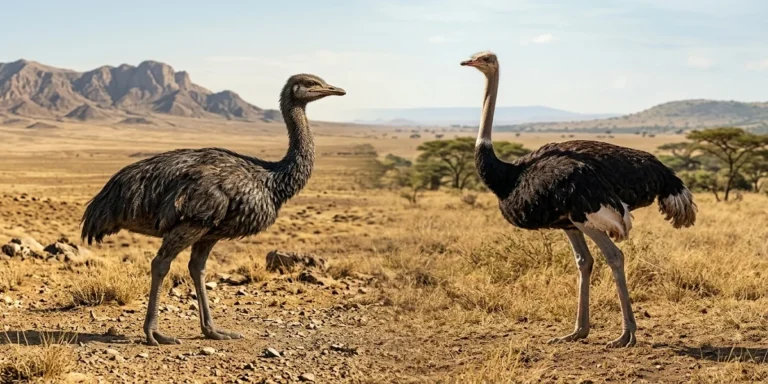
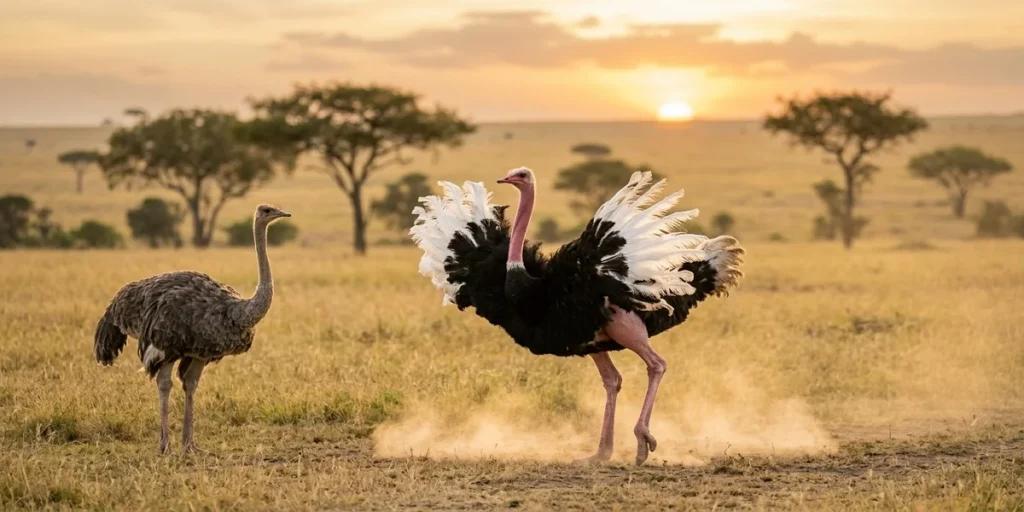
Males undergo a clear physical change as they mature. Adult males grow bold black body plumage with white wing and tail feathers, while females retain a subdued grayish-brown plumage that provides camouflage.
During the breeding season, mature males use this contrasting appearance, along with specialized vocalizations and aggressive courtship displays, to claim territory and attract females.
When Is the Ostrich Breeding Season?
Ostriches are seasonal breeders, meaning their reproductive activity peaks during specific parts of the year rather than remaining constant. The timing of the ostrich breeding season varies based on geography and environmental conditions, so the exact calendar differs by population.
In southern Africa, where wild ostriches are native, breeding begins in cooler months and continues through warmer periods. Captive ostriches follow different schedules depending on latitude, local climate, nutrition, and farm management.
Southern Hemisphere Breeding Season
In southern Africa, the primary ostrich breeding season extends from May or June through January or February. Reproductive activity fluctuates across this timeframe rather than remaining uniform.
A major breeding surge occurs from late winter into spring, followed by a smaller spike later in the season. This extended window allows ostriches to align nesting with seasonal rainfall and peak food availability.
For wild populations, this timing ensures that egg hatching and chick development occur when environmental conditions offer the highest survival rates.
Northern Hemisphere and US Breeding Season
Ostriches raised in the United States and other northern hemisphere regions breed during spring and summer. The exact schedule varies significantly between farms due to shifts in daylight patterns, local climate, and captive care routines.
Southern African dates cannot be applied directly to northern hemisphere operations because the seasons are reversed. Local weather and photoperiod changes naturally shift the start, peak, and end of the reproductive cycle.
| Region | Typical Breeding Period | Key Influencing Factors |
| Southern Africa | May/June to January/February | Wild seasonal cycle, rainfall patterns, food supply |
| Northern Hemisphere | Spring through summer | Latitude, seasonal climate, day length variations |
| Captive Farms (Global) | Variable by location | Dietary quality, farm management, artificial light |
Why Is Ostrich Breeding Seasonal?
Seasonal breeding provides a crucial biological advantage. Aligning reproduction with favorable weather ensures chick growth coincides with abundant resources.
Key factors driving the breeding cycle include:
- Day length and photoperiod changes
- Temperature fluctuations and rainfall
- Nutritional status and overall body condition
- Targeted feed management in commercial farm settings
Because these triggers vary globally, there is no single universal date for the ostrich breeding season. The biological driver remains seasonal, but the specific calendar depends entirely on location and environment.
How Do Ostriches Mate?
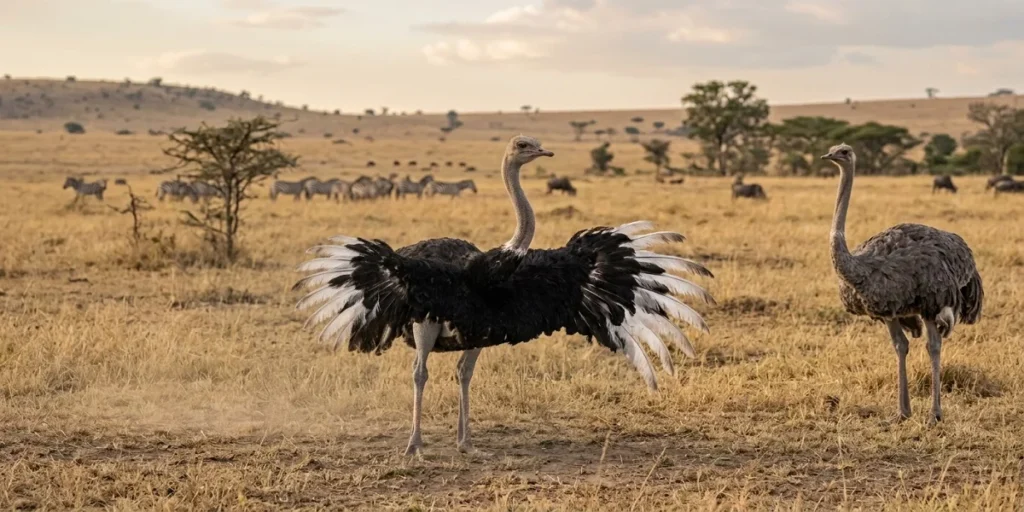
Ostrich mating combines territorial defense, specialized vocalizations, and elaborate physical displays. During the breeding season, mature males claim territories and use visual and vocal signals to attract females while repelling rival males.
Courtship is a dynamic, multi-step process. A receptive female responds with specific physical cues, leading to copulation within a complex social structure involving multiple birds.
Step 1: Male Territory Establishment
Before courtship begins, a mature male establishes and defends a specific breeding area. He displays aggressive posture, chases away competing males, and establishes dominance.
The quality and size of this area directly impact his ability to attract females. Stronger territorial hold increases mating opportunities and overall reproductive success.
Step 2: The Ostrich Courtship Display
When a female approaches, the male performs an elaborate courtship display known as “kantling”:
- Dropping low to the ground and spreading his wide wing feathers.
- Alternating wing movements in a rhythmic, swaying pattern.
- Emitting a low-frequency booming call that resonates across long distances.
This deep booming sound serves a dual purpose: attracting potential mates and signaling dominance to neighboring territory holders. The combination of black and white plumage, wing swaying, and vocalizations makes the ostrich courtship display one of the most distinct behaviors in avian biology.
Step 3: Female Response and Receptivity
A receptive female signals her interest through distinct submissive behaviors. She lowers her head and neck, flutters her wings, and pecks at the ground.
Female cooperation is required for mating to occur. The female’s behavioral signals determine whether the interaction progresses from courtship to copulation.
Step 4: Copulation and Mating System
Once the female accepts the display, copulation takes place. The male mounts the female, completing a brief mating process compared to the extensive period of courtship and territory defense.
Ostriches follow a polygynous mating system. A dominant male mates with multiple females within his established territory, rather than forming exclusive lifelong pair bonds for reproduction.
Step 5: Communal Nesting and Egg Laying
Mating directly transitions into nest building and oviposition:
- Nest Creation: The male scrapes out a simple, shallow depression in the dry ground.
- Communal Nesting: Multiple females deposit their eggs into this single ground nest.
- Egg Placement: The dominant female lays her eggs first and places them in the center of the pit for optimal protection.
This communal nest structure leads directly into shared incubation duties, with both the male and dominant female taking turns sitting on the clutch.
Ostrich Mating Behavior and Social Structure
Ostrich reproduction relies heavily on a structured social hierarchy. During the breeding season, mature males actively compete for land and females, leading to group dynamics where multiple hens associate with a single territory holder.
This reproductive setup is defined as a polygynous mating system, where one male pairs with several females. Within these breeding groups, rank determines territorial access, nesting priority, and overall reproductive success.
The Role of the Dominant Male
A dominant male secures prime land, defends resources, and drives away competing males. His dominance directly controls the breeding access of females within his territory.
Key characteristics of male dominance include:
- Territory Defense: Actively repelling rival males from core feeding and nesting sites.
- Mating Access: Securing exclusive breeding privileges with resident females.
- Subordinate Dynamics: Younger or weaker males are pushed to territorial margins, limiting their reproductive success.
Rather than pairing exclusively with one partner, the dominant male breeds with multiple hens that share his territory and use the same communal nest.
The Dominant Female (Major Hen)
Social rank among females is equally rigid. One primary hen, often referred to as the dominant female or major hen, establishes control over the communal nest.
The dominant female directly controls egg placement within the nest:
- Central Position: The dominant female places her eggs in the safest, temperature-stable center of the nest.
- Peripheral Position: Eggs laid by subordinate females (minor hens) are pushed toward the outer edges.
This strategic positioning ensures the dominant female’s offspring receive maximum protection during incubation, even though all eggs share the same communal pit.
Why Do Ostriches Use Communal Nesting?
Communal nesting offers distinct biological and survival advantages for ostriches:
- Higher Clutch Capacity: A single nest pit can safely hold 20 to 50 eggs, far more than one female could produce or manage alone.
- Resource Efficiency: Multiple females leverage a single nest site excavated and protected by the dominant male.
- Shared Defense: Concentrating eggs in one area allows adults to share incubation duties and predator defense efficiently.
While female competition remains high, communal nesting maximizes overall hatch rates across the breeding group.
Do Ostriches Mate for Life?
No, ostriches do not form monogamous life-long pair bonds. Their social structure is polygynous, meaning breeding groups reorganize between seasons based on age, health, and dominance challenges.
While males and females form close temporary bonds during the active breeding period, these partnerships end once the reproductive cycle concludes.
Egg Laying and Incubation
Successful mating transitions directly into the next phase of the reproductive cycle: egg production, communal nesting, and incubation. During the breeding season, females lay eggs at regular intervals, accumulating large clutches inside a single shared nest pit.
Total egg volume depends heavily on the female’s age, physical condition, dietary quality, and management environment (wild vs. farm raised).
How Often Does a Female Ostrich Lay Eggs?
A healthy female ostrich lays one egg every 1 to 2 days during an active laying cycle. Rather than depositing all eggs simultaneously, she adds to the nest gradually over several weeks.
Key laying metrics include:
- Individual Clutch Size: A single female typically produces 10 to 24 eggs per cycle.
- Communal Nest Accumulation: Combined clutches from multiple hens often result in 30 to 60+ eggs in one nest.
- Seasonal Farm Production: High-performing domesticated ostriches can produce 40 to 80+ eggs across an entire laying season when eggs are harvested regularly.
For a comprehensive breakdown of seasonal yield metrics, see our full guide on how many eggs an ostrich lays.
Who Incubates Ostrich Eggs?
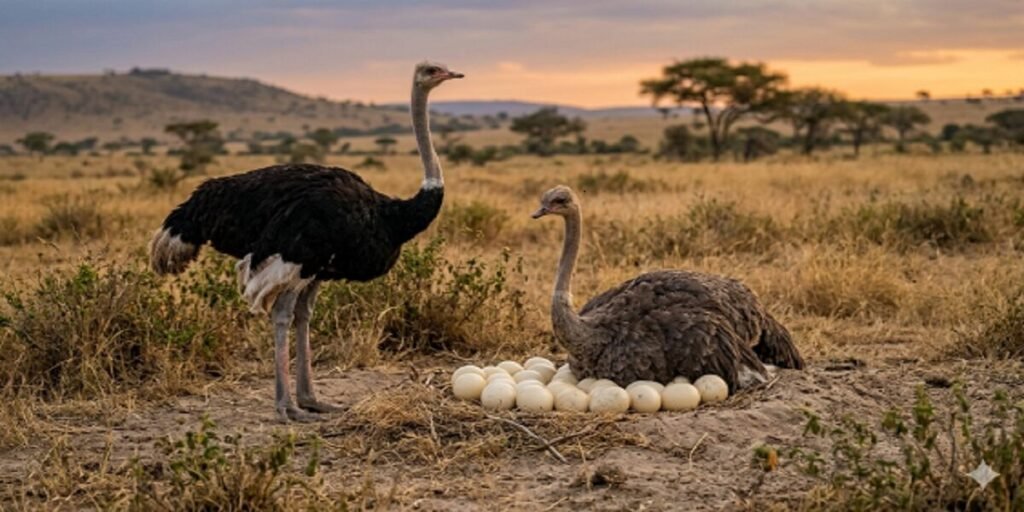
Ostrich incubation is a shared duty between the male and the dominant female, operating on a strict shift system designed around natural camouflage:
- Female Day Shift: The hen incubates during daylight hours. Her subdued grayish-brown plumage blends seamlessly with desert dirt and dry vegetation.
- Male Night Shift: The cock takes over at dusk. His jet-black body plumage provides concealment against nocturnal predators.
This specialized behavioral adaptation maximizes nest defense while minimizing predator detection. Both parents share active duties throughout the 42-day incubation period.
For complete incubation timelines, temperature requirements, and pipping mechanics, check our dedicated guide on ostrich egg hatching time.
What Happens to Eggs in a Communal Nest?
Because multiple hens utilize the same nest pit, egg position is heavily regulated by social rank:
- Central Protection: The dominant female rolls her own eggs into the center of the nest, securing optimal heat transfer and protection.
- Peripheral Exposure: Eggs from subordinate females are pushed to the outer perimeter, making them more vulnerable to heat loss or predator retrieval.
- Clutch Culling: If the nest becomes overcrowded, the dominant female may push outer eggs completely out of the pit to ensure her clutch receives full coverage.
Despite these competitive dynamics, communal incubation provides an efficient system for brooding high numbers of offspring in arid, predator-dense environments.
What Affects Ostrich Breeding Success?
Reaching sexual maturity and entering the breeding season does not automatically guarantee reproductive success. Ostrich breeding performance is heavily influenced by bird age, dietary nutrition, body condition, social group structure, and environmental triggers.
Managing these variables is particularly critical on commercial ostrich farms, where managed pairing replaces wild natural selection and territorial choice.
Age and Reproductive Maturity
Age is the primary determinant of initial breeding success. A young ostrich reaching baseline sexual maturity will not match the fertility rates or egg quality of an experienced, fully developed adult.
- Capability vs. Productivity: First-year breeding birds are biologically capable of laying or fertilizing eggs, but their overall yield remains lower.
- Peak Performance Window: Commercial breeding stock achieves maximum egg production, shell quality, and fertility 1 to 2 years after reaching initial maturity.
Establishing long-term breeding stock on fully mature adults ensures higher hatchability and more stable seasonal egg yields.
Nutrition and Body Condition
Producing massive, nutrient-dense eggs creates extreme physiological demands on females, while territorial behavior and courtship consume significant energy from males.
Substandard diets directly reduce egg laying frequency, shell thickness, and overall chick viability. Maintaining breeding birds on high-quality pre-breeding rations ensures:
- Optimal body condition scores leading into the active season.
- Higher continuous egg production without health depletion in females.
- Consistent stamina and sperm quality in dominant males.
Male-to-Female Ratio in Breeding Groups
Because ostriches utilize a polygynous mating system, breeding pens require balanced group dynamics rather than simple pair matching.
A proper male-to-female ratio optimizes reproductive output:
- Standard Farm Ratio: Most commercial setups utilize a ratio of 1 male to 2 or 3 females in trio or small group pens.
- Under-stocking Issues: Too few females can lead to excessive male harassment, physical injury, and stress for the hens.
- Over-stocking Issues: Too many males in open colony grazing systems causes severe territorial fighting, high stress, and interrupted copulation.
Farmers must adjust ratios based on pen size, bird temperament, and whether the system uses individual trios or open colony pasture setups.
Environment and Seasonality Triggers
Environmental signals dictate the timing and intensity of the ostrich breeding season. Variations in geography cause distinct local performance differences:
| Environmental Factor | Direct Impact on Breeding |
| Photoperiod (Day Length) | Increasing daylight triggers hormone production and courtship behavior. |
| Ambient Temperature | Moderate warm weather stimulates activity; extreme heat drops fertility. |
| Rainfall and Feed Growth | Natural rainfall cues abundance, prompting nest digging and egg laying. |
| Stocking Density | Adequate spatial allowances encourage normal courtship displays without friction. |
Stress Reduction and Farm Management
High stress levels directly disrupt normal courtship behavior, mating activity, and laying patterns. Environmental and social stressors include frequent human disturbance, overcrowding, poor transport handling, and loud noises.
Effective breeding management requires:
- Providing ample space for natural courtship displays and nest scraping.
- Maintaining stable social groups throughout the active reproductive cycle.
- Offering quiet, sheltered nesting areas free from high-traffic farm disruption.
Minimizing competitive stress allows ostriches to express natural reproductive behaviors, directly improving overall hatching success rates.
How Much Does an Ostrich Breeding Pair Cost?
The ostrich breeding pair cost varies widely based on bird age, proven fertility, overall health, genetic background, and regional market demand. Young, unproven birds sell at significantly different price points than fully mature, high-yielding adult pairs.
Local market supply, livestock transport logistics, and whether the pair is sold as primary breeding stock or general farm stock directly impact final commercial pricing.
Factors Determining the Value of a Breeding Pair
Several key variables dictate the market value of a proven ostrich breeding pair:
- Proven Fertility History: Mature pairs with documented records of laying fertile eggs and high hatchability command a premium price over young, untested birds.
- Bird Age and Maturity: Fully adult ostriches (ages 3 to 7) sitting within their peak reproductive window carry higher valuations than juvenile or older stock.
- Genetics and Bloodline: Recognized breeding lines optimized for superior meat yield, high-grade full-quill leather, or strong chick survival rates add significant value.
- Health and Body Condition: Strong skeletal structure, complete feathering, and clean health records enhance buyer confidence and overall pricing.
- Regional Availability and Transport: Shipping large ratites requires specialized livestock trailers, making geographic location and transport distance a key cost factor.
Evaluating total long-term value, health history, and egg productivity is far more critical than simply seeking the lowest initial purchase price. For current market ranges across chicks, juveniles, adults, and adult pairs, consult our comprehensive ostrich price guide.
Is Buying a Breeding Pair Enough to Start a Farm?
No, purchasing a single breeding pair is only the initial step in building a viable commercial ostrich business. Establishing a functional farm requires substantial capital investment beyond buying the birds.
Essential startup and ongoing farm expenses include:
- Infra-structure and Land: Perimeter fencing (minimum 5 to 6 feet high), secure holding pens, and outdoor run paddocks.
- Nesting and Shelter Facilities: Dedicated sheltered nesting areas, egg collection equipment, and chick brooding facilities.
- Specialized Nutrition: High-protein ratite feeds, calcium supplements, and clean water delivery systems.
- Veterinary Care and Husbandry: Regular biosecurity protocols, health checks, and routine parasite control.
- Incubation Equipment: Commercial incubators and hatchers required for artificial incubation if natural nest brooding is not utilized.
A successful ostrich farming business model relies on how quickly the birds begin producing eggs, chick hatch rates, and established sales channels for meat, hides, feathers, or live juvenile stock.
Frequently Asked Questions About Ostrich Breeding
What Age Do Ostriches Start Breeding?
Domesticated ostriches reach breeding maturity at 2 to 3 years old, whereas wild ostriches mature later, around 4 to 5 years. Females reach sexual maturity slightly earlier than males.
When Is the Ostrich Breeding Season?
The ostrich breeding season depends on geography. In southern Africa, breeding runs from May or June through January or February. In the Northern Hemisphere, ostriches breed during spring and summer.
How Do Ostriches Mate?
Ostriches mate after an elaborate courtship display where the male uses wing sways, low-frequency booming calls, and body posture to attract a female. Copulation occurs once the female displays receptive behavior.
How Long Does Ostrich Copulation Last?
Actual copulation is brief (lasting under a minute), but courtship, territory defense, and repeated mating interactions continue throughout the entire active breeding season.
Do Ostriches Mate for Life?
No, ostriches do not form monogamous life-long pair bonds. They follow a polygynous mating system where one dominant male mates with multiple females each season.
How Many Eggs Does an Ostrich Lay During the Breeding Season?
A female lays an egg every 1 to 2 days, creating an individual clutch of 10 to 24 eggs. High-producing domesticated females can lay 40 to 80+ eggs over a complete season when eggs are harvested continuously.
Do Male and Female Ostriches Both Incubate Eggs?
Yes, incubation is a shared responsibility:
Female (Day Shift): Her grayish-brown feathers blend into daylight soil.
Male (Night Shift): His black plumage hides the nest from nocturnal predators.
Can Ostriches Breed Outside Their Normal Breeding Season?
Generally no, because ostriches are seasonal breeders triggered by day length and climate. However, controlled captive conditions, high nutrition, and artificial lighting can shift or extend active laying periods.
Why Do Captive Ostriches Perform Courtship Displays Toward Humans?
Courtship behavior directed at humans occurs due to imprinting. Chicks hand-raised without adult ostriches accept humans as social partners, leading to abnormal adult courtship displays.
Can You Legally Own an Ostrich in the United States?
Yes, but ownership depends on state and local regulations. Zoning laws, land size minimums, and exotic livestock permits vary significantly by county and state.
Is Ostrich Farming Profitable Starting with Breeding Pairs?
Ostrich farming can be profitable, but purchasing a breeding pair is only one cost component. Profitability relies on hatch rates, feed conversion efficiency, fencing infrastructure, and established commercial markets for meat, leather, and breeding stock.
Final Takeaway
Successful ostrich breeding requires matching farm management to the bird’s natural biological cycle:
- Age and Maturity: Domesticated birds mature earlier (2 to 3 years) than wild populations.
- Seasonality: Breeding timing shifts based on hemisphere, photoperiod, and local climate.
- Social Hierarchy: A polygynous mating system and communal nesting require balanced male-to-female ratios and low-stress pen design.
Providing high-quality pre-breeding nutrition, adequate acreage, and proper social grouping ensures optimal egg production, strong shell quality, and high hatching success rates for your flock.