Quick Answer: Ostrich feathers are used mainly in fashion and costumes, home and event decoration, feather dusters, crafts, and fly-tying. Retail prices can range from around $1.50 to $12 or more per feather, depending on length, quality, color, and type. Unlike feathers from many protected wild birds, ostrich feathers are generally legal to buy, own, and sell because ostriches are commercially farmed, non-native birds.
Table of Contents
Ostrich feathers have been associated with beauty, luxury, and status for centuries, but their appeal goes far beyond fashion. Their soft texture, flexible structure, and distinctive movement have made them useful for everything from elaborate costumes and wedding decorations to delicate dusting tools and fishing flies.
Today, ostrich feathers are commercially available in many lengths, grades, and colors, making them suitable for both professional and everyday uses. But how much is an ostrich feather actually worth, and why can two feathers of similar size have very different prices?
There is also an interesting legal distinction between ostrich feathers and feathers from protected wild birds, particularly in the United States. And if you have ever wondered whether ostrich feathers are the most valuable bird feathers in the world, the answer may surprise you.
Let’s look at where ostrich feathers are used, what they cost, how they are sourced, and which bird actually holds the record for the most expensive bird feather ever sold.
What Are Ostrich Feathers Used For?
Ostrich feathers are used for much more than decorative fashion pieces. Their soft, flexible structure makes them particularly useful where a feather needs to provide movement, texture, or gentle contact with a surface.
Unlike the stiff, tightly connected vanes found in many flight feathers of flying birds, ostrich feathers have loose, flexible barbs that give them their characteristic fluffy appearance. This structure allows them to move easily and creates the soft, flowing effect that makes ostrich feathers so popular in fashion and decoration.
The most common ostrich feathers uses can be divided into several major categories:
| Category | Common Uses |
|---|---|
| Fashion & Costumes | Boas, gowns, dresses, hats, fascinators, stage costumes |
| Home & Event Decor | Wedding centerpieces, floral arrangements, backdrops, chandeliers, table displays |
| Cleaning & Practical Uses | Feather dusters, delicate-surface cleaning, some automotive detailing |
| Fishing & Crafts | Fly-tying, DIY projects, jewelry, ornaments, and other crafts |
| Historical & Ceremonial Uses | Fans, headwear, ceremonial clothing, and traditional decorative pieces |
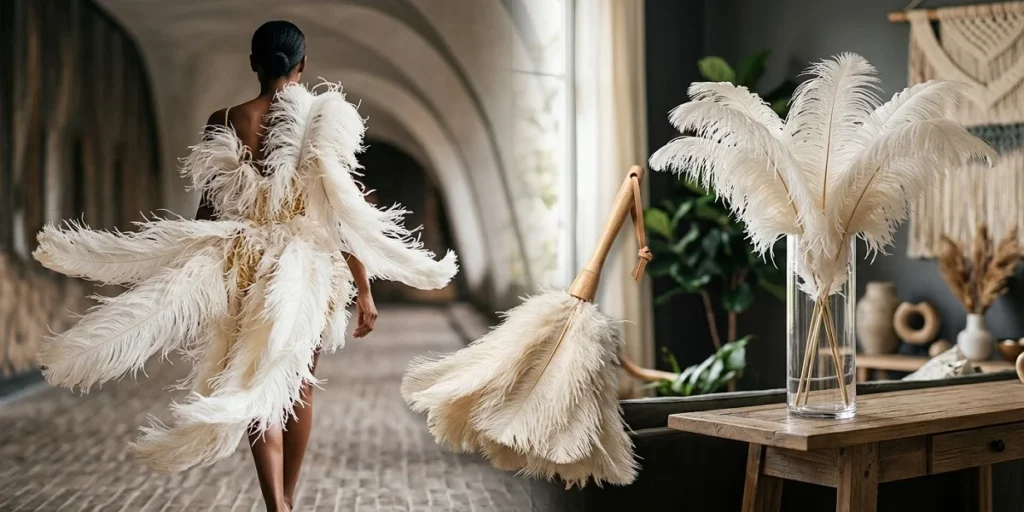
The appeal of ostrich feathers comes partly from their versatility. A long, full plume can become a dramatic fashion accent, while smaller feathers can be dyed for crafts or arranged into decorative displays. The same soft structure that makes them visually striking can also make them useful for gently removing dust from delicate objects.
Some uses are centuries old, while others have developed into modern commercial applications. Fashion remains one of the most recognizable markets, but decoration, cleaning products, crafts, and other specialty applications have helped keep demand for ostrich feathers alive.
In the following sections, we’ll look at each major use in more detail, starting with one of the industries most closely associated with these distinctive feathers: fashion and costume design.
Ostrich Feathers in Fashion and Costumes
Fashion is one of the best-known ostrich feathers uses, and the reason is easy to understand once you see how these feathers behave. Their soft texture, natural volume, and flowing movement can add drama to a garment without making it look rigid or heavy.
Ostrich feathers have long been associated with elegance and luxury. Designers can use individual plumes as subtle accents or combine hundreds of feathers to create a much more dramatic effect. Because the feathers can be trimmed, shaped, dyed, and arranged in different ways, they offer considerable creative flexibility.
Ostrich Feathers in Haute Couture
In high fashion, ostrich feathers are often used as decorative details rather than as the primary material of a garment. Designers may attach them to sleeves, collars, skirts, hemlines, or bodices to create movement and texture.
Long, full plumes are particularly effective on garments that are designed to move with the wearer. As the feathers sway while someone walks, they create a visual effect that fabrics alone cannot easily reproduce.
Ostrich feathers can also be dyed in a wide range of colors, allowing designers to match them with specific fabrics and collections. Natural white and black feathers are popular, while dyed pink, red, blue, yellow, and other shades are commonly available from specialty suppliers.
Ostrich Feathers in Costumes and Entertainment
The dramatic movement of ostrich feathers makes them especially useful in theater, dance, film, and stage costumes. A relatively small number of feathers can make a costume appear larger, more elaborate, or more visually dynamic under stage lighting.
Feathers are commonly incorporated into headdresses, boas, skirts, sleeves, capes, and other costume elements. They are particularly effective in performances where movement is an important part of the visual presentation.
Their association with glamour has also made ostrich feathers a familiar design element in costumes inspired by historical entertainment and early twentieth-century fashion. They can immediately evoke the visual language of cabaret, burlesque, ballroom performances, and other theatrical styles.
Ostrich Feathers in Hats and Millinery
Another long-standing use is millinery, the design and decoration of hats. Smaller ostrich plumes can be attached to formal hats, fascinators, and other headwear to add height, softness, and texture.
Unlike some stiff decorative materials, feathers can move naturally as the wearer walks. This makes them particularly effective when a designer wants a hat to have a noticeable but lightweight decorative element.
The quality of the feather matters here. Fuller, cleaner plumes with consistent barbs tend to produce a more polished appearance, while smaller or less uniform feathers may be better suited to crafts and less formal decorative work.
Why Are Ostrich Feathers Popular in Fashion?
The popularity of ostrich feathers in fashion comes down to a combination of texture, movement, softness, and versatility. They can make a simple garment look more elaborate while remaining light enough for detailed costume and millinery work.
They also have a distinctive visual character. Even when used in relatively small quantities, a cluster of ostrich feathers can create volume and movement that immediately draws attention.
That combination helps explain why ostrich feathers continue to appear in fashion and costume design today, even though many other synthetic and natural decorative materials are available.
Ostrich Feathers for Home and Event Decor
Beyond fashion, ostrich feathers for home and event decor offer an effective way to introduce height, volume, and texture. Their soft, open-barb structure fills large spatial areas without creating physical weight or dense visual barriers.
Designers utilize these versatile plumes across various settings:
- Natural shades: White, black, and gray plumes for minimalist or classic aesthetic themes.
- Dyed colors: Vibrant hues tailored to seasonal displays, holiday arrangements, and custom palettes.
Wedding and Event Decor
Ostrich feather centerpieces represent one of the most recognizable styling trends in event design. Tall plumes placed in slender vases add dramatic height above guest eye levels without obstructing across-the-table conversation.
Key applications in event styling include:
- Table centerpieces: Combined with floral elements or displayed as standalone feather towers.
- Ceremony accents: Backdrop displays, altar arrangements, and aisle markers.
- Photographic setups: Photo booth backdrops, entrance arches, and lounge decor.
- Stage & venue design: Focal point displays for galas, theatrical events, and vintage themes.
White ostrich feathers remain the standard choice for luxury wedding concepts, while brightly dyed plumes serve retro, Hollywood glam, or modern celebration styles.
Interior Decoration
In residential and commercial spaces, ostrich plumes serve as lightweight architectural accents. Placed in tall floor vases, a sparse group of feathers adds vertical interest and softness to structured modern interiors.
Common interior applications include:
- Statement vases: Placed on entry tables, mantels, or floor corners.
- Lighting design: Incorporated into feather lampshades and ambient light fixtures.
- Custom accents: Wreaths, wall art, and handcrafted decorative accessories.
Maintenance note: Because ostrich feather barbs naturally catch dust, interior arrangements require gentle dusting with an air blower or soft duster. Keep displays away from high-humidity areas and direct heat sources to preserve plume volume.
Why Ostrich Feathers Work Well as Decor
Ostrich plumes remain a staple material in interior and event styling due to three core physical properties:
- High Visual Volume with Low Weight: Large plumes fill wide architectural footprints without requiring heavy structural supports.
- Dynamic Air Movement: Unlike rigid artificial foliage, plumes sway gently with subtle room air currents, creating a living texture.
- Flexible Styling Options: Plumes easily mix with fresh flowers, dried botanicals, micro-LED lighting, and crystal strands.
Beyond visual styling, the unique physical structure of ostrich feathers also serves functional, practical applications where movement and texture take precedence over appearance.
Ostrich Feathers for Practical Uses
While famous for fashion and decor, the unique physical structure of ostrich feathers makes them highly practical tools. Unlike contour feathers from most birds, ostrich feathers lack interlocking barbules. This creates a soft, independent network of barbs that naturally traps fine particles and flows fluidly in liquids or air.
Ostrich Feather Dusters and Household Cleaning
One of the most efficient practical ostrich feather uses is in manual dusting tools. The microscopic filaments along each barb generate a natural static charge that attracts and captures fine dust rather than pushing it around.
Key structural advantages for gentle surface cleaning include:
- Conforming reach: Soft barbs wrap around complex items, entering tight crevices without snagging.
- Non-abrasive touch: Safe for delicate porcelain, vintage glassware, fine artwork, and framed canvas.
- Zero pressure needed: Removes loose dust instantly without requiring force or liquid cleaning agents.
Commercial dusters range from compact handheld tools for delicate collectibles to extra-long telescoping dusters for high ceiling fans and light fixtures.
Ostrich Feathers in Fly-Tying for Fishing
In fly-fishing, small sections of ostrich feathers serve as a specialized material for tying artificial flies. Anglers use ostrich herl, the individual soft strands attached to the main feather quill, to craft realistic bait imitations.
Applications in fly construction include:
- Fly bodies: Wrapped tightly around hooks to mimic segmented insect torsos.
- Thorax and collars: Creates fine, breathing fibers on nymphs and streamer patterns.
Under water, ostrich herl pulses and moves continuously with the current, generating a natural breathing action that triggers predatory fish strikes.
Ostrich Feathers for Crafts and DIY Projects
For crafters and independent artists, ostrich feathers offer a lightweight, high-volume material for mixed-media projects. Smaller, lower-grade plumes or trimmed herl provide affordable texture without requiring premium, full-length plumes.
Popular handmade applications include:
- Wearable art: Custom jewelry, hair clips, fascinators, and masquerade masks.
- Paper crafts: Embellishments for wedding stationery, greeting cards, and scrapbooks.
- Home accents: Handcrafted dreamcatchers, holiday ornaments, and feather trim for textile designs.
Dyed ostrich feathers absorb pigments deeply, giving crafters access to vibrant color options that retain their soft visual appeal over time.
Ostrich Feathers in Automotive Detailing
Professional detailers and car enthusiasts use specialized ostrich feather dusters for interior vehicle maintenance. They excel at clearing fine dust from sensitive car interiors where rough microfiber cloths or stiff brushes might leave micro-scratches.
Ideal automotive applications include:
- Instrument clusters: Safely clears clear plastic gauge covers without scratching.
- Touchscreens and piano-black trim: Removes dust from high-gloss surfaces prone to swirl marks.
- Air vents and switchgear: Reaches deep into narrow vent slats and around dashboard dials.
Usage note: Feather dusters are designed strictly for removing loose, dry surface dust. They are not intended for scrubbing grime, grease, or heavy dirt deposits.
Ostrich Feather Prices and Market Value
The ostrich feather cost varies significantly across the commercial market. A basic craft feather can cost under $2, while a long, full-grade plume used in high-end fashion or event centerpieces can reach $12 or more per stem.
Retail pricing depends primarily on length, density, color processing, and order volume rather than a single fixed commodity rate.
Ostrich Feather Cost Breakdown
Prices vary depending on the grade and dimensions of the plume. Below is a standard retail price breakdown:
| Feather Type | Average Length | Retail Price (Per Feather) | Primary Applications |
| Craft Feathers | 5–8 inches | $1.50–$3.00 | DIY crafts, jewelry, card making |
| Medium Plumes | 12–16 inches | $2.00–$8.00 | Costumes, small centerpieces, hats |
| Long Premium Plumes | 18–24+ inches | $10.00–$12.00+ | Luxury fashion, large event decor, stage performance |
| Bulk Packs | Mixed sizes | Varies by weight / count | Weddings, theatrical productions, commercial manufacturing |
Note: Wholesale suppliers often provide steep volume discounts when purchasing in bundles of 50 to 100+ stems.
Key Factors Determining Ostrich Feather Value
Several structural and commercial factors influence the market value of individual plumes:
- Overall Length: Longer plumes require extended growth cycles and offer maximum visual presence, making them the most expensive category.
- Barb Density and Condition: Premium plumes feature thick, unbroken, and uniform barbs along the quill without sparse patches or split tips.
- Color Processing: Natural white and black feathers serve as baseline standards. Specialty dyed hues, custom metallic finishes, or precisely color-matched batches command higher prices due to additional chemical processing.
- Feather Type & Position: Primary wing plumes (females and males) differ in size, texture, and fullness compared to body or tail feathers.
- Purchase Volume: Buying single replacement stems yields the highest per-feather price, whereas commercial event designers buy by weight or bulk count to lower unit costs.
Are Ostrich Feathers Considered Expensive?
Compared to rare, wild, or protected bird plumage, ostrich feathers remain widely accessible. Because ostriches are commercially farmed worldwide for meat, leather, and feathers, the supply chain is stable and regulated.
However, costs scale quickly depending on project scale:
- Low-cost applications: Small craft projects requiring a few accent feathers remain budget-friendly.
- High-cost applications: Outfitting an entire stage production, gala venue, or haute couture collection with hundreds of color-matched, premium-grade 24-inch plumes can quickly turn into a multi-thousand-dollar investment.
While individual plumes are affordable, the total cost for large-scale, professional arrangements reflects the sorting, grading, and cleaning required to produce uniform luxury-grade displays.
Ostrich Feather Legal Status and Regulations
Feather trade laws often confuse buyers and sellers because regulations protecting wild native birds are commonly confused with rules for commercial livestock. Ostrich feathers are fully legal to buy, sell, and own in most jurisdictions because ostriches are non-native, commercially farmed birds rather than protected wild species.
Legal Framework in the United States
In the United States, native wild birds fall under strict federal protection under the Migratory Bird Treaty Act (MBTA). This law prohibits possessing, buying, selling, or transporting feathers from native migratory species without federal permits even if found shed on the ground.
Ostrich feathers differ entirely from wild plumage under federal law:
- MBTA Exemption: Ostriches (Struthio camelus) are non-native, agricultural livestock not protected by the MBTA.
- No Wildlife Permits Required: Consumers and businesses do not need federal migratory bird permits to purchase, retain, or process ostrich plumes.
- Commercial Availability: Plumes flow legally through open craft, fashion, and retail markets nationwide.
Why Ostrich Feathers Differ From Wild Bird Feathers
The key distinction lies in species origin and conservation status:
| Regulatory Trait | Wild Native Birds (e.g., Hawks, Eagles, Songbirds) | Commercially Farmed Ostriches |
| Legal Classification | Protected wild species | Commercial agricultural livestock |
| Trade Restrictions | Sale and possession strictly prohibited or regulated | Fully legal for open commercial trade |
| Sourcing Method | Poaching / Wild collection (illegal) | Regulated ostrich farm production |
| Primary Goal | Species conservation and anti-exploitation | Controlled agricultural commodity supply |
International Trade and Import/Export Rules
While domestic possession and sales are straightforward, international shipments of ostrich feathers involve cross-border customs regulations.
Key considerations for cross-border transactions include:
- CITES Regulations: The common ostrich (Struthio camelus) is generally not listed under strict CITES Appendix I prohibitions for commercial stock, but specific subspecies or wild populations may carry restrictions.
- Veterinary and Biosecurity Clearances: Many countries require sanitary certificates or heat-treatment documentation to verify that raw feather shipments carry no avian pathogens (such as Avian Influenza).
- Customs Declarations: Commercial bulk imports require accurate tariff classification and declared values to clear import duties cleanly.
Summary: Domestic ownership and retail sales of ostrich feathers are legal and unrestricted. However, businesses importing or exporting bulk plumes across international borders must verify local agricultural import permits and biosecurity requirements prior to shipping.
What Is the Most Expensive Bird Feather?
If you are wondering whether ostrich feathers are the most expensive bird feathers in the world, the answer is no. Ostrich feathers have a commercial market and can become relatively expensive when sold as premium plumes, but they are not in the same category as extremely rare historical bird feathers.
The record is associated with the huia, an extinct bird from New Zealand. A single preserved huia tail feather sold at auction in 2024 for NZ$46,521.50, equivalent to roughly US$28,000 at the time, making it the most expensive individual feather recorded by Guinness World Records.
Why Was the Huia Feather So Expensive?
The extraordinary price of the huia feather has little to do with its usefulness as a feather. Its value comes from a combination of extreme rarity, cultural significance, historical importance, and the extinction of the species.
The huia (Heteralocha acutirostris) disappeared from New Zealand in the early 20th century. Its feathers had a particularly important place in Māori culture, where they were associated with status and were traditionally worn by people of high rank.
Because the species is extinct, surviving huia feathers are exceptionally rare. A well-preserved example therefore belongs more to the world of historical collectibles and cultural artifacts than to the ordinary feather market.
How Do Ostrich Feathers Compare?
Ostrich feathers are almost the opposite of huia feathers in terms of availability. Ostriches are commercially farmed around the world, and their feathers are produced and sold as part of an established agricultural industry.
That makes genuine ostrich feathers much easier to obtain and generally far less expensive. A premium ostrich plume might sell for several dollars or more, but that is a commercial retail price rather than the kind of collectible value associated with a rare historical feather.
This distinction is important when comparing feather prices. The most expensive bird feather is not necessarily the most expensive commercially produced feather. The huia record reflects rarity and historical significance, while ostrich feather prices are primarily determined by characteristics such as size, quality, fullness, color, and demand.
For OstrichPro readers interested in the history and symbolism of ostrich feathers, their cultural significance extends much further back than the modern fashion industry. Ostrich feathers have appeared in ceremonial dress, royal imagery, and ancient art for thousands of years.
Ostrich Feather Facts You Might Not Know
Ostrich feathers have a few unusual characteristics that help explain why they have remained useful for so long. Some are related to the biology of the ostrich itself, while others explain the feather’s long history in fashion, decoration, and culture.
Ostriches Have the Largest Feathers of Any Living Bird
The ostrich is the largest living bird in the world, and its feathers are correspondingly large compared with those of most other birds. Long, full plumes can create considerable visual volume despite weighing very little.
This combination of size and lightness is one reason ostrich feathers work so well in fashion, costumes, and large decorative arrangements.
Male and Female Ostriches Have Different Feather Colors
Adult male and female ostriches have noticeably different plumage. Males typically have predominantly black body feathers with white wing and tail feathers, while females are generally more muted, with grayish-brown plumage.
This difference is related to the ostrich’s biology and breeding behavior, but it also means that feathers from different birds can have naturally different appearances before they are dyed or processed.
Ostrich Feathers Are Not Just Decorative
The feathers serve important biological functions for the ostrich itself. They help with insulation and temperature regulation, and the wings and tail also play roles in display, balance, and movement.
This is a useful reminder that the qualities people appreciate in ostrich feathers commercially, such as their softness, volume, and movement, originally evolved for biological purposes.
Ostrich Feathers Can Be Dyed in Almost Any Color
Natural ostrich feathers are available in a relatively limited range of colors, but commercially prepared feathers can be cleaned, processed, and dyed into a wide variety of shades.
This is particularly useful in fashion, costumes, event decoration, and crafts, where designers often need feathers to match a specific color scheme.
Not All Ostrich Feathers Are the Same
“Ostrich feather” is a broad commercial term rather than a description of one identical type of feather. Feathers can differ significantly in length, shape, fullness, texture, and the part of the bird from which they come.
That variation helps explain why prices can range from a few dollars for small craft feathers to considerably more for long, full premium plumes.
Ostrich Feathers Have Been Used for Centuries
The decorative use of ostrich feathers is not a modern fashion trend. Ostrich feathers have appeared in ceremonial clothing, royal imagery, fans, headdresses, and other forms of status display across different periods and cultures.
Their long association with prestige is one reason they continue to carry a sense of luxury today, even though commercially farmed ostrich feathers are now much easier to obtain than they were historically.
Frequently Asked Questions About Ostrich Feathers
What Are Ostrich Feathers Used For?
Ostrich feathers serve both decorative and functional purposes across multiple industries:
Fashion & Costumes: Applied to haute couture garments, stage costumes, boas, and millinery.
Event & Interior Decor: Arranged into wedding centerpieces, floor vase displays, and lighting fixtures.
Practical & Specialized Uses: Assembled into static-charging dusters, mixed-media crafts, and fly-fishing lures.
How Much Is an Ostrich Feather Worth?
Ostrich feather pricing spans a wide retail spectrum:
Small craft feathers (5–8 inches): $1.50–$3.00 per feather.
Medium costume plumes (12–16 inches): $2.00–$8.00 per feather.
Long premium plumes (18–24+ inches): $10.00–$12.00+ per stem.
Final costs depend on plume length, barb density, custom dye processing, and bulk purchasing discounts.
Is There a Commercial Market for Ostrich Feathers?
Yes. Ostrich feathers maintain a stable global market backed by commercial ostrich farming. Plumes are harvested and sold alongside primary agricultural yields, including ostrich leather and lean meat cuts.
Is It Legal to Own or Sell Ostrich Feathers?
Yes. In the United States and most international jurisdictions, ostrich feathers are legal to buy, sell, and possess. Because ostriches are non-native, commercially farmed livestock, they are exempt from native wildlife restrictions like the Migratory Bird Treaty Act (MBTA).
Are Ostrich Feathers Ethically Sourced?
Sourcing ethics depend on farm practices. Feathers are naturally shed during annual molting cycles or collected during routine agricultural processing. Buyers seeking ethical assurance should source plumes from registered farms that maintain humane animal welfare standards.
What Is the Most Expensive Bird Feather in the World?
The world record belongs to a single extinct Huia bird feather from New Zealand, which sold at auction for over NZ$46,000 in 2024. By contrast, commercially available ostrich feathers are accessible agricultural commodities rather than rare historical artifacts.
Can Ostrich Feathers Be Used for Cleaning?
Yes. Ostrich feather dusters excel at cleaning because their soft barbs create a natural static charge that attracts and holds fine dust. Their soft, non-abrasive texture makes them safe for delicate electronics, fine art, and instrument clusters.
Why Are Ostrich Feathers Popular in Fashion and Costumes?
Designers favor ostrich feathers for three primary visual characteristics:
Fluid Movement: Sway naturally with motion under stage or spotlight lighting.
Weightless Volume: Add dramatic visual depth without making garments heavy.
Dye Retention: Absorb rich color pigments evenly across all barbs.
Where Can You Buy Genuine Ostrich Feathers?
Authentic ostrich feathers are available through several channels:
Specialty Feather Wholesalers: Best for bulk, color-matched, long premium plumes.
Craft & Fabric Retailers: Ideal for smaller quantities and craft-grade feathers.
Direct Ostrich Farms: Sourced directly from agricultural producers offering raw or processed plumes.
Final Thoughts on Ostrich Feathers
Ostrich feathers are much more versatile than their glamorous reputation might suggest. They are used in fashion, costumes, event decoration, crafts, cleaning tools, and specialty applications, while their price can range from a few dollars for small feathers to considerably more for long, high-quality plumes.
Their commercial availability also makes ostrich feathers very different from rare or protected wild-bird feathers. While a single ostrich feather is not the world’s most expensive feather, the combination of its distinctive appearance, practical qualities, and long cultural history has helped keep it valuable in modern markets.
From elaborate fashion pieces to something as simple as a feather duster, ostrich feathers continue to prove that one of the world’s most distinctive bird feathers can be both beautiful and surprisingly useful.