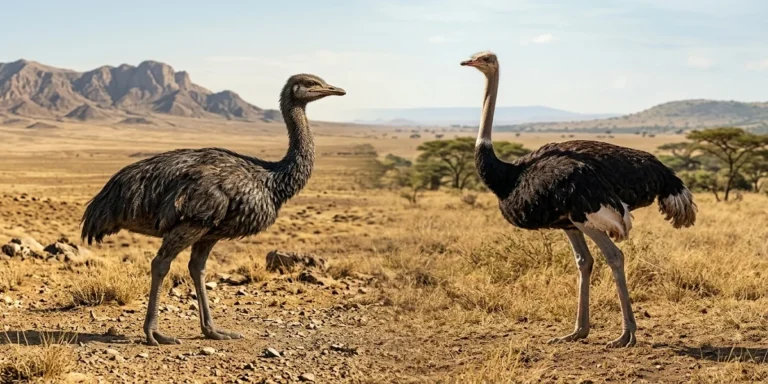
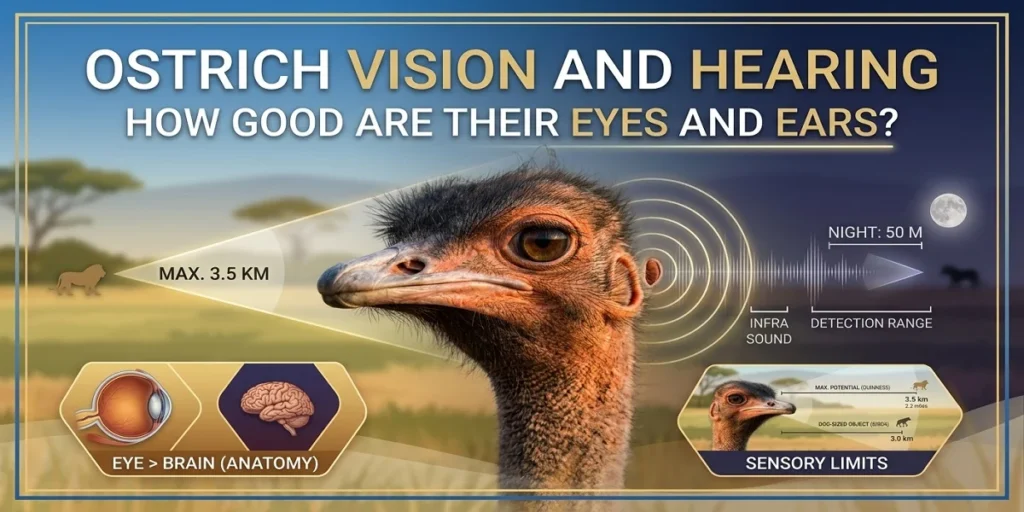
Quick Answer: Ostrich eyesight is excellent in daylight. Ostriches have the largest eyes of any land animal, with an eye measuring up to 50 mm (2 inches) from the front of the cornea to the back of the retina. Each eye is also larger than the bird’s brain, and Guinness World Records reports that ostriches can see for up to 3.5 km (2.2 miles), helping them detect potential predators across open landscapes.
Ostrich hearing is much less studied. They have ear openings but no external ear flaps, and researchers have examined the acoustic mechanics of their inner ears in laboratory studies. However, science has not established a simple, reliable number for the ostrich’s complete hearing range or sensitivity.
Table of Contents
Introduction
An ostrich can weigh more than a full-grown man, yet one of its enormous eyes is larger than its entire brain. That unusual combination tells us something important about how this bird survives in open African habitats.
On grasslands and savannas, spotting danger early can mean the difference between escaping a predator and becoming its next meal. Ostriches have evolved an impressive visual system for scanning their surroundings, detecting movement, and identifying potential threats from a distance.
But what about hearing? Ostriches do have ears, even though they lack the visible external ear flaps found in mammals. Their hearing has also been studied scientifically, but far less extensively than their remarkable eyes.
So how good is an ostrich’s eyesight and hearing? In this guide, we look at what researchers and reliable sources actually tell us about ostrich vision, eye size, night vision, hearing, and the famous claim that an ostrich’s eye is bigger than its brain.
How Good Is an Ostrich’s Eyesight?
Ostrich eyesight is exceptionally well adapted to life in open landscapes. Their enormous eyes give them a large optical system for collecting light and forming images, while specialized areas of the retina support detailed vision across the horizon. Research on the ostrich retina has estimated a maximum visual acuity of about 19.3 cycles per degree along its visual streak.
An ostrich also has a major advantage that has nothing to do with eyesight alone: height. With its eyes positioned high above the ground, it can scan a broad area of open habitat while standing or feeding. For a large prey animal living alongside predators, detecting movement early can provide valuable time to react.
Eye Size and Why It Matters
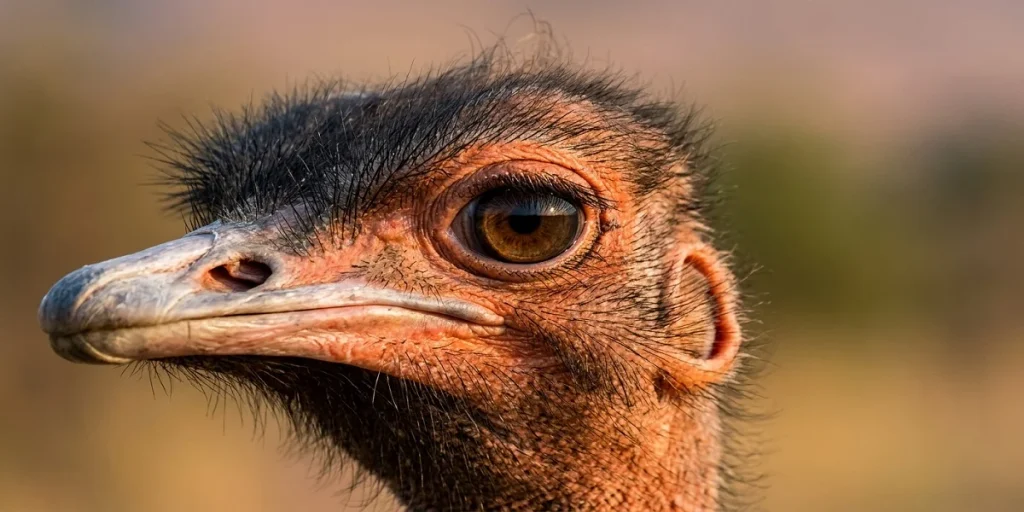
The ostrich has the largest eyes of any land animal. Guinness World Records gives an eye measurement of up to 50 mm (2 inches), measured from the centre of the cornea at the front of the eye to the centre of the retina at the back. That is roughly twice the corresponding diameter reported for the human eye.
The size of an eye matters because its optical dimensions influence how an image is formed on the retina. In general, a longer optical system can support a larger retinal image and higher potential spatial resolution. Researchers studying ostrich ocular optics have found that the eye is unusually large and has a specialized optical design in which the lens and cornea contribute roughly equally to its total optical power.
The important point is that the ostrich’s huge eye is not simply a novelty. Its size is closely connected to the demands placed on vision in a large, open environment.
| Feature | Ostrich | Human |
|---|---|---|
| Eye size | Up to about 50 mm in the Guinness measurement | About half the ostrich measurement |
| Eye position | Laterally positioned, supporting a broad visual field | More frontally positioned |
| Visual role | Long-distance environmental scanning and threat detection | Broad range of detailed visual tasks |
The ostrich retina also contains specialized regions associated with high visual resolution. One study found a pronounced visual streak and estimated maximum acuity of approximately 19.3 cycles per degree, suggesting that the bird can resolve considerable detail along the horizon.
This helps explain why an ostrich’s eyesight is so important: the bird is not relying on enormous eyes simply to see a larger version of the same scene. Its visual system is adapted to extract useful information from a wide, open landscape.
How Far Can an Ostrich See?
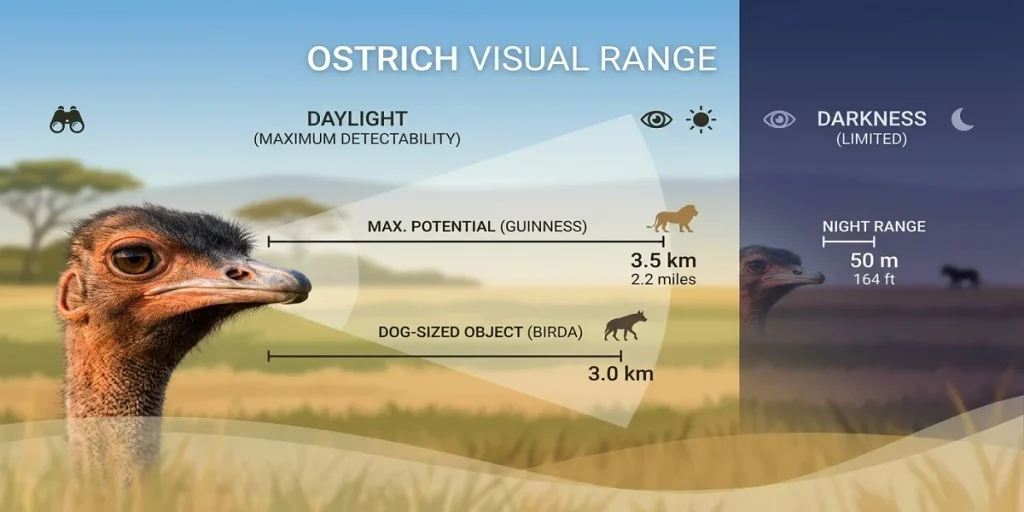
There is no single scientifically established distance at which an ostrich suddenly stops seeing. Instead, the distance depends on what the bird is trying to detect, the size and movement of the object, terrain, and lighting conditions.
Guinness World Records reports that an ostrich can see for up to 3.5 km (2.2 miles), enough to detect potential predators such as lions while they are still far away.
Other sources give somewhat different figures. Birda, for example, reports that an ostrich can detect a large dog-sized moving object at around 3 km during the day, while estimating a much shorter distance of about 50 m in darkness.
| Source | Reported distance | What it describes |
|---|---|---|
| Guinness World Records | Up to 3.5 km (2.2 miles) | Long-distance vision and predator detection |
| Birda | About 3 km | A large dog-sized object in daylight |
| Birda | About 50 m | The same type of object in darkness |
These numbers should be treated as reported detection estimates, not as measurements of how far an ostrich can resolve fine details. Seeing a large moving shape several kilometers away is very different from identifying exactly what that object is.
The ostrich’s visual system is particularly suited to scanning the horizon. Researchers have identified a prominent horizontal visual streak across the retina, with the highest estimated visual acuity occurring along this region. The study estimated maximum visual acuity at about 19.3 cycles per degree, suggesting that this part of the retina plays an important role in viewing objects across the horizon.
This combination of high eye position, a broad visual field, and specialized retinal anatomy gives the ostrich an excellent system for detecting potential threats across open terrain. It does not need to recognize every detail of a distant predator; detecting movement or an approaching shape early can already give it valuable time to react.
Do Ostriches See Color?
Yes. Ostriches have a well-developed color vision system with several types of cone photoreceptors in the retina. Researchers studying ostrich retinas identified four classes of single cones, in addition to rods and double cones, showing that the bird has a visual system capable of detecting different wavelengths of light.
One of the ostrich’s cone pigments has a peak sensitivity at around 405 nanometers, while other cone pigments respond to longer wavelengths. The overall combination of photoreceptors and oil droplets is broadly similar to the visual systems found in many other birds.
There is also evidence that ostriches are violet-sensitive rather than ultraviolet-sensitive. A comparative study of avian visual pigments found that available spectrometric evidence supports violet sensitivity in the ostrich, although the evolutionary genetics of short-wavelength sensitivity in birds is more complicated.
This means it is safe to say that ostriches have color vision, but it is harder to translate their retinal biology into a simple list of exactly which colors they can see better than humans.
For everyday life, color is only one part of the picture. The ostrich’s specialized retinal regions, large eyes, and high position above the ground all contribute to a visual system designed to gather information across a wide, open landscape.
Is an Ostrich’s Eye Really Bigger Than Its Brain?
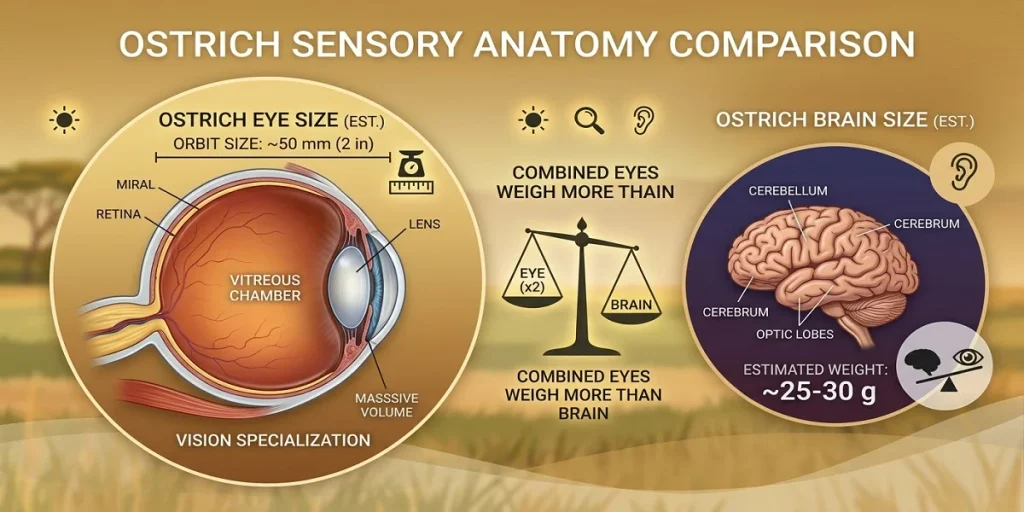
Yes. An ostrich’s eye is larger than its brain, one of the most unusual proportions in the anatomy of a living bird. This is not simply an internet myth: Guinness World Records specifically notes that the ostrich’s eye is larger than its brain.
The reason this comparison is so striking is the enormous size of the ostrich’s eyes. Each eye can measure up to about 50 mm (2 inches) in the Guinness measurement, giving the bird a visual system that occupies a substantial amount of space within its skull.
The Evolutionary Trade-Off
A giant eye requires considerable space and biological resources, but there is a clear advantage for an animal that lives in open habitats and faces predators from the ground.
Guinness World Records reports that researchers calculated the ostrich eye to be close to the maximum size that can produce a clear image. Beyond that point, increasing the size further would begin to introduce optical problems rather than simply improving vision.
The important point is that this does not mean the ostrich literally “gave up” brain development to build bigger eyes. Evolution does not work as a simple exchange of one organ for another. Instead, the ostrich’s anatomy reflects the demands placed on a large, fast-moving bird that spends much of its life scanning open terrain.
Its visual system provides several advantages:
- Large eyes provide an extensive optical system for forming images.
- High eye placement gives the bird an elevated view over vegetation.
- Specialized retinal regions support detailed vision along the horizon.
- Wide visual coverage helps the bird monitor its surroundings for potential threats.
The result is a sensory system strongly suited to early detection of danger, which can be particularly valuable before an ostrich needs to rely on its speed.
Does a Small Brain Mean a Dumb Bird?
Not necessarily. Brain size by itself does not provide a reliable measure of an animal’s intelligence or behavioral abilities.
Ostriches have relatively small brains compared with their enormous bodies, but they are capable of navigating large territories, recognizing their surroundings, interacting socially, and caring for their young. Their survival strategy also depends heavily on sensory awareness, physical size, and running ability rather than on the kind of complex manipulation or problem-solving seen in some highly intelligent birds.
So the famous “eye bigger than brain” fact is best understood as an anatomical curiosity and an example of specialization, not as evidence that ostriches are simply unintelligent birds.
Can Ostriches See at Night?
Ostriches can see in low-light conditions, but their ability to see at night should not be confused with the exceptional nocturnal vision of animals such as owls.
This is one area where popular sources make conflicting claims. Some descriptions emphasize the advantage provided by the ostrich’s unusually large eyes, while others point out that ostriches are primarily adapted for daytime activity and do not possess the specialized night vision of nocturnal birds.
The safest conclusion is that ostriches can use their eyes when light levels fall, particularly around dawn and dusk, but there is not enough evidence to describe them as having exceptional vision in complete darkness.
Birda reports a detection distance of roughly 50 m in darkness for a dog-sized object, compared with around 3 km in daylight. This illustrates how dramatically visual detection can change as available light decreases, although the figure should be treated as a reported estimate rather than a standardized laboratory measurement.
Large eyes can be advantageous when available light is limited because the visual system can collect more light. But a large eye alone does not make an animal a nocturnal specialist.
Owls, for example, have a suite of adaptations specifically associated with seeing in very low light. Ostriches, by contrast, are primarily adapted to daylight vision across open landscapes.
How Ostrich Eyes Are Protected
Having enormous eyes is useful only if those eyes can remain functional in the dusty and often windy environments where ostriches live. The bird therefore has several structures that help protect this unusually large visual system.
Long Eyelashes
Ostriches have prominent eyelashes that help protect their eyes from airborne particles. In a dry environment where dust and sand can be kicked up by wind or other animals, keeping debris away from the surface of the eye is particularly important.
Their eyelashes are also one reason the ostrich’s face looks so distinctive. They are not merely decorative; they form part of the physical protection surrounding the eye.
Large Eyelids and Eye Protection
The ostrich also has substantial eyelid structures that help shield the eyeball. Like other birds, it possesses a third eyelid, or nictitating membrane, which can move across the eye and help protect and moisten its surface.
This is particularly useful for a bird that spends time moving through dusty environments at ground level while also running at high speed.
The combination of eyelashes, eyelids, and the nictitating membrane allows the ostrich to protect its large eyes without sacrificing its ability to maintain a broad view of its surroundings.
How Good Is an Ostrich’s Hearing?
Ostrich hearing is much less well understood than ostrich vision. Researchers have studied the mechanical properties of the ostrich ear in laboratory experiments, but those studies do not give us a simple, verified number for the bird’s complete hearing range or hearing sensitivity.
That distinction matters because measurements of how an ear responds mechanically to stimulation are not the same thing as measuring exactly which sounds an animal can hear in the wild.
Do Ostriches Have Ears?
Yes. Ostriches have ear openings on the sides of their heads, although they do not have the prominent external ear flaps seen in mammals such as humans, dogs, or elephants.
The visible opening is positioned behind and slightly below the eye, and feathers around the head can make it difficult to notice. Like other birds, ostriches have an avian ear structure that includes a tympanic membrane and a single middle-ear ossicle called the columella.
That design is different from the mammalian ear, which uses three middle-ear ossicles. In birds, the columella transmits vibrations from the tympanic membrane toward the inner ear.
What Has Science Actually Measured?
One of the most detailed studies of ostrich hearing mechanics was published by Pieter G. G. Muyshondt, Peter Aerts, and Joris J. J. Dirckx in Hearing Research in 2016. The researchers studied the acoustic input impedance of the ostrich inner ear, using measurements of vibrations in the columella.
For the acoustic measurements, the researchers used electromagnetic stimulation and laser Doppler vibrometry across frequencies from 0.3 to 4 kHz. They also used piezoelectric stimulation and a force sensor for lower-frequency measurements.
The study found that the measured inner-ear impedance in ostriches was one to two orders of magnitude lower than values reported for mammalian ears. The researchers also noted important structural differences between avian and mammalian inner ears, including the fact that the auditory portion of the avian inner ear is straight rather than coiled like the mammalian cochlea.
However, the 0.3–4 kHz range should not be presented as the ostrich’s hearing range. Those were frequencies used during the experimental measurements. The study was measuring the mechanical impedance of the inner ear, not determining the lowest and highest frequencies an ostrich can hear.
What Do We Still Not Know?
The available research gives us useful information about the mechanics and anatomy of the ostrich ear, but it does not answer every question about how the bird actually perceives sound.
| Measured or documented | Not clearly established |
|---|---|
| Acoustic impedance of the ostrich inner ear | The complete hearing range |
| Mechanical response of the columella | Hearing sensitivity at different frequencies |
| Structure of the avian inner ear | The quietest sounds an ostrich can detect |
| Experimental responses across specific frequencies | How far away an ostrich can detect a particular sound |
This is why claims that ostriches can hear within a precise frequency range should be treated carefully unless they are supported by a study that actually measures auditory sensitivity or behavioral hearing thresholds.
The ostrich’s vocal behavior does provide an interesting clue about the importance of sound. Males produce a characteristic deep booming call, along with other vocalizations used during social and breeding behavior. But the existence of low-frequency vocalizations does not, by itself, establish exactly how well ostriches hear those frequencies.
For now, the scientifically defensible conclusion is simple: ostriches have a functional and well-developed avian hearing system, but their hearing abilities have not been studied nearly as extensively as their extraordinary vision.
How Do Ostriches Use Sight and Hearing to Survive?
For an animal living in open grasslands and savannas, detecting a potential threat before it gets close can be extremely valuable. Ostriches combine their exceptional visual system with hearing and other senses to monitor their surroundings.
Vision is particularly important. Their elevated head position gives them a broad view across open terrain, while the specialized regions of their retina support detailed vision along the horizon. Research on the ostrich retina has identified a prominent visual streak and estimated maximum visual acuity of about 19.3 cycles per degree.
When an ostrich notices something unusual, it may stop feeding, raise its head, and visually scan the surrounding area. If the potential threat continues to approach, the bird can rely on its powerful legs and running ability to escape.
Hearing may provide an additional source of information, particularly when something cannot be seen clearly. However, the precise contribution of hearing to predator detection has not been well quantified, so it is better to describe it as part of the ostrich’s sensory system rather than claim that hearing plays a specific, measured role in early warning.
Ostriches also live alongside other large grazing animals. When one animal becomes alert, others may respond to the change in behavior, creating a shared awareness of potential danger. This is one reason ostriches are sometimes described as an early-warning presence on African plains, although the ecological importance of this relationship should not be overstated.
If you want to understand what happens when an ostrich actually encounters one of Africa’s major predators, our guide to whether an ostrich can kill a lion looks at the bird’s size, weapons, speed, and defensive abilities.
Ostrich Vision vs. Human Vision vs. Other Birds
Ostrich vision is unusual, but saying that one animal has simply “better eyesight” than another can be misleading. Different species have visual systems adapted to different environments and tasks.
An ostrich is particularly specialized for daytime vision across open terrain, while other birds have evolved visual abilities that are especially useful for activities such as long-distance hunting or seeing in very low light.
| Animal | Notable visual strength | Key feature |
|---|---|---|
| Ostrich | Long-distance detection across open habitats | Exceptionally large eyes and a specialized visual streak |
| Human | Detailed central vision | Strong binocular vision and high visual acuity |
| Eagle | Exceptional long-distance visual acuity | Highly specialized eyes for detecting prey from a distance |
| Owl | Low-light vision | Eyes and retina adapted for seeing in very dim conditions |
The ostrich therefore does not need to outperform an eagle in every aspect of vision. Its visual system is specialized for the demands of a large terrestrial bird that spends much of its time in bright, open environments.
The size of the ostrich’s eyes is one of its most distinctive adaptations. Its visual streak also provides a region of relatively high acuity along the horizon, supporting the kind of scanning behavior that is useful on open plains. Research has estimated maximum visual acuity in this region at approximately 19.3 cycles per degree.
By comparison, owls are highly specialized for low-light conditions, while eagles are famous for their exceptional visual acuity. These are different forms of visual specialization rather than a single hierarchy of “best eyesight.”
Myths About Ostrich Senses
Ostriches have inspired several persistent myths, particularly about their eyes, intelligence, and behavior. Some of these ideas come from genuine observations that were later misunderstood or exaggerated.
Myth 1: Ostriches Bury Their Heads in the Sand
Reality: Ostriches do not bury their heads in the sand.
An ostrich may lower its head and neck close to the ground when it feels threatened, and from a distance this can create the illusion that the head has disappeared into the ground.
Ostriches also spend time tending their nests and turning or inspecting their eggs. These behaviors can produce a similar appearance when viewed from far away.
The famous story that an ostrich hides its head in the sand because it believes predators cannot see it is therefore not an accurate description of ostrich behavior.
You can explore the full explanation in our guide to whether ostriches really bury their heads in the sand.
Myth 2: Ostriches Have Poor Eyesight
Reality: Ostriches have highly developed visual systems.
Their eyes are exceptionally large, and their retinas contain specialized regions associated with high visual acuity. Their elevated head position also gives them an excellent vantage point for monitoring open surroundings.
The fact that an ostrich sometimes lowers its head has nothing to do with poor eyesight.
Myth 3: An Ostrich’s Eye Being Bigger Than Its Brain Means It Is Unintelligent
Reality: Eye-to-brain size is not a measure of intelligence.
The famous eye-versus-brain comparison is a statement about anatomy, not a test of cognitive ability. A relatively small brain does not automatically tell us how well an animal can learn, navigate, recognize individuals, respond to its environment, or perform other behaviors.
The unusual ratio is better understood as one of the remarkable anatomical characteristics of the ostrich.
Frequently Asked Questions About Ostrich Vision and Hearing
How good is an ostrich’s eyesight?
Ostrich eyesight is excellent in daylight. Their exceptionally large eyes and specialized retinal structures are adapted for detecting and resolving information across open landscapes, making vision an important part of their ability to detect potential threats.
How far can an ostrich see?
Guinness World Records reports that an ostrich can see for up to 3.5 km (2.2 miles). Other sources report distances of around 3 km for detecting a large object in daylight. These figures should be understood as long-distance detection estimates, not as evidence that an ostrich can see fine details from several kilometers away.
Is an ostrich’s eye really bigger than its brain?
Yes. Each ostrich eye is larger than the bird’s brain, according to Guinness World Records. The eye can measure up to about 50 mm in the Guinness measurement, making it one of the most remarkable proportions in ostrich anatomy.
Why do ostriches have such big eyes?
Large eyes provide an extensive optical system for collecting light and forming images. Combined with the ostrich’s specialized retina and elevated head position, they are well suited to monitoring large, open environments for potential threats.
Can ostriches see at night?
Ostriches can see when light levels are low, but they are not nocturnal vision specialists like owls. Their large eyes may provide an advantage as light levels fall, but strong claims about exceptional vision in complete darkness should be treated cautiously.
Do ostriches have good hearing?
Ostrich hearing is much less thoroughly studied than ostrich vision. Researchers have measured the acoustic mechanics of the ostrich inner ear, but a complete, reliable hearing range and sensitivity profile has not been established from the research reviewed.
Do ostriches have ears?
Yes. Ostriches have ear openings on the sides of their heads, but they do not have external ear flaps like mammals. Their ears contain the structures of an avian auditory system, including a tympanic membrane, middle-ear structures, and an inner ear.
Can ostriches see color?
Yes. Ostrich retinas contain multiple types of cone photoreceptors, demonstrating a visual system capable of color discrimination. Research indicates that ostriches are violet-sensitive rather than ultraviolet-sensitive, although that does not translate into a simple list of colors that ostriches see better than humans.
Why do ostriches have long eyelashes?
Long eyelashes help protect the ostrich’s large eyes from dust and airborne particles. This is particularly useful in the dry, windy environments where ostriches commonly live.
Do ostriches hide their heads in the sand because of their eyesight?
No. Ostriches do not bury their heads in the sand to hide from predators. Lowering the head and neck close to the ground can create this appearance from a distance, but it is not evidence of poor eyesight or a belief that predators cannot see them.
Which animal has the best eyesight in the world?
There is no single answer because different animals excel at different aspects of vision. Eagles are renowned for exceptional long-distance visual acuity, while owls are highly specialized for seeing in low light. Ostriches stand out for their exceptionally large eyes and their adaptations for visual detection across open land.
Conclusion
Ostrich vision is one of the most remarkable sensory adaptations in any large land bird. Their enormous eyes, specialized retinal structures, and elevated position give them a powerful visual system for monitoring the open landscapes where they live.
An ostrich’s eye can measure up to 50 mm in the Guinness World Records measurement and is larger than the bird’s brain. Guinness also reports that an ostrich can see for up to 3.5 km, although long-distance detection should not be confused with seeing fine details at that distance.
Their hearing is a different story. Ostriches clearly have functional ears, and researchers have studied the acoustic mechanics of their inner ears, but their complete hearing range and sensitivity remain much less well documented. The available evidence gives us useful information about how the ear works without supporting the precise hearing-frequency claims often repeated online.
Taken together, the evidence shows an animal whose senses are strongly adapted to life in open, daylight-dominated environments. Ostriches do not need to have the best eyesight in every possible category; they need a visual system capable of detecting what matters to them, often before a potential threat gets close.
And that may be the most interesting thing about the ostrich’s famous giant eyes: their size is not just a strange anatomical fact. It is part of a sensory system built around seeing the world from a distance.