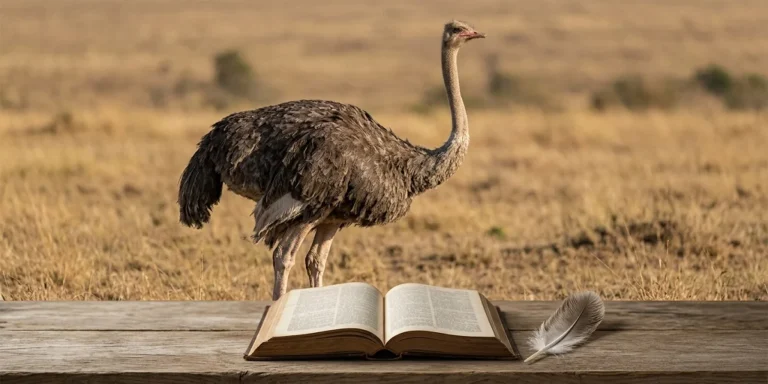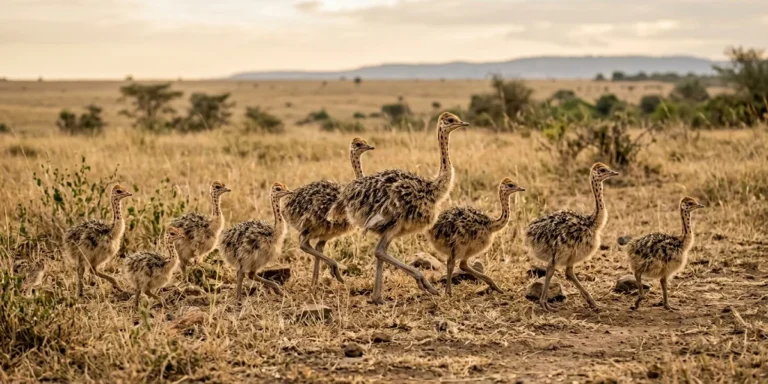
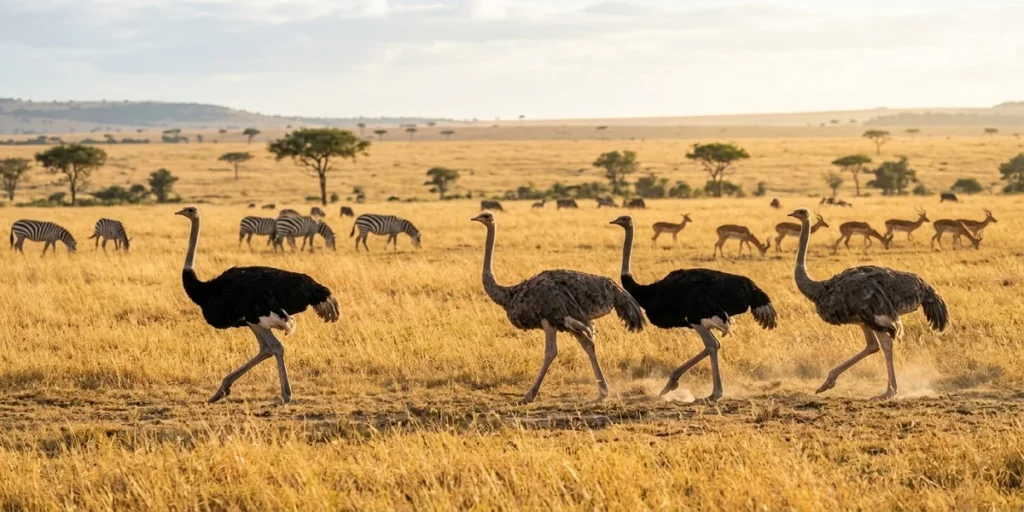
Quick Answer: Ostriches are social birds that usually live in flexible groups rather than alone. A typical group may contain around 10 to 12 birds, but reported group sizes range from just 2 to as many as 50 or more, depending on the season, habitat, and type of group being described. During the breeding season, groups become more territorial and organized around dominant males and females, while smaller, looser groups form outside the breeding season. Ostriches also commonly feed alongside zebras and antelope, creating mixed-species groups that can benefit from each other’s presence.
Table of Contents
Ostriches are often pictured as solitary wanderers across the African savanna, but ostrich social structure is surprisingly dynamic. Ostrich groups continuously adjust in size and composition depending on the season, breeding conditions, and food availability.
Within these groups, dominant males and females establish key roles, multiple females share communal nests, and individual birds move fluidly between flocks while feeding or traveling. Ostriches also frequently associate with zebras, antelopes, and other grazers to form defensive mixed-species herds across open habitats.
Because of this flexibility, there is no single model for an ostrich flock. A tight breeding unit, a loose non-breeding group, and a large temporary gathering all represent normal social behavior.
This guide explores how ostrich groups operate, how dominant pairs lead, why females share communal nests, and how herd dynamics change throughout the year.
What Is the Social Structure of Ostriches?
The social structure of ostriches is flexible rather than rigid. While ostriches generally live in mixed-sex flocks, group size and composition adapt constantly to breeding seasons and environmental conditions.
During the breeding season, social hierarchies become more defined. A dominant male and a dominant female lead the group, while secondary females lay eggs in a shared communal nest. Dominant males actively defend territories and compete with rivals for mating access.
Outside the breeding season, territorial pressures decrease. Ostrich groups often dissolve into smaller, loosely organized flocks that travel and forage together without strict rank.
This structural flexibility explains why ostrich group descriptions vary. A tightly bonded breeding unit operates very differently from a large, temporary flock traveling across open grassland.
The Basic Structure of an Ostrich Group
Although ostrich groups are not organized according to one permanent social template, several recurring roles appear in descriptions of their behavior:
- Dominant male: Plays a major role in territorial defense and breeding.
- Dominant or major hen: Forms the core of the communal nesting system and lays eggs in the main nest.
- Other hens: May lay eggs in the communal nest without taking the primary nesting role.
- Other males: May compete for breeding opportunities or move between groups.
- Juveniles: Can form part of larger groups and may remain associated with other young birds.
The result is a social system that is structured enough to have dominance relationships, but flexible enough for group membership and size to change.
That distinction helps explain why different sources report surprisingly different numbers for the size of an ostrich herd.
How Big Is an Ostrich Herd?
There is no single number that defines an ostrich herd. Different sources report groups ranging from just a few birds to 50 or more, depending on whether they are describing a breeding group, a normal social group, or a larger temporary gathering.
For example, National Geographic and Mpala Live describe groups of up to about 12 birds, while other zoological sources report much wider ranges. Animal Diversity Web describes breeding groups consisting of a male and several females, while larger flocks can contain many more birds.
Reported Ostrich Group Sizes
| Source | Reported group size | Context |
|---|---|---|
| National Geographic | Up to about 12 birds | Small social groups |
| Mpala Live | Up to about 12 birds | Typical group description |
| Animal Diversity Web | 5–50 birds | Wider flock range |
| Maryland Zoo | Usually around 10, sometimes 50+ | Larger nomadic groups can occur |
| Animal Diversity Web | 1 male + 3–5 females | Breeding group |
These figures should not be treated as competing measurements of one fixed herd size. They describe different kinds of social groups, and ostrich group size is naturally flexible.
A group of around 10 birds may be perfectly normal in one setting, while dozens of ostriches may gather temporarily in another. This is especially important in open habitats, where birds can come together while moving or feeding.
Why Does Ostrich Herd Size Vary?
Several factors can influence how many ostriches are found together:
- Breeding status: Territorial breeding groups are organized differently from non-breeding groups.
- Season: Group size and cohesion can change after the breeding season.
- Food and water: Birds may concentrate where resources are available.
- Habitat: Open landscapes allow ostriches to see and move across large areas.
- Group type: A breeding unit is not necessarily the same thing as a larger temporary aggregation.
This is why saying that “ostriches live in herds of 10” gives an incomplete picture. Around 10 birds may be typical in some observations, but it is not a fixed rule for the species.
In other words, an ostrich herd is better understood as a flexible social grouping than as a permanent unit with a set number of members.
Ostrich Herd Behavior Changes With the Season
Ostrich herd behavior becomes particularly interesting when the breeding season begins. Birds that may form relatively loose groups at other times of the year can become more territorial and socially organized when reproduction becomes the priority.
During the breeding season, males establish and defend territories while competing for access to females. Groups can therefore become more closely associated with breeding territories and dominant individuals.
Monroe Zoo describes ostriches as forming territorial groups during the breeding season, while outside that period they may form smaller, looser groups of roughly 2 to 5 birds.
| Period | Typical social pattern | Main driver |
|---|---|---|
| Breeding season | More territorial and organized groups | Mating and territory defense |
| Outside breeding season | Smaller, looser groups | Feeding, movement and general social behavior |
| Temporary gatherings | Larger groups may form | Movement, resources or local conditions |
The important point is that ostrich society does not remain frozen throughout the year. The same bird may experience very different social conditions depending on the season.
During breeding, territory and access to mates become especially important. Outside breeding, the pressure to defend a breeding territory is reduced, allowing birds to associate more loosely.
This seasonal flexibility also helps explain why one observer might describe ostriches as living in small groups while another reports a much larger flock.
For ostriches, group size is not simply a species characteristic. It is part of their changing social behavior.
Ostrich Hierarchy: Who Leads the Group?
Ostrich groups have dominance relationships, particularly during the breeding season. Rather than following a permanently fixed hierarchy throughout the year, their social structure becomes more pronounced when males are defending territories and competing for reproductive opportunities.
A dominant male and a dominant female form the core of many breeding groups. The male plays an important role in territorial defense, while the dominant hen is closely associated with the communal nest and the eggs laid there. Other males and females may also be part of the group, but their reproductive roles are not necessarily equal.
This creates a hierarchy based largely on breeding status, dominance, and access to reproductive opportunities.
The Dominant Male
The dominant male plays a central role during the breeding season. He defends a territory, displays to females, and competes with other males for access to mates.
Male ostriches can use visual displays, calls, postures, and aggressive behavior during these interactions. Direct physical fighting is possible, but social competition does not necessarily begin with a fight. Displays can communicate size, strength, and willingness to defend a territory before a confrontation escalates.
The dominant male also becomes an important part of the communal nesting system. He shares incubation duties with the major hen and helps defend the nest and young.
The Dominant or Major Hen
The dominant female, often referred to as the major hen, has a particularly interesting position in the social structure.
She is associated with the main communal nest and lays her own eggs there alongside eggs from other females. Her eggs tend to occupy the more protected central part of the nest, while eggs from other females are more likely to be found toward the outside.
This arrangement is more than a simple case of several females sharing the same nest. Research by Brian Bertram in Kenya showed that the major hen can distinguish her own eggs from those laid by other females. His field research also demonstrated that females can alter their reproductive strategy rather than following one inflexible role throughout their lives.
That makes the major hen an important part of the social system rather than simply the female that happens to own a nest.
Other Hens and Males
Not every female in a breeding group occupies the same social position.
Other females, sometimes described as minor hens, may lay eggs in the major hen’s communal nest. They contribute to the shared clutch but do not take on the same primary role in incubation and nest defense.
Other males may also be present around breeding groups and can compete for mating opportunities. The relationships between individuals therefore involve more than a simple male-female pair. Several individuals can participate in the same reproductive system while occupying different social positions.
This is one reason ostrich social structure is more interesting than the simple “one male, one female, one nest” model often used in general animal profiles.
Ostrich Dominance Is Not a Permanent Ranking
It is also important not to imagine an ostrich herd as having a rigid hierarchy where every bird has a permanently fixed rank.
Social relationships can change with age, sex, breeding status, group composition, and season. A breeding group has stronger territorial and reproductive pressures than a loose group outside the breeding season.
So while dominant individuals are important, ostrich social structure is flexible rather than a permanent ladder of rank.
And that flexibility becomes even more obvious when several females begin using the same nest.
How Do Ostriches Share a Communal Nest?
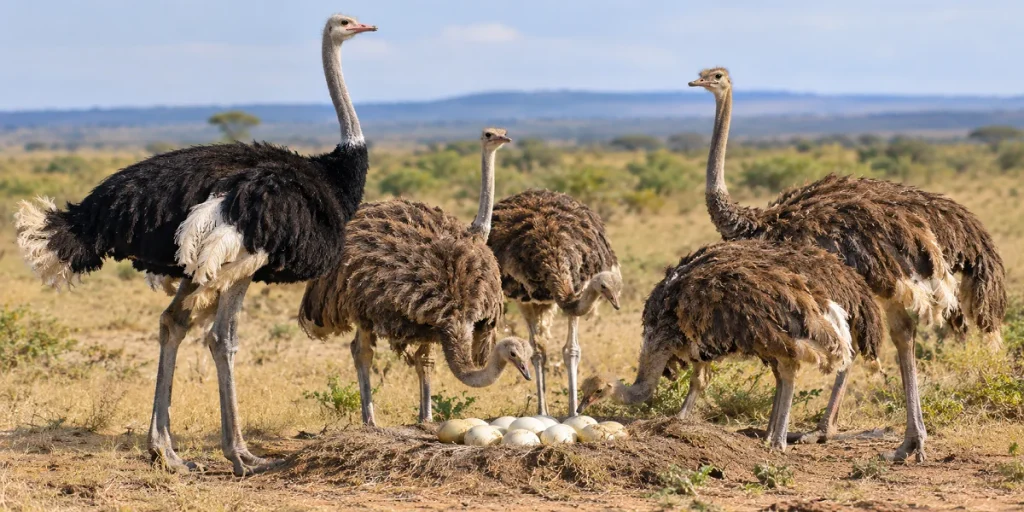
One of the most unusual features of ostrich social behavior is their communal nesting system. Several females can lay their eggs in the same nest, creating a shared clutch that may contain far more eggs than a single female could produce.
At first glance, this seems like a simple case of several females cooperating. In reality, the system is more complicated.
The communal nest has a social structure of its own. A major hen establishes the main nesting relationship with the male, while other females may add their eggs to the same nest. The male and major hen then provide the main incubation and nest defense.
Major Hen vs. Minor Hens
| Feature | Major hen | Minor hens |
|---|---|---|
| Nest role | Main female associated with the communal nest | Lay eggs in the communal nest |
| Incubation | Shares the main incubation role with the male | Do not provide the main incubation |
| Egg position | Her eggs are more likely to remain in the protected center | Their eggs are more likely to be toward the outside |
| Reproductive strategy | Can maintain the main nesting role | May use another female’s nest |
The system creates an unusual reproductive arrangement: females compete and cooperate at the same time.
They share a nest and benefit from having a protected incubation site, but the major hen has a stronger interest in ensuring that her own eggs survive. Bertram’s research showed that the major hen can recognize her own eggs, providing evidence that communal nesting is more sophisticated than simply mixing every egg together without distinction.
Why Do Ostriches Share Nests?
Communal nesting may provide several advantages. Multiple females can place eggs in a nest that is already established and defended, while the male and major hen provide the primary incubation effort.
But the arrangement has a built-in limitation: there can be more eggs than the incubating adults can effectively cover.
Bertram’s observations in Tsavo West National Park, Kenya, documented communal nests containing eggs from several females. His work showed that once a nest becomes heavily loaded, eggs can be pushed toward the outside and eventually removed from the nest.
This produces an interesting form of competition. A female benefits from laying in a communal nest, but the survival of her eggs depends partly on where those eggs end up within an overcrowded clutch.
Who Incubates the Eggs?
The sexes divide incubation between them.
The male generally incubates at night, when his dark plumage provides better camouflage, while females take the daytime incubation shifts. This division also allows the adults to maintain some protection around the nest while reducing the amount of time either individual must remain continuously exposed.
The communal nest therefore connects several parts of ostrich social structure at once:
dominance → breeding relationships → communal nesting → incubation → chick survival
That is what makes ostrich social behavior particularly unusual. Their groups are not simply collections of birds traveling together. Their social relationships directly influence how they reproduce and raise the next generation.
Why Do Ostriches Travel With Zebras and Antelope?
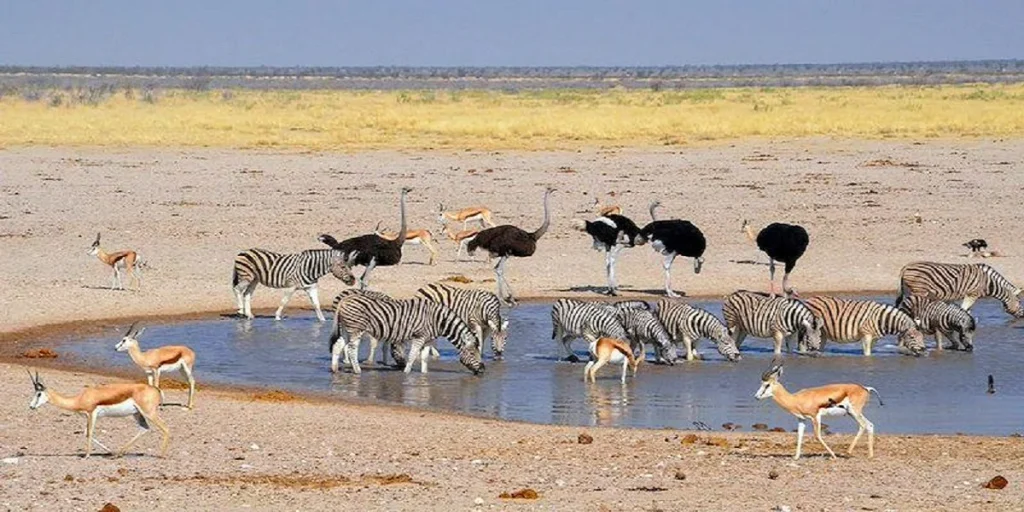
Ostriches are often seen feeding alongside zebras, antelope, wildebeest, and other grazing animals. These mixed-species groups are common enough to be an important part of ostrich behavior, particularly in open savanna habitats.
The association is not simply a coincidence. Different species can gain different advantages from feeding in the same area.
As grazing animals move through vegetation, they disturb insects and other small animals that ostriches can catch. At the same time, an ostrich’s height and excellent eyesight give it a wide view across open ground, which can help detect potential threats.
How Both Sides Can Benefit
| Animal | Potential benefit from the association |
|---|---|
| Ostriches | Grazing animals disturb insects and other food items as they move |
| Zebras and antelope | Ostriches have a high vantage point and can detect approaching danger |
| Wildebeest and other grazers | Benefit from additional eyes and ears within a mixed group |
The relationship is best understood as a flexible association rather than a formal partnership. Ostriches do not need to stay with zebras or antelope all the time, and the other animals can move away whenever conditions change.
Instead, several species may gain an advantage from occupying the same feeding area.
Why Are Ostriches Good Lookouts?
An adult ostrich can stand close to 9 feet (2.7 meters) tall, giving it an unusually high viewpoint compared with most of the mammals around it.
That height matters in open landscapes. An ostrich can scan across a large area while feeding or standing alert, potentially detecting predators before they get close.
This does not mean an ostrich acts like a dedicated guard animal. Its primary concerns are still feeding, avoiding predators, and staying with other birds. But when several species are feeding together, the ostrich’s height and visual capabilities can become an additional advantage for the whole group.
The result is one of the most recognizable sights of the African savanna: an ostrich walking or feeding among much larger groups of grazing mammals.
Wild vs. Captive Ostrich Social Behavior
Ostriches can form social groups in both wild and captive environments, but the conditions are very different.
In the wild, birds have access to large areas where they can spread out, move between feeding areas, establish breeding territories, and change group associations. On farms and in other captive settings, fences, available space, sex ratios, food distribution, and breeding management all influence how birds interact.
This difference is particularly important because ostrich social behavior can become more obvious when birds are kept in confined groups.
Wild and Captive Groups Compared
| Factor | Wild ostriches | Captive ostriches |
|---|---|---|
| Space | Large areas allow birds to spread out and move between groups | Movement is restricted by enclosure size |
| Group composition | Can change with season and local conditions | Usually determined by management |
| Food | Birds forage over natural feeding areas | Food is supplied by people |
| Territory | Males can establish and defend breeding territories | Territorial behavior occurs within available space |
| Social pressure | Birds can move away from some individuals | Individuals may have fewer options to avoid one another |
| Aggression | Can be dispersed across a large landscape | May become more noticeable when birds are kept close together |
A study of captive ostriches on farms in Romania documented a range of social behaviors, including dominance-related interactions, pecking, displays, and aggression. The researchers also observed changes in behavior associated with the breeding period.
This does not mean that captive ostriches are inherently more aggressive than wild birds. Rather, captivity changes the circumstances in which social behavior occurs. A bird that could simply move away from another individual in a large natural area may have fewer options inside an enclosure.
Why Group Composition Matters on Ostrich Farms
For farmers, this makes space and group composition important parts of social management.
Sex ratio, age, breeding status, enclosure size, and the number of birds sharing the same space can all influence how much social pressure individual ostriches experience.
During the breeding season, males in particular may become more territorial and competitive. Keeping this natural behavior in mind can help explain why a group that appears calm during one part of the year may behave very differently during another.
Understanding ostrich herd behavior is therefore useful beyond wildlife observation. The same social instincts that shape wild breeding groups also influence how ostriches interact on farms.
Are Ostriches Friendly to People?
Ostriches are social animals, but their social behavior is primarily directed toward other ostriches, not humans. A bird becoming accustomed to people does not necessarily mean that it considers them companions or pets.
Ostriches raised around people can become habituated to familiar handlers, particularly when they encounter the same people regularly. However, habituation should not be confused with domestication or affection. Even a familiar ostrich remains a large, powerful animal capable of defensive behavior.
This is particularly important during the breeding season, when males may become more territorial and protective around females, nests, and chicks.
For that reason, people working around ostriches should treat them as wild or semi-domesticated animals rather than unusually large pets.
Do Ostriches Bond With Humans?
There is a difference between recognition, habituation, and social bonding.
An ostrich may learn to recognize familiar people and become less reactive around them. A hand-raised bird may also show behaviors that appear unusually comfortable around its keeper.
But that does not necessarily mean the bird has formed a human-style emotional bond.
The strongest social relationships in an ostrich’s natural behavior are with other ostriches, particularly within breeding groups and communal nesting systems. A familiar human can become part of the bird’s predictable environment without becoming a member of its social group.
That distinction is important when interpreting ostrich behavior around people.
Can Ostriches Be Dangerous?
Yes. An ostrich does not need to be aggressive to be dangerous.
Adult ostriches have extremely powerful legs and can deliver potentially serious kicks when threatened or cornered. National Geographic notes that an ostrich can use its powerful legs as a defense against predators and other threats.
The safest approach is therefore simple:
- Do not assume a familiar ostrich is tame.
- Avoid approaching nests or chicks unnecessarily.
- Give males additional space during the breeding season.
- Never deliberately corner or provoke an ostrich.
- Follow the handling procedures used by experienced keepers on farms or wildlife facilities.
Social does not mean harmless. An ostrich can be highly social with its own species while remaining defensive toward people.
Ostrich Personality: What Does Their Behavior Tell Us?
People sometimes search for an “ostrich personality” because individual birds can behave differently around people and other ostriches.
It is reasonable to describe observable behavioral tendencies, but it is better to avoid treating personality as a fixed human-like trait. An ostrich’s behavior can change depending on its age, sex, breeding status, surroundings, and previous experience with people.
From the social behavior described in wild and captive ostriches, several broad characteristics stand out:
- Alert: Ostriches spend considerable time monitoring their surroundings and responding to potential threats.
- Social: They commonly associate with other ostriches and may join mixed-species groups while feeding.
- Territorial: Breeding males defend areas and compete for reproductive opportunities.
- Flexible: Group size and social relationships can change with the season.
- Defensive: When threatened, ostriches can run, display, or use their powerful legs to defend themselves.
These traits help explain why an ostrich can appear calm and sociable in one situation but become highly defensive in another.
The behavior is not contradictory. Context matters.
What Is an “Ostrich Mentality”?
The phrase “ostrich mentality” is an expression used to describe someone who ignores an obvious problem instead of confronting it.
It comes from the old myth that ostriches bury their heads in sand when frightened.
They do not.
When threatened, an ostrich may lower its body and neck close to the ground, particularly around the nest. From a distance, this can create the impression that the bird has disappeared beneath the soil.
In reality, ostriches rely on vigilance, speed, camouflage, and powerful defensive kicks rather than burying their heads.
For the full explanation, see our guide to Do Ostriches Really Bury Their Heads in the Sand?.
Frequently Asked Questions
Q1: Are ostriches social animals?
Yes. Ostriches are social birds that commonly live in groups. Their group size and social organization can change with the season, breeding status, and local conditions.
Q2: How many ostriches live in a herd?
There is no fixed number. Many sources describe groups of around 10 to 12 birds, while reported group sizes can range from 2 to 50 or more, depending on the type of group being described.
Q3: Who leads an ostrich herd?
A dominant male and dominant female play central roles in breeding groups. The male is particularly important in territorial defense, while the major hen is closely associated with the communal nest.
Q4: Do ostriches live alone or in groups?
Mostly in groups. They can form small groups outside the breeding season and larger temporary gatherings under suitable conditions, although individual birds may sometimes be seen alone.
Q5: Why do ostriches travel with zebras and antelope?
Both sides can benefit from the association. Grazing animals disturb insects that ostriches can eat, while ostriches provide an additional set of eyes and a high vantage point for detecting potential threats.
Q6: How do ostriches share nests?
Several females can lay eggs in a communal nest. The major hen and male provide the main incubation and nest defense, while other females may contribute eggs to the shared clutch.
Q7: Are ostriches friendly to people?
Not in the way a domesticated pet is. Ostriches can become accustomed to familiar people, but they remain powerful animals that may become defensive, particularly around nests and during the breeding season.
Q8: Do ostriches bond with humans?
Ostriches can recognize and become habituated to familiar people, but this should not automatically be interpreted as a human-like emotional bond. Their primary social relationships are with other ostriches.
Q9: What is an ostrich mentality?
“Ostrich mentality” is an expression for ignoring or avoiding a problem. It comes from the false belief that ostriches bury their heads in sand when threatened. They do not actually behave this way.
Q10: Do ostriches live in the same group all year?
Not necessarily. Ostrich groups can change in size and composition throughout the year. Breeding groups become more territorial, while smaller and looser groups can form outside the breeding season.
Key Takeaways
- Ostriches are social birds, but their groups are flexible rather than permanently fixed.
- A typical group may contain around 10 to 12 birds, although larger gatherings of 50 or more can occur.
- Breeding season changes ostrich herd behavior, making groups more territorial and socially organized.
- A dominant male and major hen play central roles in many breeding groups.
- Several females can contribute eggs to a communal nest, creating a complex system of cooperation and competition.
- Ostriches frequently feed alongside zebras, antelope, and other grazing animals.
- Captive ostriches show many of the same social behaviors as wild birds, but limited space can change how those behaviors appear.
- Ostriches can become accustomed to humans, but habituation is not the same as domestication or friendship.
- The famous “ostrich mentality” has nothing to do with real ostrich behavior. The head-in-the-sand story is a myth.