
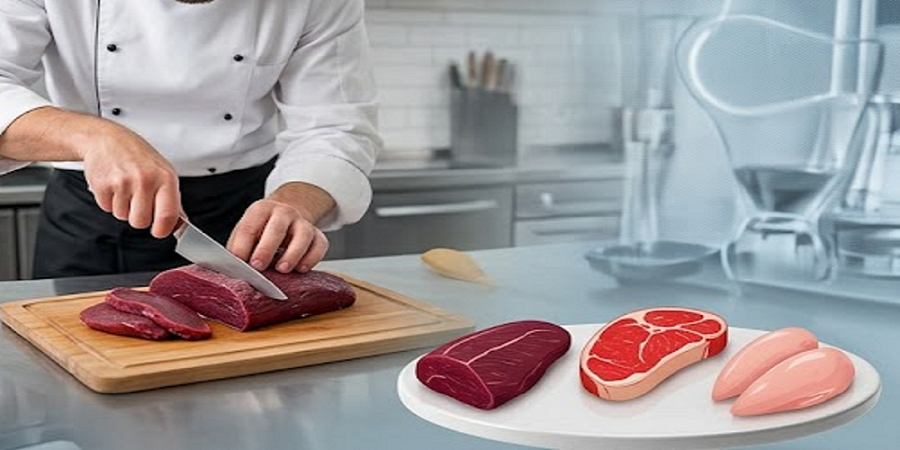
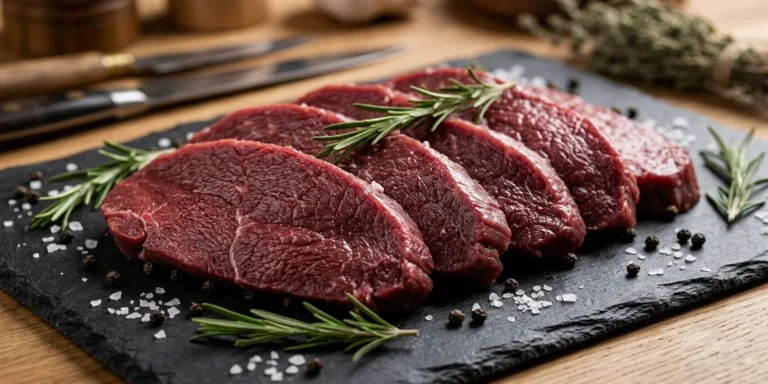
Many people are surprised to learn that ostrich meat is red meat, not poultry, despite coming from a bird. That deep crimson color you see on a raw ostrich steak is not a coincidence. The science behind it is what makes ostrich one of the most fascinating proteins on the market. This raises a question that surprises many people: is ostrich meat actually red meat?
The short answer is yes. But the full explanation is more interesting than a simple classification, and it changes how you think about ostrich as a food entirely.
Quick Answer: Ostrich meat is officially classified as red meat, not poultry. Despite coming from a bird, it shares the same muscle structure, myoglobin content, and nutritional profile as lean red meats like beef. It is also one of the leanest red meats available, making it a rare combination of red meat flavor with a clean, low-fat nutritional profile.
Table of Contents
Is Ostrich Meat Red Meat? The Official Classification
Yes of course, ostrich meat is formally classified as red meat by food regulatory bodies including the USDA.
This might seem counterintuitive. Ostriches are birds, and most birds produce white meat like chicken breast or turkey. But the red or white classification is not determined by the animal’s species. It is determined by the myoglobin content of the muscle tissue.
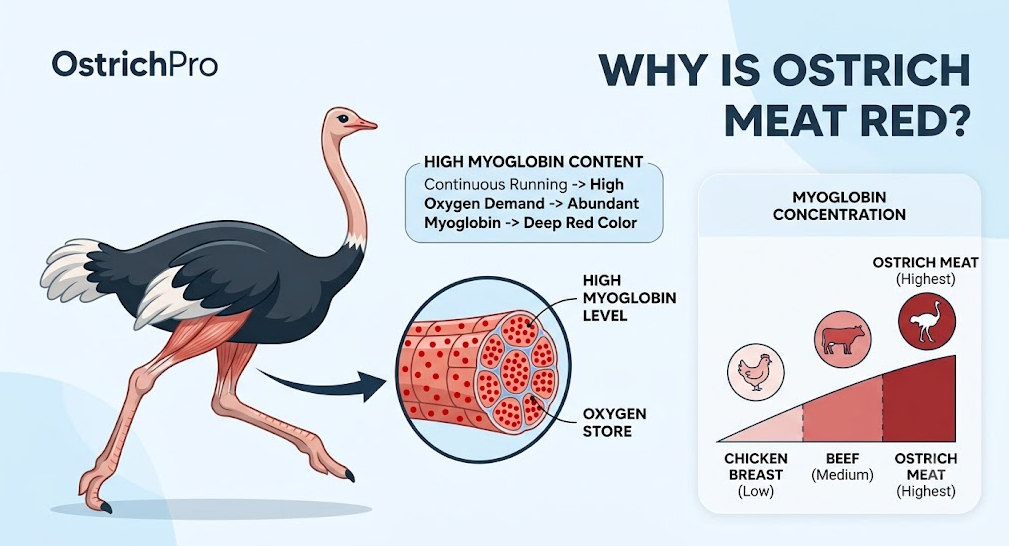
Myoglobin is a protein found in muscle fibers. Its job is to store and transport oxygen within the muscle. The more myoglobin a muscle contains, the darker and redder the meat appears, both when raw and after cooking.
Ostrich muscles are exceptionally rich in myoglobin. This is why ostrich meat looks and behaves more like beef than like chicken, even though the animal has feathers and two legs.
Why Is Ostrich Meat Red? The Science Explained
So is ostrich meat red meat in every practical sense? By nutrition, color, and official regulation ”absolutely yes.” The color of ostrich meat comes down to three interconnected factors: the animal’s physiology, its muscle function, and the resulting myoglobin concentration.
Built for Running, Not Flying
Ostriches are the fastest running birds on the planet, capable of sustained speeds of up to 45 mph (72 km/h). Their legs are extraordinarily powerful and doing the work that wings do for other birds, and then some.
Sustained, high-intensity muscle activity demands large amounts of oxygen. To meet this demand, ostrich leg muscles store oxygen locally using myoglobin, the same way human endurance athletes’ muscles adapt to prolonged exertion. The result is muscle tissue that is deeply saturated with this oxygen-carrying protein.
Myoglobin = Red Color = Red Ostrich Meat
Myoglobin contains iron, and iron gives meat its red hue. The more myoglobin present, the deeper the red. This is why:
- Chicken breast is pale; it is used for short bursts, not sustained activity, so it has very little myoglobin
- Beef is red; cattle are larger animals with more active muscles
- Ostrich is deep red; often darker than beef, because its leg muscles are among the most active of any land animal
When ostrich meat is exposed to air, the myoglobin oxidizes and the color deepens further, similar to what happens with beef. This is completely normal and not a sign of spoilage.
Iron Content
The high myoglobin concentration also means ostrich meat is rich in heme iron, the most bioavailable form of iron for the human body. This makes it particularly valuable for people with iron deficiency or those who want to increase their iron intake through diet.
Is Ostrich Red Meat or Poultry?
This is where the classification gets interesting and where most people are surprised.
In everyday language, people often assume that anything coming from a bird must be poultry. But in food science and nutrition, the categories work differently.
| Classification | Based On | Ostrich |
|---|---|---|
| Species | Animal type | Bird ✓ |
| Meat color (culinary) | Myoglobin content | Red meat ✓ |
| Regulatory (USDA) | Inspection & processing standards | Red meat ✓ |
| Nutritional category | Fat, protein, iron profile | Red meat ✓ |
Ostrich is a bird by biology, but red meat by every practical food standard. It is processed in red meat facilities, regulated under red meat guidelines, and nutritionally categorized alongside beef, lamb, and venison not alongside chicken or turkey.
This distinction matters in practice. If you are following a diet that limits red meat consumption for health reasons, ostrich falls into that category. If you are avoiding poultry for dietary or religious reasons, ostrich is not poultry and follows different rules.
How Does Ostrich Red Meat Compare to Beef?
Since both are red meats, the natural comparison is with beef. And this is where ostrich becomes genuinely compelling.
Ostrich delivers everything that makes red meat satisfying, additionally the deep flavor, the rich color, the firm and tender bite but with a dramatically different nutritional footprint.
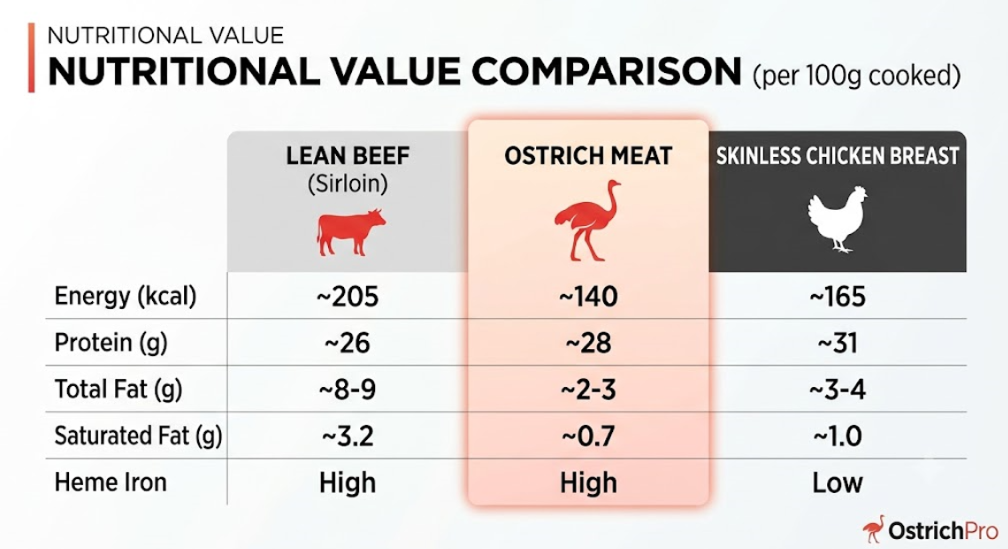
The practical takeaway: ostrich gives you red meat satisfaction with a nutritional profile closer to lean poultry. It is genuinely rare for a red meat to achieve this balance.
Flavor-wise, ostrich is slightly milder and cleaner than beef, with a subtle sweetness that comes from its low fat content. It does not have the heavy or greasy aftertaste that fattier beef cuts can leave. If you enjoy lean beef cuts like sirloin or tenderloin, ostrich will feel immediately familiar.
Is Ostrich Meat Lean? Nutrition at a Glance
Ostrich is not just lean by red meat standards, it is lean by almost any meat standard.
With roughly 2–3g of total fat per 100g, it sits in the same territory as skinless chicken breast, which typically contains 3–4g of fat per 100g. The difference is that ostrich delivers this low fat content while still being a red meat with all the associated flavor depth and iron content.
Key nutritional highlights:
- Very high protein: Approximately 28g per 100g, supporting muscle maintenance and satiety
- Extremely low saturated fat: Less than 1g per 100g in most cuts
- Rich in heme iron: Important for energy, oxygen transport, and preventing iron deficiency anemia
- Good source of zinc and B vitamins: Particularly B12, which supports nerve function and energy metabolism
- Lower cholesterol than beef: Relevant for people managing cardiovascular health
For people who want to eat red meat without the saturated fat load that comes with regular beef, ostrich is one of the very few options that genuinely delivers on that promise.
Does the Red Meat Classification Affect How You Cook It?
Yes and this is practical information that makes a real difference in the kitchen.
Because ostrich is a lean red meat with very little fat marbling, it behaves differently from fatty cuts of beef during cooking. Fat insulates meat from heat and retains moisture. Without that fat buffer, ostrich loses moisture quickly if overcooked.
The Golden Rule: Do Not Overcook
Ostrich steak should be cooked to medium-rare or medium, never well-done. Beyond medium, the texture becomes dry and slightly chewy, and the natural flavor diminishes significantly.
Best Cooking Methods for Ostrich
| Method | Notes |
|---|---|
| Pan-searing | Best for steaks; high heat, short time, rest after |
| Grilling | Works well; watch temperature carefully |
| Roasting | Good for larger cuts; use a meat thermometer |
| Stir-frying | Excellent for strips or mince; fast, high heat |
Temperature Guide
| Doneness | Internal Temperature | Recommended? |
|---|---|---|
| Medium-rare | 57–60°C (135–140°F) | ✅ Best |
| Medium | 63°C (145°F) | ✅ Good |
| Well-done | 71°C+ (160°F+) | ❌ Avoid |
Practical Tips
- Rest the meat for 3–5 minutes after cooking; this redistributes the juices and significantly improves texture
- Season simply; salt, pepper, garlic, and fresh herbs let the natural flavor come through without masking it
- Use a meat thermometer if you are new to cooking ostrich the margin between perfect and overdone is smaller than with beef
Because it is a red meat at heart, ostrich responds well to red meat cooking techniques. Think of it as a very lean, premium beef steak that requires a little more attention to temperature.
Frequently Asked Questions
Is ostrich considered red meat or white meat?
Ostrich is considered red meat. Despite being a bird, its high myoglobin content, the protein that gives meat its red color, places it firmly in the red meat category alongside beef, lamb, and venison.
Why is ostrich meat darker than beef?
Ostrich meat is often darker than beef because of its exceptionally high myoglobin concentration. Ostriches use their leg muscles intensively for running, which requires high oxygen storage in the muscle tissue. More myoglobin means darker, deeper red meat.
Is ostrich meat healthier than beef?
By most nutritional measures, yes. Ostrich contains significantly less total fat, less saturated fat, and fewer calories than comparable beef cuts, while offering similar or higher protein and comparable iron levels. It is widely considered one of the healthiest red meat options available.
Can you eat ostrich meat if you are avoiding red meat?
No, ostrich is classified as red meat by food regulatory bodies and nutritional standards. If you are limiting red meat intake for health, dietary, or medical reasons, ostrich falls under that restriction.
Is ostrich meat halal?
Yes, ostrich meat is generally considered halal in Islam, provided it is slaughtered according to Islamic guidelines. Most major Islamic scholarly bodies permit ostrich as a permissible food. For more detail on this topic, see our dedicated guide on whether ostrich is halal.
Where can I buy ostrich meat?
Ostrich meat is available at specialty butchers, high-end supermarkets, and online meat delivery services. It is more widely available in South Africa, Australia, parts of Europe, and increasingly in the United States. Look for deep red color, firm texture, and minimal liquid in the packaging.
Ostrich meat is red meat; not by coincidence, but by the same biological logic that makes beef red. Its powerful leg muscles, built for speed and endurance, pack muscle fibers with myoglobin, giving the meat its deep color, its rich iron content, and its satisfying, beef-like flavor.
What makes ostrich genuinely unusual is what it combines: the flavor depth and iron richness of red meat, with the low fat content more commonly associated with lean poultry. It is one of very few meats that can honestly claim to bridge that gap.
If you are curious about how ostrich compares more broadly to beef across taste, texture, and cooking, our full guide ” What Does Ostrich Meat Taste Like? ”goes deeper into that comparison.
OstrichPro is dedicated to covering everything about ostriches, from farming and eggs to meat, nutrition, and behavior. Explore the full site for in-depth guides on every aspect of the ostrich world.

1 thought on “Is Ostrich Meat Red Meat? 5 Surprising Facts Backed by Science”