Quick Answer: Ostrich meat generally costs between $46 and $159 per kg ($21 to $72 per pound), depending on the cut. Ground ostrich is the most affordable option at around $46–$60 per kg. Premium cuts like tenderloin and inside strip reach $110–$159 per kg. A whole ostrich leg is typically sold as a single large specialty item and costs several hundred dollars.
Table of Contents
Ostrich meat does not have a single standard price per kilogram. Costs vary significantly based on the specific cut, supplier, processing methods, and retail location. Because most U.S. online suppliers list prices per pound, converting these numbers to kilograms provides a much clearer picture of total costs.
Ostrich Meat Price Per Kg vs Per Pound
When comparing ostrich meat prices online, notice that most U.S. distributors price their inventory per pound. Converting these figures to kilograms is simple: multiply the price per pound by 2.2.
The reference table below highlights standard pricing equivalents across popular cuts:
| Price Per Pound | Approximate Price Per Kg |
| $10 | $22 |
| $20 | $44 |
| $25 | $55 |
| $30 | $66 |
| $40 | $88 |
| $45 | $99 |
| $50 | $110 |
| $60 | $132 |
| $70 | $154 |
| $72 | $159 |
For instance, ostrich meat listed at $25 per pound equals roughly $55 per kg, while a premium tenderloin cut at $70 per pound equates to $154 per kg.
Accurate conversion is essential when evaluating vendors. A price that appears low per pound can represent a significant investment once calculated by the kilogram. Ultimately, the cut itself dictates the final rate. Ground ostrich offers an economical starting point, whereas specialty fillets drive up the average cost significantly.
Ostrich Meat Price by Cut
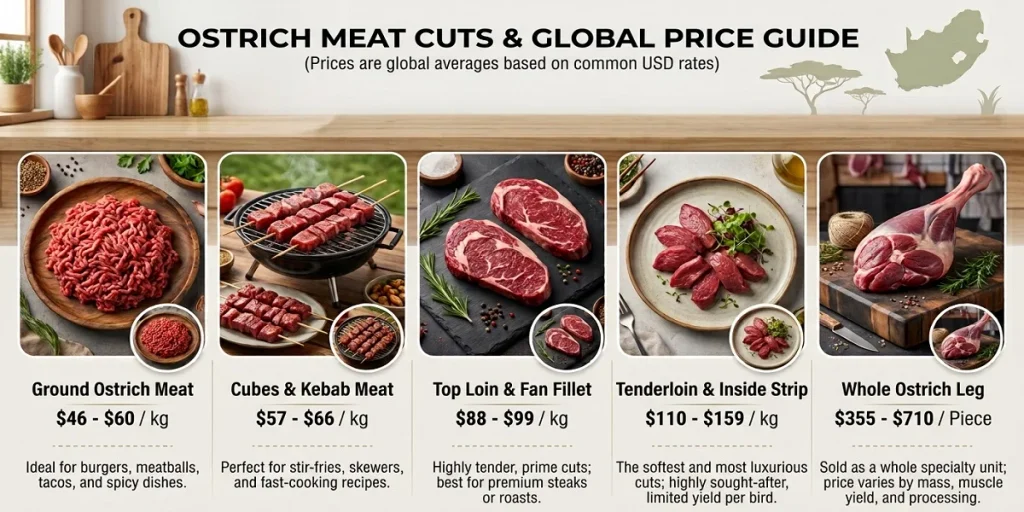
The price of ostrich meat varies dramatically depending on the specific cut. Ground ostrich is the most affordable option, whereas premium muscle cuts such as tenderloin, fan fillet, and inside strip can cost more than twice as much per kilogram.
The wide range in retail pricing means there is no single answer to how much ostrich meat costs per kilogram. Pricing depends heavily on the bird’s muscle group, trim level, and preparation method.
| Ostrich Meat Cut | Typical Price Per Pound | Approximate Price Per Kg |
| Ground ostrich | $21–$27 | $46–$60 |
| Steak strips / kebab meat | $26–$30 | $57–$66 |
| Top loin | $40–$41 | $88–$90 |
| Fan fillet | $44–$45 | $97–$99 |
| Tenderloin | $50–$70 | $110–$154 |
| Inside strip | $70–$72 | $154–$159 |
| Whole ostrich leg | $355–$710 per leg | Sold per piece |
Ground Ostrich
Ground ostrich is the most accessible entry point for consumers. Ranging from $46 to $60 per kg, it costs more than conventional ground beef but remains significantly cheaper than ostrich steaks or tenderloin.
This versatile cut works well in burgers, meatballs, tacos, and chili. For first-time buyers, ground ostrich offers an ideal opportunity to test the flavor and texture profile of ostrich meat without investing in high-end cuts.
Ostrich Steak Strips and Kebab Meat
Steak strips and kebab meat occupy the mid-range price tier at roughly $57 to $66 per kg. Typically sold as pre-cut pieces rather than full steaks, these portions are suited for stir-fries, skewers, and fast-cooking recipes.
Pricing fluctuates depending on trimming, packaging, and marketing positioning. Some suppliers package premium muscle trimmings into uniform strips, whereas others use less consistent sections of the bird.
Top Loin and Fan Fillet
Top loin and fan fillet represent prime cuts, generally priced between $88 and $99 per kg. Highly valued for their tenderness, distributors sell them primarily as thick-cut steaks or roasting roasts.
Terminology can differ between specialty butchers and online vendors. Two products with distinct names may originate from the same muscle group, while items with identical labels might feature different trim specifications. Comparing the price per kilogram alongside package net weight offers the most accurate value evaluation.
Ostrich Tenderloin and Inside Strip
Tenderloin and inside strip represent the most expensive ostrich cuts available. Tenderloin commands $110 to $154 per kg, while inside strip can reach $154 to $159 per kg across specialty retail channels.
These premium cuts come from small, highly sought-after muscle groups known for maximum tenderness. Their elevated price reflects both limited yield per bird and strong demand from buyers seeking a luxury dining experience rather than an everyday protein source.
Whole Ostrich Leg
Unlike portioned cuts, a whole ostrich leg is commonly sold as a single unit. Vendors price the entire leg as a whole specialty item, usually ranging from $355 to $710 per piece.
Final pricing hinges on leg mass, muscle yield, and processing depth. Because listed weights vary widely across suppliers, calculating an exact per-kilogram rate can be misleading. Evaluating total piece price alongside verified weight, shipping fees, and minimum order requirements ensures a clear cost comparison before purchasing.
How Much Does Ostrich Meat Cost Compared With Beef?
Ostrich meat is significantly more expensive than conventional beef when comparing equivalent retail cuts. The price gap is especially prominent among premium cuts like tenderloin and inside strip, which frequently exceed $100 per kg.
However, the comparison depends heavily on the type of beef you choose. If you want to see how the two meats compare beyond price, our detailed look at ostrich meat vs beef covers their nutritional profile, fat content, flavor, and overall value.
Ostrich does not compete directly with beef on retail price. Consumers pay a premium for its exceptionally low fat content, unique flavor profile, and status as an exclusive specialty red meat.
| Meat Type | Typical Price Position | Main Market Driver |
| Ground beef | Lower | Mass-market production and widespread availability |
| Ground ostrich | Higher | Lean, specialty red meat alternative |
| Premium beef steak | Varies widely | Dependent on cut, aging, and USDA grade |
| Ostrich tenderloin | Very high | Highly limited yield per bird and niche supply chains |
Market infrastructure plays a massive role in this price distinction. Beef benefits from massive global production scales, established processing networks, and intense supermarket competition. In contrast, ostrich farming operates on a much smaller scale, where specialized processing and logistics add substantial overhead to the final retail price.
Choosing between the two depends on consumer intent. For maximum affordability, conventional beef is the practical choice. For buyers seeking an exotic, ultra-lean red meat, the higher cost of ostrich represents a worthwhile specialty investment.
Why Is Ostrich Meat So Expensive?
The premium price of ostrich meat stems from smaller farm operational scales, specialized processing requirements, restricted retail supply, and higher distribution costs per unit.
Unlike conventional poultry and cattle, ostrich farming lacks huge industrial infrastructure. Consequently, every stage of production (from specialized feed and humane processing to cold-chain transport) accounts for a much larger share of the end-consumer price.
A complete breakdown of supply chains, yield economics, and historic production challenges is available in our detailed guide on why ostrich meat is so expensive.
Ultimately, no single variable drives up the retail cost. The high price tag reflects a boutique specialty industry operating without the massive economies of scale enjoyed by mainstream livestock markets.
How Much Meat Does One Ostrich Produce?
Understanding total meat yield per bird provides crucial context for retail pricing. While a mature market-ready ostrich can weigh between 100 and 130 kg (220 to 287 lb), live weight includes feathers, skin, bones, and organs that do not yield edible meat.
For an ostrich weighing 100 to 130 kg, marketable meat represents only a specific percentage of total body mass. Calculating carcass yield and boneless lean meat percentage is essential to evaluating both wholesale supply economics and consumer pricing structures.
| Production Stage | Approximate Amount or Yield | Calculation Basis |
| Live weight | 100–130 kg (220–287 lb) | Total bird mass at harvest |
| Carcass yield | ~58% of live weight | Dressed body after processing |
| Carcass weight | ~58–75 kg (128–165 lb) | Total hanging carcass mass |
| Separable lean meat | ~62.5% of carcass weight | Usable muscle tissue yield |
| Estimated lean meat | ~36–47 kg (79–104 lb) | Final packaged retail product |
Applying these average percentages shows how processing impacts total yield:
- 100 kg Ostrich: A 58% carcass yield equals roughly 58 kg of dressed carcass. Extracting 62.5% separable lean meat results in approximately 36 kg of packaged meat.
- 130 kg Ostrich: A 58% carcass yield yields a 75 kg dressed carcass. Applying the same lean muscle extraction yields around 47 kg of packaged meat.
These figures represent industry standards rather than fixed guarantees. Actual muscle yield varies based on bird age, genetics, nutritional regime, trimming accuracy, and specific slaughterhouse processing standards.
Why Meat Yield Matters to Ostrich Meat Prices
Meat yield directly explains why retail prices cannot be estimated from a live bird’s weight alone. Producers cannot sell 100% of an animal’s weight as meat; only a fraction survives the dressing and deboning process to reach retail shelves.
Cut breakdown further drives market value. Out of the 36 to 47 kg of usable lean meat per bird, only a tiny percentage qualifies as high-end steak:
- High-Value Cuts: Prime cuts like tenderloin, fan fillet, and inside strip account for a small portion of total body mass, driving up their per-kilogram cost.
- Standard Muscle Cuts: The remaining yield consists of less uniform muscles suited primarily for steak strips, stir-fry cuts, or ground ostrich.
Consequently, farm economics rely on balancing high-value prime cuts against high-volume ground meat. Because limited high-end yield must offset processing overheads, premium cuts carry elevated price tags.
What Does a Kilogram of Ostrich Meat Cost Per Serving?
A kilogram of ostrich meat may appear expensive at first glance when seeing prices of $50, $100, or more. However, evaluating the investment on a per-serving basis provides a much more practical consumer perspective. Actual meal costs depend on cut selection, portion sizes, and preparation yield.
For instance, a $60 kilogram of ostrich meat yields five standard 200-gram portions, bringing the raw protein cost to roughly $12 per serving. At $120 per kilogram for a high-end steak cut, that same 200-gram portion equals $24 per meal.
| Price Per Kg | Approx. Cost for 150 g (Light Portion) | Approx. Cost for 200 g (Standard Portion) | Approx. Cost for 250 g (Generous Steak) |
| $50 | $7.50 | $10.00 | $12.50 |
| $60 | $9.00 | $12.00 | $15.00 |
| $100 | $15.00 | $20.00 | $25.00 |
| $120 | $18.00 | $24.00 | $30.00 |
| $150 | $22.50 | $30.00 | $37.50 |
What Am I Getting for the Price?
Ultimately, when asking “how much does ostrich meat cost?” the evaluation extends beyond simple dollars per kilogram. Consumers weigh the total price against what the product actually delivers:
- Nutritional Density: High protein content combined with exceptionally low fat and cholesterol levels.
- Flavor Profile: A rich, lean red meat experience similar to prime beef without the heavy marbling.
- Exclusivity: Limited farm availability and boutique processing standards.
If keeping food expenses minimal is your primary goal, ground ostrich offers the most practical option. However, for those seeking a lean, specialty red meat, premium ostrich cuts provide a unique culinary experience. Their higher price can be easier to justify when you consider the nutrition of ostrich meat, particularly its high protein content and naturally low fat levels.
Ostrich Meat Prices by Region
Ostrich meat prices vary considerably across international markets. Regional comparisons require careful evaluation because the price gap between farm-gate wholesale rates and direct-to-consumer retail packaging is substantial.
The United States features the most transparent online retail market, where specialty farms list packaged cuts directly for home delivery.
| Region / Market Stage | Typical Price Range | Target Buyer & Format |
| United States (Retail) | $46–$159 per kg ($21–$72/lb) | Direct-to-consumer, portioned, vacuum-sealed |
| South Africa (Wholesale/Export) | $12–$13 per kg | Bulk agricultural trade, carcass or wholesale blocks |
United States
In the U.S. retail market, consumer pricing reflects the full supply chain overhead. Ground ostrich averages $46 to $60 per kg, while luxury cuts like tenderloin and inside strip reach $110 to $159 per kg.
These rates represent fully processed, packaged, and cold-stored consumer goods. Consequently, retail costs naturally include butchery trimming, packaging, specialty storage, and domestic logistics.
South Africa
South Africa maintains the world’s most established commercial ostrich industry and dominates global export channels. Wholesale and export figures reported from South African producers are significantly lower than western retail prices.
Agricultural trade data frequently places bulk South African export transactions around $12 to $13 per kg. However, this represents raw wholesale volume at the production stage, not the final packaged retail price paid by end consumers at a supermarket.
This vast margin highlights a crucial principle: raw export values cannot be compared directly against packaged retail steaks.
Why Regional Prices Are Difficult to Compare
There is no uniform global market price for ostrich meat. Pricing dynamics shift based on localized production scales, processing facility access, import tariffs, freight logistics, currency fluctuations, and retail positioning.
When evaluating international prices, compare products at identical points in the supply chain:
- Retail to Retail: Compare a vacuum-sealed 500-gram retail steak against another domestic retail offering.
- Wholesale to Wholesale: Compare bulk export statistics against commercial restaurant supply rates.
Additionally, international orders frequently incur extra costs for specialized cold-chain shipping, customs clearances, and local import taxes, which can significantly increase the final landed cost per kilogram.
Where Can You Buy Ostrich Meat?
Ostrich meat is not as widely available as beef, chicken, or pork, so finding it often requires looking beyond a regular supermarket. Depending on where you live, the best options may include ostrich farms, specialty meat retailers, online suppliers, farmers’ markets, and restaurants that work directly with producers.
Buying directly from an ostrich farm can sometimes provide access to a wider selection of cuts, especially if the farm sells meat online or ships frozen products. Specialty retailers may offer more convenient ordering and a broader range of premium cuts such as tenderloin, fillet, and steak.
When comparing suppliers, do not look at the listed meat price alone. A product advertised at $50 per kg may become significantly more expensive after shipping, while a slightly higher-priced product from a nearby supplier could be the better overall value.
Here are some of the main factors worth checking before placing an order:
- Price per kg: Convert all prices to the same unit before comparing suppliers.
- Cut: Ground ostrich is usually less expensive than premium steaks and tenderloin.
- Package size: A lower price may come with a larger minimum order.
- Shipping: Frozen meat can require expensive temperature-controlled shipping.
- Fresh vs. frozen: Check how the meat is stored and shipped before comparing prices.
- Processing and trimming: Two products with similar names may contain different amounts of usable meat.
- Inspection and certification: Make sure the supplier meets the applicable food-safety requirements in your country.
For a more detailed look at where to buy ostrich meat, including farms, specialty retailers, and online purchasing options, the right supplier will depend heavily on your location and the type of cut you want.
If you are buying ostrich meat for the first time, starting with a smaller package of ground meat or a reasonably priced steak can also be a better way to evaluate the flavor before committing to a large or premium order.
Is Ostrich Meat Worth the Price?
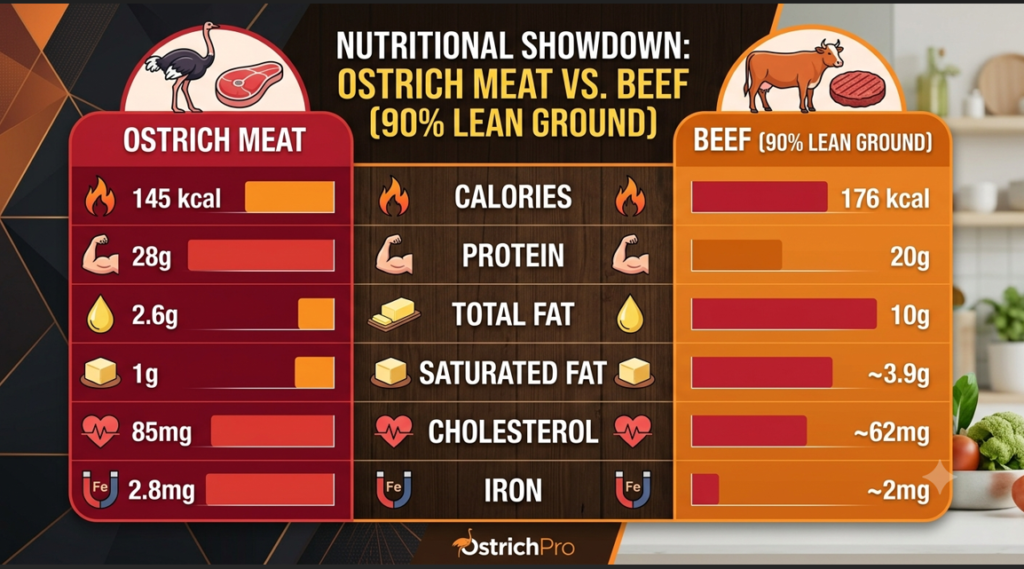
Source: USDA Food Data Central figures for raw ostrich meat and 90% lean ground beef.
Whether ostrich meat is worth the price depends on what you are looking for. If your main priority is buying the cheapest meat or getting the most protein for the lowest possible cost, ostrich is unlikely to beat conventional beef or chicken. Its higher price makes it a specialty food rather than an everyday budget option.
For buyers who value a lean red meat with a high-protein, low-fat nutritional profile, however, the calculation is different. Ostrich meat contains relatively little fat while still providing substantial protein, iron, and other nutrients commonly associated with red meat.
The price can also make more sense when you consider the type of product you are buying. A premium ostrich tenderloin should not necessarily be compared with inexpensive ground beef. It is closer to a specialty or premium meat purchase, where tenderness, flavor, rarity, and the overall eating experience all contribute to the value.
There is also very little waste from excess external fat compared with many conventional red meat products. Ostrich meat is naturally lean, so consumers who specifically want a low-fat red meat may place a higher value on it than someone simply comparing prices by weight.
If you are interested in the nutritional side of the comparison, the nutrition of ostrich meat is an important part of understanding why some consumers are willing to pay a premium for it.
Ultimately, ostrich meat is probably not worth the extra cost for everyone. But if you want to try a distinctive red meat, prefer very lean cuts, and are comfortable paying more for a specialty product, the higher price can be justified by what you are getting rather than simply by the amount of meat on the package.
Frequently Asked Questions About Ostrich Meat Prices
Is Ostrich Meat an Expensive Meat?
Yes. Ostrich meat is generally more expensive than conventional beef, chicken, or pork. Retail prices typically range from $46 per kg for ground ostrich to over $150 per kg for premium cuts, depending on the supplier and cut selection.
What Is the Price of 1 kg of Ostrich Meat?
The price of 1 kg of ostrich meat depends heavily on the cut. Ground ostrich costs around $46 to $60 per kg, while premium tenderloin ranges from $110 to $154 per kg. Specialty cuts like inside strip can reach up to $159 per kg.
How Much Meat Does One Ostrich Produce?
A market-ready ostrich weighing between 100 and 130 kg yields approximately 36 to 47 kg of separable lean meat. Actual yield varies based on bird age, processing methods, trimming precision, and carcass dressing standards.
Is Ostrich Meat Good to Eat?
Yes. Ostrich meat is a nutritious, exceptionally lean red meat with a mild flavor profile similar to prime beef. It is popular among health-conscious consumers seeking high protein content with minimal fat and cholesterol.
How Much Does Ostrich Steak Cost?
Ostrich steak prices depend on the specific muscle group. Entry-level steak strips cost roughly $26 to $30 per pound ($57 to $66 per kg), while prime steak cuts such as fan fillet and tenderloin cost $50 to $70 per pound ($110 to $154 per kg).
Is It Legal to Eat Ostrich Meat in the United States?
Yes. Ostrich meat is legal to eat in the United States. Ostriches are ratites, and commercially sold ratite meat is subject to USDA FSIS inspection requirements. Meat intended for interstate commerce must come from an appropriately inspected establishment.
Do Muslims Eat Ostrich? Is Ostrich Meat Halal?
Ostrich meat is considered halal when the bird is raised and slaughtered according to Islamic zabiha dietary laws. Because certification standards vary, consumers requiring strict halal compliance should look for verified certification labels from recognized halal authorities.
Are Jews Allowed to Eat Ostrich? Is Ostrich Meat Kosher?
Generally, no. Ostrich meat is not considered kosher because the ostrich is explicitly classified as an unclean bird in traditional Jewish dietary law (Kashrut). Consumers adhering to kosher guidelines should avoid ostrich products.
What Country Eats the Most Ostrich Meat?
Global consumption data does not track a single definitive leading consumer country. However, South Africa maintains the world’s most established commercial ostrich market, driving significant domestic consumption alongside international exports.
Final Thoughts
Ostrich meat is undeniably more expensive than most conventional meats, but there is no single price that applies to every cut. At retail, ostrich meat price per kg can range from around $46 for ground meat to more than $150 for premium cuts such as tenderloin and inside strip.
The price difference becomes easier to understand when you consider the size of the ostrich meat industry, the limited supply of premium cuts, specialized processing, and the additional costs involved in getting a relatively uncommon meat product to consumers.
For the best value, ground ostrich and mid-range cuts are usually the most practical choices. Premium cuts cost considerably more, but they offer a different experience for buyers specifically looking for a tender, very lean red meat.
So, is ostrich meat worth the price? For the cheapest meat option, probably not. For a distinctive, lean specialty meat, it can be. The best choice ultimately depends on your budget, the cut you want, and how much value you place on the nutritional and culinary characteristics of ostrich meat.
Disclaimer: Retail prices vary by supplier and product size, and the figures in this guide should be treated as representative examples rather than fixed market prices.