

Quick Answer: An ostrich egg is the largest egg laid by any living bird. A typical egg weighs around 1.4 kg (3.1 lb), although most fall between 1.2 and 1.8 kg (2.6–4 lb). It measures about 15 cm (6 inches) long and 13 cm (5 inches) wide, making it roughly equal to 20–24 chicken eggs in volume.
While its enormous size grabs most of the attention, an ostrich egg is also remarkable for its exceptionally thick shell, long incubation period, and ability to support the rapid growth of one of the world’s largest chicks.
Table of Contents
Ostrich Egg Size at a Glance
Before diving into the details, here are the measurements most people are looking for.
| Measurement | Average |
|---|---|
| Weight | 1.4 kg (3.1 lb) |
| Typical weight range | 1.2–1.8 kg (2.6–4 lb) |
| Length | 15 cm (6 in) |
| Width (Diameter) | 13 cm (5 in) |
| Shell thickness | 2–4 mm |
| Equivalent chicken eggs | 20–24 eggs |
| Incubation period | About 42 days |
These values vary slightly depending on the female’s age, genetics, nutrition, and overall health, but they represent the averages reported by most farms and scientific references.
How Much Does an Ostrich Egg Weigh?
If there’s one number people search for most, it’s the weight.
A typical ostrich egg weighs about 1.4 kilograms (3.1 pounds). However, healthy eggs commonly range from 1.2 to 1.8 kg (2.6–4 lb), and exceptionally large eggs may exceed 2 kilograms (4.4 pounds).
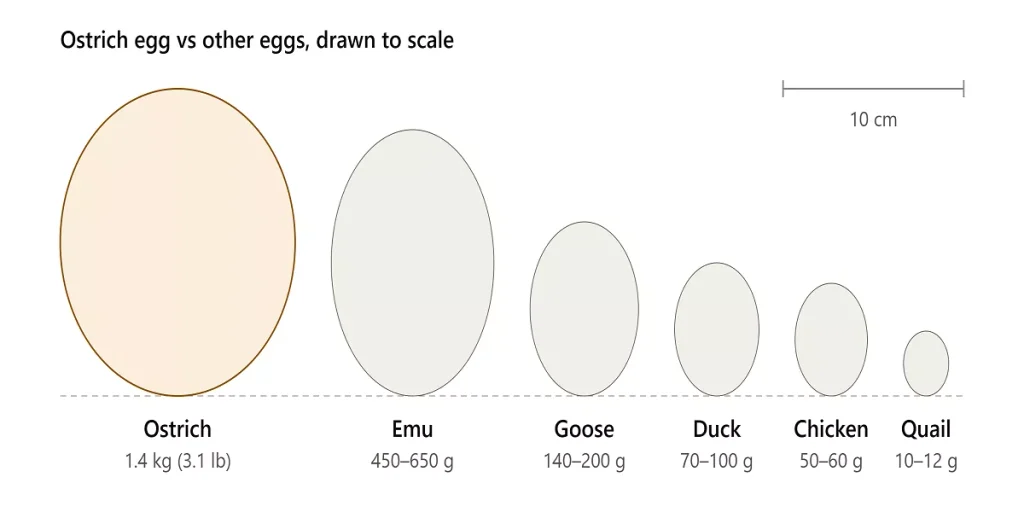
That might not sound extraordinary until you compare it with a chicken egg. The average chicken egg weighs only about 55 grams, meaning a single ostrich egg weighs roughly 25 times more.
| Egg Type | Average Weight |
|---|---|
| Ostrich | 1.4 kg (3.1 lb) |
| Emu | 450–650 g |
| Goose | 140–200 g |
| Duck | 70–100 g |
| Chicken | 50–60 g |
| Quail | 10–12 g |
Although you’ll sometimes see slightly different numbers online, there is no contradiction. Egg size naturally varies from bird to bird, and larger females generally lay heavier eggs than younger hens.
How Big Is an Ostrich Egg?
Weight tells only part of the story. The physical dimensions are just as impressive.
An average ostrich egg measures approximately:
- 15 cm (6 inches) long
- 13 cm (5 inches) wide
- Circumference of roughly 40–45 cm (16–18 inches)
Its oval shape is also noticeably rounder than most chicken eggs, giving it an almost melon-like appearance when viewed from the side.
Despite being the largest egg produced by any living bird, it is surprisingly small relative to the size of the largest bird in the world. An adult female ostrich can weigh well over 100 kg (220 lb), meaning the egg represents only a small percentage of her body weight.
This makes ostriches unusual among birds. Species such as kiwis produce eggs that occupy a much larger proportion of the female’s body size.
How Big Is an Ostrich Egg Compared to a Chicken Egg?
For most people, the easiest way to understand an ostrich egg’s size is through comparison.
| Feature | Ostrich Egg | Chicken Egg |
|---|---|---|
| Weight | 1.4 kg (3.1 lb) | 50–60 g |
| Length | 15 cm (6 in) | 5.5 cm (2.2 in) |
| Width | 13 cm (5 in) | About 4 cm (1.6 in) |
| Shell Thickness | 2–4 mm | Around 0.3 mm |
| Volume | Equal to 20–24 chicken eggs | 1 egg |
| Boiling Time | 45–90 minutes | 6–10 minutes |
Although an ostrich egg is only about three times longer than a chicken egg, its much greater width means it contains dramatically more volume.
That’s why a single egg is often enough to prepare breakfast for a large family or several guests.
How Many Chicken Eggs Equal One Ostrich Egg?
In terms of cooking, one ostrich egg is generally considered equivalent to 20–24 average chicken eggs.
The exact number depends on the size of both eggs, but this estimate works well for most recipes.
For example:
- One large family-sized omelet can be made from a single ostrich egg.
- A standard cake recipe calling for four chicken eggs would use only about one-fifth of an ostrich egg.
- Many farms recommend sharing one cooked ostrich egg among 8–12 people, depending on the meal.
This enormous capacity is one of the reasons ostrich eggs are often served as a novelty dish at restaurants and food festivals.
How Thick Is an Ostrich Eggshell?
The sheer size of an ostrich egg wouldn’t matter much without a shell strong enough to protect it.
An ostrich eggshell is typically about 2 mm thick, although measurements vary between eggs and studies. A review published in the Turkish Journal of Veterinary and Animal Sciences reported a shell-thickness range of approximately 1.6–2.2 mm. A separate study using X-ray tomography measured a mean thickness of 1.83 mm. These findings show that the shell is unusually thick for a bird’s egg, but its exact thickness is not identical in every egg.
This strength is essential because ostriches nest directly on the ground in open habitats. During the 42-day incubation period, the eggs must withstand the weight of incubating adults, shifting sand, changing temperatures, and the occasional bump from other birds sharing the nest.
How Strong Is an Ostrich Eggshell?
One of the most surprising facts about ostrich eggs is just how much weight the shell can support.
Ostrich eggshells are remarkably strong for their size. In one laboratory study, researchers measured eggshell strength at approximately 70 kg of applied force under the test conditions. However, shell strength depends on how force is applied and distributed, so this result should not be interpreted as a guarantee that every ostrich egg can safely support a person. Avoid standing or placing body weight on an egg to test its strength.
That doesn’t mean the shell is impossible to break, however. A sharp, concentrated impact can crack it much more easily than steady pressure.
This combination of strength and brittleness explains why opening a fresh ostrich egg usually requires a drill, saw, or hammer rather than a simple tap with a knife.
Interesting fact: Many empty ostrich eggshells are polished and carved into decorative art because the shell is durable enough to survive long after the egg has hatched or been eaten.
Why Are Ostrich Eggs So Big?
At first glance, it might seem wasteful for a bird to invest so much energy into producing a single enormous egg. In reality, the size is an evolutionary advantage.
Everything inside the egg is designed to support one of the largest chicks in the bird world.
Several factors explain why ostrich eggs are so large:
- Large chicks: Newly hatched ostriches already weigh around 1 kilogram (2.2 pounds) and can walk within hours of hatching.
- Long development: The embryo develops for about 42 days, requiring a substantial reserve of nutrients.
- Ground nesting: Unlike tree-nesting birds, ostriches lay their eggs in shallow ground nests where the shell must withstand environmental pressure.
- Rapid early growth: Chicks grow incredibly quickly during their first months of life, so they begin life with a generous supply of energy stored inside the egg.
Although ostriches lay the largest eggs of any living bird, the egg itself is surprisingly small relative to the mother’s body. A typical ostrich egg represents only about 1–2% of an adult female’s body weight, making it proportionally one of the smallest bird eggs compared with the size of the mother.
Is an Ostrich Egg Really the World’s Largest Single Cell?
Surprisingly, yes.
An unfertilized ostrich egg is a single biological cell, making it a striking example of how large a cell can become. Its size comes largely from the substantial yolk and other stored materials that support early embryonic development if fertilization occurs.
How Long Does It Take an Ostrich Egg to Hatch?
Ostrich eggs generally take about 42 days to hatch under suitable incubation conditions. The exact incubation process depends on temperature, humidity, ventilation, and regular egg management. For practical incubation details, see our guide to ostrich egg hatching.
Unlike many birds that build raised nests, ostriches scrape a shallow depression in the ground. Several females may lay eggs in the same communal nest, but the dominant female usually positions her own eggs in the safest central area. A healthy female can produce dozens of eggs during a breeding season, although annual production varies between wild and farmed birds.
What Is the Largest Ostrich Egg Ever Recorded?
While most ostrich eggs weigh around 1.4 kilograms (3.1 pounds), nature occasionally produces exceptional examples.
The largest officially recorded ostrich egg weighed 2.589 kilograms (5 pounds 11.4 ounces). It was laid in Sweden in 2008 and remains one of the heaviest ostrich eggs ever documented.
Extremely large eggs are uncommon and usually result from natural variation rather than representing a separate breed or species.
Factors that influence egg size include:
- Age of the female
- Overall health
- Nutrition
- Genetics
- Breeding season
Because of these natural differences, published average weights may vary slightly between scientific papers, farms, and reference books.
Are Ostrich Eggs the Largest Eggs Ever?
Among living animals, absolutely.
The ostrich lays the largest egg of any living bird, a title it has held for thousands of years.
However, if we include extinct species, the record belongs to the elephant bird (Aepyornis) of Madagascar. Its eggs were several times larger than those of modern ostriches and could hold an astonishing volume.
Interestingly, the ostrich also holds another record that sounds almost contradictory.
Although it lays the largest egg in the modern world, its egg is one of the smallest relative to the mother’s body size. A kiwi, for example, lays an egg that can reach around 20% of its body weight, whereas an ostrich egg usually represents only about 1–2% of the female’s weight.
This contrast highlights just how enormous an adult ostrich is compared with even its famously giant eggs.
FAQ
How big is an ostrich egg in cm?
A typical ostrich egg measures about 15 cm (6 inches) long and 13 cm (5 inches) wide. Individual eggs can be slightly larger or smaller depending on the age, genetics, and health of the female.
How much does an ostrich egg weigh in kg?
Most ostrich eggs weigh between 1.2 and 1.8 kilograms (2.6–4 pounds), with an average weight of about 1.4 kg (3.1 lb).
How many chicken eggs equal one ostrich egg?
One ostrich egg is generally equal to 20–24 average chicken eggs in volume. Because of its size, a single egg can usually serve 8–12 people depending on how it is prepared.
Why are ostrich eggs so big?
Ostrich eggs are large because they must provide enough nutrients for a chick that weighs around 1 kilogram (2.2 pounds) at hatching. The egg also supports a relatively long 42-day incubation period, giving the embryo everything it needs to develop before emerging.
What is the biggest egg in the world?
The ostrich lays the largest egg of any living bird. Although extinct elephant birds produced even larger eggs, no living animal lays a bigger egg than the ostrich.
Can you eat an ostrich egg?
Yes. Ostrich eggs are completely edible and taste similar to chicken eggs, although many people describe them as slightly richer and more buttery. Because one egg contains roughly the equivalent of 20–24 chicken eggs, it is usually shared among several people.
An ostrich egg is far more than just a giant version of a chicken egg. It is the largest egg laid by any living bird, weighing around 1.4 kilograms (3.1 pounds) and measuring about 15 centimeters (6 inches) in length.
Its impressive size, remarkably strong shell, and ability to nourish one of the largest bird chicks make it one of nature’s most fascinating adaptations. While people often focus on its dimensions, the real story is how perfectly the egg is designed for the ostrich’s unique lifestyle.
Whether you’re curious about its size, comparing it with a chicken egg, or simply wondering why it is so enormous, one thing is certain: few natural objects leave a bigger first impression than an ostrich egg.


1 thought on “How Big Is an Ostrich Egg? Weight, Size & Chicken Egg Comparison”