Quick Answer: Ostrich meat isn’t a regular part of the American diet because several factors reinforce each other. Most people never grow up eating it, grocery stores rarely stock it, the farming industry remains small, premium cuts are expensive, and many first-time buyers overcook it because it behaves differently from beef. None of these factors alone explains why ostrich remains uncommon, but together they have kept it a niche meat despite its nutritional benefits and beef-like flavor.
From the OstrichPro Team
At OstrichPro, our mission isn’t simply to write about ostriches. It’s to make reliable, evidence-based information accessible to anyone curious about these remarkable birds, their farming, and the products they provide. If our work helps more people discover ostrich meat and supports the long-term growth of responsible ostrich farming, we’ll be proud to have played a small part.
Table of Contents
Introduction
Why don’t we eat ostriches more often? It’s a question many people ask after discovering that ostrich meat is legal, naturally lean, and often compared to high-quality beef. In reality, the answer has far less to do with the meat itself than with history, culture, economics, consumer habits, and a farming industry that has remained surprisingly small.
If you ask most people around the world whether they’ve ever eaten ostrich, the answer is usually no. Despite being a legal and nutritious source of red meat in many countries, ostrich has never become a common part of most people’s diets.
That might seem surprising. Ostrich meat is naturally lean, rich in protein, and often compared to high-quality beef. Yet despite these advantages, it remains something many people only encounter through documentaries, specialty restaurants, or online discussions rather than something they regularly buy and cook at home.
So why hasn’t ostrich become as common as beef, chicken, or even bison?
The answer has very little to do with taste. Instead, it comes down to culture, economics, history, and one industry that never fully matured. Here’s why ostrich meat is still considered a specialty product today.
1. Ostrich Meat Never Became Part of Everyday Food Culture
Taste and nutrition are only part of the reason people choose the foods they eat. Familiarity often matters just as much. While ostrich has many qualities that make it an interesting alternative protein, it never developed the cultural habits, traditions, and everyday presence that helped meats like beef and chicken become household staples.
Food Habits Are Hard to Change
People usually eat what they grew up eating. In most places, that means familiar foods and traditional meats that have been part of local diets for generations. For many consumers, that includes familiar choices such as beef, chicken, pork, fish, or other locally common meats. Ostrich has never had the same cultural foundation, which makes convincing consumers to try it much more difficult.
No Family Recipes, No Cooking Tradition
Unlike traditional meats, ostrich doesn’t come with generations of recipes and cooking habits. Most people don’t know which cuts to buy, how to prepare them, or what flavors work best, creating another barrier between curiosity and regular consumption.
For someone trying ostrich for the first time, simple questions appear:
- How should it be cooked?
- Which cuts are best?
- What does it taste like?
- What should it be served with?
Without that familiarity, curiosity rarely turns into regular purchasing.
2. You Rarely See It in Grocery Stores
Even if someone wants to try ostrich, finding it can be surprisingly difficult. Unlike beef or chicken, ostrich meat usually isn’t available at national supermarket chains.
Instead, people typically buy it from:
- specialty butchers
- online ostrich farms
- online meat retailers
- farmers markets
- restaurants serving exotic or game meats
Because consumers rarely see ostrich during their normal shopping trips, it never becomes an impulse purchase or a household staple.
3. Ostrich Farming Never Reached the Scale of Traditional Livestock
The availability problem is closely connected to another challenge: ostrich farming has never reached the scale of traditional livestock industries. A small production base affects everything from processing and distribution to pricing, making it difficult for ostrich meat to compete with established proteins like beef and chicken.
How Small Is the Ostrich Industry?
Compared with other livestock industries, ostrich farming operates on a tiny scale.
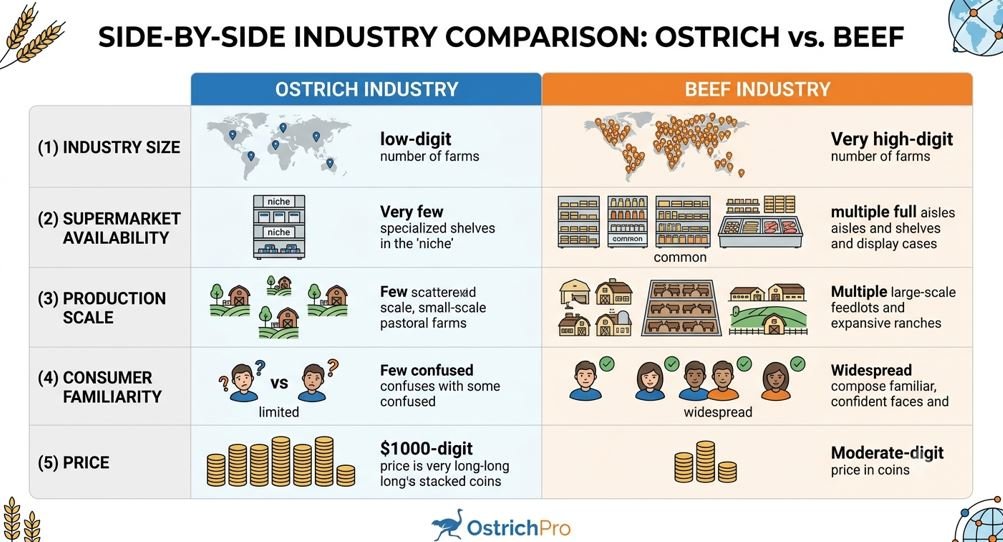
Figure: The scale of the ostrich industry compared with the beef industry helps explain why ostrich meat remains far less common in everyday grocery stores.
With only tens of thousands of birds nationwide, production simply isn’t large enough to support widespread supermarket distribution. Most farms sell directly to restaurants, specialty butchers, or online customers rather than through national grocery chains.
Why There’s So Little Official Data
One interesting sign of how small the industry remains is that ostrich meat has never received its own dedicated USDA trade classification for production reporting.
Unlike beef or pork, official production statistics are limited because the industry simply isn’t large enough to justify separate reporting.
4. The 1980s Ostrich Bubble Left a Lasting Impact
While ostrich farming continues today in countries such as South Africa and the United States, the industry has a complicated history. One of its biggest setbacks came during the ostrich breeding boom of the 1980s and early 1990s. At the time, particularly in the US, much of the industry’s growth was driven by breeding stock sales rather than by building a sustainable consumer market for ostrich meat.
When Farmers Made More Money Selling Birds Than Meat
During the late 1980s and early 1990s, breeding ostriches became extremely valuable. Instead of focusing on meat production, many farms generated most of their income by selling breeding pairs to new investors and farmers entering the industry.
As long as new buyers kept entering the market, prices continued to rise. For many producers, selling breeding birds was far more profitable than processing ostriches for meat, leaving little incentive to invest in consumer marketing, retail distribution, or meat processing infrastructure.
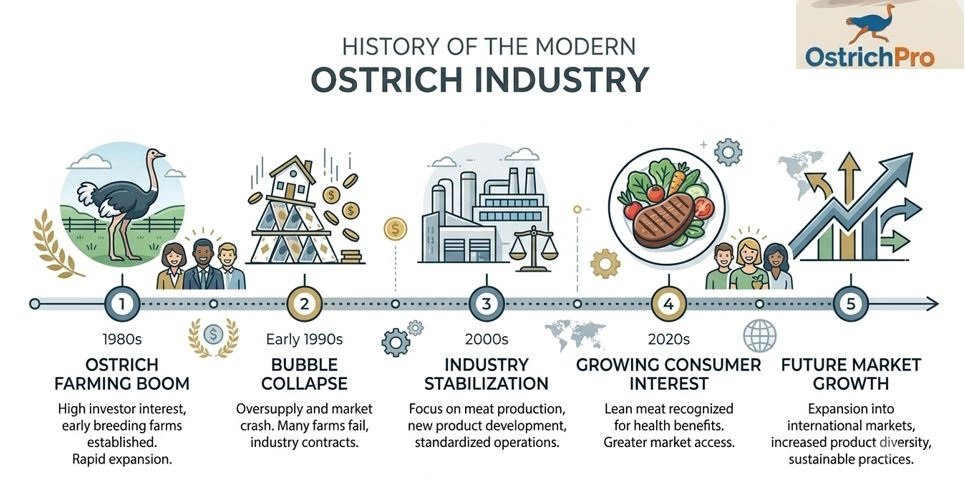
Figure: Key milestones in the development of the modern ostrich industry, from the breeding boom of the 1980s to today’s gradual market growth.
What Happened After the Bubble Burst?
Like many speculative markets, the model depended on a constant flow of new buyers. Once that demand slowed, the system quickly unraveled.
The consequences were significant:
- Breeding bird prices collapsed.
- Many ostrich farms closed or downsized.
- Investment across the industry declined.
- Consumer awareness of ostrich meat remained low.
- Distribution and processing infrastructure never fully matured.
Unlike industries such as bison or specialty beef, ostrich meat never developed the same level of consumer awareness, retail distribution, and supply chain maturity needed to become a mainstream protein. While the industry has stabilized and continues to grow gradually in some regions, the effects of that early boom-and-bust period can still be seen today.
In many ways, today’s ostrich meat market is still rebuilding from a period when the industry focused on selling birds rather than selling meat.
5. Higher Prices of Ostrich Meat Discourage First-Time Buyers
Even if someone is curious enough to try ostrich meat, the price can be enough to change their mind. Compared with everyday proteins like chicken or many cuts of beef, ostrich often feels like a premium purchase. That higher price makes many consumers hesitate before trying it for the first time.
Why Premium Cuts Cost So Much
The best-known cut is the fan fillet, one of the most tender muscles on the bird. Since every ostrich produces only two fan fillets, supply is naturally limited. Like any scarce premium cut, that pushes prices well above what most consumers expect to pay for a steak.
Fortunately, premium fillets don’t tell the whole story. Ground ostrich and several lesser-known cuts are often considerably more affordable, although they receive far less attention from first-time buyers.
Why Costs Remain Higher Than Beef
Unlike beef or chicken, ostrich farming doesn’t benefit from the same production scale or distribution networks. Fewer farms, fewer processing facilities, and lower production volumes all increase the cost of getting ostrich meat from the farm to the consumer. Those higher costs are ultimately reflected in retail prices.
Factors include:
- smaller production volumes
- fewer processing facilities
- higher transportation costs
- limited economies of scale
For many consumers, that higher price is enough to postpone trying ostrich altogether. Lower demand then makes it harder for producers to expand, reinforcing the same cycle that has kept ostrich meat a niche product for decades.
Price Isn’t the Cause. It’s Part of the Cycle.
High prices don’t exist in isolation. They are largely the result of limited production, smaller distribution networks, and lower consumer demand. At the same time, those higher prices discourage new buyers, making it even harder for the industry to grow.
6. Cooking Ostrich Isn’t Difficult, But It Is Different
Even when someone overcomes the challenges of finding and buying ostrich meat, there’s one more obstacle waiting at home. Unlike beef, ostrich behaves differently in the pan or on the grill. Many first-time buyers unknowingly cook it the same way they would a traditional steak, leading to disappointing results that have more to do with technique than with the meat itself.
Lean Meat Requires a Different Cooking Style
Ostrich contains very little fat compared with most beef steaks. That makes it healthier, but it also means overcooking happens quickly.
Just a few extra minutes can make the meat noticeably drier.
One Bad Experience Can Be Enough
Most people already know how to cook beef, chicken, or pork with confidence. Ostrich is different, and without that experience it’s easy to overcook. Unfortunately, a single dry or tough steak can leave someone believing they simply don’t enjoy ostrich meat, when in reality the preparation was the problem.
Unlike beef, ostrich rarely gets a second chance. Because it’s harder to find and often more expensive, many consumers don’t immediately buy it again after one disappointing meal. That makes first impressions especially important for the industry’s long-term growth.
Why the Cycle Keeps Repeating
By now, one thing should be clear: there isn’t a single reason why ostrich meat remains uncommon. Instead, each challenge strengthens the next. Limited production leads to higher prices, higher prices reduce demand, and lower demand gives producers little reason to expand. Together, these factors create a self-reinforcing cycle that has kept ostrich meat a niche product for decades.
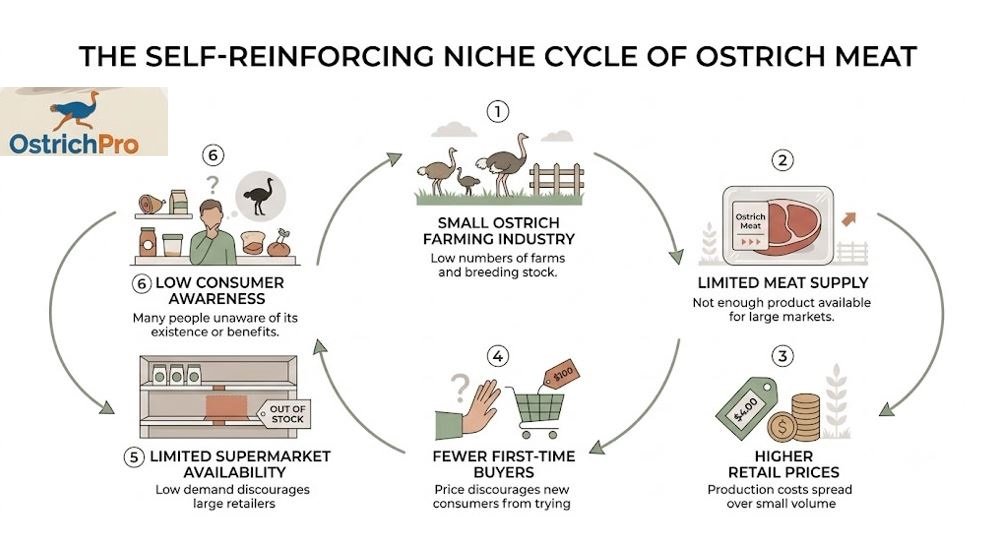
Figure: The self-reinforcing cycle that has kept ostrich meat a niche product. Each challenge strengthens the next, making long-term industry growth difficult.
None of these problems exists in isolation. Breaking just one link in the chain, such as improving availability or increasing consumer awareness, could gradually strengthen every other part of the industry.
Is Ostrich Meat Becoming More Popular?
Despite the challenges discussed throughout this article, the outlook isn’t entirely pessimistic. Consumer preferences are changing, and interest in lean, alternative proteins has grown steadily in many parts of the world. While ostrich remains a niche product, there are signs that awareness is gradually increasing.
Online retailers have also made ostrich meat more accessible than it was a decade ago, allowing consumers to buy directly from farms and specialty producers even when local grocery stores don’t carry it.
Could Ostrich Ever Become Mainstream?
Could ostrich ever become as common as beef or chicken? Probably not in the foreseeable future. But becoming mainstream doesn’t necessarily mean replacing traditional meats. Even a modest increase in production, availability, and consumer awareness could make ostrich far more accessible than it is today.
Before ostrich meat can become a common sight in supermarkets, the industry would need to overcome several connected challenges. None of these changes alone would be enough, but together they could help ostrich move beyond its current niche status.
- Greater public awareness so more consumers are willing to try ostrich meat.
- More commercial ostrich farms to increase production and improve supply.
- Additional government-approved or USDA-inspected processing facilities, depending on the country, to support larger-scale production.
- Lower production and distribution costs through greater economies of scale.
- Wider distribution into mainstream grocery stores instead of relying primarily on specialty retailers.
- Better consumer education on how to cook ostrich meat properly, helping first-time buyers enjoy a positive experience and become repeat customers.
None of these changes would happen overnight. However, if consumer demand continues to grow alongside investment in farming and distribution, ostrich meat could gradually become more accessible and affordable than it is today. It may never replace beef or chicken, but it doesn’t have to. Becoming a familiar alternative would already represent a major step forward for the industry.
Frequently Asked Questions
Is ostrich meat legal to eat in the US?
Yes. Ostrich meat is legal to eat in the United States and can be processed in USDA-inspected facilities. Although the industry is relatively small, consumers can legally purchase ostrich meat from specialty butchers, online retailers, and approved farms.
What does ostrich meat taste like?
Most people describe ostrich as tasting much closer to lean beef than to poultry. It has a mild, slightly sweet flavor with very little gamey taste, making it an easy transition for people who already enjoy steak. If you’d like a detailed comparison, see our guide to what ostrich meat tastes like.
Why don’t grocery stores sell ostrich meat?
Most supermarkets don’t stock ostrich meat because production remains limited and consumer demand is still relatively low. Instead, ostrich is typically sold through specialty butchers, online retailers, and restaurants, where suppliers can better serve a niche market.
Why is ostrich meat so expensive?
Ostrich meat costs more than many traditional meats because the industry operates on a much smaller scale. Limited production, fewer processing facilities, higher transportation costs, and relatively low consumer demand all contribute to higher retail prices. For a complete breakdown, see our guide on why ostrich meat is so expensive.
Where can I buy ostrich meat?
The easiest way to buy ostrich meat is through online ostrich farms and specialty meat retailers. Some independent butchers, farmers markets, and restaurants also offer ostrich, although availability varies depending on your location.
Is ostrich meat healthier than beef?
Ostrich meat is generally leaner than most cuts of beef while still providing high-quality protein, iron, and vitamin B12. It contains less fat and fewer calories than many beef cuts, making it a popular choice for people looking for a lean red meat.
Was there really an ostrich farming bubble?
Yes. During the late 1980s and early 1990s, particularly in the United States, many ostrich farms focused on selling breeding birds rather than meat. When demand for breeding stock collapsed, much of the industry’s momentum disappeared before a mature consumer market for ostrich meat had developed.
Is ostrich meat considered more sustainable than beef?
Research suggests ostriches can produce red meat using less feed and water than cattle while also requiring less land in some production systems. However, sustainability depends on farming practices, local conditions, and how the animals are raised, so no single comparison applies in every situation.
Could ostrich meat become more common?
Yes, but gradual growth is more likely than a sudden shift. As consumer awareness increases, more farms enter the industry, and distribution improves, ostrich meat could become easier to find and more affordable than it is today.
Will ostrich meat ever become mainstream?
It is possible, but it will likely take many years. Expanding production, improving retail distribution, lowering costs, and educating consumers about how to cook ostrich properly would all help the industry grow. Even if it never replaces beef or chicken, ostrich has the potential to become a much more familiar alternative protein.
Now that we’ve explored the many reasons behind ostrich meat’s limited popularity, let’s bring everything together.
At first glance, “Why don’t we eat ostriches more often?” sounds like a simple question. As it turns out, the answer has very little to do with the meat itself. Instead, it is the result of decades of history, consumer habits, industry economics, limited availability, and a food culture that never fully embraced ostrich as an everyday choice. Together, these factors have created a cycle that has kept one of the world’s most remarkable red meats firmly in niche territory.
None of these factors alone prevented ostrich meat from becoming mainstream. Instead, each one reinforced the next, making it difficult for the industry to gain momentum. The encouraging news is that cycles can change. As awareness grows, production expands, and more consumers experience ostrich meat for themselves, today’s niche product could become tomorrow’s familiar alternative.
At OstrichPro, our goal has never been simply to publish articles about ostriches. We want to make reliable, evidence-based information accessible to anyone curious about these remarkable birds and the products they provide. If this guide has helped you understand not only why ostrich meat remains uncommon, but also the history, science, and economics behind that answer, then we’ve achieved exactly what we set out to do.
Perhaps the real question is no longer “Why don’t we eat ostriches more often?” but “Why haven’t we given them a fair chance?”