Quick Answer: To start an ostrich farm, first decide what you want to produce and who you plan to sell to. Then check your state and local regulations, secure suitable land, build safe fencing and shelter, arrange feed and veterinary care, and only then purchase your first birds. A small starter operation may require less than a commercial breeding farm, but land, fencing, birds, equipment, feed, and permits can quickly add up to several thousand dollars or more. The key is to build the farm around a realistic business plan rather than buying ostriches first and figuring out the rest later.
Table of Contents
Introduction
Starting an ostrich farm can look surprisingly simple from the outside. You need some land, a few ostriches, fencing, food, and water. In reality, building a successful operation requires much more planning than simply putting large birds in a field.
Ostriches are among the largest living birds. They can run at high speeds, live for decades, require specialized handling, and can become difficult or dangerous to manage when fencing, shelter, or farm layout is poorly designed. They also mature slowly compared with many common farm animals, which means your business may need to operate for years before the initial investment turns into meaningful returns.
The good news is that you do not need to build a massive commercial operation on day one.
A well-planned small farm can start with a manageable number of birds and expand as you gain experience, establish buyers, and understand the economics of your local market. The important part is choosing the right production model, understanding your costs, and building the infrastructure before the birds arrive.
This guide takes you through that process step by step, from choosing your farming purpose and checking legal requirements to selecting birds, building your facilities, planning feed, finding customers, and creating a realistic path toward profitability.
Is Ostrich Farming Right for You?
Before looking at land or shopping for birds, ask yourself a more important question:
What do you actually want your ostrich farm to become?
Ostrich farming can generate income from several different products, including meat, eggs, leather, feathers, and live birds. Some farms also generate revenue through agritourism. That variety can be an advantage, but it can also make it tempting for a beginner to try everything at once.
A better approach is to start with one primary business model and add other revenue streams once the operation is established.
Ostriches also require a different management approach from conventional livestock. They are powerful animals, and inadequate fencing can lead to escapes or serious injuries. Their size means that equipment, gates, shelters, and handling areas need to be designed with adult birds in mind, not just the chicks you purchase on day one.
There is also a significant time commitment.
Depending on how you start your flock and what you produce, you may have to wait months or years before the birds generate substantial revenue. Breeding operations require an even longer planning horizon because ostriches do not become sexually mature immediately.
That makes ostrich farming a poor choice for someone looking for a quick side business with minimal upfront investment.
It can, however, make sense for someone who has access to suitable land, is willing to learn specialized livestock management, and is prepared to build a business gradually.
What Makes Ostrich Farming Different?
There are several characteristics that make ostrich farming different from raising chickens, cattle, or goats:
- Large adult size: Adult ostriches can weigh hundreds of pounds and stand more than 7 feet tall.
- High running speed: A loose ostrich can cover significant ground very quickly, making proper fencing essential.
- Long lifespan: Ostriches can live for several decades, so breeding stock represents a long-term investment.
- Slow maturity: Young birds require time and resources before they become productive adults.
- Multiple revenue streams: Meat, eggs, leather, feathers, and live birds can all contribute to farm income.
- Specialized infrastructure: Fencing, gates, shelters, feeders, and handling areas need to accommodate much larger animals than conventional poultry.
- Niche markets: Ostrich products generally have a smaller customer base than beef, chicken, or pork.
That last point is particularly important.
A farm does not become profitable simply because the animals produce valuable products. You need customers who are willing to buy those products at prices that cover your costs.
Revenue is not the same as profit.
That distinction should influence almost every decision you make before purchasing your first ostrich.
Step 1: Choose Your Ostrich Farming Model
Your first practical decision is determining what you are going to sell.
This affects the amount of land you need, the type and number of birds you purchase, the infrastructure you build, how long your money will be tied up, and which customers you need to find.
The main ostrich farming models include meat production, breeding, egg production, live-bird sales, leather and feather production, and agritourism.
Meat Production
Meat production involves raising ostriches primarily for slaughter and selling the resulting meat through appropriate processors, retailers, restaurants, or direct sales channels.
Ostrich meat is lean and has a distinctive position in the specialty meat market. However, the business model requires more than simply raising healthy birds.
You need to know:
- Who will buy the meat
- Where the birds will be processed
- What processing requirements apply in your area
- How the meat will be transported and stored
- What price you can realistically obtain
- How much feed and infrastructure each bird will consume before sale
For a beginner, the biggest mistake is often thinking about the birds before thinking about the market.
If you plan to raise ostriches for meat, identify your potential buyers and processing options before you build a large flock.
Breeding
A breeding farm keeps mature males and females to produce fertile eggs, chicks, juveniles, or breeding stock for other farmers.
This model requires a longer time horizon than meat production because you are investing in birds that must first reach reproductive maturity. Under farm conditions, ostriches can begin breeding at around 2.5 to 3 years of age, although the exact timing varies by sex, nutrition, management, and individual bird. Some females may begin producing eggs earlier, while reliable breeding performance generally develops as the birds mature.
That means a farmer starting with young chicks may need to carry the birds for roughly two to three years before the flock begins contributing meaningful breeding output. Starting with juveniles or proven adults can shorten that waiting period substantially, but increases the initial purchase cost.
The potential advantage is that a successful breeding operation can generate several types of products from the same flock:
- Mature breeding birds
- Fertile eggs
- Chicks
- Juvenile birds
Egg Production
Ostrich eggs can be sold for different purposes.
Some buyers want fertile eggs for hatching, while others purchase ostrich eggs for culinary use, specialty food products, or decorative purposes.
The target market matters because the production, handling, storage, and sales process can be very different depending on the end use.
A farm focused on fertile eggs also needs an effective incubation and chick-management system if it intends to hatch part of its own production.
Live Bird Sales
Selling live ostriches can create a relatively straightforward market for farmers who establish relationships with other farms, breeders, and new entrants to the industry.
You may sell:
- Newly hatched chicks
- Young birds
- Juveniles
- Breeding-quality adults
However, live-bird sales have their own advantages and challenges:
| Advantages of Live Bird Sales | Disadvantages of Live Bird Sales |
|---|---|
| Multiple product stages: You can sell chicks, juveniles, or mature breeding birds depending on your production model. | Smaller customer base: The number of people actively looking to buy live ostriches is much smaller than the market for conventional livestock. |
| Less dependence on meat markets: You are not entirely dependent on restaurants, butchers, or meat processors. | Limited local demand: In areas where ostrich farming is uncommon, finding nearby buyers can be difficult. |
| Potentially faster turnover: Selling younger birds can generate revenue before they reach full maturity. | Transport is more complicated: Moving live ostriches requires suitable vehicles, handling procedures, and attention to animal welfare. |
| Breeding stock can command higher prices: Healthy, well-bred adults may be considerably more valuable than ordinary young birds. | Reputation matters: Buyers are more likely to return to farms that consistently provide healthy, properly raised birds. |
| Can complement breeding operations: Fertile eggs, chicks, juveniles, and adults can create several sales opportunities from the same breeding program. | Market can be cyclical: Demand may depend heavily on the number of new farmers entering the industry and the availability of birds from established breeders. |
For a beginner, live-bird sales can work particularly well as part of a breeding-focused farm, rather than as the only revenue stream. Before building a large breeding flock, identify potential buyers in your region and determine which age groups they actually want to purchase.
Leather and Feathers
Ostrich leather and feathers have value in specialty markets, but they are generally secondary products for many farms rather than the sole reason to raise the birds.
If you are producing birds for meat, leather can potentially increase the value obtained from each animal. Feathers can provide another secondary revenue stream when there is an established buyer.
The important principle is to treat these products as part of the overall economics of the bird rather than assuming that every farm will automatically find a profitable market for them.
Agritourism
Some ostrich farms generate additional income by allowing visitors to tour the property, see the birds, purchase products, or participate in educational experiences.
Agritourism can be particularly interesting for farms located near populated areas or established tourist routes.
However, it creates additional requirements.
You may need to consider:
- Visitor parking
- Public access areas
- Insurance
- Restrooms
- Signage
- Animal-contact rules
- Local zoning requirements
- Safe separation between visitors and adult birds
Agritourism should therefore be treated as a separate business component, not simply an easy way to make extra money from the same land.
Which Model Should a Beginner Choose?
For most first-time farmers, the simplest route to building a manageable operation is selecting one primary revenue driver while treating other products as secondary revenue streams. Trying to launch every stream at once often drains capital before the learning curve is complete.
| Business Model | Primary Focus | Secondary Revenue | Best Suited For |
| The Livestock Model | Meat Production | Leather & Feathers | Farmers with access to local processing and commercial meat buyers. |
| The Breeder Model | Breeding Stock | Fertile Eggs & Chicks | Farmers with strong genetics, incubation equipment, and high-value buyers. |
| The Hospitality Model | Agritourism & Tours | Retail Eggs, Meat & Crafts | Farms located near urban centers or tourist routes with high foot traffic. |
Trying to establish every revenue stream simultaneously can consume your capital before you have learned how to manage the birds.
A focused first phase gives you a chance to learn the operation, understand your costs, build relationships with buyers, and expand based on actual results.
OstrichPro Tip: Start with a focused First Phase. This allows you to master bird management, calculate true operational costs, and secure reliable buyer networks before scaling up.
Step 2: Research Your Market Before Buying Birds
This is one of the most important steps in the entire process.
Do not buy your first ostriches before you know who might buy what they produce !!!
That sounds obvious, but it is one of the easiest mistakes for a new farmer to make.
Ostrich products occupy a much smaller market than conventional livestock products. A farm can successfully raise healthy birds and still struggle financially if it cannot find buyers at sustainable prices.
Start by mapping your potential customers.
Potential Ostrich Farm Customers
Depending on your business model, your market may include:
| Product | Potential buyers |
|---|---|
| Ostrich meat | Restaurants, specialty butchers, distributors, direct consumers |
| Fertile eggs | Breeders, hatcheries, other farms |
| Table eggs | Restaurants, specialty food buyers, direct consumers |
| Chicks | New farmers, breeders, hobby farms |
| Juveniles | Farmers building production or breeding flocks |
| Breeding adults | Established farms and serious new operators |
| Leather | Tanners, leather companies, specialty manufacturers |
| Feathers | Craft, fashion, decorative, or specialty buyers |
| Farm experiences | Tourists, families, schools, local groups |
The exact opportunities will depend heavily on your location.
Research Local Demand
Before spending money on infrastructure, spend time talking to potential buyers.
For a meat operation, contact restaurants and specialty butchers and ask:
- Do they currently buy ostrich meat?
- Which cuts are they interested in?
- How much could they realistically purchase?
- Do they require specific processing or packaging?
- Would they buy whole carcasses or only selected cuts?
- What delivery or pickup arrangements would they expect?
For a breeding operation, contact existing ostrich farms and breeders:
- Do they purchase fertile eggs?
- Do they purchase chicks?
- What age of bird do they prefer?
- What traits do they look for in breeding stock?
- How far are they willing to transport birds?
You do not need guaranteed orders before starting, but you should have evidence that a market exists.
Calculate Your Break-Even Point
Selling a bird for $2,000 does not mean you made $2,000. Revenue is what the buyer pays you. Profit is what remains after every cost of producing and selling that bird is paid.
Those costs can include feed, veterinary care, labor, transport, processing, mortality, infrastructure, and a share of your land and equipment expenses. The same principle applies to eggs, chicks, and breeding birds.
A simple spreadsheet can help you estimate your cost per bird and compare it with your expected selling price.
The goal is not to predict your future profit down to the dollar. It is to discover whether your basic business model makes sense before you commit significant capital.
Start Small, Then Scale
One of the advantages of starting with a small flock is that mistakes are cheaper.
A small operation allows you to learn:
- How much feed your birds actually consume
- How much labor daily care requires
- How your fencing performs
- Which suppliers are reliable
- How your local market responds
- What veterinary support is available
- How long it takes to sell your products
Once you have reliable numbers from your own operation, you can make better decisions about expansion. The goal of your first year should not necessarily be to become the biggest ostrich farm in your area. It should be to build a system that works.
Build the market first. Build the infrastructure second. Buy the birds third.
That order can save a new farmer from one of the most expensive mistakes in ostrich farming: owning more birds than the business is prepared to support or sell.
Step 3: Understand U.S. Licensing, Zoning and Legal Requirements
Before you buy your first ostrich, make sure you are legally allowed to keep the birds on your property and operate the type of farm you have in mind.
This is one of the easiest steps to overlook because ostriches are livestock in many agricultural settings, but the rules governing them can vary depending on what you are doing with the birds and where your farm is located.
A farmer keeping a few ostriches for agricultural purposes may face very different requirements from someone importing birds, transporting them across state lines, selling meat, or operating an agritourism business.
The safest approach is simple: check the rules before you buy the birds, not after.
Do You Need a Permit to Own an Ostrich?
There is no single nationwide “ostrich farming license” that applies to every U.S. farmer.
Instead, requirements can come from several levels of government, including federal agencies, state agriculture or wildlife authorities, counties, and municipalities.
In many states, ostriches can be kept as agricultural livestock without the type of exotic-animal licensing required for some other species. However, that does not mean every property is automatically approved for an ostrich farm.
Your local requirements may depend on:
- Whether ostriches are classified as livestock or exotic animals in your state
- The zoning classification of your property
- The number of birds you plan to keep
- Whether you are breeding or selling birds
- Whether you are selling meat or eggs
- Whether birds will cross state borders
- Whether customers will visit the farm
- Whether you are importing birds or eggs from another country
This is why copying another farmer’s permit list from a different state can be misleading.
OstrichPro Tip: Never assume state-level legality guarantees property-level permission. Zoning regulations, HOA rules, and setback requirements vary drastically by county and parcel. Confirm your property’s specific zoning classification with local planning authorities first.
Federal vs. State Regulations
At the federal level, the U.S. Department of Agriculture’s Animal and Plant Health Inspection Service (USDA APHIS) is particularly relevant when animals or animal products move between states or across international borders.
If you plan to import live ostriches or ostrich eggs from another country, additional federal import requirements can apply, including permits, health documentation, and veterinary certification.
For a farm purchasing birds from a breeder within the United States, however, your most important first step is usually understanding your state and local requirements.
That may involve contacting your state’s department of agriculture, county zoning office, and, where applicable, state wildlife or animal-control authorities.
What Should You Check Before Buying Birds?
Before paying a breeder or putting down a deposit on land, confirm the following:
| What to Check | Why It Matters |
|---|---|
| Livestock classification | Determines how ostriches are regulated in your state. |
| State permits | Some states may require additional permits for non-traditional livestock or exotic animals. |
| County zoning | Agricultural zoning does not automatically guarantee that every type of livestock operation is permitted. |
| Local ordinances | Noise, fencing, setbacks, animal numbers, or property-use rules may apply. |
| Commercial sales | Selling meat, eggs, live birds, or other products can trigger additional requirements. |
| Slaughter and processing | Meat sales may require compliant processing facilities and inspection requirements. |
| Interstate movement | Moving birds across state lines may involve health certificates or other animal-movement requirements. |
| Agritourism | Farms receiving visitors may need additional permits, insurance, parking, sanitation, or safety measures. |
| Importation | Importing birds or eggs from outside the U.S. can involve USDA APHIS requirements. |
A useful rule is to get the answers in writing whenever possible. Regulations can change, and a verbal answer from one office may not cover requirements imposed by another authority.
Who Should You Contact?
For a new U.S. ostrich farmer, the following organizations are a good starting point:
- Your state department of agriculture for livestock classification, animal health, movement, and commercial agriculture requirements.
- Your county or municipal zoning office to confirm that ostrich farming is permitted on the property.
- Your state’s wildlife or natural-resources agency if your state treats ostriches or other ratites as regulated animals.
- USDA APHIS if you plan to import birds or eggs or move animals under applicable federal animal-health rules.
- Your local or state food-safety authority if you plan to sell meat, eggs, or processed food products.
Do this research before purchasing land if possible. Finding out that a property cannot legally support the farm you planned can turn an apparently cheap piece of land into a very expensive mistake.
Step 4: Choose the Right Land for Your Ostrich Farm
Land is one of the areas where beginner guides often create the most confusion.
You may see recommendations ranging from a fraction of an acre per bird to several acres per breeding pair. These numbers can all appear contradictory until you consider what the farm is actually trying to accomplish.
There is no single acreage number that works for every ostrich farm.
A small group of birds receiving supplemental feed has very different space requirements from a large breeding operation, a commercial meat farm, or an agritourism property with visitor facilities.
Instead of asking:
“How many ostriches can I fit on one acre?”
ask:
“How much land does my entire business model need?”
That is a much more useful question.
How Much Land Do You Need?
For a small beginner operation, 0.5 to 1 acre can accommodate a limited starter group, provided the land is well-drained and supplemented with proper feed.
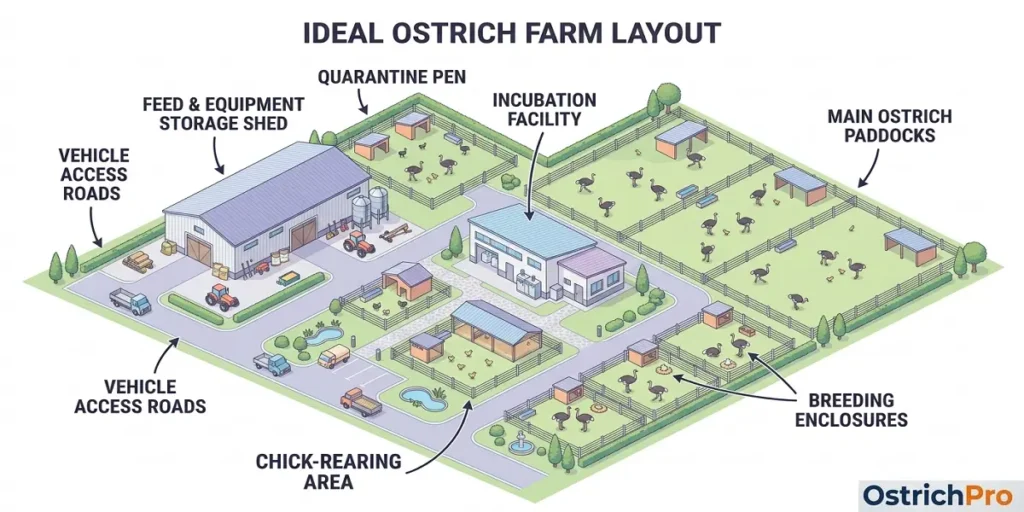
Figure 1: Ideal Layout for a Commercial Ostrich Farm (Capacity: 20–30 Adult Breeders + Offspring)
However, commercial scaling requires planning beyond bird density alone. Land requirements encompass entire facility operations, including:
- Production & Welfare: Main paddocks, breeding enclosures, chick-rearing units, and quarantine pens.
- Infrastructure & Operations: Shelters, feed storage, incubation rooms, equipment sheds, and water systems.
- Logistics & Safety: Internal fencing, vehicle access lanes, loading docks, and visitor/staff separation.
- Scalability: Room for future flock expansion and rotational grazing.
OstrichPro Tip: Never buy land based strictly on your current bird count. A property that fits 10 adult ostriches today will quickly feel cramped once you factor in chicks, machinery, storage, and operational growth.
Land Requirements by Farming Model
The following figures are useful planning ranges rather than universal legal stocking limits. Actual space requirements can vary by management system, climate, forage availability, supplemental feeding, local regulations, and farm layout.
| Farming Model | Practical Starting Range | What the Land Needs to Accommodate |
|---|---|---|
| Small starter flock | 0.5-1 acre | Starter birds, basic shelters, secure perimeter fencing, and feed/water stations. |
| Small breeding operation | 1-5+ acres | Breeding pens, quiet nesting zones, chick-rearing units, and room for flock expansion. |
| Meat-focused operation | 5 – 10+ Acres (Scales with flock size) | High-density paddocks, sorting/handling facilities, bulk feed storage, and loading logistics. |
| Agritourism & Farm Tours | 5 – 10+ Acres (10+ recommended) | Separated bird enclosures, visitor parking, walkways, retail space, and public amenities. |
The important point is that acreage alone does not determine whether a farm is suitable.
A well-designed farm on three usable acres can be more practical than a poorly laid-out operation on ten acres.
What Makes Good Ostrich Farm Land?
Not all acreage is created equal. A 5-acre flat property with good infrastructure will always outperform a 20-acre parcel on steep, inaccessible terrain. When evaluating land, look for these critical features:
Proximity to Buyers & Supplies: A cheap, remote piece of land often turns out to be expensive when every feed run, vet visit, or product delivery requires hours of driving.
Good Drainage & Soil Quality: Ostriches require dry ground to move comfortably. Poorly drained soil creates mud, which increases disease risks, causes foot problems, and makes daily maintenance difficult for workers.
Reliable & Legal Water Access: Fresh water must be accessible 365 days a year. Ensure the property has a dependable well, municipal connection, or legal rights to a spring/waterway before committing.
Heavy Vehicle Access: You will regularly receive feed deliveries, building supplies, and live-bird transport trucks. Poor road access or tight turns for large vehicles will dramatically increase your operational logistics costs.
Room for Perimeter & Internal Fencing: Usable acreage is not just open field space. Double perimeter fencing, buffer zones, internal gates, shelter structures, and service lanes will consume 20% to 30% of your total footprint.
Gently Sloping or Level Terrain: Flat to gently rolling land is far easier (and cheaper) to fence, maintain, and monitor than steep, rocky, or heavily forested terrain.
Utility Infrastructure (Power Grid): Access to electricity is non-negotiable if you plan to run egg incubators, chick brooders, security systems, or automated watering lines.
Plan Your Farm Layout Before Construction
Never build fences first and attempt to figure out the layout later. Before breaking ground or installing infrastructure, sketch a complete master plan for the property to ensure efficient daily operations and bio-security.
A functional beginner blueprint should clearly map out:
- Production & Welfare: Main ostrich paddocks, isolated breeding pens, and specialized chick-rearing areas.
- Biosecurity & Safety: A dedicated quarantine pen positioned far from the primary flock to prevent disease transmission from new or sick birds.
- Operational Essentials: Shelters, feed/equipment storage sheds, accessible water points, and loading/handling zones.
- Logistics & Scale: Wide vehicle access lanes and designated buffer space for future flock expansion.
Agritourism Consideration: If farm tours or direct customer sales are part of your business model, design visitor parking, retail spaces, and public-access walkways into the initial master plan. retrofitting visitor areas into an active, high-risk livestock layout later is costly and unsafe.
Should You Buy or Lease Land?
Buying land is not the only way to start an ostrich farm.
For some beginners, leasing agricultural property can reduce the amount of capital tied up in real estate and leave more money available for fencing, birds, equipment, feed, and working capital.
However, a lease agreement must be long-term (ideally 5–10 years) to justify your capital investment in property improvements.
Before signing any lease, ensure the contract explicitly permits:
- Livestock & Species: Keeping ratites/ostriches specifically (not just general livestock).
- Infrastructure Changes: Building or modifying perimeter and internal fencing.
- Structures: Constructing shelters, sheds, or temporary incubation facilities.
- Utilities & Water: Installing lines, drilling wells, or altering water delivery systems.
- Operations & Sales: Storing feed/equipment and directly selling agricultural products on-site.
- Commercial Access: Hosting visitors or public tours (if agritourism is planned).
- Scalability: Expanding flock size without triggering immediate rent hikes.
The Golden Rule of Leasing Land for Ostrich Farm: Never make permanent infrastructure improvements on a short-term lease. Spending tens of thousands of dollars on specialized fencing and shelters only to lose the lease after 2 or 3 years can destroy your farm’s profitability before you break even.
Leave Room for Expansion
One of the smartest strategic decisions a beginner can make is not using every available acre on day one.
As your experience grows, you may discover that high-margin opportunities like breeding stock, chick incubation, agritourism, or direct-to-consumer sales are far more profitable than your original entry point. Leaving unallocated land gives you the flexibility to pivot and expand without forcing a costly relocation of your entire infrastructure.
When securing land, consider these expansion buffers:
- Future Paddocks & Rotation: Space for additional adult runs or rotational pasture management.
- Specialized Infrastructure: Room for dedicated incubation buildings, larger feed storage, or chick brooders.
- Commercial Access: Space for expanded parking, visitor centers, or larger transport vehicle turnarounds.
OstrichPro Tip: Think of your initial property as the scalable foundation of your business, not just a temporary pen for your first few birds. Always buy or lease enough land for the farm you are building toward, not just the flock you own today.
Step 5: Build Secure Fencing and Shelter
Once you have suitable land, the next priority is keeping your ostriches safely contained and protecting them from weather, predators, and accidental injury.
This is not an area where cutting corners usually pays off.
An adult ostrich is large, powerful, and capable of running at high speed. A weak fence, poorly positioned gate, or low-clearance structure can become a serious problem once several adult birds are moving around the property.
Your fencing and shelter should therefore be designed around fully grown birds, not the chicks you may start with.
How High Should an Ostrich Fence Be?
A practical starting point for ostrich fencing is at least 8 feet high, with sturdy mesh or woven-wire construction designed to withstand large animals.
The exact design will depend on your location, predator pressure, terrain, and local requirements, but the basic principle is simple: the fence must prevent birds from escaping and provide enough visibility and clearance to reduce injury risks.
Avoid materials that can easily catch an ostrich’s legs, head, or wings.
Barbed wire is particularly unsuitable in areas where birds could make contact with it. Ostriches can move quickly when startled, and an animal running into an exposed sharp wire can suffer serious injuries.
The gates deserve just as much attention as the fence itself.
Use gates that are:
- Wide enough for equipment and livestock trailers
- Strong enough to withstand adult birds
- Securely latched
- Easy for workers to operate
- Designed to prevent birds from pushing through when opened
If possible, consider creating a small double-gate or holding area at the main entrance. This creates a buffer between the paddock and the outside world, reducing the chance of an ostrich escaping when a vehicle, visitor, or worker enters.
Should Ostrich Fencing Be Buried Underground?
The need for buried fencing depends on the predators and other animals present in your area.
If digging predators such as coyotes, foxes, or similar animals are a significant threat, extending fencing below ground or installing an appropriate buried barrier can make the perimeter more secure.
However, the goal is not simply to bury the entire fence a certain number of inches because a generic guide says so.
Instead, evaluate the actual predator risk on your property and design the perimeter accordingly.
For some farms, a properly installed fence combined with a buried apron or other predator-control measures may provide better protection than simply making the fence deeper.
This is another area where local farm and livestock professionals can be more useful than applying one universal specification to every property.
How Much Shelter Do Ostriches Need?
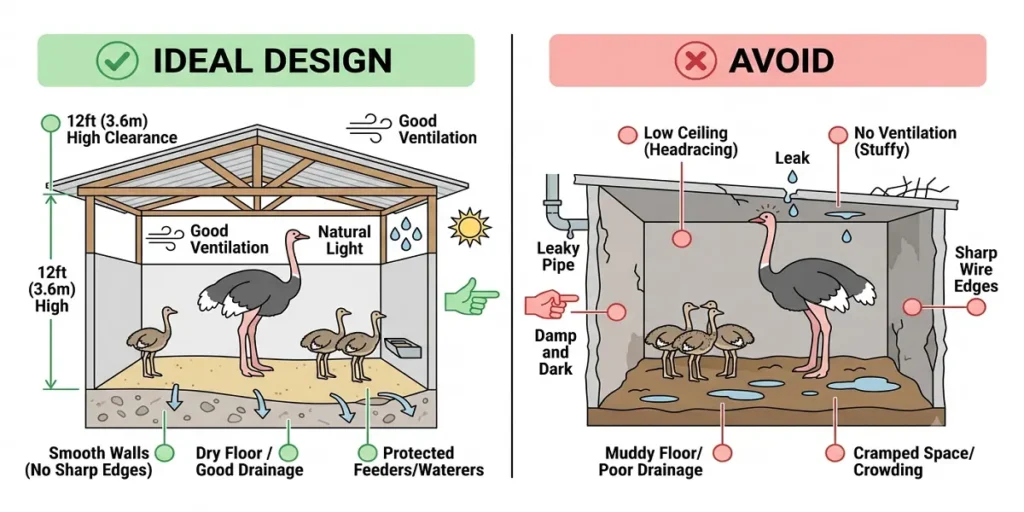
Figure 2: Ostrich Shelter Design – Ideal Layout vs. Common Mistakes.
A proper shelter requires at least 12 feet of vertical clearance, cross-ventilation, and dry drainage. Low-ceiling, damp sheds cause severe stress, injuries, and health issues.
Ostriches spend much of their time outdoors, but they still need access to shelter from severe weather and environmental conditions.
A basic ostrich shelter can be a three-sided structure that protects birds from strong wind, heavy rain, intense sun, or other extreme conditions.
Because adult ostriches can stand around 7 to 9 feet tall, the shelter should have ample vertical clearance. A structure around 12 feet high provides substantially more practical clearance than a low livestock shed and gives both birds and workers more room to move safely.
Every shelter design should meet these essential criteria:
- Good Ventilation & Low Humidity: Airflow is critical to prevent respiratory issues, but the floor must remain dry.
- Safety & Maintenance: The structure must be easy to clean and completely free from exposed nails, sharp edges, or hazardous wire.
- Proportionate Sizing: The shelter must comfortably accommodate all birds in the paddock without creating crowd stress or cornering lower-ranking birds.
- Strategic Position: Position the open side away from prevailing winds and storm directions to maximize protection.
OstrichPro Tip: Do not view a shelter as a lock-in barn where birds spend the entire day. Think of it as a safe, accessible refuge that birds can enter freely whenever harsh weather demands it.
Design the Shelter for Cleaning and Maintenance
A shelter that looks inexpensive to build can become expensive to maintain if it is difficult to clean.
Design the structure so workers can easily remove manure, replace bedding where used, inspect birds, and access feeders and waterers.
Good drainage is particularly important.
Water that collects inside or immediately around the shelter can create muddy conditions, unpleasant odors, and sanitation problems.
The best design is usually the one that makes routine work easier.
Remember that you may need to clean and inspect the facility hundreds of times over its useful life. Spending a little more during construction to improve access and drainage can save considerable labor later.
Separate Birds When Necessary
Your fencing system should allow you to separate birds when the situation requires it.
You may eventually need separate areas for:
- Breeding groups
- New arrivals
- Sick or injured birds
- Chicks
- Juveniles
- Birds being prepared for transport
A farm that has only one large enclosure can make these situations much harder to manage.
Internal fencing does not need to be as extensive as the main perimeter on a small farm, but planning for at least one additional pen can dramatically improve flexibility.
This is particularly important for breeding operations, where flock management becomes more complicated as the number of birds increases.
Build for the Birds You Will Eventually Have
One common beginner mistake is designing infrastructure around the flock they intend to buy rather than the flock they eventually want to operate.
For example, you might purchase three young birds and build a small enclosure that seems perfectly adequate.
A few years later, those birds may be mature adults, you may have added additional birds, and you may need separate breeding or quarantine areas.
Suddenly, the original design is too small.
If your long-term plan is to build a breeding operation, leave room for additional paddocks and gates from the beginning.
OstrichPro Tip: Good farm infrastructure should make expansion easier, not force you to rebuild everything when the business grows.
Step 6: Set Up Water, Feed Storage and Essential Equipment
Once fencing and shelter are planned, you need to think about the systems that keep the farm operating every day.
These are not necessarily the most expensive parts of an ostrich farm, but they are among the most important because they affect your daily labor, animal health, and operating costs.
Provide Reliable Access to Clean Water
Fresh, clean water should be available to ostriches every day.
The water system should be designed around the number of birds you plan to keep, the climate, and how easily you can inspect and clean the equipment.
Possible systems include:
- Large livestock waterers
- Automatic trough systems
- Ground-level drinkers designed for large birds
- Elevated or protected water points where appropriate
Whatever system you choose, make sure it is stable enough that adult ostriches cannot easily tip it over.
Water containers should also be positioned where manure, mud, and feed are less likely to contaminate them.
In hot climates, water demand can increase significantly, so a farm should have enough capacity to handle periods of high consumption without requiring workers to refill containers constantly.
A backup water plan is also worth considering. A pump failure or damaged water line can become an animal welfare emergency if the farm has no alternative supply.
Store Feed Properly
Feed storage is another part of farm infrastructure that is easy to underestimate.
Ostrich feed should be kept:
- Dry
- Protected from rodents and other pests
- Away from chemicals and fuel
- Easy to access
- Protected from rain and moisture
- Organized so older feed is used first
If you are purchasing feed in bulk, calculate your storage requirements before buying large quantities.
A larger storage area can reduce the number of supplier trips, but excessive inventory can create its own problems if feed deteriorates before it is used.
Good storage is ultimately about protecting the money you have already spent on feed.
Essential Equipment for a Beginner Ostrich Farm
You do not need every piece of specialized equipment on day one.
A basic operation can start with relatively simple tools and add equipment as the flock grows.
Useful equipment may include:
| Equipment | Primary Use |
|---|---|
| Feeders | Providing feed while reducing waste and contamination |
| Waterers | Maintaining reliable access to clean water |
| Wheelbarrow or utility cart | Moving feed, bedding, and supplies |
| Cleaning tools | Maintaining shelters and feeding areas |
| Basic livestock handling equipment | Moving or separating birds safely |
| First-aid supplies | Responding to minor injuries while veterinary care is arranged |
| Storage containers | Protecting feed, supplements, and equipment |
| Portable panels | Creating temporary holding or separation areas |
| Scale | Monitoring chick or juvenile growth where appropriate |
| Lighting and incubation equipment | Needed if you plan to hatch your own eggs |
The exact equipment list will depend on whether you are raising meat birds, breeding stock, chicks, or operating an agritourism farm.
Plan for Veterinary Care Before You Need It
Do not wait until an ostrich becomes sick to start looking for a veterinarian.
Because ostriches are specialized livestock, not every local veterinary practice will have extensive experience with them.
Before bringing birds onto the property, identify a veterinarian or veterinary service that is willing and able to work with ratites.
Ask about:
- Routine health checks
- Emergency availability
- Parasite control
- Vaccination recommendations
- Treatment of injuries
- Diagnostic testing
- Necropsy services when needed
- Health certificates for animal movement
Your veterinarian can also help you establish a preventive health program appropriate for your location and production system.
The goal is not simply to treat sick birds.
OstrichPro Tip: A good livestock health program is designed to prevent problems before they become expensive.
Quarantine New Birds and Protect the Flock
Whenever you purchase new ostriches, consider keeping them separate from your established flock until they have been appropriately evaluated.
Introducing a new bird directly into an established group can expose the entire flock to disease or parasites.
A dedicated quarantine area should be physically separated from your main paddocks and equipped with its own basic feeding and watering setup where practical.
The quarantine period and health procedures should be determined with your veterinarian, particularly when birds are coming from another farm or moving across state lines.
This becomes even more important as your operation grows.
A small farm may only purchase new birds occasionally. A breeding operation that regularly buys or sells birds has many more opportunities for disease introduction and spread.
Keep Farm Records From Day One
Record keeping may not feel like part of animal care, but it becomes increasingly important as the flock grows.
At minimum, keep records of:
- Bird identification
- Date of birth or purchase
- Parentage, where known
- Feed purchases
- Veterinary treatments
- Illnesses and injuries
- Mortality
- Breeding activity
- Egg production
- Hatch rates
- Sales
- Buyer information
- Transport and health documentation
These records help you understand the actual performance of your farm rather than relying on memory.
They can also reveal problems that are difficult to see day to day.
For example, if feed costs are increasing while bird growth remains unchanged, your records can help you identify the problem before it becomes a major financial issue.
For breeding farms, accurate records become even more valuable because they help you track which birds produce the best eggs, chicks, and long-term breeding results.
OstrichPro Tip: Treat your records as part of the farm’s infrastructure. They are one of the cheapest tools you can invest in, and one of the most valuable as the operation grows.
Step 7: Decide How to Start Your Flock
Once your land, fencing, shelter, water, and basic infrastructure are operational, you can finally acquire your first ostriches.
This is where many beginners fall into a costly trap: focusing purely on the purchase price of the bird rather than the total cost to reach production.
A $500 chick and a $5,000 mature breeder may seem like completely different budget tiers, but the “cheaper” bird will require months or years of feed, housing, veterinary care, and labor before generating a single dollar of revenue. The right entry method depends entirely on your business model, available working capital, experience, and required timeline to cash flow.
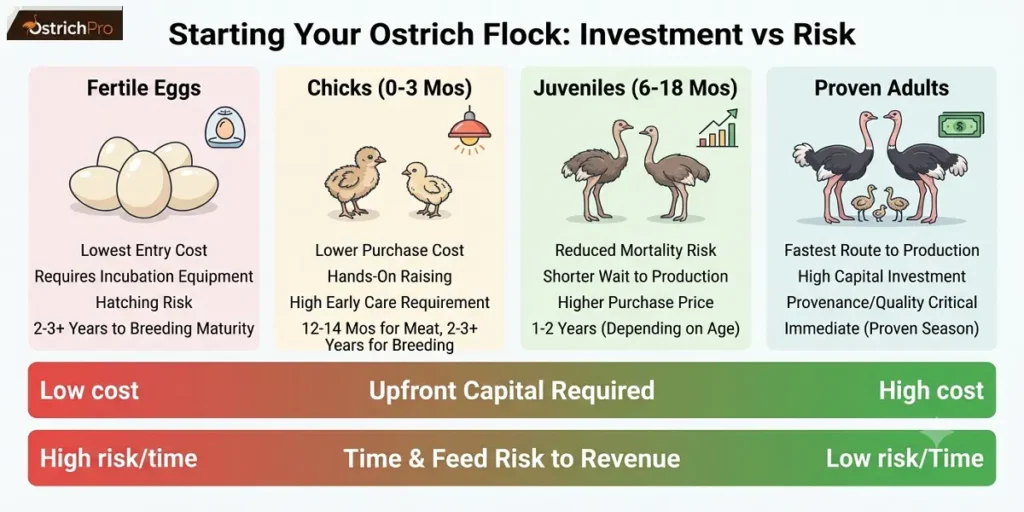
Figure 3: Ostrich Flock Entry Methods – Capital Investment vs. Time to Revenue.
Should You Start With Eggs, Chicks, Juveniles, or Adults?
There are four common starting points:
| Starting Point | Main Advantage | Main Disadvantage | Typical Time to Production |
|---|---|---|---|
| Fertile eggs | Lowest entry cost and opportunity to hatch your own birds | Requires incubation equipment, skill, and carries hatching risk | 2–3+ years (Breeding) 12–14 months (Meat) |
| Chicks | Lower purchase cost and opportunity to raise birds yourself | Higher early-care requirements and longer wait for returns | 2–3+ years (Breeding) 12–14 months (Meat) |
| Juveniles | Lower early mortality risk than very young chicks and shorter wait | Higher purchase price | 1–2 years (Depending on age at purchase) |
| Adults / breeding pairs | Fastest route to breeding or immediate production | Highest upfront cost and greater importance of bird quality | Immediate to 1 Season |
These are planning ranges rather than guarantees. Growth rate, nutrition, health, sex, genetics, management, and your intended production system can all affect the timeline.
Starting With Fertile Eggs
Fertile eggs offer the lowest initial purchase price, but they represent the highest operational risk.
If you choose this route, you must invest in professional incubation equipment, backup power supply, precise climate controls, and specialized knowledge. You must also accept that not every egg will hatch, and not every hatchling will survive.
The Risk: Building a commercial farm solely on your very first incubation attempt is an unnecessarily high-risk strategy.
Best For: Small-scale testing or experienced poultry managers.
Starting With Chicks
Chicks are another relatively accessible entry point and may be more practical than eggs for beginners who do not want to manage incubation themselves.
However, the early stages of ostrich production require careful management.
Young birds are more vulnerable than healthy adults, and problems with nutrition, temperature, hygiene, housing, or accidental injury can have a significant impact on survival and growth.
When buying chicks, ask the seller about:
- Exact age
- Hatch date
- Parentage, if available
- Health history
- Feed currently being used
- Vaccination or preventive health procedures
- Mortality history within the flock
- Any previous illnesses or treatments
- Whether the birds have been exposed to other livestock
A sudden change in feed or management after transport can create unnecessary stress, so it is usually sensible to understand the birds’ existing routine before bringing them home.
Starting With Juveniles
For many beginners, juveniles can represent a useful middle ground.
You avoid some of the intensive early-care demands associated with very young chicks while paying less than you would for mature breeding stock.
The exact definition of “juvenile” can vary between sellers, so always ask for the bird’s actual age rather than relying on the label.
A six-month-old bird and a two-year-old bird may both be described as juveniles in a sales listing, but their value, feeding costs, maturity, and expected production timeline are very different.
When comparing juvenile birds, calculate the remaining time until your intended production stage.
For example, a slightly more expensive bird that is already close to maturity may make more financial sense than a cheaper bird that requires another year or more of feed and management.
Starting With Adult Ostriches or Breeding Pairs
Buying adults is the most capital-intensive way to start, but it can also dramatically shorten the time between setting up your farm and generating production.
This is particularly attractive for breeding operations.
However, adult birds are not simply more expensive versions of young birds.
The quality of the bird matters enormously.
If you are paying a premium for breeding stock, ask for evidence supporting the seller’s claims about:
- Age
- Sex
- Health
- Parentage or genetics
- Previous breeding performance
- Egg production
- Hatch rates
- Previous offspring
- Veterinary records where available
A “breeding pair” that has never successfully produced viable offspring should not automatically be valued the same way as a proven productive pair.
This distinction can make a significant difference when calculating your expected return on investment.
How Many Ostriches Should a Beginner Start With?
There is no universal number that every new farmer should buy.
Your starting flock should be determined by your budget, land, infrastructure, labor capacity, and business model, not by a target number you found online.
For a first-time farmer, starting with a manageable group is usually safer than immediately purchasing dozens of birds.
A smaller flock allows you to learn:
- Daily handling
- Feeding requirements
- Fence maintenance
- Health monitoring
- Record keeping
- Bird behavior
- Local sales processes
- Actual cost per bird
You can then use those real numbers to determine whether expansion makes sense.
A useful approach is to divide your available startup capital into three categories:
| Capital Allocation | Purpose |
|---|---|
| Birds | Purchasing eggs, chicks, juveniles, or adults |
| Infrastructure | Land preparation, fencing, shelter, water, equipment and incubation |
| Working capital | Feed, veterinary care, transport, utilities and unexpected expenses |
Do not spend your entire budget on birds.
A farm with ten expensive ostriches and no money left for feed, fencing repairs, veterinary care, or emergencies is not in a stronger position than a farm with four affordable birds and adequate working capital.
How to Choose a Healthy Ostrich
The cheapest bird is rarely the best bargain if it arrives with health or management problems.
When possible, inspect birds in person before purchasing them.
Look for birds that are:
- Alert and responsive
- Standing and walking normally
- Well coordinated
- Free from obvious injuries
- In appropriate body condition
- Breathing normally
- Free from obvious discharge around the eyes or nostrils
- Raised in clean, reasonably maintained conditions
For young birds, pay particular attention to movement, growth consistency, feather condition, and general activity.
You should also observe the conditions in which the birds are being raised.
A seller with healthy-looking birds, clean facilities, organized records, and transparent answers to questions is generally a better starting point than someone offering unusually cheap birds with little information about their history.
Questions to Ask an Ostrich Breeder Before Payment
Before paying for your first birds, ask the seller specific questions rather than simply asking, “Are they healthy?”
Useful questions include:
- How old are the birds?
- What are their sexes?
- Where were they hatched?
- What feed are they currently receiving?
- Have they experienced any significant illnesses?
- What veterinary records are available?
- Are they related to other birds I am considering purchasing?
- If they are breeding birds, how many eggs or chicks have they produced?
- What is their typical breeding history?
- What documents are required for transport to my state?
If the seller is reluctant to provide basic information, that should be treated as a warning sign.
For breeding stock, documentation becomes particularly important because your future flock may depend on the genetics and reproductive performance of the birds you purchase today.
Buying From Multiple Farms vs. One Breeder
A beginner may be tempted to purchase every bird from the cheapest available source.
That can create problems later.
If you are building a breeding operation, buying unrelated birds from reputable sources can help you avoid unnecessary inbreeding and give you more flexibility when developing future breeding groups.
However, purchasing from multiple farms also increases the biosecurity challenge because every new source represents another potential pathway for disease introduction.
If you buy birds from more than one farm, quarantine and health screening become even more important.
Your veterinarian can help you design an appropriate introduction protocol for your particular operation.
Transporting Your First Ostriches
Getting the birds safely from the breeder to your farm is part of the purchase decision, not an afterthought.
Transport costs can be significant when birds are large, the distance is long, or specialized livestock transport is required.
Before purchasing, determine:
- Who will transport the birds
- What type of vehicle is appropriate
- How the birds will be contained
- Whether veterinary health certificates are required
- Whether interstate movement rules apply
- Who is responsible for loading and unloading
- What happens if the journey is delayed
For long-distance transport, planning around weather conditions is particularly important.
The cheapest bird may not be the cheapest bird to acquire if transportation adds a substantial amount to the final cost.
Don’t Buy the Birds Before the Farm Is Ready
The golden rule for launching your farm is simple: never let excitement push you into buying birds before your infrastructure is 100% operational.
Bringing livestock onto an incomplete property creates immediate stress, biosecurity risks, and unnecessary animal losses.
Before you place a deposit or sign a purchase agreement, verify this Pre-Arrival Readiness Checklist:
- Perimeter & Internal Fencing: Fully constructed, tensioned, and free of hazardous wires or sharp points.
- Functional Shelter: Clean, well-ventilated, dry, and built with proper clearance.
- Water & Feed Supplies: Dependable water lines active and initial feed supplies already stored on-site.
- Biosecurity Pen: A dedicated quarantine area ready to isolate new arrivals from existing stock.
- Veterinary Network: An established contact with a local vet experienced in ratites or large poultry.
- Logistics & Exit Strategy: A clear plan for transport, sales channels, or processing services when birds reach market weight.
Step 8: Feed Your Ostriches Correctly
Once your birds arrive, feeding becomes one of your most important recurring responsibilities.
Ostriches are relatively efficient compared with many large livestock species, but that does not mean they can thrive on cheap feed or whatever vegetation happens to be available on the property.
A productive farm needs a feeding program that supports growth, health, reproduction, and the intended production goal.
The nutritional needs of a chick are not the same as those of a mature breeding bird or a meat bird approaching market weight.
What Do Ostriches Eat on a Farm?
While wild birds forage naturally, understanding what ostriches eat on a commercial farm begins with high-quality, formulated ratite feed supplemented by fresh greens, grains, and essential minerals.
The exact ration should depend on the bird’s age and production stage.
A simplified feeding structure looks like this:
| Life Stage | Primary Nutritional Goal | Typical Feeding Approach |
|---|---|---|
| Chicks (0-3 months) | Rapid, healthy growth | High-quality starter ration formulated for young ratites |
| Juveniles (3-12 months) | Controlled growth and development | Grower ration with appropriate protein and mineral balance |
| Meat birds | Efficient weight gain | Finishing or grower ration adjusted to production targets |
| Breeding adults | Reproduction and body condition | Adult/breeder ration with appropriate mineral and nutrient balance |
| Non-breeding adults | Maintenance | Maintenance-oriented ration with controlled energy intake |
OstrichPro Tip- Overfeeding Warning: More feed does not equal faster profits. Overfeeding juveniles causes rapid weight gain on soft bones, leading to severe, irreversible leg deformities. Always work with a livestock nutritionist as you scale.
For commercial operations, working with a veterinarian or livestock nutrition professional is worthwhile, particularly when you begin scaling the flock.
How Much Does an Ostrich Eat?
Feed consumption varies with age, body size, climate, forage availability, feed composition, and production system.
An adult ostrich may consume around 1.5 to 2.5 kg of feed per day under some farm feeding systems, but this should be treated as a planning range rather than a fixed requirement for every bird.
Chicks and juveniles consume considerably less, while intake can change as birds mature.
This distinction matters when calculating your farm’s operating costs.
For example, estimating your annual feed bill by multiplying one adult bird’s daily intake by the entire flock can significantly overstate costs if most of your birds are still young.
A better approach is to calculate feed requirements separately for each age group.
Feed cost per bird is one of the numbers you should track from the beginning.
Keep Feed Costs Under Control
Feed can become one of the largest recurring expenses on an ostrich farm, especially as the flock grows.
There are several practical ways to control costs without compromising nutrition:
- Buy appropriate quantities based on realistic consumption
- Store feed correctly to prevent spoilage
- Reduce unnecessary feed waste
- Keep feeding equipment clean
- Monitor bird body condition and growth
- Adjust rations according to life stage
- Compare suppliers regularly
- Track feed consumption by flock or age group
Do not automatically choose the cheapest feed available.
A cheaper ration that produces poor growth, health problems, or lower reproductive performance can cost considerably more over the long term.
The goal is cost-efficient nutrition, not simply the lowest price per bag.
Provide Fresh Water Every Day
Water is just as important as feed.
Ostriches should have continuous access to clean drinking water, particularly in hot climates where dehydration can become a serious concern.
Check waterers every day and make sure they are:
- Clean
- Stable
- Accessible to all birds
- Protected from excessive contamination
- Large enough for the number of birds using them
During periods of extreme heat, inspect water systems more frequently.
A broken pump, blocked line, or empty trough can become a serious problem much faster than a feed shortage.
For this reason, farms should have a backup plan for water supply.
Feeding Chicks Requires Extra Attention
The first months of an ostrich’s life need particular attention.
Young birds are still developing and are more vulnerable to management mistakes than healthy adults.
Feed should be appropriate for their age and supplied in a way that allows chicks to eat comfortably without excessive competition.
Keep feeding areas clean and avoid sudden changes in the diet.
If you change feed suppliers or formulations, transition gradually where appropriate rather than abruptly switching from one ration to another.
Young birds should also be monitored regularly for:
- Growth
- Activity
- Appetite
- Droppings
- Leg and foot condition
- General body condition
Early detection of a problem is usually much easier and less expensive than treating an advanced health issue.
Don’t Rely Entirely on Pasture
Ostriches can consume vegetation and may benefit from access to suitable forage, but pasture alone should not automatically be treated as a complete commercial feeding strategy.
The nutritional value of available vegetation changes with season, rainfall, soil conditions, and plant species.
A farm that relies heavily on natural forage should therefore understand what is actually available on the property and whether it meets the nutritional needs of the birds.
Supplemental feeding can provide more consistent nutrition and makes it easier to calculate the actual cost of production.
This is particularly important for meat and breeding operations where predictable growth and reproductive performance matter.
Monitor Body Condition Instead of Feeding by Guesswork
Two farms with the same number of ostriches can have very different feed requirements.
Instead of assuming that every bird needs exactly the same amount, monitor:
- Body condition
- Growth rate
- Feed consumption
- Activity
- Reproductive performance
- Overall health
This is especially important for breeding birds.
A breeding bird that is underfed may have inadequate body reserves, while excessive feeding can also create undesirable body condition.
Your feeding program should therefore be adjusted based on actual flock performance rather than a generic number copied from another farm.
Keep a Feed and Growth Record
One of the simplest ways to improve profitability is to measure what you are already spending.
Record:
- Feed purchased
- Feed price
- Quantity consumed
- Number and age of birds
- Average growth
- Mortality
- Veterinary expenses
Over time, these records allow you to calculate your approximate feed cost per bird and identify whether your feeding program is becoming more or less efficient.
That information becomes extremely valuable when you eventually calculate your true production cost and decide what price you need to charge buyers.
Step 9: Establish a Daily Care and Health Routine
Ostrich farming becomes much easier when daily tasks are turned into a routine.
You should not rely on memory or only check the birds when something appears wrong.
A simple daily inspection can help you identify changes in behavior, appetite, movement, or appearance before they become serious problems.
Daily Ostrich Farm Checklist
A basic daily routine should include:
Morning
- Check all birds are present and behaving normally
- Inspect water systems
- Check feeders and feed consumption
- Look for injured, weak, or isolated birds
- Inspect fences and gates
- Check for signs of predator activity
During the day
- Observe unusual aggression or behavioral changes
- Monitor chicks and juveniles more closely
- Check water during hot weather
- Remove obvious hazards from paddocks
- Monitor breeding activity where applicable
Evening
- Confirm all birds are accounted for
- Check shelter areas
- Secure gates and access points
- Make sure water remains available
- Record anything unusual
You do not need to spend hours performing complicated inspections every day.
The value comes from consistency.
Learn Normal Ostrich Behavior
Knowing what a healthy ostrich normally looks and behaves like is one of your most useful management skills.
Healthy birds should generally be alert, active, coordinated, and responsive to their surroundings.
A sudden change can be more informative than any single symptom.
For example, a bird that normally approaches feeding areas but suddenly isolates itself deserves attention even if there is no obvious injury.
Other warning signs can include:
- Loss of appetite
- Unusual lethargy
- Difficulty walking
- Persistent isolation
- Abnormal breathing
- Swelling
- Visible wounds
- Changes in droppings
- Sudden aggression or unusual behavior
These signs do not automatically indicate a specific disease, so avoid diagnosing birds yourself based on internet searches.
Instead, treat them as reasons to investigate and contact your veterinarian when appropriate.
Handling Ostriches Safely
Ostriches are powerful animals, and their size means that poor handling can injure both the bird and the person handling it.
Do not attempt to physically restrain a large adult bird casually or without appropriate training.
For routine farm management, design your pens, gates, and handling areas so birds can be moved with as little stress and physical force as possible.
A dedicated handling corridor or smaller holding pen can become extremely useful as the farm grows.
For procedures requiring significant restraint, veterinary treatment, loading, or transport, use people with appropriate experience.
Good handling starts with farm design.
The easier it is to move a bird through gates and holding areas without chasing it around a large paddock, the safer the process becomes.
Protect the Flock From Predators
Ostriches are large, but that does not mean they are automatically protected from predators.
Young chicks are particularly vulnerable.
Depending on your location, potential threats can include coyotes, foxes, dogs, large birds of prey, and other predators.
Your protection strategy may include:
- Secure perimeter fencing
- Smaller chick enclosures
- Predator-resistant gates
- Night-time shelter
- Removal of vegetation that creates hiding places near fences
- Regular inspection for holes or damaged fencing
The appropriate strategy depends heavily on local wildlife.
A farm in rural Texas may face a very different predator profile from one in another region.
Schedule Preventive Veterinary Care
Veterinary care should not begin only when a bird becomes seriously ill.
Work with your veterinarian to establish an appropriate preventive program covering:
- Routine examinations
- Parasite monitoring
- Vaccination where recommended
- Injury management
- Nutritional assessment
- Disease testing where appropriate
- Emergency procedures
There is no universal vaccination or treatment schedule that applies identically to every ostrich farm.
Your veterinarian should consider your location, flock size, production model, disease risks, and whether birds are being moved between farms or states.
Maintain a Quarantine Routine
Any new bird entering the farm can potentially introduce disease.
For that reason, quarantine should become a standard operating procedure rather than something you do only when a bird appears sick.
Keep newly acquired birds separate from the established flock for a period determined with your veterinarian.
During quarantine, monitor:
- Appetite
- Behavior
- Body condition
- Droppings
- Respiratory signs
- Injuries
- General health
Use dedicated equipment for the quarantine area where practical and handle established birds before quarantined birds to reduce the risk of accidentally spreading pathogens.
Once the quarantine period and health checks are complete, birds can be introduced according to your veterinarian’s recommendations.
Step 10: Keep Accurate Farm Records
You cannot run a profitable farm effectively if you do not know what the farm is actually costing you.
Record keeping may sound administrative, but it is one of the most valuable habits you can develop from the beginning.
At a minimum, track:
| Record Category | What to Track |
|---|---|
| Birds | Identification, age, sex, source and purchase price |
| Feed | Quantity purchased, price and estimated consumption |
| Health | Veterinary visits, treatments, injuries and mortality |
| Breeding | Eggs produced, fertility, hatch rates and offspring |
| Sales | Buyer, product, quantity, selling price and date |
| Infrastructure | Repairs, fencing, equipment and maintenance |
| Labor | Hours worked and paid labor costs |
| Transport | Bird transport, feed delivery and product delivery |
| Utilities | Water, electricity and other farm-related services |
These records give you something that generic farming advice cannot: your own real production numbers.
After six or twelve months, you should be able to answer questions such as:
- How much does it actually cost me to feed one bird?
- What does veterinary care cost per bird?
- How much labor does the farm require?
- What is my average cost of producing a market-ready bird?
- Which revenue stream produces the best return?
- Where am I losing money?
- Which expenses increase as the flock grows?
Those answers will become the foundation for the financial planning and profitability calculations later in this guide.
If you do not track your numbers, you are running the farm on assumptions.
And assumptions are particularly dangerous when your business involves a multi-year production cycle.
Step 11: Plan Your Ostrich Farm’s Finances
Before buying your first birds, you should know not only how much the farm will cost to build, but also how much cash you will need to keep it operating while the flock matures.
This distinction is critical.
A farm can have healthy birds, good land, and strong long-term potential and still fail because the owner runs out of working capital before the business begins generating enough revenue.
Your financial plan should therefore answer three questions:
- How much will it cost to start?
- How much will it cost to operate?
- How long can I operate before the farm needs to generate meaningful revenue?
What Does It Cost to Start an Ostrich Farm?
There is no single startup figure that applies to every ostrich farm.
A small operation using leased land, a modest number of young birds, and existing infrastructure may require only several thousand dollars beyond land costs.
A commercial breeding operation with multiple adult birds, new fencing, shelters, incubation equipment, water infrastructure, and working capital can easily require $50,000 or more.
The biggest variables are usually:
- Land
- Fencing
- Shelter and construction
- Initial birds
- Incubation equipment
- Water infrastructure
- Feed and storage
- Handling equipment
- Veterinary expenses
- Labor
- Working capital
This is why online claims such as “you can start an ostrich farm for $5,000” or “$100,000 is required” should be treated cautiously. Both numbers could be realistic for completely different farm models.
Example Startup Budget for a Small Ostrich Farm
The following example is not a fixed price list. It is a planning model showing how expenses can add up for a small operation.
| Startup Expense Category | Example Planning Range (USD) | Key Budget Drivers |
|---|---|---|
| Land Lease & Site Prep | $1,000 – $5,000+ | Grading, clearing, driveway access, and utility connections. |
| Fencing & Heavy Gates | $3,000 – $10,000+ | High-tensile mesh, post installation, and secure gate latches. |
| Basic 3-Sided Shelter | $2,000 – $8,000+ | Roofing materials, height clearance (12ft), and drainage setup. |
| Initial Stock (Birds) | $2,000 – $10,000+ | Varies by age (chicks vs. juveniles vs. proven breeding pairs). |
| Feeders & Waterers | $500 – $1,500 | Heavy-duty, tip-proof troughs and automatic water lines. |
| Water Infrastructure | $500 – $3,000+ | Well access, pumps, freezing protection, and piping. |
| Incubation Equipment | $1,000 – $5,000+ | Humidity/temp-controlled ratite incubators (if hatching). |
| Handling & Farm Tools | $500 – $2,000+ | Restraint chutes, trailers, tools, and maintenance gear. |
| Initial Feed Reserve | $500 – $1,500 | Bulk starter/grower feed supply for the first 30–60 days. |
| Vet & Biosecurity Setup | $300 – $1,000+ | Initial flock testing, vaccines, quarantine prep, and first-aid kits. |
| Working Capital Reserve | $3,000 – $10,000+ | Emergency funds for feed spikes, vet visits, and unexpected delays. |
| Illustrative Total Budget | $14,300 – $57,000+ | (Excludes outright land purchase costs) |
These figures can vary substantially depending on whether you already own suitable land, have existing farm infrastructure, build the facilities yourself, or purchase turnkey equipment.
Land purchase is deliberately excluded from the total because property prices vary so dramatically by location that including a single number would make the example misleading.
The purpose of this table is not to tell you exactly what your farm will cost.
It is to demonstrate something more important:
Startup Principle: The birds are only one component of your initial outlay. Building a safe, durable, and biosecure farm environment is what protects your livestock investment over the long haul.
Why This Budget Model Works
- Infrastructure First: Notice how infrastructure (fencing, shelters, utilities) combined often exceeds the purchase price of the birds themselves.
- Working Capital Protection: A startup without a working capital reserve is highly vulnerable to early feed price hikes, seasonal delays, or unexpected veterinary expenses.
- Scalable Entry: Beginners with existing agricultural land or repurposed fencing can target the lower end of the range, while turnkey commercial builds will align with the higher tier.
Don’t Spend Your Entire Budget on Birds
This deserves special attention.
A beginner may have $20,000 available and think:
“I can buy a larger number of birds if I spend most of the money on the flock.”
That can be a dangerous strategy.
If you spend $15,000 on birds but have insufficient money left for fencing repairs, feed, veterinary care, transport, utilities, or unexpected emergencies, the farm becomes financially fragile.
A better approach is to divide your available capital between:
- Birds
- Infrastructure
- Working capital
The exact percentages will depend on your model, but keeping a meaningful cash reserve is generally more important than maximizing the number of birds you can purchase on day one.
How Much Does It Cost to Maintain Ostriches?
Your ongoing operational expenses (OPEX) will depend heavily on flock size, production goals, and the age structure of your birds.
While feed is undeniably the single largest recurring expense, relying solely on feed estimates is a critical budgeting flaw. A comprehensive farm budget must account for every variable required to keep the facility running.
| Ongoing Cost Category | What It Covers |
|---|---|
| Feed & Nutrition | Formulated ratite feed, mineral supplements, and pasture maintenance. |
| Veterinary & Health | Routine checkups, emergency care, vaccines, and deworming. |
| Labor & Management | Hired farm hands or quantified owner-operator labor time. |
| Utilities & Water | Water pumping, electricity for brooders/incubators, and heating. |
| Maintenance & Repairs | Fixing fences, gates, shelters, feeders, and mechanical tools. |
| Transport & Logistics | Feed delivery, bird transport, and product shipping costs. |
| Insurance & Permits | General farm liability insurance and local agricultural permits. |
| Breeding & Incubation | Electricity, specialized chick brooder care, and nesting supplies. |
| Marketing & Sales | Website hosting, local advertising, packaging, and buyer acquisition. |
| Mortality & Contingency | Buffer for unexpected bird losses and unrecoverable sunk costs. |
A common mistake is to calculate only the feed bill.
The True Cost of Production Rule: Calculating only feed costs gives you a false sense of profitability. True operational break-even includes every dollar spent from utility bills to marketing expenses.
Calculate Your Cost Per Bird
Once your operation is running, calculating your internal unit economics is far more critical than relying on generic industry averages. Every farm has unique feed contracts, mortality rates, and utility overheads.
For a meat-focused operation, the baseline formula for unit cost calculation is:
Approximate Cost Per Bird = Total Operational Expenses (OPEX) ÷ Number of Market-Ready Birds
Illustrative Example: 20-Bird Production Cycle
Consider a sample production cycle where a farm incurs the following direct operating costs:
| Expense Category | Cycle Allocation (USD) |
| Feed & Nutrition | $12,000 |
| Veterinary & Health | $2,000 |
| Labor Costs | $3,000 |
| Utilities & Transport | $2,000 |
| Maintenance & Overheads | $3,000 |
| Total Cycle Operating Cost | $22,000 |
If 20 birds successfully reach market weight during this cycle, the baseline operational cost per bird is:
$22,000 ÷ 20 = $1,100 per bird
Once your farm is operating, calculate the actual cost of raising each bird rather than relying on industry averages.
For a meat operation, a simplified calculation might look like:
Total production cost ÷ number of market-ready birds = approximate cost per bird
That does not necessarily represent the full economic cost because depreciation, land, infrastructure, financing, and your own unpaid labor may need to be allocated separately.
But it gives you a much better starting point than simply asking what other farmers charge.
Calculate Break-Even Before You Set Your Price
Once you understand your cost per bird, you can begin calculating your break-even point.
The basic concept is straightforward:
Break-even price = total cost ÷ number of units sold
If your fully allocated cost of producing a market-ready bird is $1,100 and you expect to sell it for $1,500, the difference is not automatically your final profit.
You still need to consider selling costs, taxes, financing, depreciation, and any other expenses that were not included in your calculation.
This is why working backward from the expected selling price is so useful.
Start with what buyers are realistically willing to pay, then subtract the costs required to produce and sell the bird.
If the numbers do not work on paper, buying more birds will not automatically fix the problem.
Build a Cash Reserve
Ostrich farming has a longer production cycle than many small livestock businesses, particularly when you are building a breeding operation.
That means you need enough cash to cover periods when expenses continue but revenue is limited.
A practical financial plan should include an emergency reserve for unexpected expenses such as:
- Veterinary emergencies
- Fence damage
- Equipment failure
- Water system repairs
- Higher feed prices
- Bird mortality
- Transport problems
- Delayed sales
Your reserve does not need to sit untouched forever.
As the farm becomes more predictable, you can adjust the amount based on your actual monthly expenses and cash flow.
But starting without any financial buffer is one of the easiest ways to turn a manageable problem into a business crisis.
Meat vs. Breeding: Which Model Requires More Capital?
The choice between meat production, breeding stock, or diversified models dictates your farm’s capital requirements, risk exposure, and timeline to revenue.
While a meat operation allows for faster cash flow cycle times as birds reach market weight (typically within 12–14 months), a breeding operation demands long-term working capital to support birds until they reach full reproductive maturity (2.5 to 3 years).
However, once mature, a proven breeding flock opens multiple, high-margin revenue streams that can sustain the business for decades.
This creates a different financial profile:
| Model | Revenue Timing | Capital Pressure | Long-Term Potential |
|---|---|---|---|
| Meat production | Earlier | Moderate | Depends heavily on meat market and processing access |
| Breeding | Slower | Higher initially | Multiple products from the same breeding flock |
| Live bird sales | Depends on age structure | Moderate to high | Stronger where local breeder demand exists |
| Agritourism | Can begin earlier if facilities are ready | High infrastructure cost | Adds non-livestock revenue |
Strategic Rule: There is no single “best” commercial model. The ideal strategy aligns directly with your working capital, local USDA/EU-certified processing access, land area, and your personal timeline for financial returns.
How Long Until an Ostrich Farm Becomes Profitable?
This is one of the hardest questions to answer honestly because profitability depends heavily on the farm’s business model.
A farm starting with chicks may begin selling meat much earlier than a breeding farm waiting for reproductive maturity.
Likewise, a farm located near a strong specialty-meat market may have a very different financial outcome from one located hundreds of miles from its potential buyers.
As a general planning principle:
Do not build your financial plan around the assumption that the farm will be profitable in its first few months.
For many new operations, the first year is primarily about establishing infrastructure, learning bird management, developing buyers, and controlling costs.
A small farm may begin generating revenue during this period, but meaningful profitability can take longer because startup costs are still being absorbed.
Breeding operations may require an even longer horizon because the initial flock must mature before it reaches full reproductive potential.
The most useful target is therefore not:
“How quickly can I become profitable?”
Instead, ask:
“How long can my business operate before it must become profitable?”
That question forces you to calculate your working capital requirement realistically.
Create a Three-Year Financial Plan
Before buying birds, build a simple three-year projection.
For each year, estimate:
Revenue
- Meat sales
- Egg sales
- Chicks
- Juveniles
- Breeding birds
- Leather and feathers
- Agritourism
Expenses
- Feed
- Veterinary care
- Labor
- Utilities
- Transport
- Maintenance
- Marketing
- Insurance
- Loan payments, if applicable
Then calculate:
Revenue – operating expenses = operating profit
After that, account for major costs such as depreciation, financing, taxes, and your own labor where appropriate.
This gives you a much more realistic picture of whether the farm can support itself.
Your first projection will almost certainly be wrong.
That’s okay.
The goal is to create a financial model that you can update as you collect real farm data.
The first budget is a hypothesis. Your actual farm records are what turn it into a business plan.
Step 12: Build Your Market Before You Scale
One of the most important rules in ostrich farming is also one of the easiest for beginners to ignore:
Do not produce first and look for buyers later.
Your farm may be able to raise healthy ostriches, but that does not automatically mean there will be a profitable market for everything you produce.
Before expanding your flock, identify who is likely to buy your products, what they are willing to pay, how much they can purchase, and what requirements you must meet to sell to them legally.
Identify Your Buyers Before You Produce
Your potential customers will depend on the business model you chose at the beginning of this guide.
A meat-focused farm may target restaurants, specialty meat retailers, distributors, or direct consumers.
A breeding operation may target other farmers and people entering the ostrich industry.
An agritourism farm has a completely different customer base, including families, schools, tourists, and local visitors.
Your main buyer groups may include:
| Target Buyer Group | Potential Product Lines | Key Buyer Priorities & Decision Factors |
|---|---|---|
| High-End Restaurants | Premium ostrich steaks, fillets | Consistent supply, uniform portion sizes, reliable delivery. |
| Specialty Butchers | Carcass sides, specialty cuts | Product quality, competitive margins, clear traceability. |
| Direct Consumers | Meat packages, table/egg shells | Convenience, animal welfare standards, culinary guidance. |
| Commercial Breeders | Fertile eggs, proven pairs | Verifiable genetics, hatch rates, egg production logs. |
| New Farm Entrants | Day-old chicks, juveniles | Flock health history, biosecurity records, post-sale support. |
| Agritourists & Schools | Farm tours, entry tickets | Accessibility, safety, family-friendly educational activities. |
| Leather & Craft Artisans | Grade-1 hides, plume feathers | Consistent curing/tanning potential, volume availability. |
You do not need to target every group.
In fact, trying to serve everyone from the beginning can make the business more complicated and dilute your marketing efforts.
Choose the buyer group that best matches your production model and location.
Find Out What Your Local Market Actually Wants
Before investing heavily in birds, spend time talking to potential buyers.
This can be as simple as contacting local restaurants, specialty butchers, breeders, and other farms and asking practical questions.
For example:
- Do you currently buy ostrich products?
- What products are you most interested in?
- How much could you realistically purchase?
- What price range works for you?
- How frequently would you buy?
- Do you require a specific cut, weight, packaging, or documentation?
- Would you consider buying from a local farm?
- What is the biggest problem with your current supplier?
These conversations can reveal opportunities that online research cannot.
You may discover that restaurants are interested in ostrich meat but cannot buy enough volume to justify regular deliveries.
Or you may find that local breeders have much stronger demand for juveniles than you expected.
The purpose of this research is not to collect promises.
It is to discover where real demand exists before you commit your capital.
How to Sell Ostrich Meat
Ostrich meat is a specialty product, so marketing it is different from selling conventional livestock.
Potential channels include:
- Restaurants
- Specialty butcher shops
- Gourmet food retailers
- Farmers’ markets where permitted
- Direct-to-consumer sales
- Online/local food businesses where legally permitted
- Distributors specializing in niche or premium meats
The biggest challenge is often not finding someone who says ostrich meat sounds interesting.
It is finding buyers who will purchase repeatedly at a price that leaves you with a reasonable margin.
This distinction matters.
A restaurant that buys 10 pounds once for a special event is interesting.
A restaurant that can reliably purchase the same product every month is much more valuable to a growing farm.
Before selling meat commercially, make sure you understand the applicable slaughter, processing, inspection, labeling, packaging, and food-safety requirements in your jurisdiction.
Your production model should be built around the legal sales channel available to you, not around an assumption that you can simply process birds on the farm and sell the meat.
💡 OstrichPro Tip: A chef who orders 10 lbs of meat once for a novelty tasting menu is a single transaction. A restaurant that integrates an ostrich tenderloin item into its permanent dinner menu is a recurring, farm-sustaining asset. (Related reading: Educate your end-consumers on culinary prep with our guide on how to cook ostrich meat).
How to Sell Live Ostriches
Live-bird sales can be particularly attractive to breeding-focused farms because you can potentially generate revenue at several stages of the bird’s life.
You may sell:
- Chicks
- Juveniles
- Young breeding candidates
- Mature breeding birds
- Proven breeding pairs
However, live-bird sales have a smaller potential customer base than conventional livestock in many regions.
Your buyers are likely to be other farmers, breeders, hobby farms, or people entering the ostrich industry.
That makes relationships particularly important.
| Advantages of Live Bird Sales | Disadvantages of Live Bird Sales |
|---|---|
| Multiple sales stages: Chicks, juveniles and adults can all become products. | Smaller customer base: Fewer buyers actively purchase live ostriches. |
| Less dependence on meat markets: Revenue does not rely entirely on restaurants or meat processors. | Local demand may be limited: Some regions have very few potential buyers. |
| Potentially faster turnover: Younger birds can be sold before reaching breeding maturity. | Transport is more complicated: Large live birds require appropriate handling and transportation. |
| Breeding birds can command higher prices: Proven productive birds may be particularly valuable. | Buyer trust is important: Customers need confidence in the birds’ health and history. |
| Works well with breeding operations: The same flock can produce eggs, chicks and future breeding stock. | Demand can fluctuate: Sales may depend on the number of new farmers entering the industry. |
If live-bird sales are part of your business plan, start building relationships with potential buyers well before your birds reach the age at which you intend to sell them.
How to Sell Fertile Eggs, Chicks and Breeding Stock
Breeding operations can create several products from the same underlying flock.
A mature breeding group may produce:
Fertile eggs → chicks → juveniles → breeding-quality adults
This gives the farmer multiple opportunities to generate revenue.
However, the value of each product depends heavily on quality and buyer confidence.
A buyer purchasing a fertile egg is taking a different risk from someone purchasing a proven breeding pair.
For that reason, accurate records become a competitive advantage.
If you can document:
- Parentage
- Hatch dates
- Egg production
- Fertility
- Hatch rates
- Growth
- Health history
- Sex
- Previous breeding performance
you can give buyers more information than a seller who simply advertises “ostrich chicks for sale.” Over time, your farm’s reputation can become one of its most valuable assets.
Build Buyer Relationships Before Your Birds Are Ready
Do not wait until you have market-ready birds to start contacting customers. Start building your network while the flock is still growing.
For meat production, this might mean visiting restaurants and specialty butchers.
For breeding, it might mean connecting with other ostrich farmers, breeder networks, agricultural organizations, and potential new entrants to the industry.
For agritourism, it could mean developing relationships with schools, tour operators, local businesses, and community organizations.
Your goal is to understand the market before you have inventory.
A simple spreadsheet can be enough to track:
| Buyer | Product Wanted | Estimated Volume | Target Price | Purchase Frequency | Contact |
|---|---|---|---|---|---|
| Restaurant A | Ostrich steaks | 10-20 lb | $XX/lb | Monthly | Contact |
| Breeder B | Juveniles | 5-10 birds | $XXX/bird | Quarterly | Contact |
| Butcher C | Whole/selected cuts | TBD | TBD | Seasonal | Contact |
These do not need to be confirmed orders.
They are market research records that help you understand whether your planned production volume matches realistic demand.
Don’t Scale Before You Have a Market
One of the most dangerous assumptions in niche agriculture is:
“If I produce it, someone will buy it.”
That may work for some established commodities with deep markets.
Ostrich products are different.
If you double your flock before confirming demand, you have also doubled your future feed requirements, housing needs, veterinary exposure, and eventual sales requirements.
A better strategy is to scale in stages.
Phase 1: Start small and learn the operation.
Phase 2: Identify your strongest revenue stream and build reliable buyers.
Phase 3: Expand production to meet demonstrated demand.
Phase 4: Add secondary revenue streams once the primary operation is stable.
This approach reduces the risk of building a large farm around a market that exists only on paper.
Build a Brand, Not Just a Farm
As the ostrich industry grows, your ability to explain why customers should buy from your farm can become just as important as the product itself.
A strong farm brand can communicate:
- Where the birds are raised
- How they are managed
- What makes the product different
- Where customers can buy it
- Why the farm is trustworthy
For direct-to-consumer businesses, even a simple website, professional photographs, clear product information, and consistent social media presence can make the farm look significantly more established.
For breeding operations, transparent bird records and professional communication can be equally important.
You are not simply selling an ostrich.
You are selling confidence in the quality and reliability of what comes from your farm.
Measure Your Market Before Expanding
Before increasing your flock, ask yourself five questions:
- Who will buy my next 10 birds?
- What product will they buy?
- How much will they pay?
- How often can they realistically buy?
- What must I do legally and operationally to complete the sale?
If you cannot answer these questions, expansion may be premature. The goal is not to become the farm with the most ostriches.
The goal is to build a farm where production and demand grow together.
Step 13: Understand the Ostrich Farming Timeline
One of the biggest mistakes beginners make is underestimating how long it takes to build a productive ostrich farm.
You can build a fence in a few weeks and buy your first birds in a single day, but that does not mean the business is immediately producing meaningful income.
Your timeline depends heavily on what you are producing.
A meat-focused farm can potentially generate its first sales within the first year if it starts with appropriately aged birds. A breeding operation requires a much longer horizon because the birds must reach reproductive maturity before they can become a reliable source of fertile eggs, chicks, or breeding stock.
That difference should influence your financial plan from the very beginning.
From Farm Idea to First Birds
Before purchasing your first ostriches, allow time for planning and preparation.
A realistic startup sequence might look like this:
| Stage | Approximate Timeline | Main Activities |
|---|---|---|
| Planning | Weeks 1-4 | Choose business model, research market, calculate budget and investigate regulations |
| Farm preparation | Month 1-3 | Prepare land, build fencing and shelter, install water systems |
| Equipment & setup | Month 2-3 | Install feeders, waterers, storage, handling areas and quarantine facilities |
| First birds | Month 3 onward | Purchase birds and begin acclimation and daily management |
| Early production | Around 12-14 months* | Potential meat production depending on starting age and management |
| Breeding maturity | Around 2.5-3+ years* | Birds may begin entering reproductive production |
| Established breeding operation | Years 3-5+ | More predictable breeding output and flock expansion |
*These are planning ranges, not guarantees. Growth, nutrition, health, genetics, sex, climate, and management can all affect the actual timeline.
The most important point is that your farm should be ready before the birds arrive.
Trying to construct fencing, arrange feed, find veterinary support, and establish a water system after purchasing the birds creates unnecessary pressure during the most important stage of the operation.
How Long Does It Take to Raise an Ostrich for Meat?
If your primary business model is meat production, the timeline can be considerably shorter than breeding.
Ostriches may reach a suitable market age at around 12 to 14 months, depending on genetics, nutrition, management, and your target market.
However, market age is not the same thing as a guaranteed sale date.
Before raising birds for meat, you need to know:
- What weight your buyers want
- What processing options are available
- What your local regulations require
- How much the processor charges
- How you will transport the birds
- What price buyers are actually willing to pay
This is why the production timeline should be connected directly to your market plan.
There is little benefit in reaching market weight quickly if your processing or sales channel is not ready.
How Long Until Ostriches Can Breed?
Breeding requires significantly more patience.
Ostriches generally reach sexual maturity at around 2.5 to 3 years of age, although individual birds and management conditions can vary.
This means that a farmer starting with chicks cannot realistically build a commercial breeding program around immediate egg production.
The timeline looks very different depending on your starting point:
| Starting Point | Approximate Breeding Timeline |
|---|---|
| Fertile eggs | Roughly 2.5-3+ years before the resulting birds reach reproductive maturity |
| Young chicks | Roughly 2.5-3+ years |
| Juveniles | Shorter, depending on their actual age |
| Mature breeding birds | Potentially immediate if healthy and already reproductively active |
This is one of the strongest arguments for deciding on your business model before buying your birds.
A farmer who wants to sell fertile eggs within the next year will have a very different purchasing strategy from someone planning to sell meat.
When Will You Make Your First Money?
Your first revenue may arrive much sooner than your first meaningful profit.
That distinction is extremely important.
For example, a farm that purchases older juveniles may sell its first birds relatively quickly.
But the money received from that sale does not necessarily represent profit because the farmer has already invested in:
- Land
- Fencing
- Shelter
- Birds
- Feed
- Labor
- Transport
- Veterinary care
- Equipment
- Marketing
The correct question is therefore not simply:
“When will I make my first sale?”
It is:
“When will my cumulative revenue exceed my cumulative costs?”
That point may take considerably longer.
What Your First 3 Years Actually Look Like (Operational Roadmap)
A realistic financial model requires realistic operational expectations. Commercial ostrich farming follows a distinct maturation curve, and understanding this timeline prevents costly overexpansion during the early years.
| Operating Year | Primary Focus & Milestones | Financial Reality & Cash Flow Profile | Key Strategic Objectives |
|---|---|---|---|
| Year 1: Build & Learn | • Infrastructure setup & biosecurity • Initial bird acquisition (chicks/juveniles) • Daily routine & feed management | Net Negative Cash Flow Heavy CAPEX outlay; minimal to zero initial revenue. | Establish operational baseline; record precise feed-to-growth and cost data. |
| Year 2: Produce & Optimize | • First market-weight birds (meat models) • Early buyer validation & trial sales • Optimization of feed conversion ratios | Approaching Break-Even OPEX stabilizes; initial sales offset daily running costs. | Identify highest-margin revenue channels; refine cost-per-bird metrics. |
| Year 3: Scale What Works | • Flock reaches full reproductive maturity • Established repeat buyer network • Multi-stream sales (meat, eggs, live) | Operational Profitability Predictable cash flow; historical data supports expansion. | Scale production based on verified market demand rather than projections. |
Phase Breakdown
Year 1 (Foundation): Your primary objective is not immediate profitability. It is establishing a bio-secure facility, building flock health routines, and gathering baseline data on local feed and utility costs.
Year 2 (Data-Driven Optimization): You now have real-world data replacing your initial assumptions. Meat-focused farms begin processing their first batches, while breeding farms continue building capital as birds approach reproductive maturity.
Year 3 (Evidence-Based Scaling): Expansion decisions in Year 3 are driven by hard evidence: verified buyer demand, established slaughterhouse access, and clear unit economics.
When Can an Ostrich Farm Become Self-Sustaining?
There is no universal year when an ostrich farm becomes self-sustaining.
A small meat operation, a breeding farm, and an agritourism business can have completely different financial timelines.
A farm may become operationally self-sustaining when recurring revenue consistently covers recurring operating expenses.
That does not necessarily mean the owner has recovered the original investment.
For example, imagine that a farm generates enough monthly revenue to pay for:
- Feed
- Labor
- Utilities
- Veterinary care
- Maintenance
The farm may now be covering its operating expenses.
But the original money spent on fencing, buildings, land improvements, equipment, and birds still needs to be recovered.
This is why cash-flow positive, break-even, and fully profitable are not necessarily the same thing.
A Practical Ostrich Farm Timeline
For a beginner, the following framework provides a useful way to think about the entire process:
| Timeline Phase | Primary Operational Focus & Action Items |
|---|---|
| Months 0 – 1 | Feasibility & Planning: Research local market demand, select business model (meat vs. breeding), verify legal/zoning requirements, and build 3-year budget projections. |
| Months 1 – 3 | Infrastructure Buildout: Land grading, perimeter/interior fencing, 3-sided shelter construction, water line installation, feed storage, and quarantine zones. |
| Months 3 – 6 | Flock Onboarding & Operations: Acquire initial stock, implement daily health/feeding routines, set up data tracking systems, and begin early buyer outreach. |
| Months 6 – 12 | Optimization & Cost Control: Monitor average daily weight gain (ADG), optimize feed conversion ratios, refine local buyer network, and manage recurring OPEX. |
| Months 12 – 14 | Initial Meat Harvest Window: Market-weight birds in meat-focused operations reach processing age (dependent on entry age and growth performance). |
| Years 2 – 3 | Data Evaluation & First Scaling: Evaluate year 1–2 profitability, analyze true cost-per-bird, and carry candidate breeding stock toward maturity. |
| Years 2.5 – 3+ | Reproductive Maturity: First-generation birds reach full breeding age (varies by sex, health, and management). |
| Years 3 – 5+ | Full Commercial Scale: Breeding operations achieve consistent egg/chick production and scale capacity based on verified market demand. |
The exact timeline will vary, but the underlying principle remains the same:
Ostrich farming rewards patience and planning more than speed.
If you rush the process, you can easily spend money before understanding your market.
If you build the farm in stages, collect real production data, and expand only when the numbers support it, you give yourself a much better chance of creating a sustainable business.
OstrichPro Tip: Don’t measure your progress only by the number of birds on your farm. Measure it by the quality of your infrastructure, the health of your flock, the accuracy of your records, the strength of your buyer network, and your ability to cover operating costs.
Step 14: Expensive Ostrich Farming Mistakes to Avoid
Starting a commercial ratite enterprise is a high-stakes undertaking. While enthusiasm is essential, uncalculated assumptions can quickly turn into compounding losses.
Most farm failures rarely result from a single catastrophic event. They are more often caused by a series of smaller, overlooked mistakes, such as purchasing birds before the infrastructure is ready, underestimating feed costs, expanding before finding reliable buyers, or confusing gross revenue with actual profit.
Below are 12 of the most common traps new ostrich farmers can fall into, along with practical strategies to avoid them.
1. Infrastructure & Setup Errors
Your first mistakes can happen before you even purchase an ostrich. Infrastructure decisions are difficult and expensive to reverse, which makes preparation one of the most important parts of starting correctly.
Buying Birds Before Infrastructure Is Complete
Never buy ostriches simply because a breeder offers a limited-time deal or an attractive price.
Your fencing, three-sided shelters, reliable water supply, feed storage, and quarantine area should be fully operational before the first bird arrives.
Trying to finish construction while simultaneously caring for newly acquired birds creates unnecessary stress and increases the risk of management mistakes.
Better Approach: Finish construction, test your water and utility systems, prepare the quarantine area, and make sure feed and essential equipment are ready before acquiring your first birds.
Installing Inadequate Fencing
Trying to save money with weak fencing can become one of the most expensive shortcuts on an ostrich farm.
Adult ostriches are powerful, fast, and capable of putting significant physical pressure on gates and perimeter fencing. Poorly designed fencing can lead to escapes, injuries, predator access, and costly emergency repairs.
As discussed earlier in this guide, use sturdy fencing appropriate for adult ostriches, with secure gates and enough height to provide reliable containment. Avoid materials and designs that create sharp edges or other injury hazards.
Better Approach: Build the perimeter around the strength and behavior of an adult ostrich, not around the cheapest fencing option available.
Skipping Quarantine and Biosecurity
Even a farm with excellent infrastructure can face serious problems if disease prevention is overlooked.
New birds can carry pathogens without showing obvious signs of illness. Introducing unvetted birds directly into an established flock can therefore expose the entire operation to unnecessary disease risk.
Better Approach: Establish a dedicated quarantine area for all new arrivals and follow a veterinarian-approved isolation and health-screening protocol before introducing birds to the main flock.
2. Financial & Budgeting Pitfalls
Once the physical farm is ready, the next major risk is financial. Many beginners focus heavily on the purchase price of the birds while overlooking the money required to keep the operation running afterward.
Spending Your Entire Startup Budget on Stock
If you have $20,000 available, spending $15,000 on birds may appear to give you a strong start.
But that leaves only $5,000 for feed, veterinary emergencies, transportation, utilities, maintenance, and unexpected expenses.
A farm with more birds but no working capital can be financially weaker than a smaller farm with adequate cash reserves.
Better Approach: Divide your available capital into three distinct categories:
- Infrastructure: Land preparation, fencing, shelter, water systems, equipment, and other capital expenditures.
- Initial flock: Eggs, chicks, juveniles, or adult birds.
- Working capital: Feed, veterinary care, utilities, transport, maintenance, labor, and unexpected expenses.
The goal is not to buy the maximum number of birds you can afford. The goal is to build a farm that can continue operating after the initial purchase.
Choosing Birds Based Solely on Price
Price is important, but it should never be the only factor when selecting birds.
A bird’s value depends on much more than its purchase price. Health, age, sex, genetics, growth history, and, for breeding stock, documented reproductive performance can all affect its long-term value.
Better Approach: Request available records covering age, sex, health history, parentage, and previous production or breeding performance before agreeing to a purchase.
Assuming a High Selling Price Equals High Profit
This is one of the easiest mistakes to make when entering a niche agricultural business.
Selling a market-ready bird for $1,500 may sound highly profitable, but $1,500 is gross revenue, not net profit.
Suppose your total production and selling costs come to $1,300. Your remaining margin is only $200 before accounting for any additional costs that were not included in the calculation.
Better Approach: Calculate your estimated Cost of Production (COP) per bird or product before deciding whether a selling price is financially attractive.
Revenue tells you how much money comes into the business. Profit tells you how much remains after the costs are paid.
Underestimating Feed Costs
Feed is another expense that can look small when viewed one purchase at a time.
The calculation changes when that expense is multiplied across dozens of birds every day for many months.
Feed can become one of the largest recurring operating expenses on an ostrich farm, particularly as the flock grows.
Better Approach: Track feed purchases and consumption from day one. For meat production, you can also monitor Feed Conversion Ratio (FCR), which measures how much feed is required to produce a given amount of body weight gain.
Use your own farm data to improve future budgets rather than relying entirely on generic online averages.
3. Operational & Market Execution Mistakes
The final group of mistakes happens once the farm is operating. At this stage, the biggest risks often come from scaling too quickly, failing to understand the market, or making decisions without reliable production data.
Starting With Too Large a Flock
It is tempting to think that more birds automatically mean more revenue.
In reality, a larger flock also multiplies your requirements for feed, water, space, labor, veterinary care, maintenance, and eventual market capacity.
Better Approach: Start with a manageable trial flock, master feeding and health routines, learn your true operating costs, and expand only when your existing system can support additional birds.
Producing Without Verified Buyers
Never operate on the assumption:
“If I raise it, they will buy it.”
A restaurant saying that ostrich meat sounds interesting is not the same as having a regular customer.
Likewise, finding one person interested in buying a juvenile does not prove that your local market can absorb dozens of birds every year.
Better Approach: Research potential buyers before expanding production. Identify realistic demand, expected pricing, processing requirements, transportation needs, and legal sales channels before committing to a larger flock.
Attempting to Launch Every Revenue Stream at Once
Meat, fertile eggs, chicks, breeding stock, leather, feathers, and agritourism can all provide potential revenue.
The problem is that every additional revenue stream brings its own customers, equipment, regulations, logistics, and marketing requirements.
Better Approach: Establish one primary revenue driver first, such as commercial meat production or chick sales. Once the core operation is stable, add secondary revenue streams that fit your existing infrastructure and customer base.
Failing to Maintain Daily Production Records
You cannot improve what you do not measure.
Without accurate records, important financial and management decisions eventually become educated guesses rather than evidence-based decisions.
At a minimum, track:
- Feed consumption
- Bird growth
- Mortality
- Veterinary care
- Breeding performance
- Egg production
- Hatch rates
- Bird purchases
- Sales
- Labor
- Transport and other major expenses
Better Approach: Start record keeping from the first day, even if you only have a small number of birds. Good records become increasingly valuable as the flock grows.
Expanding Before the Core System Is Proven
Expansion can feel like progress, but adding more birds to an inefficient operation does not solve the underlying problem.
If a 10-bird farm is losing money because of poor feed management, weak buyer relationships, or inadequate cost control, turning it into a 50-bird farm simply increases the scale of those losses.
Before expanding, make sure you understand your unit economics, meaning approximately what it costs to produce and sell each bird or product.
Better Approach: Refine your production system, improve unit cost efficiency, establish repeatable sales, and verify that the business model works before investing significant expansion capital.
The Beginner’s Ostrich Farm Readiness Checklist
Before purchasing your next batch of birds or scaling your footprint, ensure you can check every box below:
| Operational Readiness Requirement | Status |
|---|---|
| Land & Zoning: Is your land legally cleared and zoned for ratite farming? | ☐ |
| Boundary Security: Is 5–6 ft heavy-duty fencing complete with rounded corners? | ☐ |
| Shelter & Utilities: Are 3-sided wind/rain shelters and clean water lines operational? | ☐ |
| Biosecurity Pen: Is an isolated quarantine area prepared for new arrivals? | ☐ |
| Feeding Protocol: Have you secured reliable, age-appropriate ratite feed supply? | ☐ |
| Veterinary Support: Is a local livestock veterinarian on call for health checks? | ☐ |
| Working Capital: Do you have 6–12 months of OPEX reserves beyond bird purchase costs? | ☐ |
| Market Validation: Have you identified legal processing and verified local buyers? | ☐ |
| Unit Economics: Have you calculated expected feed-to-weight costs per bird? | ☐ |
| Data System: Is a daily record-keeping system (growth, mortality, expenses) ready? | ☐ |
Frequently Asked Questions About Ostrich Farming
Is ostrich farming profitable?
Ostrich farming can be profitable, but profitability depends heavily on your production model, local market, operating costs, and ability to sell products consistently. Meat, fertile eggs, chicks, breeding stock, leather, feathers, and agritourism can all provide revenue, but each requires a different market and cost structure.
The key is to calculate your actual cost of production and confirm buyer demand before expanding the flock. A high selling price does not automatically mean a high profit margin.
Can you legally own an ostrich in the US?
In many parts of the United States, ostriches can be legally owned and farmed, but the exact requirements vary by state and locality.
Some jurisdictions treat ostriches as agricultural livestock, while others may impose additional requirements for exotic or non-native animals. Zoning restrictions, permits, animal welfare rules, and commercial sales regulations may also apply.
Before purchasing birds, check with your state department of agriculture and local zoning authorities to determine which rules apply to your property and intended business.
How many ostriches can you keep per acre?
There is no single number that applies to every ostrich farm.
The appropriate stocking density depends on the birds’ age, farming model, fencing, feeding system, land quality, and whether the birds are being raised for meat, breeding, or another purpose.
A small starter operation may require significantly different space planning from a commercial breeding farm. Instead of using a single birds-per-acre figure, plan your land around the specific production system you intend to operate.
What is the lifespan of a farmed ostrich?
Ostriches can live for several decades under suitable conditions, although lifespan varies according to genetics, health, nutrition, management, and environmental conditions.
For farmers, lifespan is particularly important in breeding operations because productive breeding birds can remain valuable for many years. This means a breeding farm should be planned as a long-term livestock business rather than a short production cycle.
What are the disadvantages of ostrich farming?
The main disadvantages include high initial infrastructure costs, specialized fencing requirements, feed and veterinary expenses, a relatively long production timeline, and a smaller market than conventional livestock in many regions.
Ostriches are also large and powerful animals, so proper handling and farm design are essential. Beginners should also be prepared for the possibility that local demand for meat, breeding stock, or other products may be limited.
These challenges do not make ostrich farming unworkable, but they make careful planning particularly important.
What is the market price for an ostrich?
Ostrich prices vary considerably depending on age, sex, genetics, health, location, and whether the bird is intended for meat production or breeding.
Chicks and juveniles are generally less expensive than mature or proven breeding birds, while high-quality breeding stock can command significantly higher prices.
Rather than relying on a single published price, compare several current sellers in your target market and calculate the total cost of acquiring, raising, transporting, and selling the birds.
Why is ostrich farming considered lucrative?
Ostrich farming is sometimes considered lucrative because a single bird can potentially generate value through multiple products, including meat, leather, feathers, eggs, and breeding stock.
However, having multiple potential revenue streams does not guarantee profitability.
The real advantage is diversification. A well-planned farm can potentially generate income from different products instead of depending entirely on one market.
For that reason, the strongest business model is usually not “raise as many ostriches as possible,” but rather produce the products your market is actually willing to buy at a sustainable margin.
Is ostrich farming a good business for beginners?
Ostrich farming can be suitable for beginners who are prepared to learn specialized livestock management, invest in appropriate infrastructure, and operate with a long-term financial plan.
It is not ideal for someone looking for a quick or low-cost agricultural side business.
Starting small, choosing one primary business model, building a reliable buyer network, keeping detailed records, and expanding only after the first system is proven can significantly reduce the risks involved.
Final Thoughts
Starting an ostrich farm is not a shortcut to quick money. It is a long-term agricultural business that rewards careful planning, disciplined management, and patience.
The biggest advantage of ostrich farming is its flexibility. A well-managed flock can potentially generate income from meat, eggs, chicks, breeding stock, leather, feathers, and agritourism. But having multiple potential revenue streams does not mean you should pursue all of them from day one.
For a beginner, the smarter approach is to start with one clear business model, understand the market, control your costs, and build a reliable operation before expanding.
Before buying your first birds, make sure you have the essentials in place:
- Suitable land and secure fencing
- Appropriate shelter and reliable water
- A realistic startup and working-capital budget
- A clear understanding of local legal requirements
- Access to veterinary support
- A practical feeding and management plan
- A quarantine and biosecurity system
- A realistic production timeline
- Identified buyers and a viable sales strategy
- A reliable record-keeping system
Most importantly, do not measure your future farm by how many ostriches you can afford to buy.
Measure it by whether you can raise them efficiently, sell what you produce, and keep enough of the revenue to build a sustainable business.
Your first flock does not need to be your biggest flock.
It needs to be the flock that teaches you how to run the business.
Once you understand your real costs, your birds’ performance, your market, and your customers, expansion becomes a calculated business decision rather than a gamble.
Start small. Learn the system. Prove the numbers. Then scale.
That is the foundation of a successful ostrich farm.
Disclaimer: The information in this guide is provided for general educational purposes and should not be considered legal, veterinary, financial, or agricultural advice. Regulations, prices, costs, and farming requirements can vary by location and change over time. Always consult the appropriate local authorities and qualified professionals before starting an ostrich farming operation.