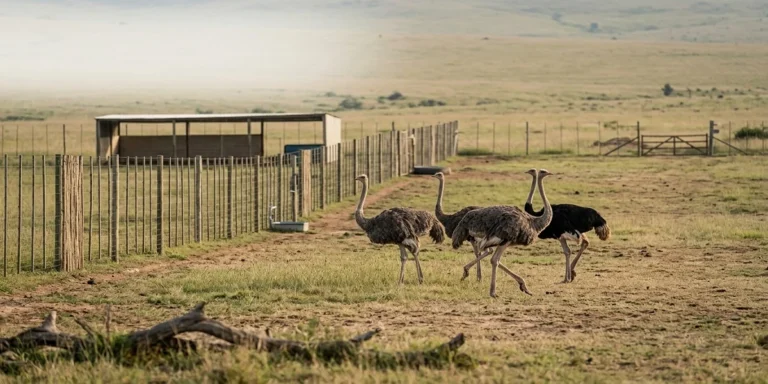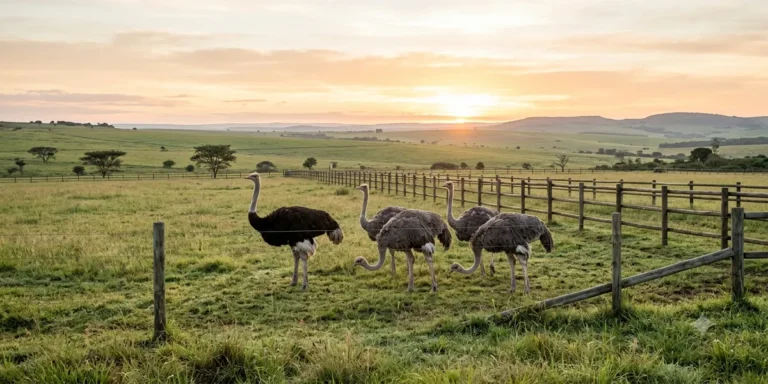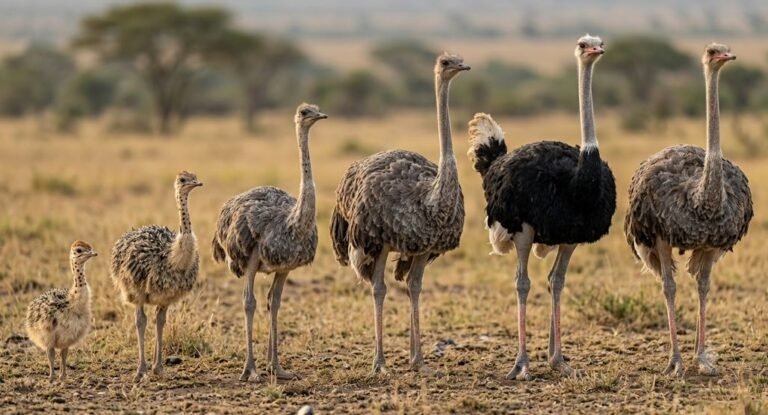
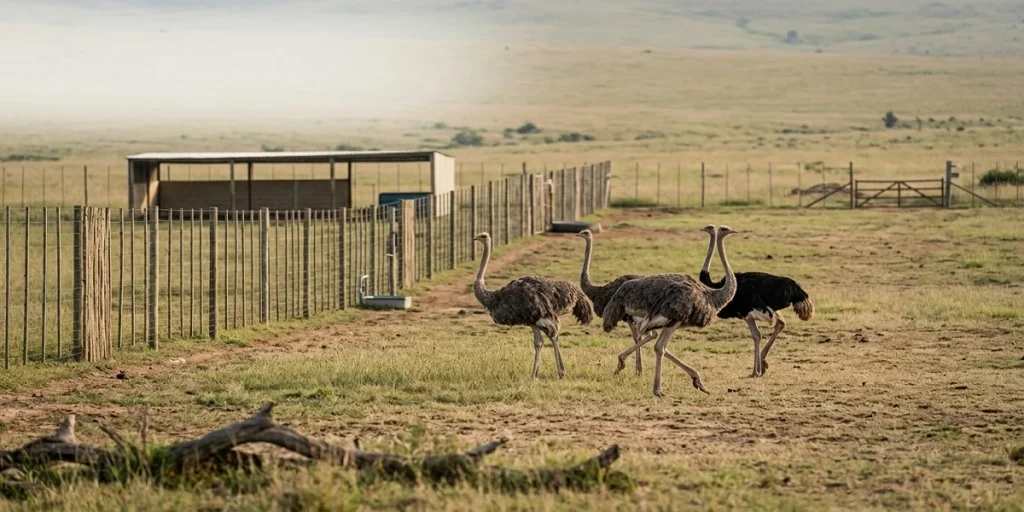
Quick Answer: The ostrich acres needed depend on the birds’ age, purpose, and housing system. Rutgers Cooperative Extension recommends at least 1 acre per breeding pair or trio, while some official enclosure guidelines specify smaller minimum pen dimensions. Pen space is distinct from total farm acreage. A complete breeding operation requires additional room for shelters, chick facilities, feed storage, handling areas, and future expansion.
Table of Contents
Planning an ostrich farm starts with a critical question: how much land do you need? The answer directly impacts fencing costs, flock management, breeding success, and overall profitability.
Published land recommendations vary considerably. Some sources suggest 0.5 acres for a pair, while others recommend 1 acre or more. Rather than choosing the absolute smallest figure, understanding what each measurement represents helps you choose the right setup for your farming system.
In this guide, the OstrichPro team breaks down land requirements by flock size, clarifies the difference between pen space and total acreage, and compares major industry guidelines to help you plan confidently.
Why Does Every Source Give a Different Number?
Land recommendations for ostriches often differ across farming guides. These variations stem from differences in enclosure types, production systems, and bird life stages.
Three main factors explain these differences:
- Pen space versus total farm acreage: Pen space refers strictly to the fenced area for the birds. Total farm acreage includes pens plus essential infrastructure like shelters, chick-rearing facilities, feed storage, handling runs, and access roads.
- Production system: Dry-lot operations supply all feed directly to birds in managed pens, whereas pasture-based systems require larger grazing land and space for rotational paddocks.
- Bird age and purpose: Breeding adults, growing juveniles, and newly hatched chicks require distinct housing setups. Recommended density for growing birds does not apply to adult breeding pairs.
Land quality plays a crucial role as well. Soil drainage, ground cover, regional climate, and fence safety dictate how effectively space is utilized. A mud-prone, poorly fenced large pasture is far less effective than a well-drained, properly configured smaller enclosure.
The key question is not just how many acres an ostrich requires. It is determining how much usable space your specific flock needs alongside the operational land required to run the farm smoothly.
What Do the Main Sources Recommend?
Published ostrich enclosure recommendations range from compact pens to an acre or more per breeding group. Examining who published these figures and the specific setup they describe helps clarify these variations.
| Source | Reported Land Guidance | How to Interpret It |
| Rutgers Cooperative Extension | At least 1 acre per pair or trio | A practical baseline for breeding-group planning |
| UK Government Guidance (gov.scot) | 15 × 40 m minimum; 25 × 80 m recommended per pair | Specific pen dimensions rather than total farm acreage |
| Grit | Approximately 150 × 150 ft for a pair or trio | An example based on small-scale farming operations |
| Farm & Animals | Approximately 1 acre per mature bird | A spacious recommendation differing from pair-based models |
| OGS Capital | 2–5 acres per breeding pair | A larger estimate tailored to full commercial operations |
The dimensions in the Scottish guidance highlight key spatial differences. A 15 × 40 m enclosure covers 600 m² (about 0.15 acres), while a 25 × 80 m enclosure covers 2,000 m² (approx. 0.49 acres). By comparison, a 150 × 150 ft enclosure provides 22,500 sq ft (approx. 0.52 acres).
These numbers represent distinct operational frameworks rather than interchangeable standards. Government figures focus on minimum enclosure footprints, whereas agricultural extensions factor in grazing capacity, flock dynamics, and land management. A smaller pen dimension does not automatically imply that lower total acreage will suit every farm.
How Much Land Should You Plan For?
For a standard breeding operation, 1 acre per pair or trio serves as a reliable starting point according to Rutgers Cooperative Extension. This benchmark ensures adequate space for budgeting and planning without underestimating the flock’s spatial requirements.
While some farms run successful operations using smaller pens, feasibility depends on pen design, soil drainage, flock management, and regional animal welfare standards. Always consult local regulations and a qualified ratite specialist before installing perimeter fencing.
This benchmark applies specifically to breeding pen space. Additional acreage must be allocated for farm infrastructure, chick facilities, juvenile housing, and isolation quarters.
Land Needed by Number of Ostriches
Estimating land requirements becomes straightforward once a baseline acreage target is set. The following table scales spatial requirements based on breeding pairs and trios, aligning with the 1 acre per pair or trio recommendation from Rutgers Cooperative Extension.
The half-acre scenario reflects high-density enclosure examples found in some small-scale operations rather than a universally recommended standard.
| Breeding Group | Smaller Enclosure Scenario | Conservative Planning Baseline |
| 1 breeding pair (2 birds) | 0.5 acre | 1 acre |
| 1 breeding trio (3 birds) | 0.5 acre | 1 acre |
| 3 breeding pairs (6 birds) | 1.5 acres | 3 acres |
| 5 breeding pairs (10 birds) | 2.5 acres | 5 acres |
| 10 breeding pairs (20 birds) | 5 acres | 10 acres |
These figures outline the primary enclosure footprints for breeding stock. They do not account for dedicated space required for incubators, chick brooders, grower facilities, quarantine runs, or farm buildings. Operations raising market birds for meat alongside adult breeders require additional space calculations.
How Much Land Does Each Bird Get?
Per-bird spatial metrics assist with budgeting, though they should supplement rather than replace group-level housing standards.
- Under the 1-acre baseline, a pair receives approximately 0.5 acres per bird, while a trio receives roughly 0.33 acres per bird.
- In a 0.5-acre enclosure, individual space drops to 0.25 acres per bird for a pair and approximately 0.17 acres per bird for a trio.
These figures represent mathematical breakdowns rather than proof of optimal stocking density. Ostriches require sufficient space for running and natural behaviors, meaning pen layout, shape, and ground quality matter just as much as raw square footage.
Does a Trio Need More Space Than a Pair?
A standard breeding trio consists of one male and two females. While a trio adds a third bird, many pasture management systems accommodate a trio within the same 1-acre allowance used for a pair.
However, adding a second female alters flock dynamics. Behavioral aggression and territorial competition can occur, making pen shape, sightlines, feeding station placement, and escape pathways critical. The Scottish guidelines recommend a 25 × 80 m enclosure for a trio, demonstrating why species-specific layout advice should guide fence placement.
If you are still comparing the costs of different flock sizes, our guide to ostrich farming profitability can help you consider land alongside feed, fencing, breeding stock and other operating expenses.
Acres per Ostrich by Farming Purpose
Not every bird on an ostrich farm requires the same enclosure footprint. Breeding adults, growing market birds, and young chicks have distinct spatial and management requirements, making purpose-based land allocation essential for accurate farm planning.
Check regional regulations, local climate conditions, and specific housing models before finalizing pen dimensions.
Breeding Pairs and Trios
Breeding ostriches require adequate space for courtship rituals, natural movement, nesting behavior, and conflict avoidance. Rutgers Cooperative Extension recommends at least 1 acre per pair or trio, providing a reliable foundation for breeding farm layout planning.
Key requirements for breeding enclosures include:
- Secure Fencing: Sturdy, high-visibility perimeter barriers designed for large ratites.
- Effective Drainage: Elevated, well-drained soil to prevent standing mud and foot health issues.
- Dedicated Layouts: Individual pens for distinct breeding groups to streamline selective breeding, monitor egg production, and ensure safe handler access.
Simply matching square footage targets does not guarantee an adequate environment if pen shape, terrain, or safety features are neglected.
Ostriches Raised for Meat
Commercial meat birds are managed in growing groups rather than pair enclosures. Spatial needs vary depending on bird age, stocking density, ground quality, and whether the farm uses pasture grazing or dry-lot feeding systems.
Rutgers Cooperative Extension outlines a slaughter age of approximately 10 to 14 months under standard production schedules. This timeline defines the duration of the grow-out phase for land budgeting purposes.
A standard industry reference for grow-out density includes:
- Enclosure Size: 100 × 300 ft (30,000 sq ft or approx. 0.69 acres).
- Stocking Rate: 6 to 10 yearlings per enclosure.
- Per-Bird Area: Approximately 0.07 to 0.12 acres per bird.
This scenario represents a specific high-density grow-out model rather than a fixed standard. Verify that stocking rates maintain proper drainage, shelter access, and adequate space for exercise.
Chicks and Young Ostriches
Newly hatched chicks require specialized brooding facilities rather than large open pasture space. Early housing demands controlled warmth, non-slip flooring, predator protection, and gradual access to expanding outdoor exercise runs.
Allocating a full acre to newly hatched chicks is unnecessary. Instead, design a dedicated chick-rearing unit that scales with growth stages:
- Brooder Phase: Compact, climate-controlled indoor space.
- Intermediate Run: Sheltered outdoor runs with direct sunshine and restricted wind exposure.
- Grower Pen: Larger enclosures transitioning juveniles toward standard pasture stocking densities.
As the birds grow, their space requirements change. A farm that hatches its own eggs should therefore plan for several stages of development rather than treating the chick enclosure as a permanent solution. Our guide to baby ostriches covers early-life care in more detail.
Ostrich Pen Size, Fencing, and Shelter Requirements
Acquiring sufficient land is only the initial step in farm design. Enclosure geometry, fencing quality, shelter accessibility, and handling layout dictate whether a farm functions safely and efficiently.
A poorly configured large pasture presents far more operational challenges than a well-designed, smaller enclosure optimized for bird management. Plan land division, access lanes, and bird transfer routes before purchasing breeding stock.
Recommended Enclosure and Facility Dimensions
The following benchmarks summarize key industry guidelines. Use these metrics as planning references alongside local animal welfare requirements and regional zoning codes.
| Facility or Feature | Measurement or Guidance |
| Pair Enclosure (Scottish Minimum) | 15 × 40 m (600 m², approx. 0.15 acres) |
| Pair Enclosure (Scottish Recommended) | 25 × 80 m (2,000 m², approx. 0.49 acres) |
| Adult Perimeter Fencing | Rutgers guidance specifies fencing around 6 feet high |
| Breeding Shelter (Pair) | Approximately 20 × 20 ft in Rutgers guidance |
| Catch Pen | Approximately 40 × 8 ft in Rutgers guidance |
| Handling & Loading Facilities | Solid construction with adequate clearance for safe handler access |
These dimensions provide reference frameworks rather than rigid blueprints. Shelter design must adjust according to group size, regional climate, ventilation requirements, and floor sanitation, while pen dimensions should always reflect local regulatory standards.
Why Ostrich Fencing Needs Careful Planning
Ostriches are high-speed, powerful birds requiring secure boundaries and unobstructed runs. Substandard fencing, exposed sharp edges, loose wires, and tight corners create severe injury risks when birds bolt or startle.
Rutgers Cooperative Extension outlines suitable options, including high-tensile wire and heavy-gauge chain-link systems. Material effectiveness depends heavily on proper post anchoring and routine maintenance. Regular inspections are necessary to identify sagged wire, post deterioration, or gaps capable of trapping heads or limbs.
Pen geometry is just as critical as material selection:
- Eliminate Sharp Corners: Design rounded corners or angled corner braces to prevent birds from trapping each other during high-speed runs.
- Maintain Clear Runs: Remove sharp rocks, stumps, and debris along boundary lines.
- Install Wide Gates: Ensure all gates allow smooth passage during routine flock movement and equipment access.
Proper fencing layout also maintains clear isolation between distinct breeding pens, grow-out groups, and quarantine facilities.
Shelter, Handling, and Quarantine Areas
A fully operational ostrich farm extends beyond primary grazing paddocks. Dedicated space must be reserved for environmental protection, veterinary processing, and biosecurity management.
Essential infrastructure requirements include:
- Shelter: Weather-resistant structures featuring proper ventilation, dry footing, and non-slip flooring.
- Catch and Handling Pens: Narrow, solid-walled handling chutes for health checks, tagging, weighing, and transport loading.
- Incubation and Brooding Facilities: Climate-controlled indoor units reserved for egg incubation and early chick rearing.
- Quarantine Facilities: Biosecure isolation pens located away from the main flock to monitor new or returning birds.
- Feed and Equipment Storage: Dry, pest-proof structures for feed preservation and tool storage.
Rutgers Cooperative Extension recommends isolating newly acquired birds for a minimum of 30 days. Adjust quarantine duration and health monitoring protocols based on expert veterinary advice and regional biosecurity standards.
Designing farm layouts with direct, uncrowded access lanes allows handlers to transport birds safely between pens and facilities without disrupting surrounding groups.
How Much Land Is Needed? Ostrich Acres Needed by Farm Size
The acreage allocated to breeding pens represents only part of total property requirements. Even if primary enclosures fit comfortably on a parcel, additional space must be reserved for operational buildings, feed storage, chick-rearing facilities, and daily farm management.
A farm housing 10 breeding pairs should not be planned as a 10-acre total property simply because the breeding pens require 10 acres. Complete operations demand land beyond the core pen footprint.
What Should You Include in Your Land Plan?
Before acquiring property, outline all necessary facility components and sketch their physical arrangement around primary enclosures:
- Shelters: Weatherproof structures providing adequate space and ventilation for each flock section.
- Incubation and Brooding Rooms: Climate-controlled indoor units reserved for egg incubation and early chick rearing.
- Grower Pens: Expanded housing for growing juveniles transitioning out of brooder facilities.
- Handling and Loading Areas: Secure chutes and catch pens designed for safe health inspections, weighing, and vehicle transport loading.
- Feed and Equipment Storage: Dry, pest-proof structures positioned for easy delivery access without disrupting bird movement.
- Quarantine Facilities: Biosecure isolation pens managed under strict veterinary protocols.
- Access Lanes and Drainage: Dedicated service roads, gate systems, and water management channels.
- Future Expansion: Space buffer for additional breeding groups or growing stock.
Because operational setups vary, draw the preliminary farm master plan first, then calculate the precise acreage needed for each infrastructure component.
Plan for the Birds You Will Have in Two or Three Years
Land requirements evolve as the flock matures and production scales. A spatial setup accommodating a single adult pair today will prove insufficient once egg incubation, chick rearing, and replacement stock management begin.
Rutgers Cooperative Extension notes that females reach maturity at around 20 months and males at approximately 30 months, with active breeding starting at 2.5 to 3 years. Use these timelines as references for multi-year land development planning.
Determine your exact production strategy early (whether buying adult breeders, purchasing chicks, selling growing stock, or running a full vertical meat production system) as each model creates distinct spatial and infrastructure demands.
Pasture vs. Dry-Lot Ostrich Farming: Which Needs More Land?
Your production model dictates total acreage requirements. Pasture-based systems maximize grazing area, while dry-lot operations utilize managed pens with direct feed supplementation.
| Farming Model | Primary Advantage | Key Spatial & Management Consideration |
| Pasture-Based System | Utilizes natural foraging to supplement feed | Requires larger acreage, soil management, and rotational paddocks |
| Dry-Lot System | Minimizes total land requirement | Relies entirely on purchased/stored feed and requires top-tier drainage |
Pasture-Based Systems
Pasture systems allow ostriches to forage naturally. However, total pasture acreage does not automatically guarantee productive forage. Soil quality, seasonal rainfall, and stocking density dictate pasture utility.
Implementing rotational grazing preserves vegetation, prevents ground degradation, and allows systematic paddock recovery.
Dry-Lot Systems
Dry-lot systems house ostriches in smaller, managed enclosures while supplying complete diets directly. While this reduces the total land footprint, it increases reliance on feed storage and supply logistics.
Proper drainage is critical in dry-lot designs. Mud accumulation and standing water compromise foot health and biosecurity, meaning high-density pens must feature well-drained, easily maintained surfaces year-round.
Which System Is Better for a Small Farm?
For properties with restricted acreage, a managed dry-lot system offers an efficient framework. Conversely, properties with existing quality forage benefit from a pasture-based or hybrid system.
Evaluate total operational costs rather than focusing solely on land size. Smaller properties trade lower land costs for higher feed purchases, whereas larger pasture farms require greater capital investment in fencing, land maintenance, and paddock management.
Acre, Square Foot, Square Meter and Hectare Conversions
Land measurements can get confusing when one guide uses acres, another gives dimensions in meters and a third describes an enclosure in square feet. Converting everything to the same units makes it much easier to compare recommendations and calculate the size of a proposed farm.
Use the following reference table when estimating enclosure areas or comparing land for sale.
| Area | Acres | Square feet | Square meters | Hectares |
|---|---|---|---|---|
| 1 acre | 1.00 | 43,560 | 4,047 | 0.405 |
| 0.5 acre | 0.50 | 21,780 | 2,023 | 0.202 |
| 1 hectare | 2.47 | 107,639 | 10,000 | 1.00 |
| 100 × 300 ft enclosure | 0.69 | 30,000 | 2,787 | 0.279 |
| 150 × 150 ft enclosure | 0.52 | 22,500 | 2,090 | 0.209 |
| 25 × 80 m enclosure | 0.49 | 21,528 | 2,000 | 0.200 |
| 15 × 40 m enclosure | 0.15 | 6,458 | 600 | 0.060 |
One acre is approximately 4,047 square meters, while one hectare is about 2.47 acres. These conversions are particularly useful when comparing land listings or agricultural guidance published in different countries.
Remember that the area of a rectangle is calculated by multiplying its length by its width. A 25 × 80 m enclosure, for example, covers 2,000 m². The actual usable area may be smaller if part of the site contains buildings, drainage features or other obstacles.
How Much Land Does a Profitable Ostrich Farm Need?
A larger property does not automatically make an ostrich farm more profitable. Land is one part of the investment, alongside breeding stock, fencing, feed, shelter, veterinary care, labor and access to buyers.
A small farm with one breeding pair or trio may be a practical starting point for someone learning the business. However, the total land requirement will increase if the operation also incubates eggs, raises chicks, maintains replacement breeders or grows birds for meat.
Before purchasing land, estimate the number of birds you intend to keep at each stage of production. Then calculate the enclosure area, add the facilities needed to manage those birds, and compare the resulting layout with your available budget.
Market access deserves equal attention. A farm may have plenty of space but still struggle if it cannot sell eggs, chicks, breeding birds, meat or other products at viable prices. Processing arrangements, transport costs and local demand can all influence the business case.
For a more detailed look at revenue, operating expenses and the challenges of building a sustainable operation, read our guide to ostrich farming profitability. If you are still estimating the cost of purchasing breeding stock, our ostrich price guide is another useful starting point.
Common Mistakes When Planning Ostrich Farm Acreage
Choosing land for ostriches involves more than finding a property with enough acres. Small planning mistakes can become expensive once fencing, buildings and birds are already in place.
Watch out for these common problems before committing to a site.
- Planning only for the initial flock: Chicks grow, breeding groups change and replacement birds need somewhere to go. Plan for the flock you may have in a few years, not just the birds you intend to buy first.
- Confusing enclosure area with total property size: The land occupied by the pens is only one part of the farm. Shelters, storage, handling areas, chick facilities and access routes also take space.
- Choosing poorly drained ground: Persistent mud and standing water can make an enclosure difficult to maintain. Check the site’s drainage and seasonal conditions before construction.
- Underestimating fencing costs: Large, powerful birds need secure, carefully designed boundaries. Saving money on unsuitable fencing can lead to repairs, escapes or injuries.
- Crowding breeding birds: A pen’s dimensions alone do not establish whether its stocking density is appropriate. Allow room for movement and account for the behavior and compatibility of individual birds.
- Ignoring feed availability: A dry-lot farm may need less grazing land, but it must have a dependable feed supply and enough storage.
- Skipping local regulations: Check livestock, land-use, animal-welfare and any applicable wildlife or exotic-animal rules before buying birds or building enclosures.
The best time to address these challenges is before you invest in land or livestock. Our ostrich farming business plan PDF can help you organize your initial planning, estimate startup costs and think through the practical requirements of building a sustainable ostrich farm.
Frequently Asked Questions
These are the most common questions about the acreage required to raise ostriches, from starting with a single breeding group to planning a larger meat-production operation.
How many acres does an ostrich need?
A useful starting point is at least 1 acre per breeding pair or trio, following Rutgers Cooperative Extension guidance. That works out to approximately 0.5 acre per bird in a pair or 0.33 acre per bird in a trio. These figures describe a group-based planning allowance, not a universal minimum for every ostrich or production system.
How much land do you need for a pair of ostriches?
Plan around 1 acre for a breeding pair as a conservative starting point. Some enclosure guidelines specify smaller areas, including a recommended 25 × 80 m pen in Scottish government guidance, equivalent to about 0.49 acre. The appropriate size depends on the applicable guidance, enclosure design and management conditions.
How much land do you need to start an ostrich farm?
A small ostrich farm with one breeding pair or trio may need approximately 1 to 2 acres as an initial planning estimate, while a larger breeding operation with 5 pairs may need around 5 acres for the breeding enclosures alone. You will need additional land for shelters, chick-rearing facilities, feed storage, handling areas and future expansion.
How many ostriches can you keep per acre?
There is no single stocking density that applies to every ostrich farm. For breeding birds, Rutgers recommends at least 1 acre per pair or trio. Growing birds may be managed at higher densities under some systems, but age, enclosure conditions, welfare requirements and the original management guidance must all be considered.
How big should an ostrich pen be?
For a breeding pair, Scottish government guidance gives 15 × 40 m as a minimum and 25 × 80 m as the recommended enclosure size. The recommended dimensions cover approximately 0.49 acre. These are specific published guidelines, so confirm which requirements apply in your location before construction.
How much does a full-grown ostrich cost?
The price depends on the bird’s age, sex, breeding history, health, location and intended use. In the United States, ostrich chicks may cost around $450 to $900 each, yearlings about $1,000 to $1,500, and adult birds around $2,000 to $2,500 or more. Established breeding pairs can cost several thousand dollars, with proven breeders sometimes selling for significantly higher prices. These figures are examples from U.S. sellers, not universal prices, so always check local availability and transport costs before budgeting.
Is ostrich farming profitable?
Ostrich farming can generate income, but profitability depends on feed and labor costs, breeding performance, mortality, market demand and the prices you receive for your products. Land size alone cannot predict a farm’s financial performance.
How long does an ostrich take to grow?
Ostriches raised for meat may be slaughtered at around 10 to 14 months under the production conditions described in Rutgers guidance. Growth rates and the appropriate slaughter age vary with genetics, nutrition and management. Our guide to how big ostriches get explains their growth and adult size in more detail.
How often do ostriches lay eggs?
During the breeding season, females may lay an egg approximately every other day, although output varies with the bird, season and management. Rutgers guidance discusses seasonal production in the range of 30 to 50 eggs per female. See our guide to how many eggs an ostrich lays for more detail.
Can you raise ostriches on a small property or in a backyard?
It may be possible on a suitably designed small property, but having enough land is only one requirement. You also need secure fencing, appropriate shelter, safe handling arrangements and compliance with local rules. Ostriches are large, powerful animals, so a typical residential backyard should not be assumed suitable simply because it has open space.
How many acres does ostrich meat production need?
The acreage depends on the number and age of the growing birds, their stocking density and whether the farm uses pasture, dry-lot pens or a mixed system. Breeding pens must also be included if the operation produces its own chicks. Calculate the area for each group separately, then add the land required for buildings, handling facilities and other infrastructure.