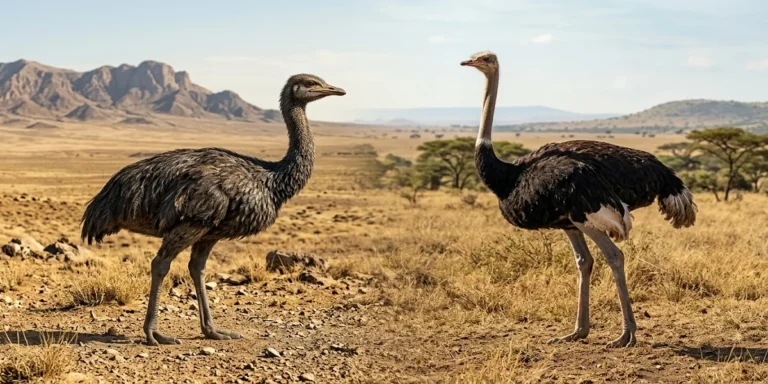
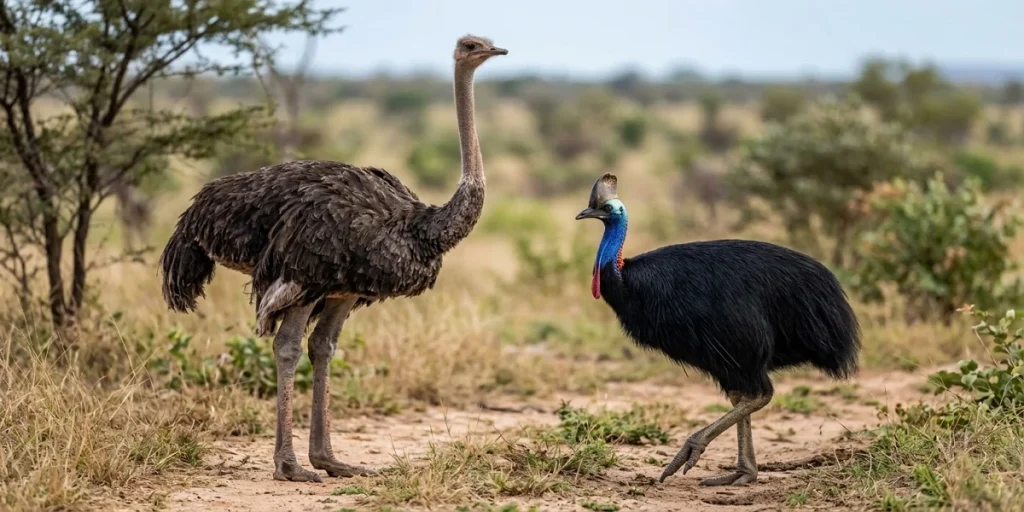
Quick Answer: The ostrich is vastly larger, heavier, and faster than the cassowary, standing up to 9 feet (2.7 meters) tall and sprinting at over 40 mph (64 km/h). The cassowary is smaller but wields a deadly defensive weapon: a 4-inch (10 cm), dagger-shaped inner claw capable of inflicting fatal wounds. Regarding human interactions, the cassowary is widely considered more dangerous due to its unpredictable territorial behavior, though fatal attacks from either bird are extremely rare. In a hypothetical confrontation, there is no scientific evidence to declare a winner. The ostrich holds the advantage in size, reach, and sheer kicking force, while the cassowary is uniquely lethal at close range.
Table of Contents
Ostriches and cassowaries are two of the most formidable flightless birds on Earth. Both tower over average human height, both possess massive leg power, and both are capable of inflicting serious injury on anything that threatens them.
Comparing them, however, requires looking past internet sensationalism and examining real biological capabilities.
While the ostrich reigns as the world’s largest living bird and the fastest two-legged animal on the planet, the cassowary has earned a reputation as the world’s most dangerous bird thanks to its knife-like talons and aggressive defense mechanics.
There is also a crucial ecological fact that makes a real-world clash impossible: ostriches and cassowaries inhabit completely different continents and share no natural geographic overlap.
To understand how these two giants compare, we must analyze their physical data, defense weapons, behavioral patterns, and documented human encounters based on scientific records rather than arbitrary fight statistics.
Ostrich vs Cassowary at a Glance
| Trait | Ostrich (Struthio camelus) | Southern Cassowary (Casuarius casuarius) |
|---|---|---|
| Height | Up to 9 feet (2.7 meters) | Up to 6 feet (1.8 meters) |
| Weight | 200–300+ lbs (90–136+ kg) | 120–168 lbs (55–76 kg) |
| Top Speed | Up to 43 mph (70 km/h) | Up to 31 mph (50 km/h) |
| Native Range | Africa | Northern Australia and New Guinea |
| Typical Habitat | Grasslands, savannas, open shrublands | Tropical rainforests and dense woodlands |
| Primary Defense | Powerful forward kicks and extreme speed | Powerful legs and dagger-like inner claw |
| Toes Per Foot | 2 toes | 3 toes |
| Inner Claw Length | Up to 4 inches (10 cm) | Up to 4.7 inches (12 cm) |
| Flying Ability | Flightless | Flightless |
The physical size difference between these two ratites is substantial.
According to data from the Smithsonian’s National Zoo, the ostrich reigns supreme as the world’s tallest and heaviest living bird. Adult ostriches commonly weigh between 200 and 300 pounds (90 to 136 kg) and can stand up to 9 feet (2.7 meters) tall. This massive frame is built for open-country survival, allowing the bird to sprint at sustained speeds of up to 43 mph (70 km/h).
The Southern Cassowary, while the largest of all cassowary species, is visibly smaller than its African cousin. Records from the Queensland Government note that adult female cassowaries (which are larger than males) reach up to 168 pounds (76 kg) and stand up to 6 feet (1.8 meters) tall, while adult males top out around 121 pounds (55 kg). Data preserved by the Library of Congress places the upper weight limit for the largest individual cassowaries at approximately 160 pounds (73 kg).
While a cassowary is more than heavy enough to overpower an unprepared human, it is essentially a heavyweight contender standing next to a super-heavyweight giant.
Size and Physical Differences
The ostrich is considerably bigger than the cassowary in almost every physical dimension.
A large adult ostrich can stand close to 9 feet (2.7 meters) tall, with much of that height coming from its exceptionally long neck and legs. Its body mass is also dramatically heavier than that of a cassowary, giving the ostrich a major advantage in raw size, body weight, and physical reach.
Cassowaries are smaller, but that does not make them fragile. The southern cassowary reaches around 6 feet (1.8 meters) in height, with females being visibly larger and heavier than males. Their compact bodies, heavily muscled legs, and low center of gravity are masterfully suited for maneuvering through dense tropical vegetation.
Evolutionary Design: Open Plains vs. Dense Rainforest
The stark contrast in their physical builds directly reflects the environments in which these two flightless giants evolved:
- The Ostrich (Built for Open Country): Its body structure is optimized for long-distance running. The long legs produce massive strides, allowing it to sprint across open savannas and detect predators from a great distance.
- The Cassowary (Built for the Rainforest): Its shorter, more compact frame and low center of gravity allow it to push through thick jungle underbrush where high-speed, long-distance running is impossible.
This fundamental difference in biomechanics becomes critically important when evaluating how each bird defends itself in a physical encounter.
Speed: Which Bird Is Faster?
The ostrich is significantly faster in open terrain.
According to research from the Smithsonian, ostriches can sustain running speeds of 30 to 37 mph (48 to 60 km/h) and reach top sprinting speeds of up to 43 mph (70 km/h). Their long, heavily muscled legs can cover more than 10 feet (3 meters) in a single stride, making them exceptionally efficient long-distance runners.
Related Guide: Learn more about the biology behind the ostrich’s top sprinting speed in our dedicated guide: How Fast Can an Ostrich Run?
Cassowaries are also remarkably fast for jungle-dwelling birds. Data from the Library of Congress indicates that a cassowary can reach speeds of up to 31 mph (50 km/h) even while navigating dense rainforest habitat.
While the ostrich holds a clear speed advantage, speed is only effective in the right ecosystem. An ostrich uses its velocity across open savannas where it has room to accelerate and maneuver. A cassowary does not need to outrun predators over long distances; it relies on rapid acceleration, tight agility, and moving through dense jungle obstacles where sustained speed is impossible.
Weapons: Kicks vs. Claws
Both birds can inflict catastrophic injuries, but they rely on entirely different physical mechanisms. The ostrich’s primary defense relies on brute force and leg reach, whereas the cassowary wields a highly specialized cutting weapon.
The Ostrich’s Muscular Force
An ostrich has only two toes on each foot, an unusual anatomical adaptation among living birds. Each foot carries a large, blunt claw, powered by massive leg muscles built for defense.
When threatened, an ostrich prefers to escape using its speed. If cornered, however, it delivers devastating forward kicks. The combination of standing height, leg length, and sheer muscle mass allows an ostrich to strike with powerful impact.
Medical literature contains documented cases of severe human trauma caused by ostrich strikes, including severe ocular (eye) and abdominal injuries. There is no need to rely on internet myths about an ostrich being a “lion killer” to respect its lethality. Its physical anatomy alone explains why standing within kicking range is extremely dangerous.
The Cassowary’s Dagger-Like Talon
The cassowary’s most intimidating weapon is its specialized foot structure. Each foot features three toes, with the innermost toe bearing a heavily elongated, razor-sharp claw. Official records from the Queensland Government describe this inner claw as a dagger-shaped weapon measuring up to 4.7 inches (120 mm) in length.
The Australian Museum notes that cassowaries utilize these talons during territorial disputes and defensive strikes against threats, including humans.
This specialized digit provides the cassowary with an exceptionally lethal close-range weapon. It does not require the physical body weight of an ostrich to inflict severe damage. Its defensive mechanics rely on explosive leaping movements and a specialized claw capable of inflicting deep puncture wounds and severe lacerations.
In essence, these two ratites evolved different solutions to the same survival challenge:
- The Ostrich: Combines height, physical reach, and massive blunt force.
- The Cassowary: Combines compact strength, close-range agility, and a specialized cutting weapon.
Ostrich vs. Cassowary: Who Would Win in a Fight?
This is where many online comparisons lose scientific credibility.
Numerous websites assign arbitrary percentages to hypothetical fights between wild animals, often claiming that one species would win 60%, 70%, or 75% of the time. These numbers are completely fabricated; they are not based on controlled scientific experiments, documented natural encounters, or biological models.
There is no reliable scientific study in which ostriches and cassowaries have been placed into combat. Consequently, there is no scientifically established winner.
Instead of making up fight statistics, the most objective approach is to evaluate the distinct physical advantages each bird brings to a hypothetical confrontation.
The Ostrich: Size, Reach, and Speed Advantages
In open terrain, the physical statistics lean heavily in favor of the ostrich:
- Massive Body Weight: A large adult ostrich can weigh up to 300+ lbs (136+ kg), roughly double the weight of a large cassowary.
- Superior Reach: Standing up to 9 feet (2.7 meters) tall with exceptionally long legs, the ostrich possesses a significantly longer striking range.
- Overwhelming Velocity: Sprinting at speeds exceeding 40 mph (64 km/h), the ostrich can dictate the pace and spacing of an engagement compared to a bird topping out around 31 mph (50 km/h).
On open plains, these physical traits provide a massive edge. The ostrich’s long legs can keep an opponent at a distance while delivering heavy, blunt-force kicks. Its sheer body mass would also make it exceptionally difficult for a smaller animal to overpower.
The Cassowary: Close-Range Lethality and Agility
While smaller, the cassowary possesses key evolutionary adaptations that make it uniquely dangerous:
- Specialized Weaponry: Its inner toe carries a 4.7-inch (120 mm) dagger-like talon designed for piercing and slashing.
- Dense Habitat Adaptation: Its compact body, low center of gravity, and heavily muscled legs allow it to leap, dodge, and burst through obstacles seamlessly.
The battle environment plays a decisive role. In dense rainforest underbrush, the ostrich loses its long-distance sprinting capabilities and reach advantage. In a tight, confined space, the cassowary’s explosive agility and close-range cutting talon become immensely lethal.
The Verdict: Who Wins?
If the comparison is based strictly on physical statistics, the ostrich holds the stronger overall combat profile due to its superior weight, height, reach, and speed.
However, having the physical advantage is not definitive proof of an outcome. The cassowary’s specialized talon poses a constant threat of severe, sharp-force injury to any attacker. A close-range struggle could easily result in catastrophic injuries to both birds.
The most accurate, evidence-based conclusion avoids clickbait numbers: The ostrich commands the raw physical advantage, but the cassowary remains a lethal opponent at close range.
Explore More: Curious how these giants compare to other massive ratites? Check out our complete guide: Ostrich vs. Emu vs. Rhea vs. Cassowary
Which Bird Is More Dangerous to Humans?
When evaluated specifically regarding human safety, the answer shifts. The cassowary is widely recognized as the more dangerous species to humans.
Data from the Library of Congress highlights the cassowary as the bird most frequently cited as the world’s most dangerous. However, researchers emphasize that cassowaries are naturally secretive and shy; serious incidents almost exclusively occur when the birds are habituated to people, cornered, or defending their territory.
This reputation is not based on dramatic folklore, but on concrete wildlife data and documented medical cases.
Cassowary Attacks: Human Behavior and Key Incidents
One of the most comprehensive investigations into cassowary attacks was conducted by Christopher Kofron of the Queensland Parks and Wildlife Service. Kofron reviewed 221 documented cassowary attacks in Queensland, including 150 involving humans:
- The Primary Cause (75% Rule): The study revealed that 75% of human encounters occurred because the birds had been previously fed by humans.
- Behavioral Shift: Feeding wild cassowaries strips away their natural fear of humans, leading to aggressive food-seeking behavior and heightened risk of territorial conflict.
While the Australian Museum notes that cassowaries typically retreat into deep rainforest when sensing humans, they will aggressively hold their ground if pressed.
Documented Fatal Encounters
Fatal attacks by cassowaries are extraordinarily rare, with only two universally documented cases in modern history:
- Australia (1926): A 16-year-old boy near Mossman, Queensland, suffered a fatal puncture wound to the neck when an agitated cassowary struck him after the bird was chased and attacked by humans and dogs.
- United States (2019): A 75-year-old private bird collector in Florida was killed after falling near a captive cassowary, an incident formally referenced by wildlife authorities and the Library of Congress.
Ostriches: Massive Power and Ocular Injuries
While the cassowary receives the bulk of media attention, ostriches are far from harmless. Medical literature documents severe, life-altering injuries inflicted by defensive ostrich kicks:
- Severe Facial Trauma: Published clinical reports describe a patient suffering catastrophic ocular (eye) and facial injuries from an ostrich strike, resulting in permanent vision loss.
- Abdominal Trauma: Another medical study recorded a 71-year-old farm owner who sustained severe abdominal internal injuries after being repeatedly kicked by a territorial male ostrich.
- Agricultural Encounters: Occupational safety studies in South Africa indicate that serious injuries and occasional fatalities occur annually on commercial ostrich farms, where humans work in close daily proximity to mature birds.
The Core Difference in Risk Profile
The distinction between the two species does not mean one is dangerous and the other is placid:
- The Ostrich: Relies on its sheer physical scale, massive blunt-force impact, and high-speed escape capability. Most attacks occur in agricultural or farm settings.
- The Cassowary: Possesses a unpredictable territorial defense mechanism equipped with a sharp-force cutting weapon. Most attacks stem from human feeding habituation in wild or private captive environments.
Habitat: Why They Would Never Meet in the Wild
There is no natural environment on Earth where an ostrich and a cassowary encounter one another.
- The Ostrich (Africa): Inhabits grasslands, savannas, open shrublands, and semi-arid plains across the African continent.
- The Cassowary (Australasia): Native to the tropical rainforests and dense woodlands of northern Australia, Papua New Guinea, and surrounding island chains.
This geographic separation explains their divergent body designs. An ostrich benefits from long legs, massive stride efficiency, and high-speed endurance because it evolved in open landscapes. Conversely, a cassowary benefits from compact muscle density, a lower center of gravity, and agility to navigate dense jungle vegetation.
The ostrich is an open-country specialist; the cassowary is a rainforest specialist.
Are Ostriches and Cassowaries Related?
Yes, but not as closely as their physical similarities might suggest.
Both birds belong to Palaeognathae, an ancient lineage of birds that includes ostriches, cassowaries, emus, rheas, kiwis, and tinamous. They are traditionally classified alongside other large, flightless birds known as ratites.
However, modern genomic studies have revised traditional understandings of ratite evolution:
- Multiple Evolutionary Paths: Genetic analysis indicates that flightlessness evolved independently multiple times within the palaeognath lineage rather than descending from a single flightless ancestor.
- Early Divergence: Ostriches represent a much earlier diverging branch of this ancient lineage.
- Sister Taxa: Cassowaries and emus share a far more recent common ancestor, making the emu the cassowary’s closest living relative, not the ostrich.
Their shared physical traits are partly a result of common ancestry and partly the product of evolutionary convergence, where distinct species develop similar adaptations to solve similar physical challenges.
Frequently Asked Questions
Who would win, an ostrich or a cassowary?
There is no scientifically established winner because the two species have never been tested against each other in a controlled environment. The ostrich holds major physical advantages in size, weight, speed, and reach, while the cassowary possesses an extremely dangerous dagger-like inner claw for close-range defense.
Are ostriches or cassowaries more aggressive?
Neither species is naturally aggressive toward humans. Cassowaries are generally shy and avoid human contact, though they can become dangerous when habituated to human food, cornered, or defending territory. Ostriches are similarly defensive, particularly when protecting nests or territory.
Is an ostrich bigger than a cassowary?
Yes, the ostrich is substantially larger. Adult ostriches stand up to 9 feet (2.7 meters) tall and weigh between 200 and 300+ lbs (90 to 136+ kg). The largest cassowaries reach around 6 feet (1.8 meters) in height and top out around 160–168 lbs (73–76 kg).
Who is faster, an ostrich or a cassowary?
The ostrich is considerably faster. Research from the Smithsonian records ostriches sprinting at up to 43 mph (70 km/h), whereas the Library of Congress notes a top running speed of roughly 31 mph (50 km/h) for cassowaries moving through dense rainforest.
Are cassowaries related to ostriches?
Yes, both belong to the ancient Palaeognathae lineage and are traditionally grouped as ratites. However, modern genetic studies reveal that flightlessness evolved independently multiple times, making their evolutionary connection more complex than once thought.
What is the closest living relative to a cassowary?
The emu is the cassowary’s closest living relative. Genetic studies consistently group emus and cassowaries together as sister taxa within the palaeognath tree.
What can defeat an adult cassowary?
Healthy adult cassowaries have virtually no natural predators due to their powerful kicking capability and sharp talons. While eggs and chicks are vulnerable to smaller predators, adult cassowaries sit firmly near the top of their ecosystem’s food web.
Do cassowaries like humans?
No. Cassowaries are solitary, reclusive birds that prefer to avoid humans. Issues arise when humans feed them; a study by the Queensland Parks and Wildlife Service revealed that 75% of recorded cassowary attacks on humans involved birds that had been previously fed by people.
What is the main predator of an ostrich?
Adult ostriches face few natural predators, but apex carnivores like lions, leopards, cheetahs, and spotted hyenas occasionally hunt them. Ostrich eggs and young chicks face much higher predation rates than mature adults.
Can a human outrun a cassowary?
No. A cassowary can sprint up to 31 mph (50 km/h), which easily outpaces any human. If encountered, running away is ineffective; giving the bird ample space and slowly backing away is the safest strategy.
Who would win in a fight: an emu or a cassowary?
While emus and cassowaries are close relatives, they are adapted to different habitats and possess different anatomical structures. Any hypothetical fight scenario remains purely speculative, with no scientific data or guaranteed outcome.
Ostrich vs. Cassowary: The Verdict
So, which bird is ultimately more dangerous? The answer depends entirely on how danger is measured.
- In Terms of Physical Power: The ostrich holds the undisputed advantage. It is taller, dramatically heavier, faster, and equipped with immense blunt-force kicking power.
- In Terms of Close-Range Weaponry: The cassowary takes the lead. Its specialized 4.7-inch (120 mm) inner talon acts as a lethal cutting instrument.
- In Terms of Risk to Humans: The cassowary is widely recognized as the more dangerous species. Documented attacks, including rare fatal encounters, support its formidable reputation, even though the bird is naturally reclusive.
When it comes to the hypothetical fight scenario, physical statistics favor the ostrich due to its mass, reach, and speed, yet the cassowary remains extraordinarily lethal at close range. There is no scientific evidence or empirical trial to declare a definitive winner.
The most accurate, evidence-based takeaway is clear: The ostrich is the larger and more physically dominant bird. The cassowary poses the greater documented threat to humans. Neither bird has been scientifically proven to defeat the other.